
AI Marketing Daily · 2026-11-18
AI Marketing Daily for 2026-11-18 rounds up 20 items: AI agents entering B2B vendor screening, Meta's plan for fully automated ads by year-end, Google AI Mode ads launching in Australia, MCP access for agents across platforms, GEO guidance and benchmarks, and EU Digital Fairness Act progress.
Today's top story belongs to B2B marketers: AI agents have taken a seat in procurement evaluations, and 61% of buyers are already using them — or planning to — to screen vendors. On the same day, the EU wrote AI-driven personalized manipulation into its penalty clauses, Meta readied fully automated advertising by year-end, and six platforms opened account access to agents. Both sides of the market are being handed to agents at once — a day worth parsing closely.
🎯 Today's Headline
AI agents now screen vendors for buyers — evidence density has become the new ticket to entry
MarTech ran Tanya Thorson's analysis on November 17, and its protagonist is a new player in the procurement process: the AI agent. Picture a procurement lead asking an agent to evaluate supply chain software. The agent goes off and compares capabilities, integrations, implementation timelines, and total cost of ownership on its own, then comes back with a shortlist of three. This isn't science fiction. G2's 2026 Buyer Behavior Report finds that 61% of B2B software buyers already have — or plan to give — AI agents a role in procurement, most often for price comparison, solution research, and building candidate shortlists. A Semrush survey of more than 600 US business professionals fills in the other half of the picture: even after receiving an AI recommendation, 71% of buyers still go browse the vendor's own website, then cross-check reviews and comparison sites. And Gartner's data from this past May is the third piece of the puzzle — 69% of buyers want to verify the AI's conclusions with a sales rep.
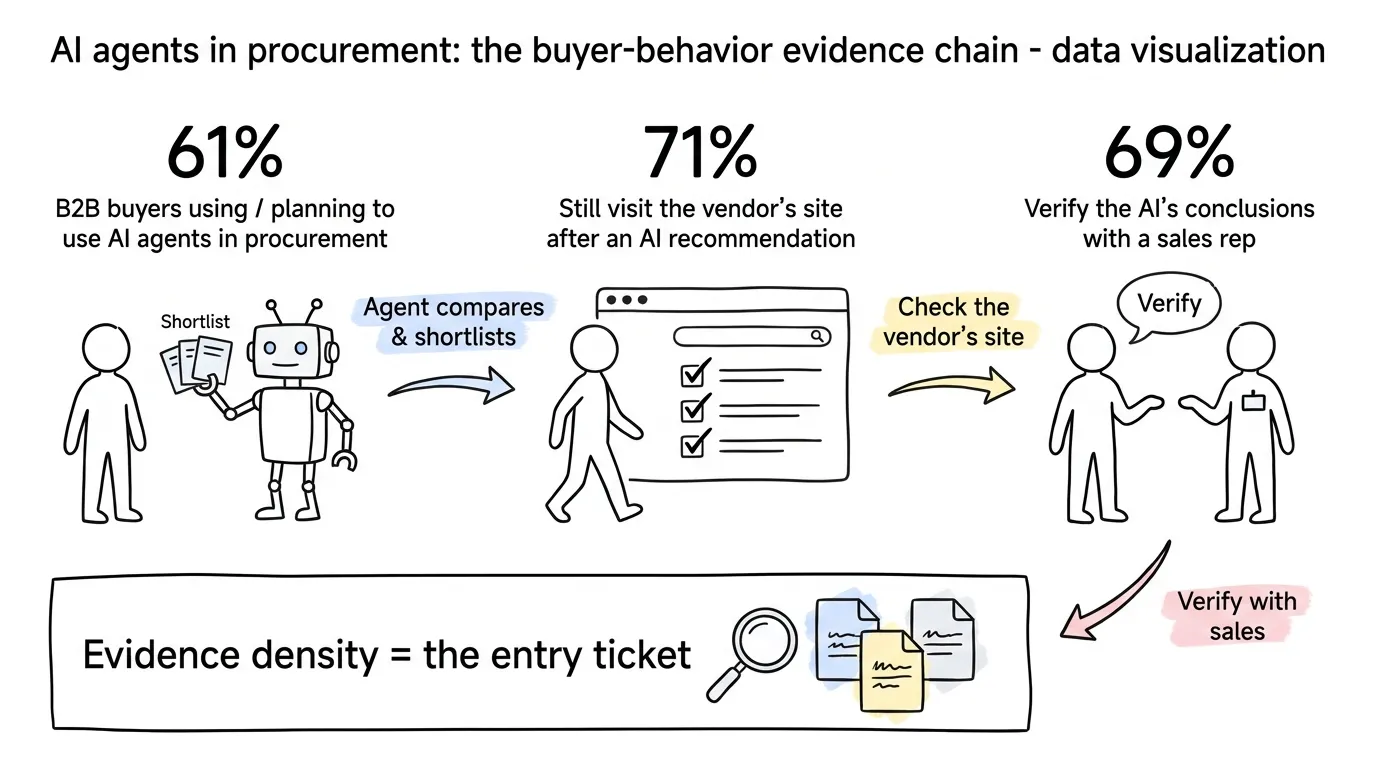
Why does this matter? The author uses a retail analogy in the piece: a mannequin styled in a full outfit tells you about the occasion and the lifestyle, and it persuades better than individual items lined up on a shelf. B2B's predicament is exactly the same. Adjectives like "innovative," "scalable," and "disruptive" carry almost no information for buyers or agents. What actually carries information is which systems you integrate with, which operational problem you solve, and which existing processes an implementation will touch. Over the past two years, industry talk about GEO (Generative Engine Optimization) has focused on one question: how to get cited by AI. This article pulls the camera back one frame. Getting cited is only the entry ticket; the real make-or-break line is the consideration stage. When agents compare evidence, whoever's product information is tied to business problems, and whoever's evidence can be verified, makes the shortlist. Being visible and being understood are two different things — only being understood wins you a slot on the list. For anyone in B2B, the optimization target has shifted from rankings to the evidence chain.
For marketers, the impact shows up in how information is organized. The failure point isn't a lack of traffic; it's fragmented information. The product page says one thing, the case studies say another, the technical docs say a third, and customer reviews don't line up with sales talking points. Human buyers will fill in the gaps. Agents won't — they treat inconsistency as noise and simply strike your name from the shortlist. Two more things are worth noting. First, 69% of buyers still want to verify with sales, so AI and human processes coexist: the sales team's value hasn't been diluted — it has become the human checkpoint where that verification happens. Second, agents are moving from retrieval toward executing commercial actions on your behalf, and there is still no industry standard for identity, permissions, or accountability. Whether agents can touch contracts, security requirements, and service commitments in enterprise relationships — everyone is still feeling out that boundary.
How to act on it. First, walk your own product pages from an agent's perspective: what can it actually pick up, and can it answer the hard questions — which integrations, what implementation timeline, what results at comparable scale? Next, pull the key facts from product pages, case studies, docs, and reviews into a single alignment table, and check numbers, definitions, and wording item by item — fix any mismatch the same day. Then brief the sales team once, making sure what they say matches what the website says, so that Gartner's 69% verification step doesn't turn into your own team undercutting you. One principle for the trade-offs: the goal of writing content is not to please the machine — it's to organize the facts that matter to procurement decisions. What both machines and humans can read is what lasts. One step further: tag AI-sourced traffic in your web analytics and monitor the funnel from recommendation to verification. That is the new baseline for B2B web analytics in 2026.
My take: don't treat AI agents as yet another traffic channel. Treat them as your first reader — a reader that never fills in gaps and only believes evidence. G2's 61% is still climbing, and the 2026 budget should carry a line item for evidence engineering on your website. That investment gets you closer to a closed deal than ten more blog posts.
🔗 Further reading: Read the full article
🏷 Platforms & Ad Automation
Meta aims to fully automate advertising by year-end — the referee and a player are the same company
Meta's endgame for ad automation is drawing closer. The WSJ report pins the date at the end of 2026: advertisers supply the objective, the budget, and a connected bank account, while Meta handles creative, targeting, bidding, and delivery — aimed mainly at its roughly 9 million small and mid-size advertisers. Most of this capability already exists under the name Advantage+, which surpassed $75 billion in annualized spend in Q2 2026, and its quarterly image-generation volume doubled. Meta's own figures claim that ad ranking improvements alone delivered an 8.3% lift in clicks and a 15.7% lift in conversions. Nanos's analysis adds two pieces of history: in 2016 Facebook admitted its average video view duration was overstated by 60% to 80%, and since 2018 US advertisers have sued over inflated potential reach, with claims at one point as high as 400% — those cases are still unresolved. The article also offers a front-line observation: in their own campaigns, purely AI-generated assets underperformed human-made creative.
💬 The platform sells the inventory and referees the game, so your countermove is a second source of truth. Do this week: get your own event tracking and form stats running, then put at least one third-party measurement platform into the budget so Meta's numbers have something to be checked against. And don't hand all your creative to the machine just yet — keep a human-made version as a control.
🔗 Further reading: Read the full article
Google AI Mode ads go live in Australia — ads are now officially inside the AI answer stream
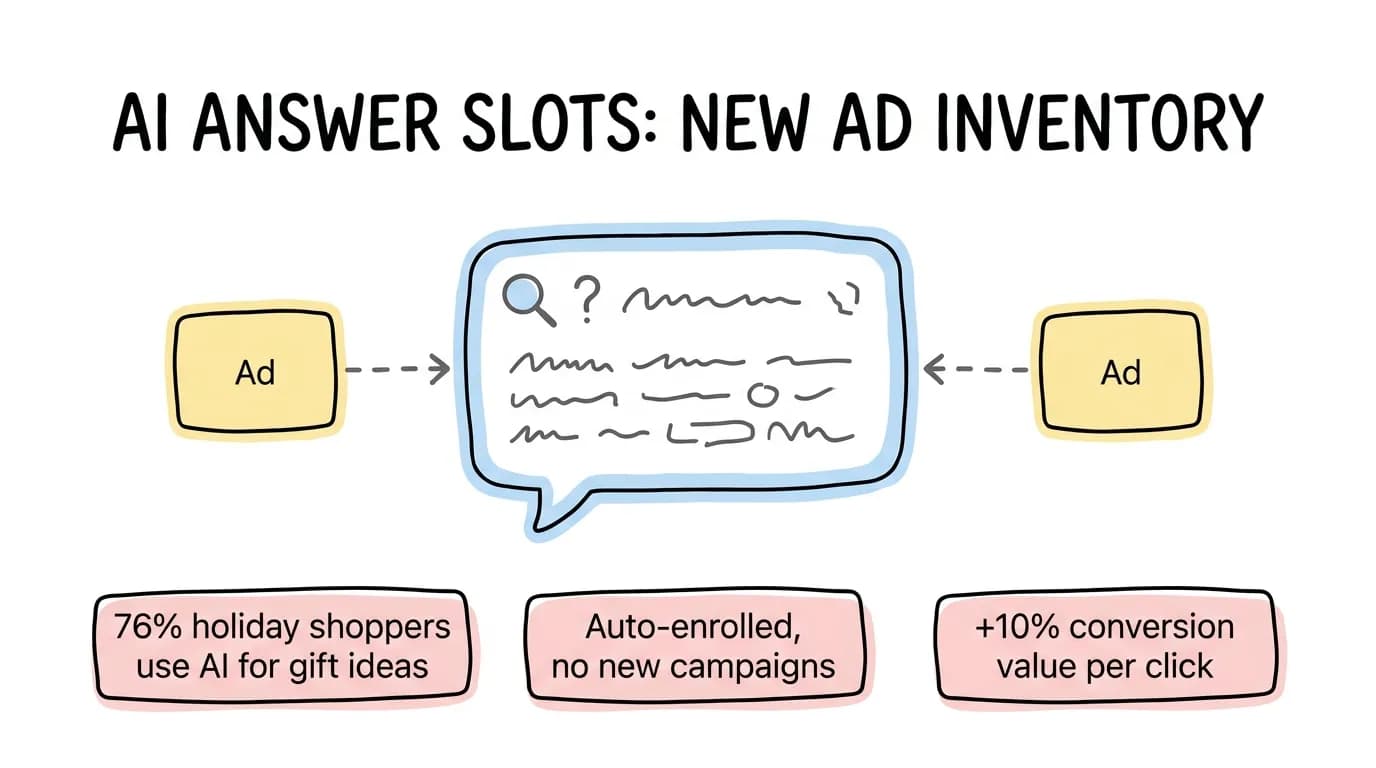
Google's AI Mode ads launched in Australia on October 28, marking the formal arrival of ads inside the AI answer stream. Digital Hitmen's weekly report of November 2 reads this change alongside several others: Semrush found that SERP monitoring data is being contaminated by AI answer summaries, which discounts how much you can trust rank-tool readings; Google and Microsoft rolled out AI ad controls in the same window, letting advertisers adjust or shut off ad placement inside AI summaries; and attribution for the Gemini channel remains incomplete — the report explicitly warns against slashing other channels' budgets based on Gemini data too early. For teams targeting Australia, this is the first directly observable sample set; the auction logic and presentation of these ad slots will gradually reveal themselves over the coming weeks.
💬 Paid media teams should first go hands-on with the AI Mode ad controls and decide for themselves what to keep and what to switch off — don't let defaults make the decision for you. Until attribution is complete, treat Gemini reports as read-only: look, don't move budget, and gather at least two weeks of data before drawing conclusions.
🔗 Further reading: Read the full article
Bing publishes its AI training timeline — December 15 is the first decision point
Dipak Paneru's November 7 SEO roundup contains several hard dates. Bing has published a phased timeline for AI training and grounding — December 15, 2026, then February 1, March 1, and September 30, 2027 — and content owners must decide whether to opt out before each of these dates. Google AI Mode extended its service to booking home services, with Angi, Thumbtack, Housecall Pro, and Jobber already integrated, opening a channel for local service businesses to get distributed directly by AI — another step for transactional AI search. Microsoft Clarity added an Agent Activity report, letting you see how AI agents access your site. And Semrush's data delivers a counterintuitive read: click-through rate rose from 39.74% to 46.11%, while zero-click fell from 24.97% to 22.99% — the opposite of the popular "AI Overviews killed clicks" narrative.
💬 December 15 is a decision point that belongs on the calendar now. Have legal and your content lead walk through Bing's opt-out options. Clarity's Agent Activity report is free — turn it on today, because behavioral data on agent traffic only gets more valuable the earlier you start collecting it.
🔗 Further reading: Read the full article
OpenAI launches automated Maximize Results bidding — one more player in ad auctions
Within JumpFly's August ad trends, the item worth singling out is OpenAI entering the media-buying race. Maximize Results is an automated campaign option akin to Google's Smart Bidding, and ChatGPT's shopping entry point keeps adding capability. Pinterest shared an interesting stat: 96% of users browse with no brand intent in mind, which re-prices the value of interest-driven discovery traffic. xAI launched Grok Imagine 2.0 and Grok Bot, a shopping agent that can crawl product data directly. And the conversion-side comparison is hard to argue with: ChatGPT shopping traffic converts at 7.1% versus 7.8% for paid search — a gap of just 0.7 percentage points. AI shopping has moved from concept into live testing.
💬 ChatGPT conversion sits within 0.7 points of paid search — a number strong enough to win a small pilot budget at your next planning meeting. Concretely: run Maximize Results at small scale for four weeks in parallel with a manual-bidding control group, and let the data make the case.
🔗 Further reading: Read the full article
AI referral traffic converts 42% higher; six platforms open MCP so agents can plug straight into ad accounts
Two structural shifts in JumpFly's June trends issue deserve their own entries. The first is traffic quality on AI channels: conversion rates 42% higher than traditional search, dwell time up 48%, and Adobe observed AI referral traffic up 393% year over year — the "smaller but better" pattern holds. The second is agent direct connection: Pinterest, Microsoft, Google, Amazon, Yahoo, Meta, and TikTok have successively opened MCP (Model Context Protocol) servers, letting AI agents read and write ad accounts directly — mostly read-only, with a handful able to read and write. In the same window, OpenAI launched product feed submission and persistent user objects, with an official figure of 50 million shopping queries per day. Google AI Mode reached full rollout on June 15.
💬 Open MCP means managing ad accounts moves from script-and-black-box to a standard interface. This year, paid media teams should assign one person to map out the account permission matrix — which are read-only, which are writable — and stand up a whitelist first. And don't swallow the "AI traffic is high quality" conclusion whole; verify it against your own attribution before shifting budget.
🔗 Further reading: Read the full article
🏷 GEO & AI Search Optimization
Infosys elevates GEO to enterprise strategy with a five-dimension citability model
Infosys's enterprise GEO guide lifts the topic from tactics to strategy. The baseline data comes first: 68% of searches end without a click, the click-through rate of the No. 1 organic result fell 58% after AI Overviews appeared, ChatGPT has 800 million weekly active users, and AI Mode has passed 1 billion monthly active users. The framework offers five dimensions of citability: semantic depth, entity clarity, embedding friendliness, chunk retrievability, and citation value. The piece also disentangles five near-synonyms — GEO, SEO, AEO (Answer Engine Optimization), AI SEO, and LLMO (LLM Optimization) — and recommends unifying the terminology inside the enterprise. Its conclusion: the biggest obstacle to landing GEO isn't technical, it's cross-functional coordination among content, SEO, data, and legal.
💬 The five-dimension model can go straight into your internal alignment meeting. Unify the definitions of GEO, AEO, and the rest first — so three teams don't run three sets of KPIs. The real work is the cross-functional coordination: have the content lead convene a short session and break the five dimensions into action items per team.
🔗 Further reading: Read the full article
GEO evidence from the French market: three case studies doubled citation rates
BotRank's GEO guide is built on the French market — a rare piece of first-hand evidence. Background: ChatGPT weekly active users had already reached 900 million by February 2026, France's AI Overviews launched on July 22, and 48% of French users are on generative AI. The citation reality is sobering: by Pew's count, AI cites only 8% of sources, and SparkToro's research found that AI answers to the same question agree less than 1% of the time. The technical prerequisites come first: outside of Google and Apple, most AI crawlers don't execute JavaScript, so SSR (server-side rendering) and schema are the ticket to entry; Cloudflare has blocked AI crawlers by default since July 2025, so you must actively configure an allow policy. On the content side, the levers have numbers behind them: Princeton's research found adding citations lifts visibility 27% and adding statistics lifts it 25%, and "best X" list-style queries account for 43.8%. The three local case results: Smash grew keyword coverage from 45% to 70%, IGENSIA lifted citations from 25% to 55%, and Conectic+ grew traffic 70% and revenue 120%. As for llms.txt, Google's Mueller has explicitly dismissed it.
💬 This guide is most valuable for teams in European markets. Three steps first: check SSR and schema, configure the AI-crawler allow policy, and add citations and data to your priority pages. Stop putting hours into things like llms.txt — the time is better spent on entity building.
🔗 Further reading: Read the full article
GEO doesn't need to start from scratch: by Google's own definition, it's still SEO
A Seattle SEO team's guide takes a clear stance: under Google's official framing, GEO is essentially still SEO, and you don't need to rewrite your whole site for AI. At the mechanism level, RAG retrieval and query fan-out mean extractability matters more than keyword density — content must be splittable into chunks that can be independently retrieved. The article cautions that the conclusions of the KDD 2024 GEO paper should be transferred carefully: the experimental setup differs from real engines, so don't set expectations off the paper's numbers. The implementation section is a seven-step checklist covering structured data, answer-first structure, entity building, and source attribution.
💬 This guide works well as a baseline calibration read for the team — it's a one-hour read. When you set rules for the content team, use its seven-step checklist as the foundation: start by reworking answer-first structure and source attribution on your twenty priority pages, check citation changes in two weeks, and don't jump straight into a full-site rewrite.
🔗 Further reading: Read the full article
The two-sentence test: can your content be cited by AI?
OptimizeGEO's step-by-step guide breaks GEO into actions you can start the same day. The technical prerequisite is SSR and structured data, because most AI crawlers don't execute JavaScript and can't read client-rendered pages. On method, replace keyword research with prompt-based research — find topics inside real questions people ask. For answer-first structure, there's a self-check called the two-sentence test: take the first two sentences of any paragraph and see whether they stand alone as a complete, citable answer. On signal weighting, the judgment is that brand mentions and entity consistency predict AI citations better than backlinks, and featured-snippet-style structure improves both clicks and the odds of being cited.
💬 The two-sentence test costs nothing — have your editorial team run it across the whole site today and queue up the failing paragraphs for revision. Freeze part of the backlink budget and redirect it to brand mentions and entity consistency — encyclopedia entries and industry directories, for instance — where the return per hour is better.
🔗 Further reading: Read the full article
Only 38% of top-10 pages get cited by AI — the value of a ranking is being repriced
Mean CEO's November AI Overviews monthly report does something useful: it puts conflicting traffic numbers side by side and interrogates the methodology. Ahrefs estimates organic clicks fall about 34.5% when AI Overviews are present; on SparkToro's basis, 58% of searches are zero-click. The two figures are far apart — before citing either, check how they were computed. The more sobering stat is the value of a ranking: only about 38% of pages that reach Google's top 10 get cited in AI answers. The operational advice is specific: keep answer blocks to 40–60 words, write about entities with few adjectives, and proactively name your data sources. The warning on programmatic SEO comes from Nomad List, where batch-generated pages average just 1.6 visits. On the technical side, Yoast 28.8's schema output is already optimized for AI readability.
💬 Next time someone scares you with "58% zero-click," ask about the methodology first. Auditing the AI citation rate of your own core keywords beats reciting industry numbers. If a pSEO batch-production line is still running, that 1.6-visit average is your stop-loss signal — move those hours to deep content that can actually be cited.
🔗 Further reading: Read the full article
🏷 Data & Budget Benchmarks
BCG surveys 300 CMOs: investment is accelerating, revenue realization is lagging
BCG published an AI marketing survey built on more than 300 CMOs and 50 in-depth interviews, quantifying the gap between investment and payoff. 96% of CMOs now have AI responsibilities written into their titles, and about half personally lead AI investment. The money is genuinely ramping: 43% of companies now spend more than $15 million on AI marketing, up from 28% a year earlier. The payoff side is much colder — 31% of B2C companies have seen a material revenue impact from AI, versus only 20% in B2B. Expectations on the CEO side keep climbing: 94% are raising their expectations of AI marketing, and 90% believe generative AI is changing how consumers discover products. On organization, 80% of companies are reskilling, and capability building is the main bottleneck.
💬 When you present next year's budget, put B2B's 20% revenue realization rate in the deck — it defends your budget's credibility better than any vision slide. The counter is to converge: cut the pilots sprinkled too thin and compress big spending into two or three scenarios that can produce revenue data.
🔗 Further reading: Read the full article
2026–2027 AI marketing benchmarks: 87% report efficiency gains, 39% report effectiveness gains
A compilation of 2026–2027 AI marketing statistics assembles the benchmark set. On penetration: 87% of teams use AI workflows in Salesforce, 94% of enterprise teams have adopted, 78% use HubSpot's AI daily, and 91% use Jasper. Workload and budgets are rising in step — the share of marketing work handled by AI has grown from 24.2% to 55.9% in three years, and the budget share has reached 15.3%. Market size, by Gartner's reckoning, was $64.25 billion in 2025, up 63.4%. The most useful number is the pair of contradictions: 87% of teams report productivity gains, but only 39% report content effectiveness gains, and 41% still struggle to prove ROI. Among new channel growth areas, GEO accounts for 41.5%, AEO 24%, and agent-type applications 13%. Forrester warns that 33% of teams will cut AI marketing spend in 2027.
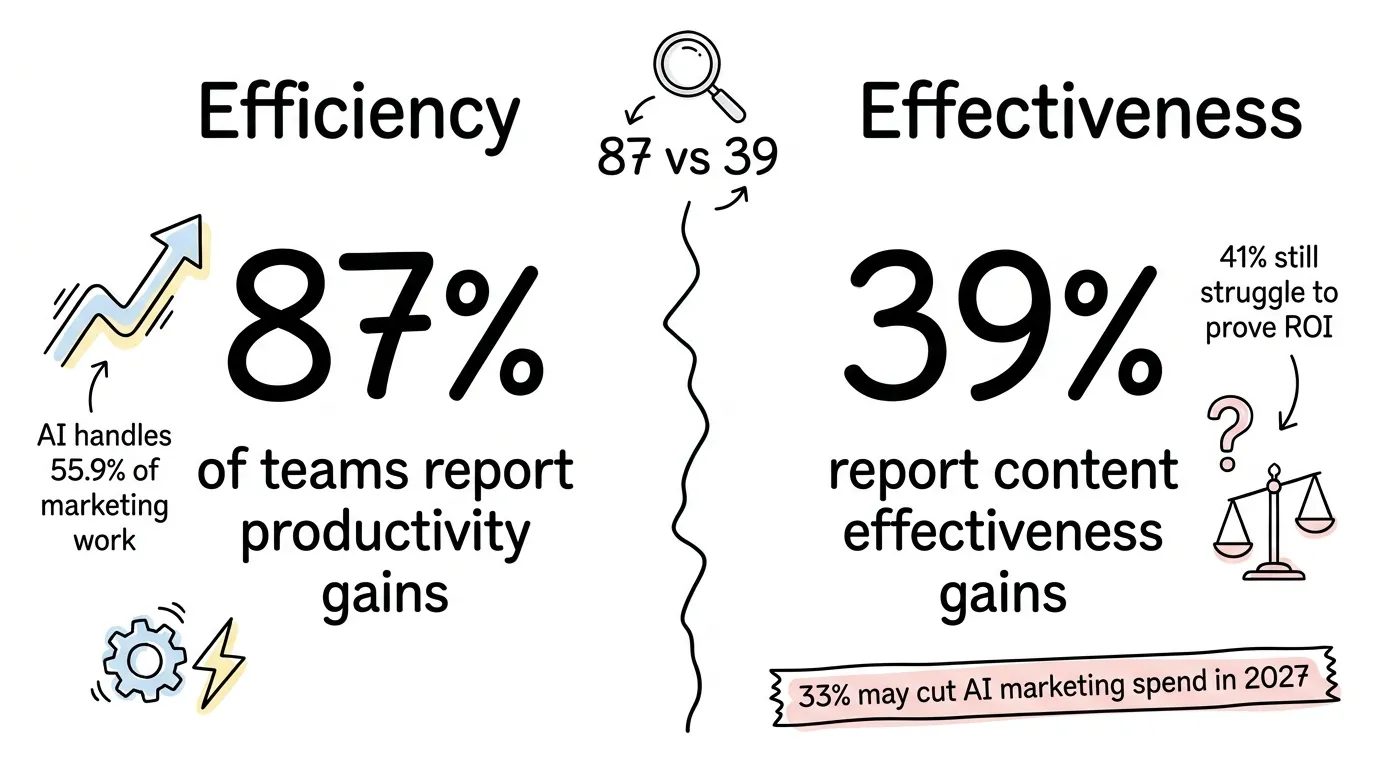
💬 This dataset is handy for team benchmarking — focus on the 87%-vs-39% seam. Don't celebrate efficiency gains yet; reinvest the saved hours into content quality and distribution if you want to move up from 39%. And note Forrester's warning: build a pullback contingency into next year's budget request.
🔗 Further reading: Read the full article
Content marketing's median return is $7.65 — but 80% of teams lose money
QuickSEO compiled more than 60 content marketing statistics, and the distribution is more informative than the average. The median return is $7.65 per $1 invested; B2B SaaS compounds at 844% over three years, and SEO returns reach 748%. But the spread is extreme: 80% of companies lose money on content marketing, returns concentrate in the hands of 20% of teams, and that segment's returns exceed 500%. The AI-search impact data is in there too: under Ahrefs' methodology, AI Overviews now cause 58% click loss — worse than the 34.5% of April 2025 — the Daily Mail's organic traffic share fell from 25.2% to 2.8%, HubSpot estimates losses of 70–80%, and Adobe observed a 42% inflection signal in June. The hedging strategies come with real numbers: original research delivers a 64% conversion lift, email returns $36–79 per $1 spent, and in Ahrefs' own case email-driven signups were 23 times more effective than search. The quality picture for AI traffic differs by how it's measured, too: Pew shows AI users click only 8%, while Similarweb measured AI-channel conversion at 11.4% versus 5.3% for traditional search.
💬 Don't fool yourself with averages — first work out whether you're in the 80% or the 20%. Two actions: add one original research piece to next quarter's content plan (that's the 64% conversion-lift hedge), and don't stop building the email list — an efficiency 23 times that of search is right there on the table.
🔗 Further reading: Read the full article
IAB's 37-point trust deficit: consumers aren't exactly sold on AI ads
Creatify's eight-trends report makes the risk side clearer than the opportunity side. By McKinsey's reckoning, two-thirds of enterprises are still in the pilot stage and 80% have seen no EBIT-level improvement — the pilot-to-scale gap is right there. The IAB trust data is what marketers should memorize: consumer trust in AI ads scores just 45%, versus 82% for non-AI ads — a 37-point gap — and 73% of consumers demand explicit disclosure of AI content. The opportunity side has its numbers too: Adobe counts AI usage up 1,200%, AI traffic up 693%, and AI-driven reach-to-conversion up 31%. Tec-Do's case is a cost-effectiveness proof point: creative costs compressed from $20 to $2, plays tripled, and 80% of output went to performance advertising. Agent-type applications sit at only 13% adoption — but an 82% return rate.
💬 A 37-point trust gap is a pricing problem. Don't swallow all the savings from AI creative — spend part of it on disclosure and human endorsements. Label AI-generated content clearly on landing pages: it's both compliance preparation and the practical way to minimize trust damage.
🔗 Further reading: Read the full article
🏷 Cases & Methods
Hotel Chocolat's AI creative made System1's top 0.3% — AI is the present, not the future
MarketingWeek argues its case with a set of named examples: generative AI isn't the future of marketing — it's already the present. Briefly built the Strat.GPT briefing system for Dell, turning brand knowledge into structured assets that AI can use. The Pencil platform has served 5,000 brands and generated over 1 million ads, and Ugg saw results roughly double after adopting it. Hotel Chocolat's case is even more persuasive: the AI-assisted creative for its Velvetiser ad scored 5.9 on System1, placing in the top 0.3% of all tests — evidence that AI assistance doesn't sacrifice emotional quality. The counter-data comes from CreativeX: roughly half of budgets flow to creative unfit for media spend, so making creative quality measurable is the precondition. The article's conclusion leans toward "AI is just software" — a tool layer, not a replacement — and APG has already formed an AI working group to track this.
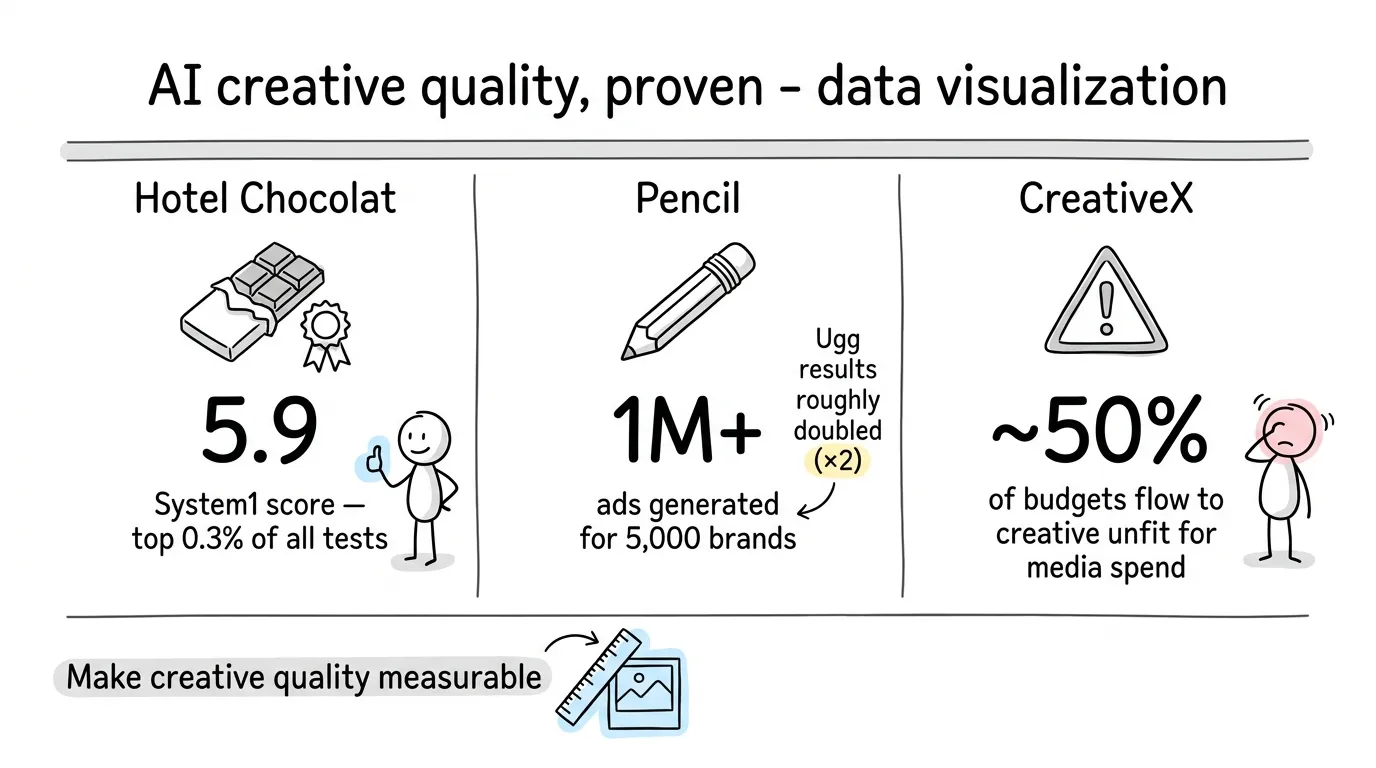
💬 Take Hotel Chocolat's 5.9 score to answer the internal line that "AI creative has no soul" — it works better than arguing. Start implementation with briefing structure: feed brand knowledge to AI the way Dell did. Input quality determines output quality, and this step requires no new tools.
🔗 Further reading: Read the full article
A roundup of 25 AI marketing cases: from Klarna replacing 700 support agents to the Barbie poster
DigitalDefynd compiled 25 named AI marketing cases spanning CPG, retail, finance, and entertainment. The representative cases each have a memorable hook: Dove's Real Beauty used AI to generate diversity assets, Burger King used AI to play with a controversy meme, Klarna's AI support agent replaced 700 human seats, and the Barbie movie used AI for poster marketing. The set is organized into four application categories — personalized recommendation, generative creative, predictive analytics, and programmatic delivery — and every case carries verifiable result numbers, making it easy to search by industry. The piece also supplies background data on the $100 billion market expected by 2028, handy when you need a number for external proposals. The weakness of compilation material is equally plain: most cases are secondhand retellings with uneven depth of detail — better used as an index than as evidence.
💬 Best used as an inspiration library — flip through two cases by industry when a proposal stalls. Note the two sides of the Klarna case: replacing 700 people is a cost story, and the complaint data is another matter. Check the follow-up reporting before you cite it, so you don't get caught out in front of a client.
🔗 Further reading: Read the full article
Klaviyo polls 13 experts: in 2026, automation graduates from co-pilot to full pilot
Klaviyo's roundup of 13 experts sets out the main narrative for marketing automation in 2026: AI moves from a human-driven co-pilot to autonomous orchestration of omnichannel journeys. On data, zero-party data has become the preferred personalization source as privacy tightens, and the biggest share of the report goes to orchestration schemes combining B2C teams' CRM channels — email, SMS, and the like — with AI agents. The report covers privacy, personalization, and automation in three layers. It's vendor-produced, but the structured interviews add real information, and you can see B2C practitioners are already ahead of B2B in accepting agent orchestration.
💬 When CRM and EDM teams put autonomous orchestration on next year's roadmap, pick one lifecycle scenario as a pilot first — abandoned-cart recovery or a new-customer welcome series, say — and expand only after it proves out. Start building the zero-party data collection points now; surveys and quizzes are the lightest opening move.
🔗 Further reading: Read the full article
🏷 Policy & Agent Governance
The EU's Digital Fairness Act enters ticket-writing mode: fines up to 6% of global turnover
The EU advanced the Digital Fairness Act on November 11, and the WSJ reported the proposal's details. The regulatory scope covers three areas: deceptive interfaces such as dark patterns, influencer marketing on social media, and addictive design. AI-driven personalized manipulation is, for the first time, explicitly written into the definition of deceptive design — meaning tactics that use AI to probe your weaknesses and bait you with hooks have moved from the gray zone to outright prohibition. The penalties follow the GDPR template: fines of up to 6% of global turnover. The direct implication for advertisers is that landing pages, subscription flows, and AI-recommended copy all need a compliance audit pass. For teams doing influencer marketing, disclosure requirements will tighten — the European Commission has specifically called out misleading practices in influencer marketing.
💬 Teams facing the EU market should put this act on next quarter's compliance calendar and self-check three things: is the unsubscribe button easy to find, does AI-recommended copy carry manipulative phrasing, and is influencer disclosure properly documented. The 6% fine base is global turnover — don't use a small European revenue share as a shield.
🔗 Further reading: Read the full article
Share of Model: your brand's share of model training corpora becomes a new metric
EICTA's agentic AI guide cites McKinsey's April 2026 judgment that roughly two-thirds of marketing activities can be delegated to AI agents, with revenue impact in the range of 10% to 30%. The article proposes a new measurement concept, Share of Model: your brand's share of the corpora used to train and fine-tune models. It will shape brand mindshare in the AI era, by analogy to the old share of voice: where a brand sits in the human mind used to be bought with media weight; going forward, it also depends on how much of you the model remembers. The governance section uses India's DPDP Act as a reference point, flagging the data compliance boundaries under agent automation — the authorization chain when agents automatically process user data is the audit focus. The migration path comes in three stages — human execution, AI-assisted, agent autonomy — each with guardrail design attached.
💬 The Share of Model concept belongs in this year's strategy discussion. Even if it can't be measured precisely yet, first take stock of how much presence your brand has in the corpora of mainstream models, and shore up the thin spots with highly citable content. For agent autonomy, set the guardrails on people and money first — never delegate approval authority to the machine.
🔗 Further reading: Read the full article
💡 Today's Big Picture
Read today's 20 items together and there is only one throughline: AI agents are taking over both sides of commerce simultaneously. On the buyer side, 61% of B2B buyers have agents in the evaluation, and evidence density decides who makes the shortlist. On the seller side, Meta is preparing fully automated delivery by year-end, six platforms have opened MCP for agents to read and write ad accounts, and OpenAI has turned automated bidding into a product. In between, the search layer is being repriced — top-10 rankings now carry only a 38% citation rate — and GEO methodology is moving from folklore to checklists, with even llms.txt getting an official verdict. Money is accelerating in: 43% of companies now spend over $15 million on AI marketing. But revenue realization in B2B is only 20%, and consumer trust in AI ads still trails by 37 points. One line sums up today's market: the tools are evolving faster than trust and organizational capability — whoever closes those two gaps first collects the dividend.
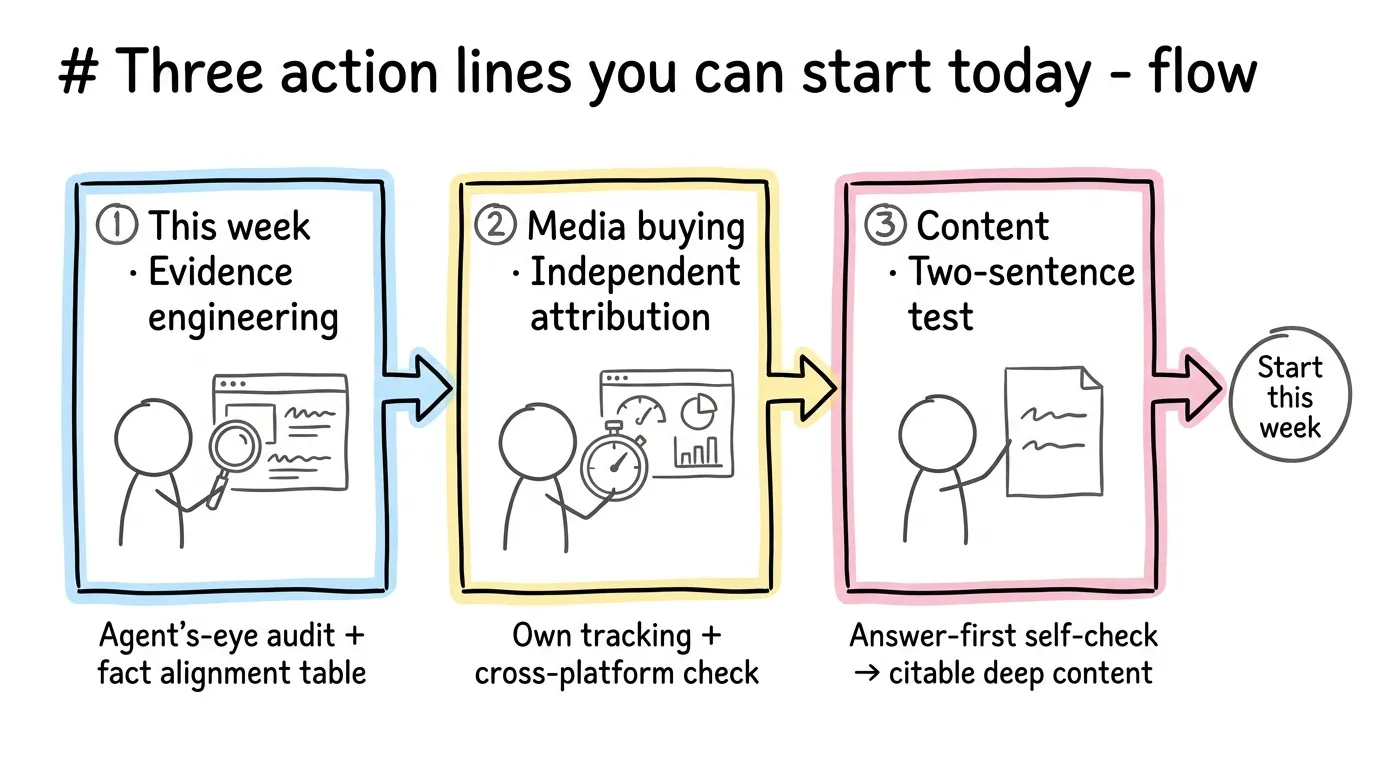
Three action lines to close the day. This week, start with evidence engineering on your website and an agent's-eye self-audit — that's the headline's conclusion, and B2B's make-or-break line. On media buying, build independent attribution and cross-platform comparison — in the era of the platform as referee, you need your own stopwatch. On content, shift from batch production to citable deep content — the two-sentence test can start today. Plenty of noise, but only these three things are actionable; everything else can wait another week.
Continue reading
Related articles
AI Marketing Daily · 2026-11-22
AI Marketing Daily for 2026-11-22 rounds up 20 items led by Microsoft opening Bing AI Overviews to ads and Google expanding AI Mode ads to ten countries, plus GEO guides, ad automation delegation guidance, AI Overviews CTR data, and a legal-risk checklist for AI-generated creative.
AI Marketing Daily · 2026-11-21
A November 21, 2026 AI-marketing daily covering AI search visibility, GEO methods, Google AI Mode ads expanding to ten countries, Meta's pre-Black Friday changes, agentic shopping, and industry adoption and ROI data.
AI Marketing Daily · 2026-11-20
AI Marketing Daily for 2026-11-20 rounds up 19 items centered on measurement: OpenAI's ChatGPT Business Hub dashboard, EU rules for agent-mediated purchasing, Meta pausing four AI terms, and B2B data on shortlists and the dark funnel, each with action advice.