
AI Cites Only Three Companies at a Time — Why Should One of Them Be You?
This article explains GEO (generative engine optimization) and why AI answers cite only a small number of sources. It covers the five factors AI weighs when choosing citations, plus practices like answer-first writing, schema markup, authority building, and self-measured citation rates.
A couple of days ago, an old friend who runs an enterprise software company messaged me at eleven at night.
He said: something's odd. Our search rankings haven't dropped, we're still publishing content on schedule — but our traffic keeps bleeding out, chunk by chunk. Tell me, did we do something wrong?
I told him: you probably didn't do anything wrong.
It's the road that changed course.
Your Customers Have Stopped Browsing the Shelves
What is traffic?
Traffic is attention passing by your front door. For the past twenty years, that attention traveled along a single road: the search results page. Users typed a word into the search box, and the search engine laid out ten blue links like supermarket shelves, row after row. Doing SEO was, at its core, the effort to get your products onto the top shelf.
Surely users still have the patience to browse the shelves?
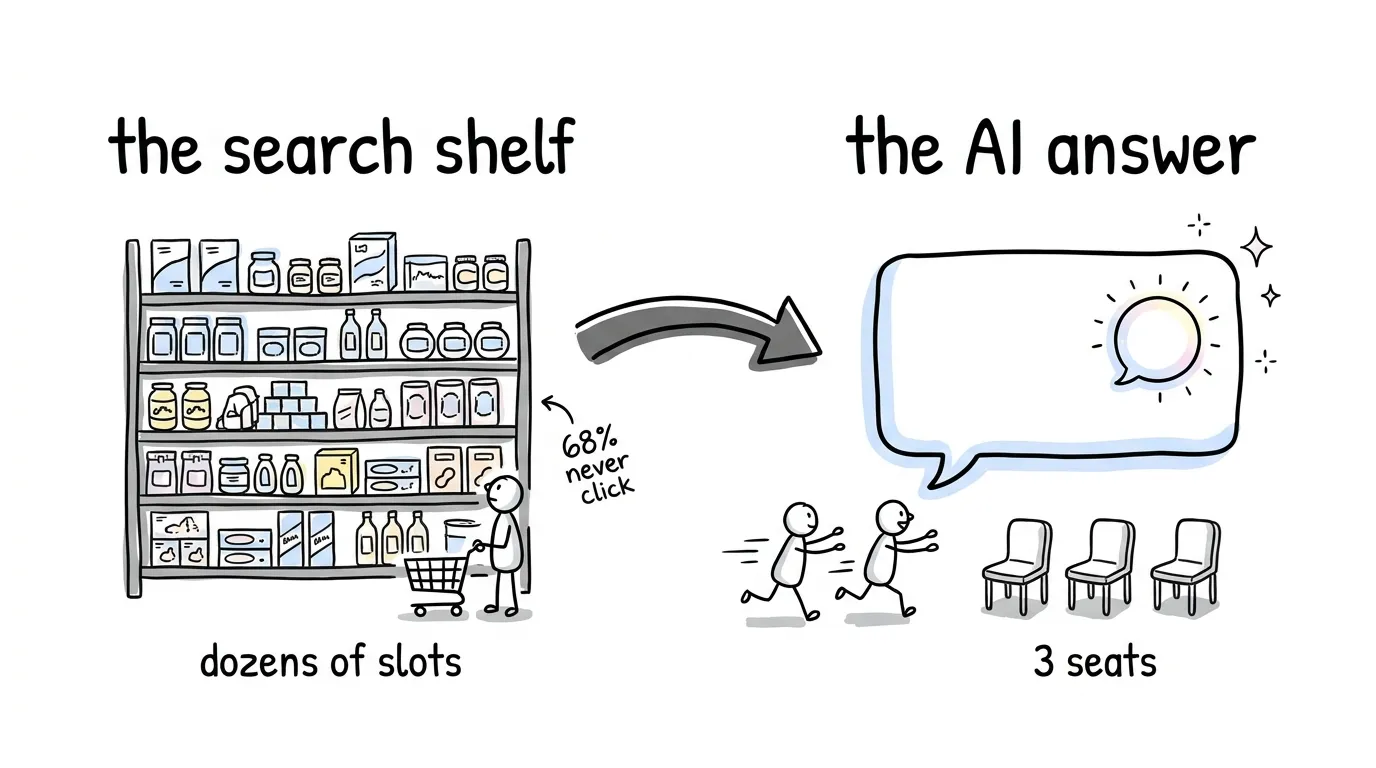
Not necessarily. Today, 68% of searches worldwide end before the user clicks a single link. No click. The answer is plastered right onto the results page. Marketing agencies have estimated that once an AI-generated summary appears at the top of the results page, the top-ranking result's click-through rate drops by nearly 58%.
Why?
Because more and more people have stopped browsing the shelves and just ask AI directly. ChatGPT, Gemini, Perplexity, Claude… ask one question, and the AI doesn't throw you ten links to pick from — it hands you an answer.
One. Just one.
How many sources does that answer cite?
Three at most. Often, none at all.
The shelf has dozens of slots; the AI's answer has only three chairs.
As early as the beginning of 2025, ChatGPT had already reached 800 million weekly active users. Google's AI Mode has crossed one billion monthly active users worldwide, with query volume still doubling every quarter. Where did my friend's traffic go? It wasn't lost. The attention was rerouted from the shelves to a chat box that holds only one answer — and his company was never mentioned.
What Exactly Is GEO?
Lately new acronyms are flying everywhere: AEO, AI SEO, LLMO… Don't be intimidated by the words — they are all different crossings on the same river. The newest and hardest crossing is called GEO, Generative Engine Optimization.
What is GEO?
In one sentence: making your content something AI can find, can understand, and wants to cite.
The endgame of SEO is ranking at the front. The endgame of GEO is being cited. Those are two different things.
How does AI pick its citation sources? Let me walk you through the process behind it.
You ask the AI one question. The AI first sends helpers out to gather material: keyword matching, vector retrieval, and hybrid ranking all kick in at once, pulling a pile of candidate documents out of the index. Then it scores those documents: how authoritative, how easy to excerpt, whether it's actually on topic, how fresh. Once the scoring is done, the AI writes the answer — and, almost as an afterthought, decides whom to cite.
One to three slots.
Who got cited, and under what conditions — this data gets recorded, and in turn guides the next round of content optimization.
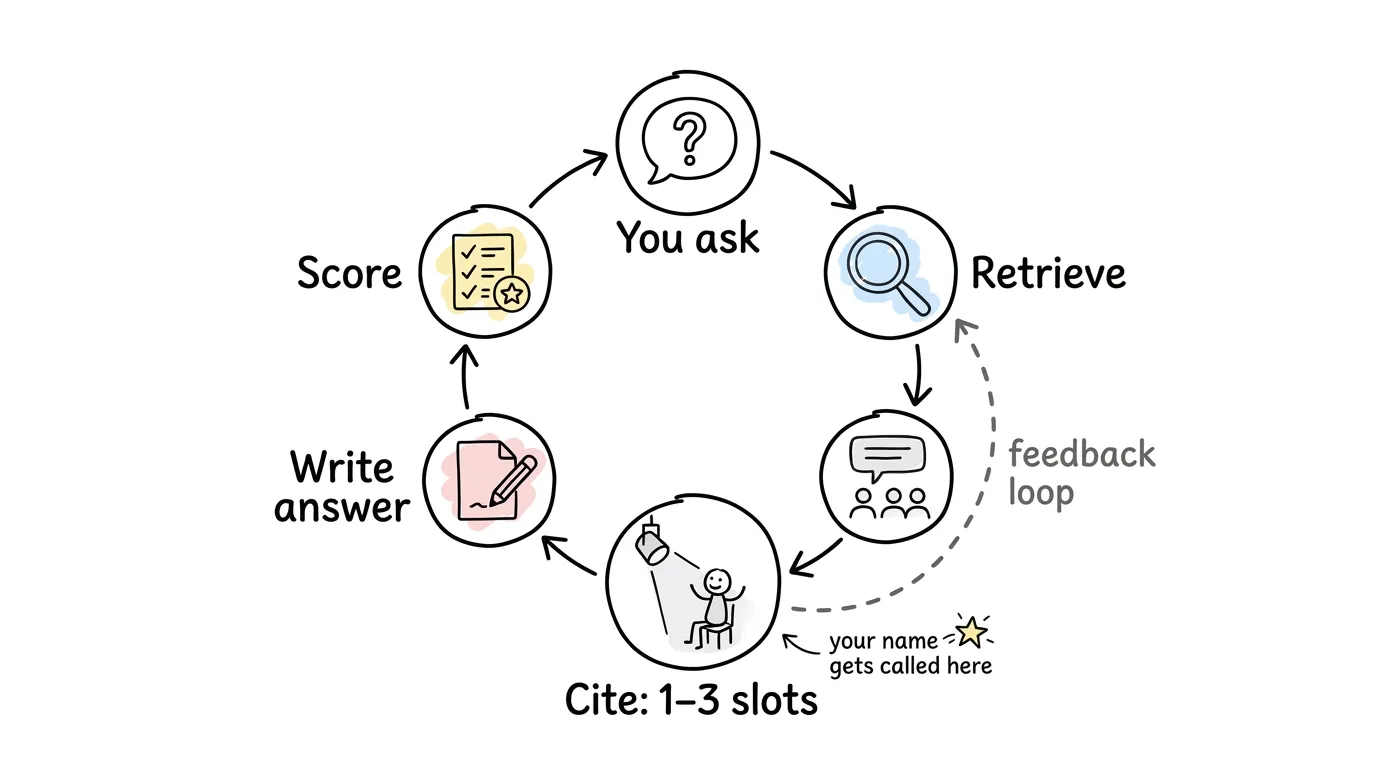
A closed loop. Your job is to squeeze yourself into that loop — and to be the name called at the "whom to cite" step.
The New Syllabus Has Five Questions
What did old SEO compete on? Keyword density, backlink counts, whether crawlers could reach your pages. These still matter today, but they decide only whether you get into the exam hall — they cannot decide whether your name gets called.
AI looks at five things when picking sources. Let me break them down:
First, how deep you go. Not spreading keywords all over the page, but explaining a topic — together with the concepts around it — with real insight. AI can tell at a glance who truly knows the field and who is copying.
Second, how clear your name is. What your company is called, what your product is called, who your spokesperson is — is it told the same way everywhere on the web? AI recognizes entities by name; once the name gets muddled, it takes you for two different companies.
Third, how well you can be filed into its "brain." AI retrieval runs on vector databases; how completely and clearly your content is represented there decides whether it can be fished out.
Fourth, how extractable you are. When AI cites, it must be able to cut a self-contained passage out of your article. If the whole piece winds around and no cut is complete, don't blame anyone for not quoting you.
Fifth, whether you're worth trusting. What are the author's credentials? Any exclusive data? Do the claims contradict each other? Is the content fresh?
Why No Single Department Can Handle This
At this point you might think: isn't this just the marketing department's job?
It really isn't.
The content team can write in depth. The SEO team can fix the technical foundation. The data team can manage structured data. The PR team can build authority out in the world. The brand team can straighten out the name. Five teams, five keys.
But when AI scores, it scores all five items together.
Which sets up the most familiar scene: the company finds itself invisible in AI answers and assigns the job to marketing. Marketing says, this needs code changes — talk to engineering. Engineering says, this needs writing — talk to content. A full circle later, nobody has moved an inch.
This isn't any one department dropping the ball — it's a mismatch between organizational structure and the way AI keeps score.
Let's run the numbers again. In traditional search, the results page has dozens of positions, so everyone at least has a seat. The AI's answer has at most three citation slots. The exam is still the same exam, but admissions have been cut from dozens to three. Whoever moves first, claims a seat first.
So What Do You Actually Do? Four Things
First, make your content serve two masters at once: AI and humans.
Open with 40 to 60 words that answer the question users are most likely to ask. No buildup — give the answer first. This is called an answer capsule. Keep heading levels tidy — H1, H2, H3 — each one a self-contained statement. Keep paragraphs short; make the first sentence of each paragraph the point, and vague pronouns like "it" and "this" are out. Turn common questions into proper Q&A blocks. And on the page, mark the "last updated" time.
Second, put up the full set of signposts that machines read.
A clean robots.txt, a sitemap with accurate timestamps, URL canonicalization, plus schema markup for organization, product, and FAQ. Users can't see any of this, but AI crawlers rely entirely on it to find their way.
Third, accumulate authority.
The name across the whole web must be consistent — company name, product name, spokesperson, not a single word out of place. Then, find a way to produce things others don't have: original research, first-party data, expert opinions. The AI world calls this "information gain." To put it bluntly, only if you have material others don't have will the AI have a reason to cite you, instead of citing someone else who says exactly the same thing.
Fourth, measure it yourself.
This one's the most awkward. AI's citation behavior is opaque by nature, and there is no ready-made ranking report to buy. You can only test it yourself: list a batch of questions users would really ask, run them one by one through ChatGPT, Gemini, Perplexity, and Claude, and note who got cited, at what position, and how much was said.
There is exactly one core metric: the citation rate. Among the relevant questions users ask, in what proportion of answers are you cited?
Then watch three details: the position and length of a citation indicate its quality; the difference in how the same question performs across different AIs tells whether you're a one-platform wonder or genuinely have broad support; the questions where competitors get cited and you don't are your opportunity list.
This test must be run continuously. Because models get retrained, indexes get updated, and AI citation tastes can change at any moment.
Who Does the Work? One Table, One Head
This job spans five departments, so there must be a table to seat everyone together — and someone at its head.
The approach that works in practice is to set up a cross-functional GEO council: marketing, product, data & technology, and PR & communications each send one person; they sit together and share a single set of goals. And above the council, an executive sponsor has to stand behind it. Why? Because original research and first-party data all cost real money — without someone to make the call, this never gets moving.
Above the council, there must also be one person watching it every day. This role is called the Head of GEO, and it's a new job title: fluent in content strategy, grounded in technical SEO, familiar with how AI retrieval works — and ideally skilled at cross-team coordination. Settle this person first, and the experience will accumulate in the company year after year, rather than ending up scattered across chat groups.
And one ugly truth up front: this is not a one-off job.
Models are evolving, your products are updating, and companies rename themselves and swap logos. Treat GEO as a project, and the day you sign off is day one of the decline. The right approach is to embed it into the daily routine: content reviewed and refreshed on a schedule, schema updated the moment the product changes, a name audit across the web every time the brand moves.
Looking Three Steps Ahead
First, AI doesn't just read words anymore. Video subtitles, image captions, the logic inside charts — all of it gets read. Your videos and images need to "make sense" to AI too.
Second, the platforms will fragment further. ChatGPT, Gemini, Perplexity, Claude, Copilot — each has a different retrieval architecture and different citation tastes. Making one set of content work across every AI will get harder and harder.
Third, manual effort stops scaling. Once the content volume gets large — hundreds of thousands of pages — fixing them one by one by hand is impossible. Batch evaluation, automated markup generation, continuous freshness monitoring — these automation capabilities will sooner or later be table stakes.
Companies that start building these capabilities now will already have been on the pitch for a long time by the time their rivals are still picking teams.
Back to My Friend
Later, I sent him a long reply that walked through everything I've told you today.
And I closed with one line: when a road changes course, it never announces it in advance. It simply carries the foot traffic quietly away — until the day you look up and find nobody at your door.
The search shelf is still there, but the checkout has moved.
Here's hoping you're early to the new crossing.
Continue reading
Related articles

It's 2026: Stop "Buying" AI Tools for Your Marketing Team — Start "Hiring" AI Agents
This learn article explains how AI agents differ from standalone AI tools in marketing, outlines three agent categories — build-your-own platforms, CRM-native agents, and vertical tools — and covers use cases across SEO, social media, advertising, and reporting, plus criteria for choosing one.

What Is GEO? How Your Brand Gets "Mentioned" in the Age of AI Search
An explainer on GEO (Generative Engine Optimization) for e-commerce and DTC brands: how it differs from SEO and AEO, why AI answers shape brand visibility, and eight practices covering question-focused content, consistent brand messaging, structured pages, external evidence, comparisons, and AI mention tracking.

AI Is Already Making Decisions for Your Customers. Are You on the List?
A learn article explains GEO (Generative Engine Optimization): why AI-generated answers now shape which brands customers see, and how SEO fundamentals, entity clarity, citable evidence, and monthly measurement affect visibility in AI answers.