
Your Marketing Team Just Got a New Hire Who Never Sleeps
An explainer on marketing AI agents: how goal-driven agents differ from rule-based automation, which marketing tasks can be delegated first, three management rules for oversight, and how GEO affects brand visibility in AI assistant recommendations.
A while back, a friend of mine who runs a cross-border e-commerce business couldn't wait to show off: his marketing department had just onboarded a new employee. It doesn't take a desk, doesn't need benefits, and will never ask for a year-end bonus.
On day one, it read through an entire year of ad performance data and every asset in the archive. By day three, on its own initiative, it had shut down two ad campaigns that were burning cash with no conversions, shifted the budget to the better-performing creative, and, while it was at it, re-timed the whole email schedule.
The boss knew nothing about any of it.
I asked him, "Aren't you angry?"
He said, "Angry about what? It runs our media buying more steadily than our own buyers do. There's just one thing that gives me the creeps: at 3 a.m., it's still making moves in my account — and I'm asleep."
This "employee" isn't a person. It's a marketing AI agent — what the industry calls Agentic AI.
In 2026, these things are moving into marketing departments en masse. After hearing my friend's story, one thing finally clicked for me, and today I want to share it with you.
What Exactly Is a Marketing AI Agent?
First, let's get the concept straight.
What is a marketing AI agent? In one sentence: you give it a goal, and it finds its own way there.
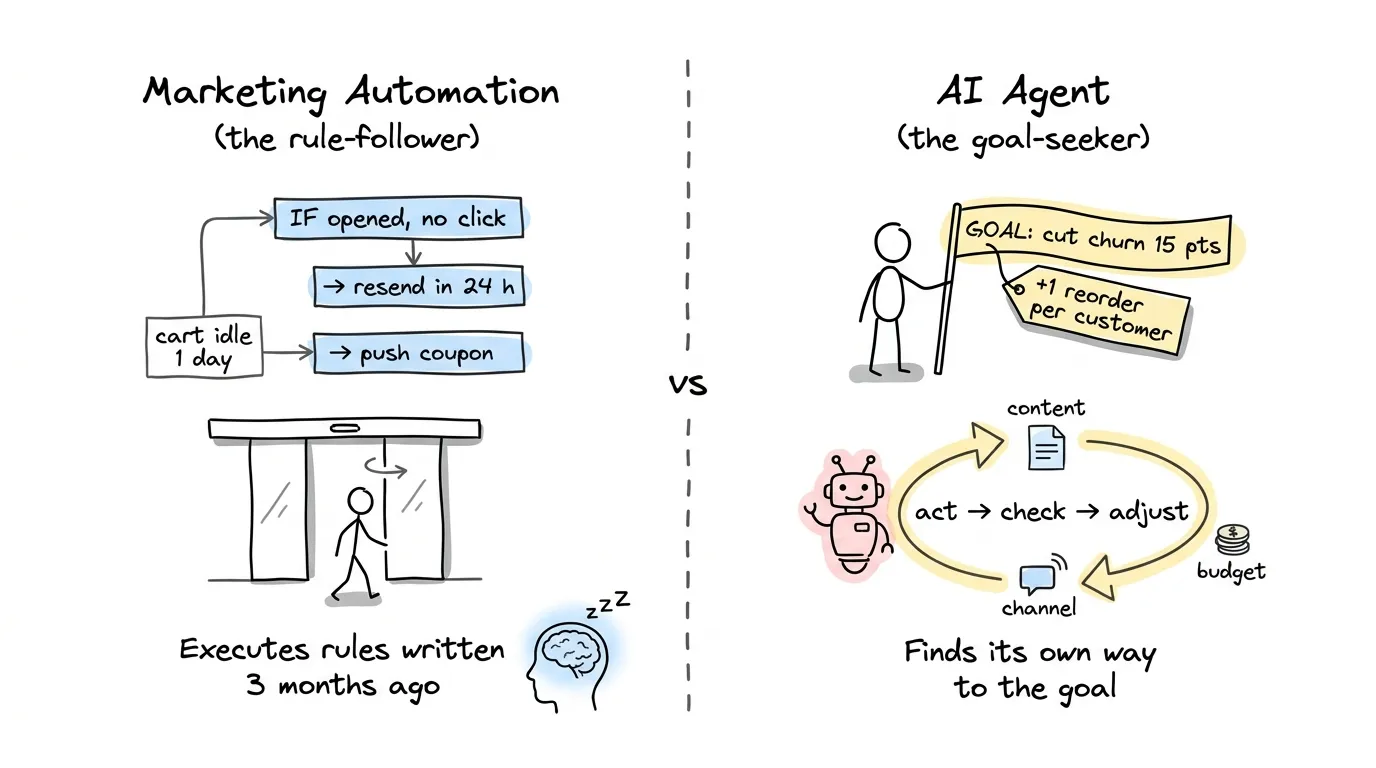
You've almost certainly used traditional marketing automation. Pre-set rules: if a user opens an email but doesn't click, send a second one 24 hours later; if a shopping cart sits abandoned for a day, push a coupon.
Is this stuff any good? Yes. But its brain is dead.
It only executes rules — rules somebody hardcoded three months ago. A competitor cuts prices, it doesn't know. A platform changes its algorithm, it doesn't know. Customer tastes shift, it doesn't know either. It's the automatic door at the mall entrance: you walk up, it opens. That's all.
An AI agent is different.
What you hand it isn't a rule; it's a goal. For example: cut this segment's churn rate by 15 points. Or: get these existing customers to each place one more order.
As for which route to take, what content to send, when to send it, on which channel, and how to split the budget — it decides for itself. It acts, checks the results, adjusts its approach, and keeps going.
One figures out how to win; the other just follows the manual. These are two different species.
In April 2026, McKinsey published a study with a striking judgment: up to two-thirds of existing marketing activities could be handed over to agents like these — including auto-generating content, running tests on synthetic audiences, and building audience-segmented media plans. Hyper-personalization, meanwhile, can lift revenue by 10% to 30%.
Two-thirds.
Meaning: most of the work in your marketing department is already written on that list.
What Does Its Day Look Like?
So what does this new hire actually do all day?
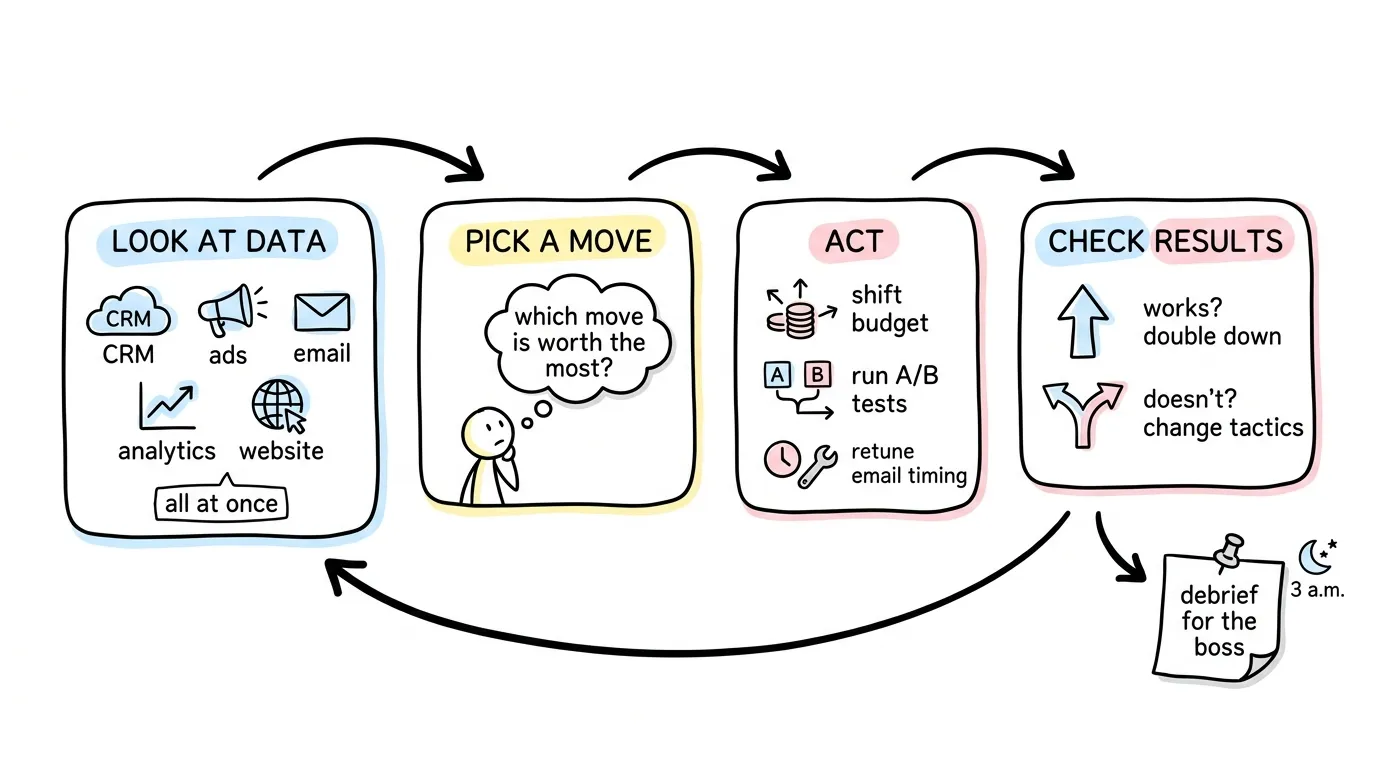
Really, just one loop: look at the data, figure out a move, make it, check the results, adjust.
In the morning, it runs through everything — CRM, ad platforms, email, analytics, the website. Note: all watched at once, with no hopping between systems to sync anything. After reviewing ad performance, user behavior, and competitor moves, it starts weighing: next step, which move is worth the most? Once it decides, it acts. Then it watches the results: if they're good, it doubles down; if not, it changes tactics.
The first assignment my friend's system took on was a SaaS goal: grow trial signups 20% in 30 days.
It dug into the data first and found the landing page conversion rate and email click-through rate were both weak. Its hypothesis: the copy didn't match search intent. So it launched several A/B tests on its own, moved budget from the losers to the winners, and reworked the email flow. Two weeks later, a winning version emerged, and it scaled it up. Then it left behind a debrief summary — ready and waiting when the boss logged on the next morning.
Pay attention to that last detail. It doesn't just do the work and vanish; it knows which things need to be left for a human to see.
That's already what a competent employee looks like.
Which Jobs Can You Hand Over First?
You might ask: of everything on my plate, what can I give it?
Let me draw up a shift roster for you.
The media-buying post. Adjusting bids, rotating creative, shifting budget — hundreds of manual moves a day, more than any human can watch. This is what machines are best at. Google's Performance Max and Meta's Advantage+ are built exactly on this path.
The email post. Segmenting, testing subject lines, timing sends to each recipient's own rhythm. Tools like Klaviyo, HubSpot, and Salesforce Marketing Cloud have already grown agent capabilities into their products.
The lead post. Tracking one person's every move across your website, email, livestreams, and community, and calculating in real time how far they are from buying. When the moment is ripe, it hands them to sales — background profile included.
The content post. Tools like Jasper and Copy.ai can draft blog posts, ads, and landing pages to brand guidelines, and even refresh your older articles. But one thing I must state clearly on its behalf: the publish button stays in your hands. It writes the drafts; you sign off.
The night-shift post. On social accounts, routine comments and FAQ replies, it can handle within guardrails. What competitors are doing, whether sentiment is stirring — it watches, and only wakes you when something breaks.
The platforms are moving fast, too. In April 2026, Adobe launched CX Enterprise, an agentic system covering the full customer lifecycle; Salesforce's Einstein and Agentforce, and HubSpot's AI tools, are all baking agents into their marketing workflows.
Tools aren't in short supply. What's in short supply is a boss who knows how to manage.
Three Iron Rules for Managing a New Hire
And managing — that's the real test.
Plenty of companies end up botching their agent projects — not because the model isn't capable, but because the boss never quite learned to be the boss. Three iron rules for you.
Rule one: before it starts, clean up the books.
Every judgment the agent makes comes from your CRM and analytics data. If the data is dirty, it will charge with total confidence toward the wrong goal — and run a lot faster than any human would. So run a data health check before you talk about onboarding. There are no shortcuts on this step.
Rule two: the permission list, in black and white.
Which things it decides on its own: swapping creative, adjusting bids, picking send times. Which things require sign-off first: publishing anything public, large single budget changes, any promise involving pricing. It's like managing an intern: the clearer the authorization, the faster the break-in. Authorization without a written list isn't authorization — it's a free-for-all.
Rule three: don't let it game its KPIs.
This is the most hidden trap. If you only measure email open rates, it will write ever more sensational subject lines, trick users into opening once, and get you blacklisted for good. The metric is met; the brand is gone.
An employee accountable only to a narrow metric will hurt the company; and a boss who doesn't understand this will blame the AI.
So you set the guardrails and review regularly. Don't just look at its report card — look at how it got there. Privacy and compliance work the same way: which data it may use, and how far user consent extends — draw that line before you let go.
One More Test Is Coming — And Most People Haven't Seen It
Everything above assumes you now have a team that never sleeps.
But there's another half to this story: your customers are starting to hire AI employees of their own.
More and more people no longer browse for purchases themselves. They just ask an AI: "Find me a hotel that's good for a weekend trip with the kids." The AI searches, compares, recommends.
What does that mean? It means you have to make someone else's AI employee willing to recommend you. This now has a name of its own: GEO — Generative Engine Optimization. Your claims must be clear, your structure clean, your sources authoritative, your coverage comprehensive — only then will an AI dare to cite you. Assistants like Google AI Overviews, ChatGPT, and Perplexity are pickier about what they cite than you'd think.
The industry has even coined a new metric: Share of Model — when users ask an AI assistant to recommend something in your category, what's the probability your brand comes up. It's share of voice for the agent era.
People have been grinding away at search rankings for twenty years. Now, a brand-new exam hall has opened.
Finally
Back to my friend's new hire that never sleeps.
He later worked something out: what he was anxious about was never that the AI was too capable. What he was anxious about was that the part of the job he'd always been proudest of — watching the dashboards, tweaking bids, planning the schedule, writing the reports — was precisely the part AI does fastest.
So what can't AI take away?
Setting direction. Making judgment calls. Bearing responsibility. Machines don't carry the blame, so machines don't make the decisions.
The tools have changed four or five generations already — from bulk email software, to automation, to today's agents. But the core craft of the marketer hasn't changed by a single item.
What's changed is only this: the hands helping you do the work keep multiplying — and they need sleep less and less.
And here's hoping you're the one who sets the goals, draws the guardrails, and signs off on the publish button — not the one who gets "optimized" out of a job.
Continue reading
Related articles

What Is GEO? How Your Brand Gets "Mentioned" in the Age of AI Search
An explainer on GEO (Generative Engine Optimization) for e-commerce and DTC brands: how it differs from SEO and AEO, why AI answers shape brand visibility, and eight practices covering question-focused content, consistent brand messaging, structured pages, external evidence, comparisons, and AI mention tracking.

AI Is Already Making Decisions for Your Customers. Are You on the List?
A learn article explains GEO (Generative Engine Optimization): why AI-generated answers now shape which brands customers see, and how SEO fundamentals, entity clarity, citable evidence, and monthly measurement affect visibility in AI answers.

Google Is Stuffing Ads Into AI Search: These Recent Stories Are Really One Story
A news roundup linking recent AI marketing stories—Google adding ads to AI Mode, Amazon's Ads Agent, ChatGPT image updates, a UK startup tracking brand mentions in AI answers, and an AI ransomware warning—arguing that control over ad data and visibility is shifting toward platforms.