
Is Content Marketing Still Profitable? I Went Through 60-Plus Data Points and Realized One Thing
A learn article reviews 60-plus data points on content marketing returns, covering how AI overviews reduce organic clicks, why AI-referred visitors show higher conversion value, channel-level ROI notes, and attribution gaps, ending with a 30/60/90-day plan for improving AI search visibility.
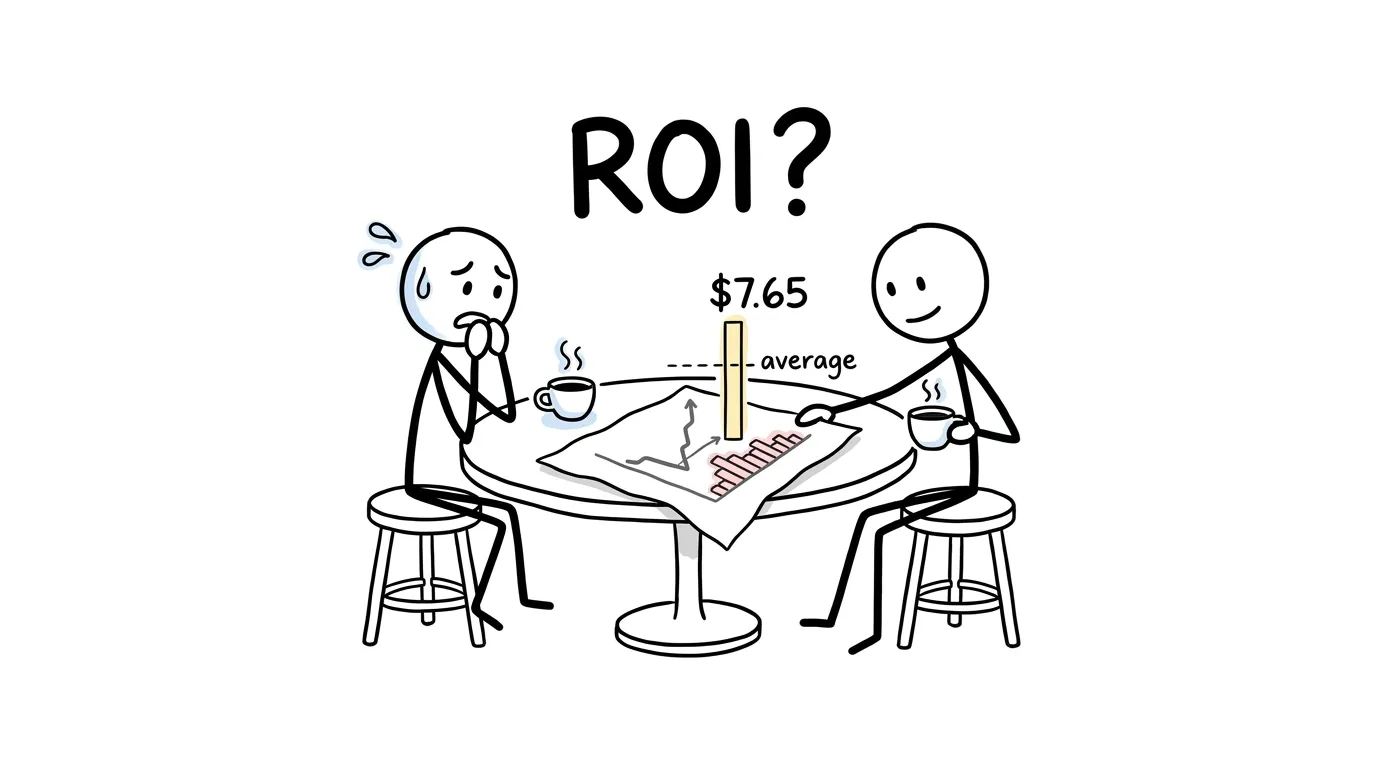
A while back, an old friend who has been doing content for seven or eight years asked me out for coffee.
The first thing he said when he sat down: "Tell me honestly — is this content business done for? Our blog traffic has been cut in half, then halved again. My boss is already asking whether we should keep the budget next year at all."
I told him: don't rush to a verdict. So I went home and dug through the 60-plus sets of data I had on content marketing returns, from start to finish — McKinsey's, Ahrefs', HubSpot's, the Pew Research Center's, the Content Marketing Institute's, Adobe's…
What I found was more complicated than he thought — and more hopeful than he thought, too.
Today, let me walk you through the math.
The Good News First: This Business Still Pays
A lot of people hear "content marketing" and think: voodoo. Money pit. Is it, really?
Let's run the numbers.
Someone ran the calculation in 2025: for every $1 spent on content marketing, the average return is $7.65. B2B SaaS is even wilder — a 2026 industry benchmark puts content marketing's average three-year ROI at 844%. What does 844% mean? You put in $1 million, and three years later you're holding $9.44 million.
Then there's search. A 2026 study on SEO returns put the median at 748%. Translated: every $1 you spend brings back $22 — and on average you break even by month 7.
Email? Every $1 brings back $36 to $42. Top performers clear $70.
And there's one old benchmark that has been cited countless times: content marketing generates 3x the leads of traditional outbound marketing, at 62% lower cost.
Good grief. That's not voodoo. That's a money printer.
But there's always another side.
Averages Are Liars
Hidden in this very same batch of data is another number: 80% of content loses money. The remaining 20% earns returns above 500%.
What does that mean?
It means the returns in content marketing aren't spread evenly — they're distributed in extremes. It's like the stock market: a rosy average gets pulled up by a handful of bulls, while most players quietly lose money down below.
There's a harsher number still: 96.55% of web pages get zero traffic from Google. Hitting publish is not the same as being read.
So my friend's anxiety was half right. The half that's right: mediocre content really is dead.
The Real Upheaval: The Intersection Where Money Changes Hands Has Moved
If only mediocre content died, the problem would be simple. The real upheaval happened at the intersection where money changes hands.
What's that intersection? Wherever users ask their questions and park their attention — that's where the deal gets done.
McKinsey surveyed 1,927 consumers in October 2025, and the results contain a number I think everyone in marketing should memorize: 44% of AI search users say AI is already their preferred source of information. Traditional search? 31%.
AI has pulled ahead.
McKinsey also ran a projection: by 2028, $750 billion of US consumer spending will flow through AI search. Where the money goes, the intersection moves.
So how's the congestion at that intersection now? Ahrefs analyzed 300,000 keywords in December 2025 and found something alarming: the moment an AI overview appears on the page, the click-through rate of the top-ranked result drops 58%. Barely six months earlier, in April 2025, that number was only 34.5%. In half a year, it nearly doubled.
The Pew Research Center studied 900 US users in July 2025: with an AI overview on screen, the share of users clicking traditional results fell from 15% to 8%. And the links attached inside the AI overview? Only 1% of people click them.
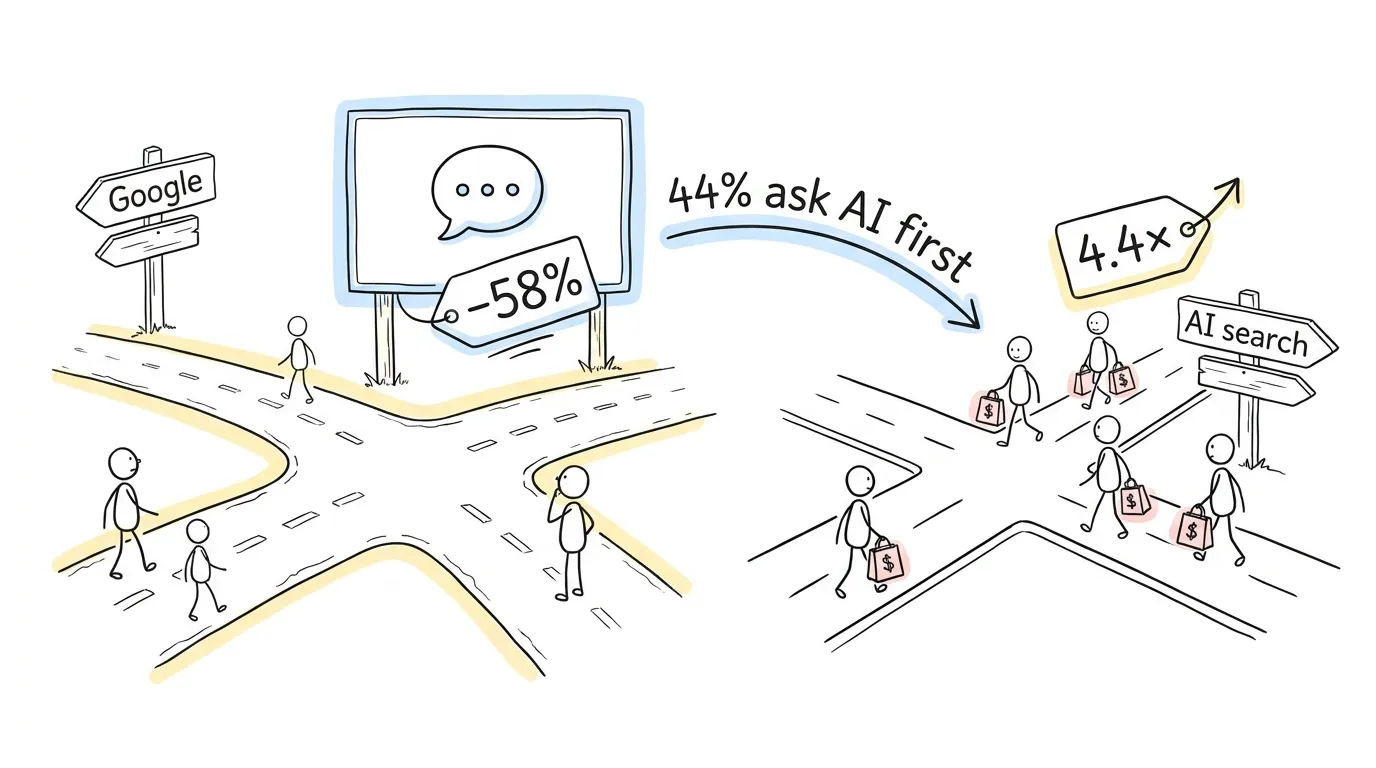
Picture the scene: you grind your way to the #1 ranking, and AI pastes a ready-made answer right on top of your result. The user reads the answer, doesn't spare you a single glance, and leaves.
It's not just small sites getting crushed. HubSpot — a mecca for marketers — saw blog organic traffic fall roughly 70 to 80 percent from November 2024 through Q2 2025, and its CEO admitted on an earnings call that organic search is declining worldwide. The Daily Mail has it worse: on queries with AI overviews, click-through rate fell from 25.2% to 2.8% — down 89%. Business Insider laid off 21% of its staff in May 2025, partly because traffic collapsed.
By now you may be itching to say those two words: content is dead.
Hold on. What comes next is the biggest twist of this whole story.
The Big Reversal: Guests from AI Are the Ones Who Buy
If you only look at click-through rates, AI looks like a tax on content marketing. But the data tells another story: the customers AI brings are few — but sharp.
A Semrush analysis in June 2025 found that visitors arriving via AI search carry 4.4 times the conversion value of visitors from traditional search.
Internal data from Ahrefs is more extreme: AI search sends them just 0.5% of their traffic, yet it accounts for 12.1% of their signups. What does that mean? A person who arrives from AI is, in terms of willingness to buy, worth 23 ordinary visitors.
Retail data Adobe released in March 2026 drives the reversal home: for US retailers, traffic from AI channels converts at a rate 42% higher than non-AI traffic. And just one year earlier, in March 2025, that number was negative 38% — AI traffic was less likely to buy than ordinary traffic.
In one year, it went from dragging the class down to top of the class.
Similarweb's data lines up too: traffic that ChatGPT refers to ecommerce sites converts at 11.4%; traditional search manages only 5.3%.
To be honest, though, some research reaches the opposite conclusion. One academic study covering 973 ecommerce sites and $20 billion in orders found that traffic from ChatGPT converts 13% worse. The disagreement most likely comes down to how conversion is attributed: do you count the last click, or the full assist? But the direction across large-sample data is broadly consistent: AI visitors come in smaller numbers, and higher quality.
Here's an analogy. You used to hand out flyers on the street and fish a few customers out of ten thousand. Now it's a friend walking someone who has already done their homework straight into your shop. Fewer people — but nearly everyone who walks in intends to buy.
Run the math: even if AI is only 1% of your traffic, with a conversion edge of several times to twenty-plus times, it could be driving more than 12% of your orders. A lot of companies have never done this math.
Where the Money Should Go: A Few Channel Truths
That brings us to the most practical question: where should the budget go?
Start with email. The old relic is still king. And there's an interesting detail: the money is really in automated email. Automatically triggered emails, one statistic shows, earn more than 3 times the revenue of ordinary blasts — and they account for 77% of email's total returns. The secret of making money with email isn't sending — it's setting things up.
Then short video. In a 2026 survey, 49% of marketers ranked it the highest-return content format.
An interesting split has opened up between blogging and SEO. Marketers who keep blogging are 13 times more likely to see positive returns; leads from SEO convert at 14.6%, while leads you buy with ad money convert at only 3.75%. At the same time, the average blog post has been shrinking two years running, down to 1,350 words in 2025. It's the middle ground — the bland, anyone-could-have-written-it generic content — that's collapsing fastest.
So don't ask whether blogging is still worth it. Ask instead: is this article something only you could have written?
That brings us to an appreciating asset: original research. A 2026 report shows marketers who publish original surveys see conversion rates 64% higher, and 86% of B2B marketers plan to invest more here. Why? Because what AI engines love to cite most is exclusive data and facts. One analysis found that articles cited in AI overviews cover 62% more facts than those left out. Exclusive data is becoming the most copy-proof content asset of this era.
Finally, AI writing itself. A 2025 study found that 74.2% of newly published web pages contain AI-generated content. But here's the fascinating part: 86% of the articles that rank high on Google are human-written; 82% of the articles cited by ChatGPT and Perplexity are human-written. And in one experiment covering 68 sites, human-written articles pulled 5.44 times the traffic of AI-written ones.
So is the conclusion "don't use AI"? No. The conclusion is: the model that works is AI drafts, human edits. One long-established personal-finance content site in the US ran this model across 160-plus articles, bringing in 125,000 organic visits a month.
The Most Dangerous Question: The Money Comes In — But You Can't See It
At this point my friend asked a good question: if the channels are healthy and AI traffic is high quality, why do 64% of marketers still feel like they're in pain?
Because the pipe in the middle is broken. Money you can't measure is money you haven't made.
One set of 2026 data: only 36% of marketers can accurately measure the return on content; 47% can't get multi-channel attribution under control.
And the biggest blind spot is here: McKinsey's October 2025 research found that among the sources AI engines cite, content owned by the brands themselves accounts for only 5% to 10%. Worse still: only 16% of brands systematically track how they show up in AI search.
What does that mean? The shoppers have moved into a new mall, and most brands are still counting foot traffic by the door numbers on the old street.
So the dashboard has to change. Start with an old metric that's falling behind: backlinks. One analysis found the correlation between how often a brand is mentioned across the web and whether an AI overview appears is 0.664; for traditional backlinks, it's only 0.218. And there's an interesting lever: for every 10% increase in G2 review count, AI citations rise by about 2%.
The new dashboard needs at least three gauges: AI share of voice (out of all the industry-relevant questions being asked, how many show you), AI citation rate (when you do show up, does the answer actually link to you), and conversion rate broken down by source.
If You Only Have Three Months, Do Three Things
First thing: spend 30 days on a checkup. Pull out your 20 most profitable pages and check each one: does an AI overview show up? Do AI engines cite you? If you rank well on Google but your share of voice inside AI engines is under 5%, you're a high-risk account.
Second thing: in 60 to 90 days, move money. Take the budget that goes into "intro explainers anyone could write" and move it to three places: original research; transactional pages (interestingly, only 5.78% of transactional queries trigger an AI overview, versus 57% for informational queries); and third-party endorsements — media coverage, review sites, genuine discussions in communities.
Third thing: in 90 to 180 days, replace the dashboard. Track on two rails: Google performance, plus your visibility inside AI engines like ChatGPT, Gemini, and Perplexity. When to scale up? Set yourself a rule: if conversion from AI sources stays above 3x that of organic search for two consecutive months, raise the budget by 25%.
One more thing, and commit it to memory. The 2024 Princeton study on Generative Engine Optimization (GEO) found that adding credible citations, specific data, and expert quotes to your content can lift its visibility in AI engines by up to 40%. Also, stop touching subjects you don't understand. One reason the fallen mecca of marketing stumbled was that it wrote about everything.
And finally, a flare to watch for. The day you notice your organic clicks have dropped by more than 30% while impressions haven't fallen, you can be nearly certain an AI overview is intercepting the traffic. At that point, don't double down on "more SEO" — move 30 to 50% of your SEO budget, within 60 days, to this new front line of AI visibility. Navigating a new continent with an old map is the true way to die.
Back to That Cup of Coffee
That day, when I finished walking him through the math, my friend went quiet for a moment, then said: so it's not that there's no game left — I was just looking in the wrong place.
Right. Content marketing isn't dead. What died is the habit of watching a single intersection, a single report, a single dashboard.
The economics haven't changed. Where the money changes hands has.
I've laid out the math for you. How you move your money from here is your call.
Here's to seeing your own 12% soon.
Continue reading
Related articles

It's 2026: Stop "Buying" AI Tools for Your Marketing Team — Start "Hiring" AI Agents
This learn article explains how AI agents differ from standalone AI tools in marketing, outlines three agent categories — build-your-own platforms, CRM-native agents, and vertical tools — and covers use cases across SEO, social media, advertising, and reporting, plus criteria for choosing one.

What Is GEO? How Your Brand Gets "Mentioned" in the Age of AI Search
An explainer on GEO (Generative Engine Optimization) for e-commerce and DTC brands: how it differs from SEO and AEO, why AI answers shape brand visibility, and eight practices covering question-focused content, consistent brand messaging, structured pages, external evidence, comparisons, and AI mention tracking.

AI Is Already Making Decisions for Your Customers. Are You on the List?
A learn article explains GEO (Generative Engine Optimization): why AI-generated answers now shape which brands customers see, and how SEO fundamentals, entity clarity, citable evidence, and monthly measurement affect visibility in AI answers.