
AI Is a Copyist: Eight Steps to Get Your Sentences Copied
A learn article explaining GEO (generative engine optimization) and how it differs from SEO, with eight steps covering technical crawlability, question-based research, copyable page structure, mentions and internal links, and citation tracking.
Last weekend I went to my sister's place for dinner. My nephew, who's in middle school, was hunched over the table doing his Chinese homework. The teacher had assigned copywork: pick good sentences from outside reading, copy them into a notebook, and note the source for each one.
I leaned over and took a look. The whole notebook was single sentences. No full articles — just sentences, picked out one by one.
I stared at that notebook, and froze for a second.
Well, isn't this exactly what AI does?
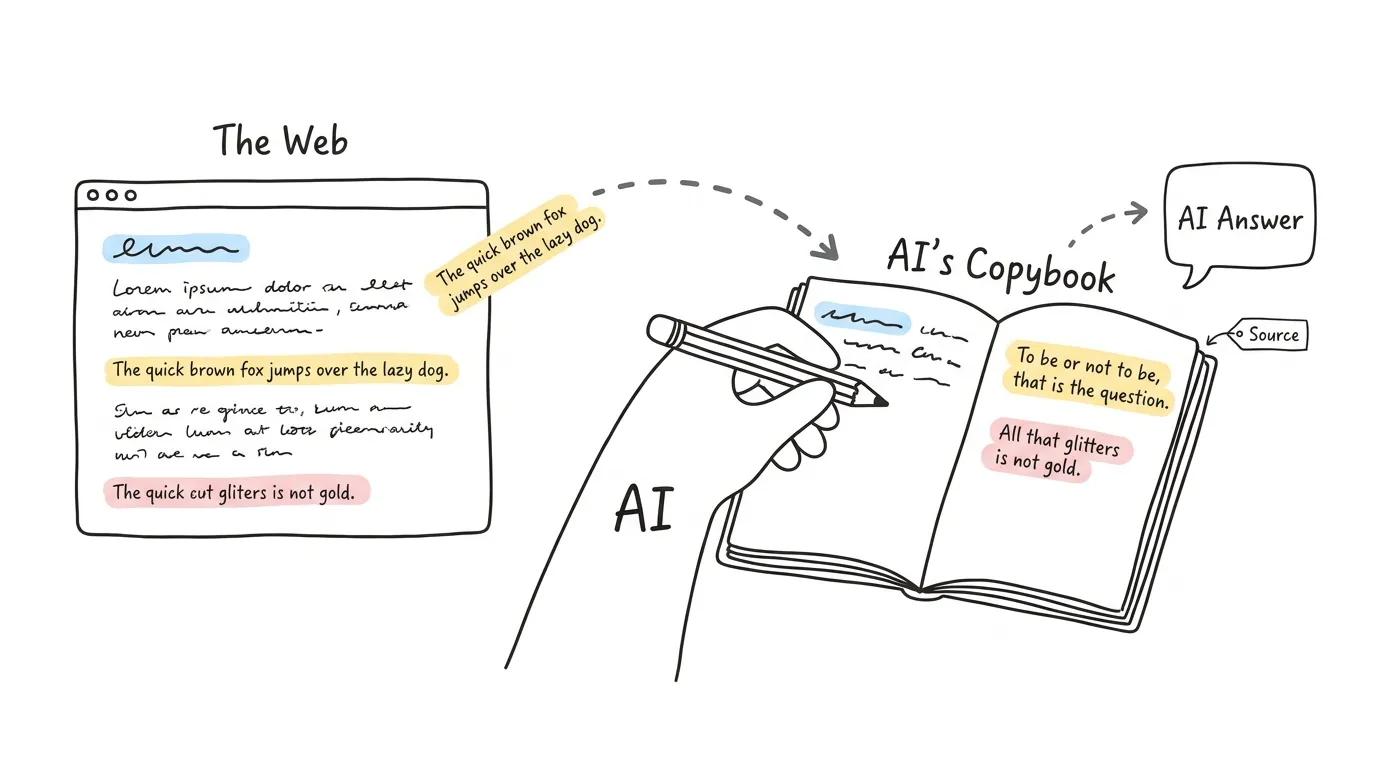
You ask ChatGPT a question, and the answer it writes for you is, plain and simple, lifted from the giant copybook that is the entire web: it picks out a few of the clearest sentences, stitches them together, and stamps sources on at the end. It doesn't appreciate your article. All it takes is your sentences.
So what is GEO?
GEO — Generative Engine Optimization, the craft of getting your content quoted by AI answer engines. In plain terms: getting your sentences into AI's copybook.
SEO fights for rankings. GEO fights to be copied.
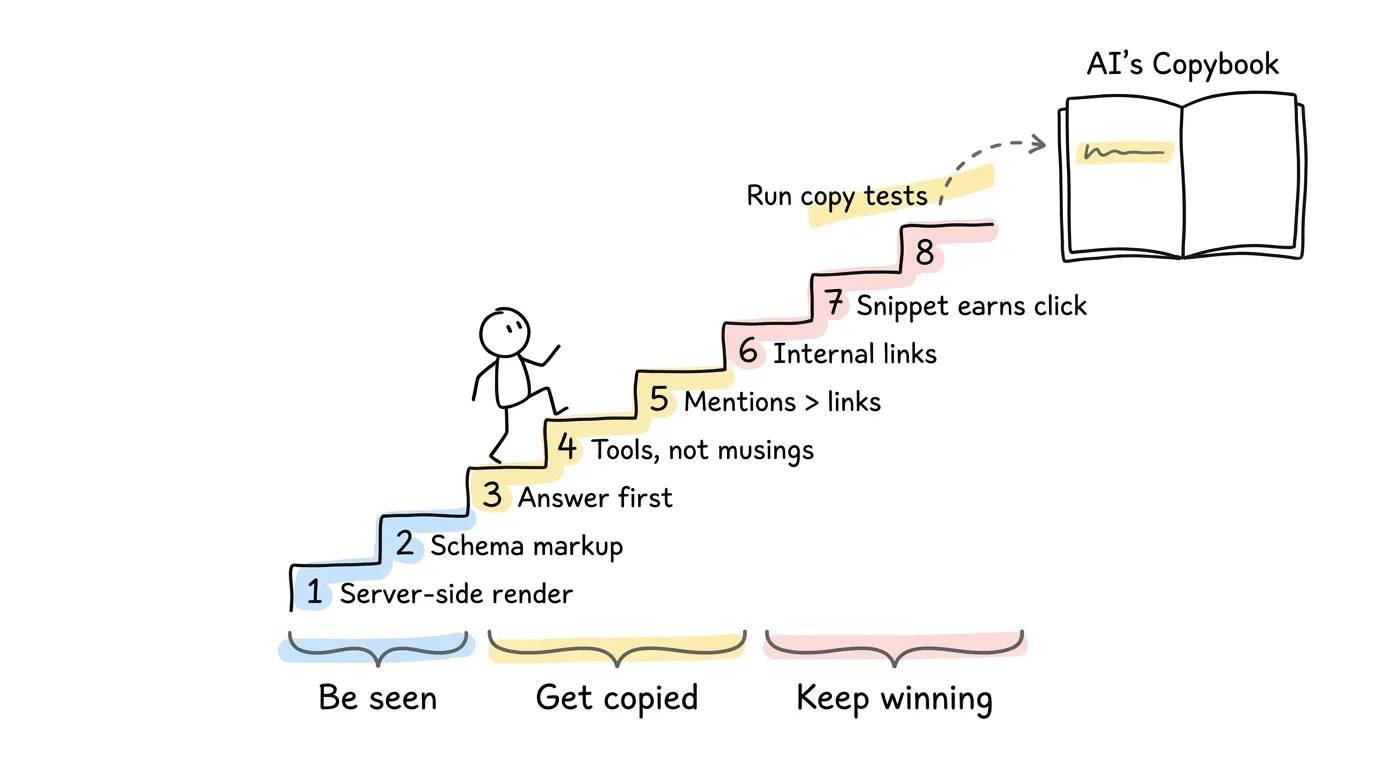
Over the past year I've watched quite a few brands feel their way into this from scratch — SaaS companies, consumer-health companies, luxury brands, carmakers. Gather up the pitfalls they hit and the routes that actually worked, and you get exactly eight steps. The first two decide whether AI can even see you; the middle three decide whether AI can carry your words off; the last three decide whether you can keep this fight going for the long run.
Where to start? Start with the bare-shell house.
Step 1: Get AI Through the Door First
The company website you spent serious money on might be, in AI's eyes, a locked bare-shell house — bare concrete, nothing finished inside.
Why?
Because large models crawl your site nothing like a person with a browser. Those beautiful pages of yours that only come together through live JavaScript rendering might be blank space to it. It's blind. What it can't feel, it treats as nonexistent.
So before touching any content strategy, do three unglamorous things first.
First, write your content on the server side; don't leave it all to the browser to assemble on the fly. Serve the full page — don't let AI crawl an empty shell. The lesson is an old one: back when Googlebot couldn't crawl Flash sites, the previous generation paid for it once already. Only today's AI crawlers are pickier eaters than Google ever was.
Second, lay down schema structured markup (structured data that describes your pages in machine-readable form). It's a machine-readable ID card for your website: who you are, what you sell, which FAQs you answer, which concepts you relate to. Not only Google understands it — every AI that comes crawling understands it.
Third, stop misusing heading levels. H1 through H4, each should be what it's supposed to be. When AI extracts an answer snippet from your page, it relies on this table of contents. If the outline is a mess, extraction gets hard — and it will just go extract from someone else.
There are tools built specifically to check this, like OptimizeGEO, which audits whether AI crawlers can read you — not just whether Google's crawler can. That distinction matters enormously: a page Google can read, AI still may not.
If AI can't read you, every content strategy is just hot air.
Step 2: Stop Researching Keywords; Start Listening to How People Ask
If you've spent ten years on keywords, this is where you're most likely to feel lost.
You used to optimize "best laptops." Today users ask AI things like: "I travel constantly and my budget is under 15,000 yuan (roughly $2,000) — which laptop should I get?"
What's the difference?
Keywords are words. Questions are sentences. And sentences carry context, budget, constraints — a whole pile of unspoken intent. AI can handle that nuance; your content has to handle it too.
So where do you go to hear how people ask?
Wade into Q&A communities like Reddit and Quora and watch how users describe their problems in their own words. Look at Google's People Also Ask boxes and see where one question drifts to next. And here's a low-tech trick I personally find most useful: go ask ChatGPT or Perplexity directly, stare at the answer it gives, and reason backward — what kind of question would produce an answer like this? The question you back into is the one you should be betting on.
And these questions evolve. The longer people use AI, the more specific and the longer their questions get. Follow the direction the questions are evolving, and you'll know what demand looks like six months before your competitors do.
Step 3: Write Pages Shaped for Easy Copying
Back to the copybook.
My nephew has a standard for picking sentences: whatever he copies must drop straight into an essay, no reworking needed.
AI picks sentences on exactly the same principle.
So what does a page look like when AI loves to copy it? Answer first, reasons after. In the first two or three sentences, answer the question outright; then lay out the evidence, data, comparisons. This style is old too — journalism calls it the inverted pyramid, and it's been written that way for over a century. Except AI is far more matter-of-fact than a human editor: however you lay it out is exactly how it will lift it.
Here's a two-sentence test.
Grab any page on your site and ask yourself: if AI could lift only one passage from this page to answer a user, which passage would it take? And once lifted, could it stand alone as an answer?
Most pages fail this test. Either the passage makes no sense without its surrounding context, or it's wrapped in a layer of marketing language — AI strips the wrapper off when it retells, and by the end there's nothing left of you.
One more dumb-but-effective trick: write your subheadings as the exact sentences users would ask. Someone asks Perplexity "What's the difference between GEO and SEO?" — and your page happens to have a subheading that says exactly that, with a crisp one-sentence answer right under it. Guess which one AI lifts?
Step 4: Write Fewer Musings, More Tools
This step might offend some fellow content marketers.
Here's the uncomfortable truth: most of the "content" companies publish is invisible to AI. Not because it's badly written — because it's the wrong shape.
What kind of thing does AI love to copy?
Tools. Definitions, comparisons, trade-off analyses, decision criteria — the kind of thing you could drop straight into a knowledge base without a seam. What it doesn't love to copy is the soft-opening, slow-burn essay: three paragraphs of scene-setting before the point shows up in paragraph four. Human readers enjoy it. The copyist turns the page.
Two concrete actions.
Run every paragraph through the "could this be lifted wholesale?" check. If a sentence is too opinionated, too vague, or too dependent on context, rewrite it.
And trade depth for volume. Content teams used to be measured on posts per week; now, ten thin filler posts are worth less than one genuinely solid guide. Comparison pages, glossaries, methodology breakdowns, decision frameworks — that's the shelf AI reaches for when it assembles answers.
On definitions, one thing worth saying separately. If, within your own field, you define a key concept early and clearly, AI will very likely cite your definition. Definitions are among the most frequently used parts in AI answers. Claim one definition, and you've staked out a plot of land in AI search.
As for which sentences get copied and which get ignored — there are now tools that let you see this, and that feedback is exactly what OptimizeGEO does. Once the team knows which sentence AI actually took, they know where to push hardest.
Step 5: AI Doesn't Trust Links; It Trusts How Others Talk About You
This is, I think, the most valuable insight of the lot.
In traditional SEO, authority comes from backlinks. That still holds today. But in GEO, the highest-weighted authority signal has changed: it's mentions.
When your brand shows up in an industry report, in a forum thread cited again and again, in a data-rich comparison article, AI takes note each time. Its logic isn't PageRank; it's closer to how a person builds a reputation: mentioned repeatedly, in credible settings, by credible people.
Where is this most underestimated? Forums.
Reddit, Hacker News, vertical communities of every kind — these are where people who actually do the work talk about real problems. When the same product comes up again and again, in different threads, from different users' mouths, AI sees it.
So GEO work is half public relations, half content engineering. Content, PR, and business teams need to sit at the same table. Don't abandon backlinks — they're still the foundation. It's just that the authority scales are tipping toward mentions.
Step 6: Internal Links Are Messages Written for AI
Anyone can build internal links. But in GEO, their purpose has changed: they exist to explain to AI how the concepts across your site relate to each other.
An anchor text that says "click to learn more" gives AI exactly zero information. Written as "compare the enterprise plan and the startup plan," AI immediately understands what these two pages are to each other.
Which relationships are most worth linking? Comparisons (X versus Y — how to choose), use-case splits (enterprises use X, startups use Y), and alternatives (don't want X? here are the options). Wire your internal links along these patterns and you've built a small knowledge graph inside your own site — AI follows the threads, and the whole structure comes clear.
Step 7: Being Copied Is Only Half the Win — the Snippet Has to Earn the Click
Plenty of people stop here. Not quite there yet.
Being cited by AI is only half a win. The quoted sentence the user actually sees — that's your storefront.
When AI tags your brand in an answer, it attaches a short snippet of your own words beside it. That snippet is your headline, your ad slogan, your first impression — all three in one. Write it vaguely — "we provide comprehensive solutions for enterprise clients" — and users scroll past without a glance. Write it specifically — "same budget, customer-acquisition cost down 30 percent" — and users click.
So how do you find out which sentence AI actually copies? The dumb way works best: take your most important pages, ask ChatGPT, Perplexity, and Copilot about them one by one, and write down exactly what each quotes. Is it the sentence you most want quoted? If not, go back and rewrite.
Step 8: Don't Trust Your Gut — Run the Copy Test on a Schedule
The last step — and the most easily skipped.
On the SEO side, rank-tracking tools are mature. On the GEO side, the measurement stack is still being built, so for now it's manual checks plus lightweight tools. Don't knock the low-tech route.
What to measure? Three things, tracked over the long term.
Citation frequency: across your target questions, how often does your brand appear?
Position: in the answer, are you mentioned first — or fifth?
Passage hits: which passages of yours got copied, and which never got touched.
And rotate the engines you test on. ChatGPT, Perplexity, Copilot, Google's AI Overviews — each engine cites with its own temperament. Visible on one, invisible on the next; that's the norm.
Measurement that doesn't turn into action is measurement wasted. If a passage never gets copied, rewrite it. If a competitor gets cited on a question you should own, go write the missing content. This is a loop, not a one-time audit. Gartner has predicted that traditional search engine usage will fall by a quarter as AI assistants become the default entry point. Whether the drop has run its course doesn't matter — the direction is already written on the wall.
Finally
Back to my nephew's copybook.
The standard his teacher taught him boils down to one sentence: what can be copied out is what counts as a good sentence.
Now it's our turn — those of us who write content. Every day, AI is writing answers for your customers, picking sentences out of the giant copybook that is the web. You can't bribe it, you can't slip ads into it. You have exactly one path: write plainly, argue solidly, and make every sentence worth copying.
Publishing volume doesn't make winners. The most-copied do.
May every sentence of your next piece land in the copybook.
Continue reading
Related articles

It's 2026: Stop "Buying" AI Tools for Your Marketing Team — Start "Hiring" AI Agents
This learn article explains how AI agents differ from standalone AI tools in marketing, outlines three agent categories — build-your-own platforms, CRM-native agents, and vertical tools — and covers use cases across SEO, social media, advertising, and reporting, plus criteria for choosing one.

What Is GEO? How Your Brand Gets "Mentioned" in the Age of AI Search
An explainer on GEO (Generative Engine Optimization) for e-commerce and DTC brands: how it differs from SEO and AEO, why AI answers shape brand visibility, and eight practices covering question-focused content, consistent brand messaging, structured pages, external evidence, comparisons, and AI mention tracking.

AI Is Already Making Decisions for Your Customers. Are You on the List?
A learn article explains GEO (Generative Engine Optimization): why AI-generated answers now shape which brands customers see, and how SEO fundamentals, entity clarity, citable evidence, and monthly measurement affect visibility in AI answers.