
When AI Agents Pick Vendors for Their Buyers, What Makes Them Remember You?
An essay on how AI agents now research and shortlist B2B vendors, arguing that being seen is not the same as being understood. It urges marketers to organize scattered product knowledge into consistent, verifiable materials, while noting human buyers still verify AI recommendations themselves.
A few days ago I was having dinner with a friend who works in enterprise software. Halfway through, he said something that made me put down my chopsticks.
He said: we recently lost a deal, and from start to finish, we never said a single word to the customer.
It wasn't stolen away by a competitor. It was filtered out by an AI agent. The customer's procurement lead gave the agent a task: evaluate the supply chain software on the market — look at capabilities, integrations, implementation timelines, and total cost of ownership (TCO). The agent finished its sweep and handed over three names. His company never even got an interview.
My first reaction: isn't this just résumé screening, procurement edition? HR used to screen résumés; now AI screens vendors.
But think a layer deeper, and this is far more ruthless than résumé screening.
G2 published a buyer behavior report in 2026: 61% of B2B software buyers have already involved — or plan to involve — AI agents in purchasing. What do they have the agents do? Compare prices, research solutions, build shortlists. All of it landing on exactly the stages that sales teams most want to get their hands on.
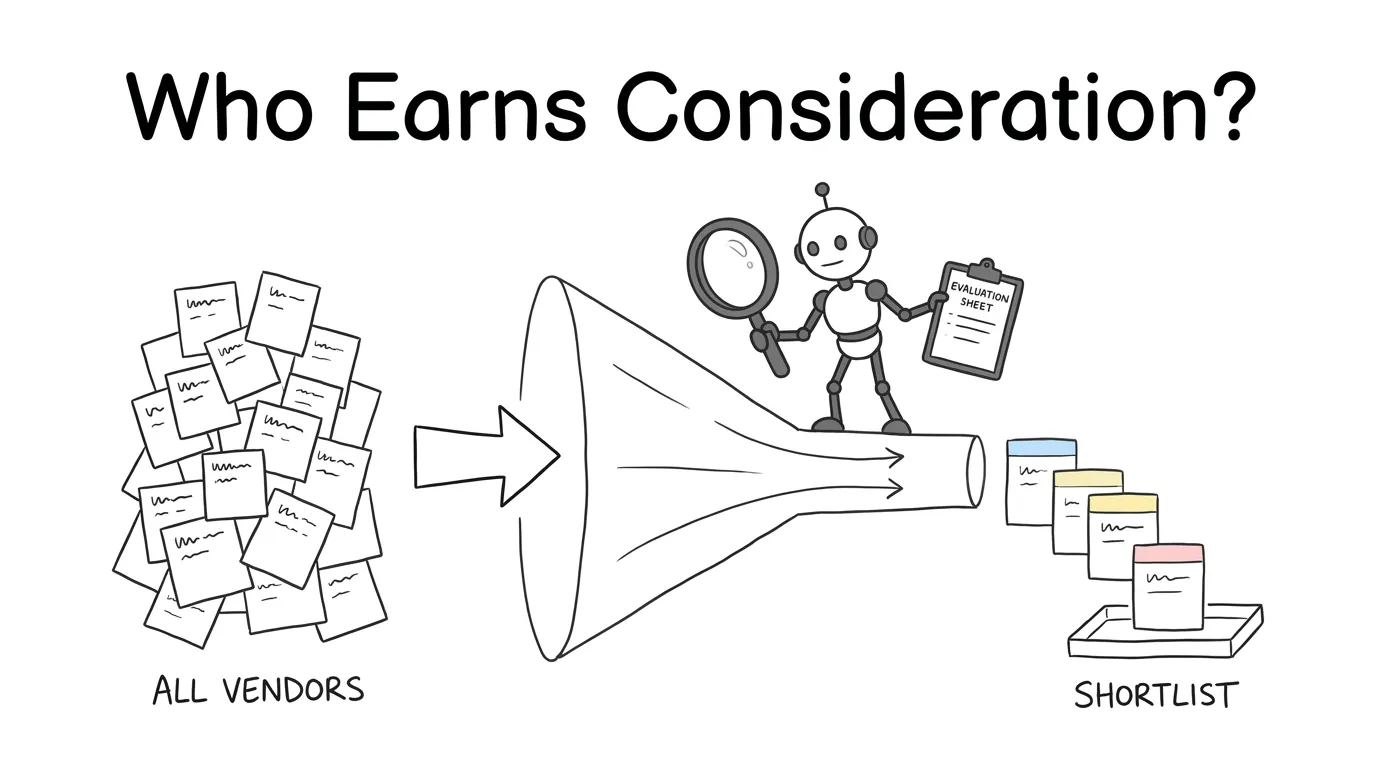
In other words, for many of your future buyers, the first thing they look at may not be your website, but the "evaluation sheet" an agent has put together for them.
So here comes the question: on that evaluation sheet, what makes them remember you?
Being Seen Is Not the Same as Being Understood
What does "being seen" mean?
Search engines can find your website, your product pages are neatly written, all the keywords that should be there are there. That is being seen.
What does "being understood" mean?
When an AI agent takes on a task, what it needs to do is not "browse" but "evaluate." It has to match your product's capabilities up against the buyer's business problems: can you connect to the systems the customer already runs? Which processes will implementation touch? Is there evidence proving that you really can save money and improve efficiency?
Think about how wide that gap is.
Being seen means the information exists. Being understood means the information can be matched to a specific question — and that you can produce the evidence.
You can be seen without being understood. But the ones who earn consideration have always been the latter.
A Shop-Window Mannequin Explains This Perfectly
This topic sounds very new, but the underlying logic is extremely old. How old? Old enough that retail has been using it for over a hundred years.
Let me tell you about something in the shop window: the mannequin.
A jacket, a shirt, a pair of trousers, hanging on a rack — that's inventory. You look at them, and your mind produces only three words: clothes, clothes, clothes.
But put those three pieces onto a mannequin, and things change immediately. A scene appears: a weekend, a café, autumn. A certain vibe appears, along with an imagining of "what would it be like if I dressed like this?"
The mannequin does the one thing that product specs can never do: it combines three isolated products into a story.
On the B2B side, the logic is exactly the same — only the decisions are much heavier.
A software vendor describes its platform as "innovative, scalable, and transformational." On the rack, those words are just three isolated garments. The buyer's reaction after reading them is: oh, that's nice. And then? Can it connect to our ERP? How long until launch? For manufacturing enterprises like ours, what have the actual results been?
These questions cannot be answered by slogans. Only "display" can answer them: integration documentation, industry case studies, implementation timelines, the real numbers customers actually achieved.
Here comes the interesting part. Many companies are not lacking these materials — quite the opposite. The product pages have one story, the case library has another story, and sales has yet another. Scattered across five places, worded differently in each, with no piece able to connect to any other.
It's as if the mannequin stands in the east-facing window, the clothes hang on the west racks, and the price tags are locked in the finance office upstairs.
The customer walks past and sees no story at all.
Let's Run the Numbers
If that still sounds abstract, let's run the numbers.
Suppose two vendors with roughly equal capabilities both come to bid for a manufacturing customer's supply chain project.
The first one's website says "empowering enterprises to reduce costs and increase efficiency, embracing digital transformation." Its case-study section holds a handful of success stories, a few hundred words each: no numbers, no customer context, no implementation timeline.
The second one provides complete integration documentation, explaining which systems it can connect to and how the APIs are called; it gives two case studies from customers in the same industry, clearly stating the before-and-after comparison of inventory turnover days; implementation expectations are crystal clear — how many phases, and what the customer must invest at each phase.
You are the procurement lead. Who would you put on the shortlist?
Or, to put the question differently: if an AI agent screened on your behalf, who would it put on the shortlist?
The answer is even less in doubt. Because the agent's filtering logic is plain: whoever's information is searchable, comparable, and verifiable ranks first. Vague adjectives are, for a machine, roughly equivalent to nonexistent.
By the way, tidying up your information doesn't only benefit machines. Human buyers need these materials just as much. The more clearly the content is written, the more everyone involved in the purchase benefits — the agent is just the most demanding reader.
So don't reduce this to "doing SEO for AI." Keywords and technical accessibility are of course still important, but the real question has changed: consistency, accuracy, and the depth of information needed to support a purchase decision.
A Recommendation Is Only the Entry Ticket
By this point, you might be thinking: fine, I'll tidy up my information and just wait for the AI to recommend me.
Not so fast.
Semrush did a study in 2026, surveying more than 600 American business professionals: 71% of them, after receiving an AI recommendation, will go visit that vendor's website. And they don't stop there — they go on to use search engines, read reviews, and run comparisons, verifying layer by layer whether this recommendation holds up.
See, AI walks you through the door. But it's still a human who does the verifying.
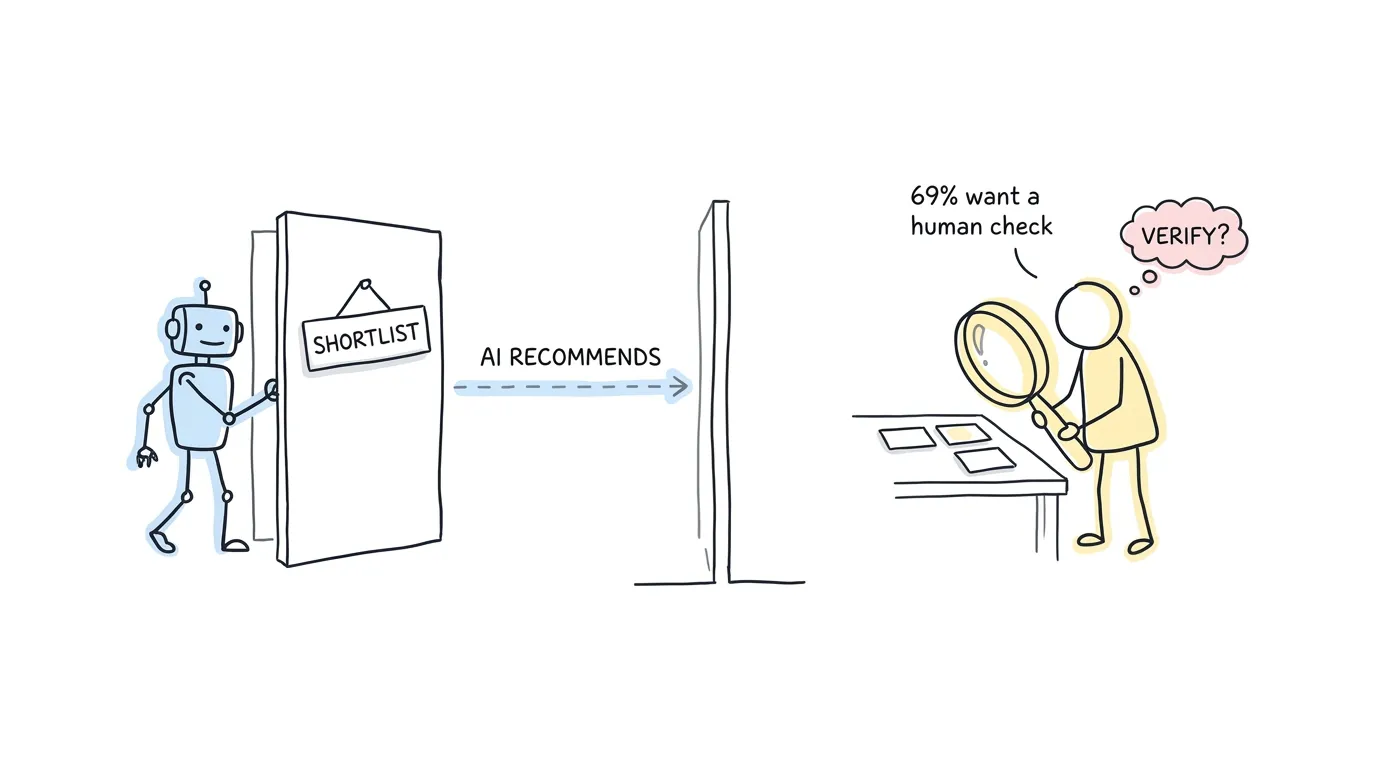
What does this mean? It means all the groundwork you did earlier must, in the end, pass through a checkpoint called "verification." And the place where verification happens is your website, your case studies, your documentation.
Suppose the agent recommended you, the customer clicks through to your site, and what they see is vague positioning language, product information that hasn't been updated in three years, and page after page of claims with no sources. What will happen?
That opportunity will quietly disappear at the verification stage. And no one will notify you.
Being recommended is luck; passing verification is skill.
What is verification? To put it plainly, it is the buyer wanting to personally confirm a few questions: can your solution actually run in my existing environment? What will implementation touch? What results have companies similar to mine produced? Which risks should I know about ahead of time?
Answering these questions takes more than a content calendar. Marketing, product, sales, customer success — each holds only one piece of the puzzle. If the pieces never come together, what the customer and the agent see will forever be a pile of fragments.
After the Agent Reaches the Door
One more thing you should keep an eye on.
Today's agents mainly do "research" work. But technology companies are already laying the infrastructure for the next step: how to verify an agent's identity, how to grant it permissions to execute transactions. In other words, sooner or later the agent will move from "researching for you" to "buying for you."
But enterprise business is not ordering takeout.
The relationships between enterprises contain contracts hammered out in negotiation, security and compliance requirements, service commitments, and trust accumulated over many years. An agent can look all of this up. But "looking it up" and "being authorized to act on the basis of that information" are two entirely different things.
There's a number from Gartner's May 2026 research that I particularly love: 69% of B2B buyers want to talk with a sales representative in order to validate the insights AI has given them.
Sixty-nine percent. Two-thirds of buyers, after AI gives its answer, still want a real person to confirm it.
The buyers' insistence has nothing to do with whether they trust the technology — it is a business instinct. AI can compare a hundred solutions tirelessly; but "is this investment truly worth it for us" and "who do we turn to when something goes wrong" — the answers to these questions live in people.
Technology and relationships have never been an either-or choice. AI handles research and comparison; people handle judgment and the safety net.
A Word at the End
Looking back at that friend from the beginning. He later distilled a line in his retrospective that stings: it is not that we weren't good enough — it is that we were never "understood."
For B2B marketers, the opportunity is hidden inside this line: take the product knowledge scattered across the organization — capabilities, evidence, boundaries — and shape it into what buyers and their agents actually need. Accurate, specific, matched to the questions, able to withstand verification.
The next generation of buyers may really send an agent to do the research, compare solutions, and build the shortlist. But behind the agent, those ancient business questions haven't changed a bit: can you solve my problem? What proof do you have? Do you understand my business? Are you worth trusting?
What has changed is who asks the questions first. What hasn't changed is that only a solid answer can catch them.
The first question may well be asked by an agent on behalf of the buyer. But that final "I trust you now" has always had to be spoken by a person.
Here's to being chosen by humans, in an age when agents do the screening.
Continue reading
Related articles

It's 2026: Stop "Buying" AI Tools for Your Marketing Team — Start "Hiring" AI Agents
This learn article explains how AI agents differ from standalone AI tools in marketing, outlines three agent categories — build-your-own platforms, CRM-native agents, and vertical tools — and covers use cases across SEO, social media, advertising, and reporting, plus criteria for choosing one.

What Is GEO? How Your Brand Gets "Mentioned" in the Age of AI Search
An explainer on GEO (Generative Engine Optimization) for e-commerce and DTC brands: how it differs from SEO and AEO, why AI answers shape brand visibility, and eight practices covering question-focused content, consistent brand messaging, structured pages, external evidence, comparisons, and AI mention tracking.

AI Is Already Making Decisions for Your Customers. Are You on the List?
A learn article explains GEO (Generative Engine Optimization): why AI-generated answers now shape which brands customers see, and how SEO fundamentals, entity clarity, citable evidence, and monthly measurement affect visibility in AI answers.