
On AI Marketing, Let Me Tell You 25 Stories
This learn article retells 25 brand AI-marketing cases spanning 2003 to 2025, grouped into four playbooks: user-generated content, personalization at scale, rebuilt production workflows, and AI as lead creator, closing with Dove's opposite stance on authenticity.
A while back, an old friend of mine who works in branding invited me out for tea. He sighed the moment he sat down.
He said, we've embraced AI too. Text-to-image, copywriting, short videos — everything that could be deployed, we deployed. We didn't spare the budget. But guess what? The business hasn't changed one bit.
I asked him, so what do you think AI is?
He said, a tool. An intern who can draw.
I said, that might be exactly where the problem lies.
Recently I went through 25 cases of brands using AI for marketing, from start to finish. From Amazon in 2003 to Nestlé in 2025, spanning more than twenty years. When I was done, there was one thing I wanted to tell him: The dividing line in AI marketing isn't which tool you use. It's where you place AI within your business.
Put it in the toy slot, and you get a bit of a spectacle. Put it in the tool slot, and you save some money. Build it as a system, and you actually make money.
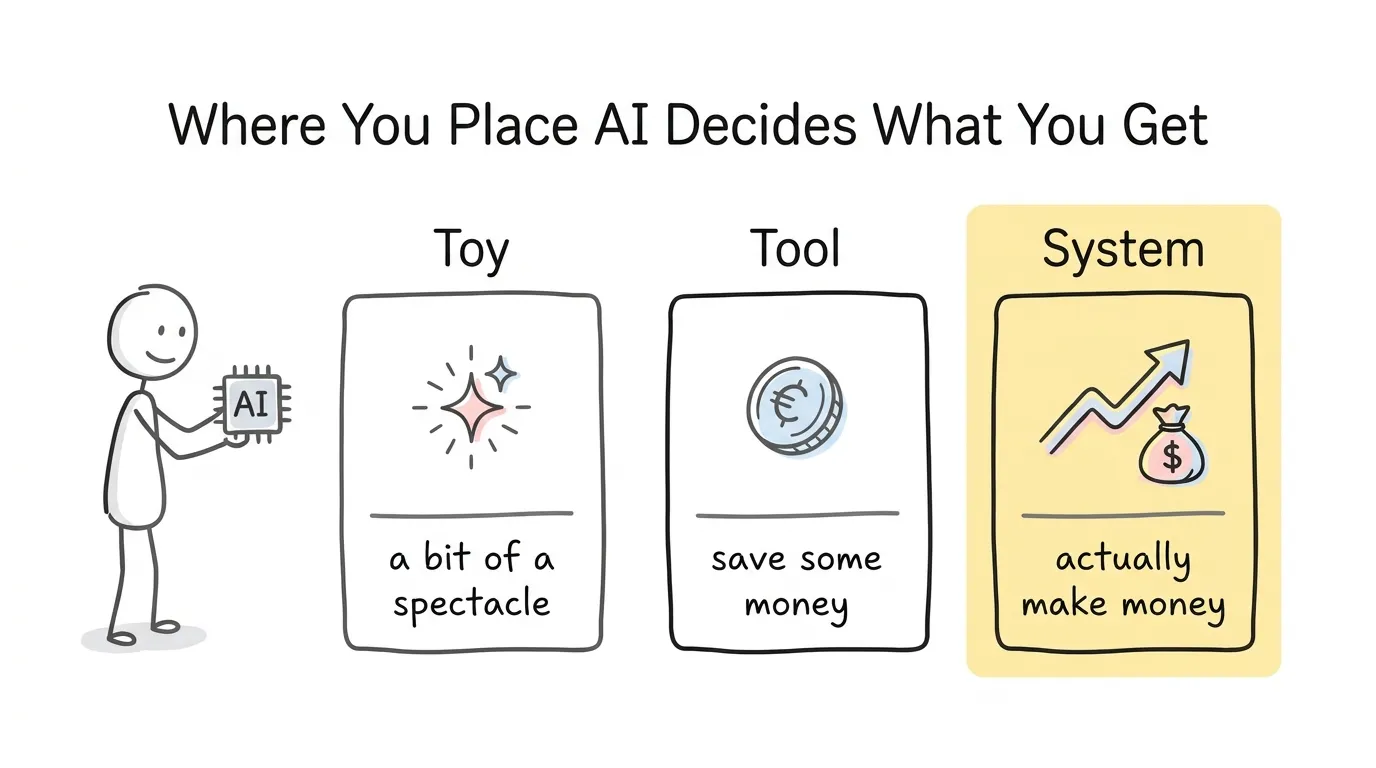
What does "build it as a system" mean? Hold on. Let me tell you 25 stories, sorted into four playbooks — plus one story at the end that runs the other way.
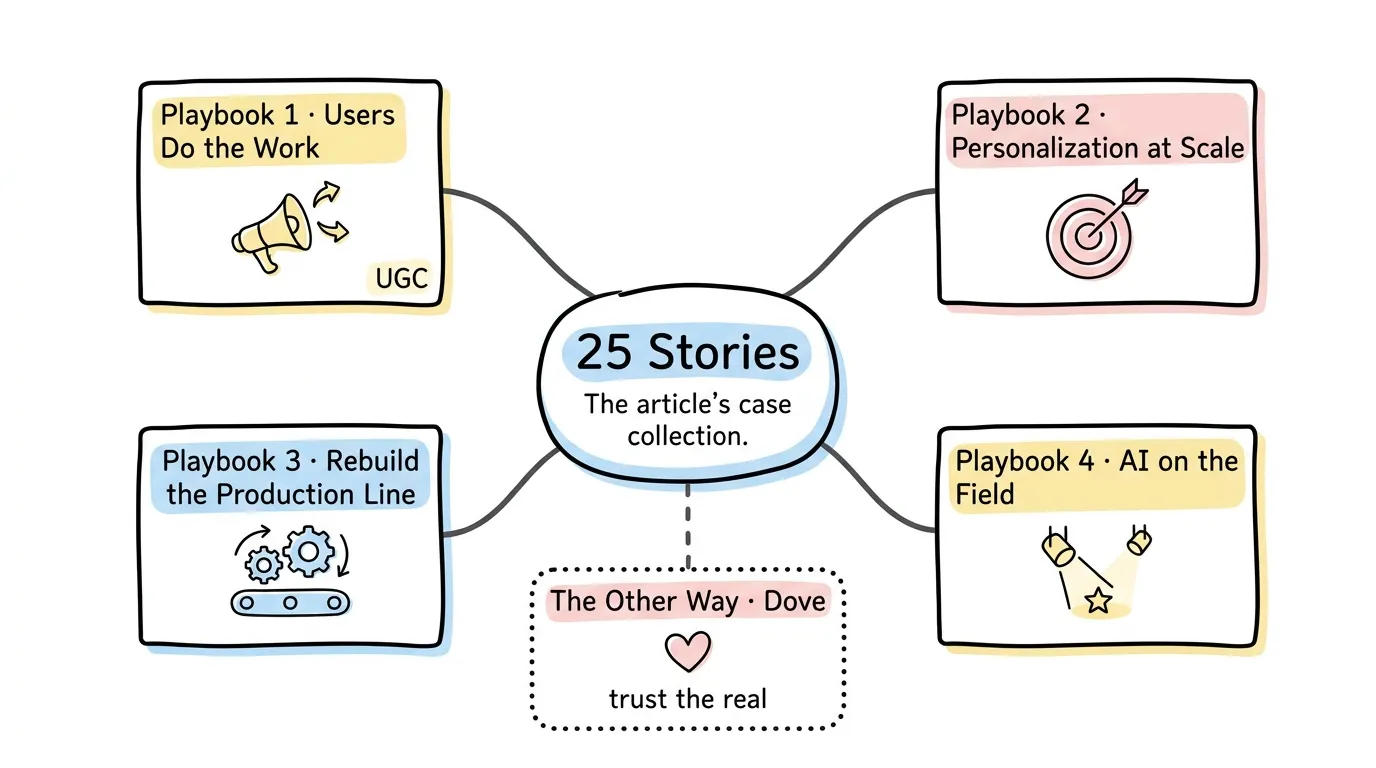
Playbook One: Let Your Users Do the Work
First, a question: how many ads can a single ad multiply into?
In 2023, Warner Bros. was building buzz for the release of Barbie. Instead of betting everything on pre-roll spots and hard-sell ads, it teamed up with the photo-editing company PhotoRoom to launch a "Barbie Selfie Generator." You upload a photo of yourself, and within seconds the AI turns you into the lead of a movie poster.
Not long after launch, the tool had been used more than 13 million times, generating roughly 13 million social shares along with it.
Think about what that means for a second. Thirteen million people made their own posters, posted them themselves, and tagged their friends themselves. The studio didn't pay a single cent of ad money for any one of those shares.
What is UGC (user-generated content)? This is UGC. The difference is that user-generated content used to depend on spontaneous enthusiasm. This time, the brand used AI to push the barrier to participation down to nearly zero.
The Burger King story is even more direct. In 2024, it launched the "Million Dollar Whopper" contest with a $1 million cash prize — real money. The mechanics: you freely mix and match your own custom burger inside its app, the AI instantly generates a studio-quality "glam shot" of that burger, then automatically attaches a personalized ad jingle to go with it.
A user submits one idea — and what do they get back? A full set of assets ready to post on social media.
Not "thanks for playing." Content. A $1 million prize, in exchange for the whole internet producing free content for it. However you run the numbers, the math works.
The Heinz story is older. In 2022, how does a ketchup brand with more than 150 years of history talk to young people? It set its sights on DALL-E 2, the text-to-image tool that was blazing hot at the time, and posed a question: if you ask AI to draw a ketchup bottle, what does it come up with?
The result: whether you prompted it to draw "Renaissance ketchup" or any other wild scenario, the bottle it painted always came out looking like the classic Heinz bottle.
The campaign racked up more than 850 million impressions worldwide, more than 25 times its actual media spend, with engagement rates 38% higher than its previous campaigns. Later, Ducati and a Canadian sports media outlet came knocking on their own, asking for an "AI ketchup" of their own brand.
A 150-year-old brand used AI to prove one thing: my bottle is already etched into humanity's collective aesthetic. That's more persuasive than any slogan.
And here's a case I especially love. Cadbury, 2021, India, Diwali.
Its brand ambassador was the Bollywood superstar Shah Rukh Khan. But instead of shooting a brand ad featuring Khan, it worked with Ogilvy to use AI to build a tool: the owner of a small street-side shop opens the campaign page, types in their shop's name and what they sell, and within seconds, Shah Rukh Khan is personally "endorsing" that little shop. The AI grafts Khan's face, voice, and mannerisms frame by frame into the customized content.
During Diwali, more than 2,500 small shops generated their own personalized ads. The campaign reached 140 million people, brand engagement rose 32%, and it went on to win a pile of awards including Cannes Lions.
Savor this for a moment: a global giant hires a superstar — not to shoot its own ad, but to make one for each of thousands of roadside shops. That gesture of goodwill is worth more than the ad itself.
So Playbook One boils down to a single sentence: the best ad is the one your users make for you. AI's role is to drive the cost of "participating" down to nearly zero.
Playbook Two: Personalization for Everyone, on an Assembly Line
The second playbook is the first thing marketers think of when AI comes up: personalized recommendation.
But the player who has been at it the longest is, ironically, that "old relic" Amazon. Back in 2003, it deployed a recommendation engine, analyzing your browsing and purchase history to guess what you'd want to buy next. After more than twenty years of grinding on it, that one small line — "customers who bought this item also bought" — props up a sizable chunk of its sales.
Netflix took this to the extreme. 260 million subscribers, coverage in more than 190 countries, and 80% of all viewing time on the platform comes from the recommendation system — not from users searching on their own.
Even more remarkable are the thumbnails. For the same show, the poster you see might not be the one I see: if you love romantic dramas, you get the leads gazing into each other's eyes; if he loves action, he gets explosions. Just by testing back and forth with this one small image, click-through rates can swing by 20% to 30%.
One image, 20 to 30 percentage points. Be honest — did you ever take cover art seriously before?
The recommendation system has a byproduct that's often overlooked. The Spanish series Money Heist, the French series Lupin — the reason non-English content exploded globally is that the algorithms pushed it to audiences around the world whose tastes matched. Algorithms aren't just distributing content. They're distributing culture.
The beauty industry took this road even further. In 2019, L'Oréal embedded its AR virtual try-on tool ModiFace into its own website, app, and partner retail platforms; virtual try-ons have been used more than 1 billion times. People who used the try-on tool were 3 times more likely to place an order than those who didn't. Its other AI skin-analysis tool has generated more than 20 million personalized skincare diagnoses to date.
Sephora moved even earlier, launching Virtual Artist in 2016 — facial recognition plus AR, letting you try on lipstick and eyeshadow on your phone, with the system recommending products based on your skin tone and facial features.
The logic is simple: with something like lipstick, who dares to order without trying a shade? Once AI "tries" it for you, trust follows, and orders follow the trust.
Starbucks took a different road. Its Deep Brew AI engine analyzes consumption data from its app and loyalty program, serving every customer different drink recommendations, offers, and new-product alerts. Sharper recommendations lifted the average ticket; sharper forecasting brought down inventory waste. One system, paying off at both ends.
Spotify's play was to turn the data itself into content. Every year-end, it generates a bespoke year-in-review report called Wrapped for every user, turning a year of your listening taste into a set of beautiful share cards — more than 60 million shares worldwide every year. What users are forwarding isn't an ad; it's "who I was this year." Personalized playlists account for 35% of listening time on the platform. Even the ads are personalized — served dynamically based on the listener's mood, time of day, and device — lifting ad recall to 2.7 times and click-through rates 20% higher. Big brands like Starbucks and Adidas have come specifically to run their ads on this very toolset.
Playbook Two, in one sentence: personalization means treating you as one unique individual, not as an average buried inside a "demographic."
Playbook Three: Rebuild Your Own Production Line
The third playbook is the least glamorous, but the math is the clearest: use AI to rebuild your internal processes.
Start with Klarna, the Swedish buy-now-pay-later company. In 2024, it plugged generative AI into its marketing-asset production line. The production cycle for a single marketing image dropped from about 6 weeks to 7 days; three months yielded more than 1,000 customized images; over a full year, marketing costs came down by roughly $10 million.
Six weeks to seven days — what does that mean? It means that in the same stretch of time, you can test 6 times as many creative ideas. In marketing, so much of the game comes down to who tests fast, fails fast, and iterates fast.
The Spanish fashion brand Mango, in 2024, produced a visual campaign for its youth line generated entirely with AI participation, under the theme "Sunset Dreams." What's interesting is the approach: first it photographed the real clothes, then used AI to generate the scenes and model imagery around the products. The clothes are real; the atmosphere is AI's. It preserves the authentic presentation of the product while capturing AI's speed and unlimited variations.
And this wasn't a one-off PR stunt. It was written into Mango's 2024-to-2026 strategic plan as a capability to be built for the long term.
Unilever moved even earlier. In 2016, it partnered with IBM Watson to build a content intelligence system called U-Studio, serving more than 400 of its brands. The AI analyzed videos, images, and copy from past campaigns to summarize which color palettes, moods, and selling points had performed well, then fed suggestions to new creative work — and along the way, it also captured shifting cultural moods in different regions. The results: production costs on multiple campaigns dropped 30%, planning cycles were cut in half in some cases, and in emerging markets, content tuned to local culture saw engagement rates 35% higher.
H&M applied AI where you can't see it: inventory. It has AI synthesize purchase data, social media trends, weather, and local events to predict how much stock every style, every size, and every store should carry. Overstock fell 21% in a year, the pace of catching up with trends quickened by 30%, and full-price sales made up 10% more of the mix.
Fashion's biggest enemy is unsold stock piling up. Every point of the 21% it didn't overstock drops straight to the bottom line.
A few smaller-but-beautiful examples, told together.
A mattress startup called Tomorrow Sleep entered the market in 2017. Solid product, but nobody visited the website — 4,000 monthly visits. The next year it rebuilt its content with the AI content-strategy tool MarketMuse: analyzing the top 20 search results for content gaps, then filling in keywords and semantic coverage. A year later, monthly visits had grown to 400,000. A hundredfold. On core keywords, it even outranked the industry leader Casper, holding several positions on the same search results page.
The European online florist Euroflorist used an AI platform to test thousands of variants of its website simultaneously: layouts, color schemes, buttons, product placement. Conversion rate ultimately rose 4.3%.
You might think, 4.3% is worth talking about? For a florist — a repeat-purchase business — every single point of conversion multiplies across every order of the entire year.
BMW partnered with IBM Watson in 2016 on social marketing: the AI analyzed trending topics and user sentiment, generating personalized content and replies in real time, and social engagement rose 30%. Coca-Cola built an AI content platform in 2023, mass-producing ads and posts tailored to different audiences — output up, costs down.
The most decisive move belonged to Cosabella, the American high-end lingerie brand. In 2016, it dropped the digital agency it had worked with for years and replaced it with the AI marketing platform Emarsys, letting algorithms write and send emails automatically based on each subscriber's data. Right out of the gate, email open rates rose 4%; over the long run, revenue driven by email rose 60%; and at that year's holiday promotion, with not a single penny discounted, sales came in 40 to 60 percent above the previous year.
Swapping an agency for an algorithm took some nerve back then. But it proved one thing: when it comes to "writing to people who already know you," AI is more diligent than humans — and it understands your customers better.
Playbook Four: Put AI on the Field Itself
The fourth playbook is the boldest: let AI be the lead creator.
Lexus, 2018. Together with the agency The&Partnership and the technology partner Visual Voice, it produced the world's first TV commercial scripted entirely by AI. IBM Watson first "watched" 15 years of award-winning car commercials, learning which narrative structures, musical cues, and emotional arcs move people, then generated the script — and finally, Oscar-winning director Kevin Macdonald was brought in to shoot it.
The film follows a self-driving Lexus that avoids an accident on pure "intuition." The finished spot's completion rate on YouTube ran 53% higher than Lexus's previous video ads; surveys showed the share of audiences who saw Lexus as "innovative" rose 13%.
The interesting part: what the AI learned wasn't inspiration. It was the pattern of award-winning ads. Master the pattern, and your creativity stands on the shoulders of giants.
The Washington Post moved faster. During the 2016 US election and the Olympics, it launched Heliograf, a writing system it developed in-house, auto-generating quick updates on race results and election outcomes. More than 850 articles in its first year. Most of these were small stories no human desk could afford to write: instant reports from some locality, some local reminder. Journalists were freed up to do the deep reporting only humans can do. AI-generated personalized pushes had click-through rates 17% higher than human-written ones; sponsored content distributed through Heliograf doubled its page views, with average read time up 50%.
Give volume to the machines. Leave depth to the humans. That line deserves to be taped to the wall of every content team.
Nestlé is the most recent case — and the biggest sample size. In 2025, this giant selling in more than 180 countries with more than 2,000 brands in its portfolio plugged AI into its marketing nerve center: partnering with Accenture, Salesforce Einstein, and others, it uses AI to monitor social sentiment, sales data, and research inputs simultaneously — spotting trends and adjusting its play in real time. The adjustment cycle went from weeks in the past to a few hours.
Its Japan team fought a particularly clever battle. During exam season, keywords related to "stress" spike on social media, and the AI adjusted KitKat's copy and media placements in real time, riding the emotional pulse of students and parents. In that battle, brand engagement in the Japanese market rose 28%. Across the whole system, AI-supported campaigns converted 18% better, with media efficiency up 12%.
Global strategy, local execution. For the first time, AI lets a behemoth pivot as nimbly as a small team.
Here's one more case that binds content and culture together. In 2019, Netflix and Adidas launched a co-branded collection for Stranger Things, bringing in the AI marketing platform Cortex for dynamic creative: die-hard fans who had just finished the show saw ads with Easter eggs buried inside; sneaker collectors saw copy about the limited edition; people scrolling late at night saw a different color grade entirely. The result: click-through rates ran 1.9 times those of ordinary static ads, the co-branded shoe sold out in the US, Germany, and Japan in under 24 hours, and engagement on related posts ran 63% higher.
One show, one shoe, with AI in the middle as translator — carrying the fans' passion, with precision, to the checkout counter.
Oh, and Nike. In 2022, Nike's 50th anniversary coincided with tennis legend Serena Williams announcing her retirement. Working with the digital agency AKQA, it staged an "across-time showdown" with AI: Serena who won her first Grand Slam in 1999, versus Serena who won the Australian Open in 2017 — each turned into an AI-recreated digital athlete, playing a match against herself across time. The AI analyzed her game from both eras, item by item: shot placement, reaction speed, court coverage.
A match that never actually happened — and 1.7 million people watched it on YouTube. Organic views for the piece ran more than 10 times Nike's usual level.
This is AI's most romantic use: it doesn't steal anyone's work. It turns "impossible" into possible.
Finally, a Story That Runs the Other Way
Four playbooks down. But the last story is the one I find most worth thinking about.
2024, Dove. This brand, twenty years deep into its Real Beauty campaign, looked at screens full of AI-generated perfect faces and made a decision: it publicly released a prompt handbook, teaching creators how to write prompts so AI generates more realistic, more diverse images of women — and it pledged not to use AI to depict "real women" in its advertising.
While everyone else raced to use AI to manufacture more beautiful faces, it went the other way: teaching people how to use AI to protect the "real."
It also commissioned a global study to understand the appearance pressure women face online today. AI-generated imagery is amplifying a single narrow beauty standard — this is anxiety backed by data, not unfounded worry.
The case shows off no technical wizardry; there isn't even an "AI blockbuster" to point to. And yet it may be the smartest of all 25 stories.
The logic isn't complicated: when content can be generated in unlimited volume at zero cost, content itself stops being valuable. What's valuable is the real. When everyone can fabricate images indistinguishable from reality, the person who dares to promise "no fakes" is holding something in their hands — it's called trust.
And trust, in an industry like beauty, converts directly into conversion rate.
Back to That Cup of Tea
Twenty-five stories told. Time to answer my friend's question.
Treat AI as an intern who can draw, and all it will ever do is draw for you. Treat it as a system: on the outside, let users spread your message and run personalization at assembly-line scale; on the inside, rebuild your content production line; and if you're bolder still, put it on the field to create. That is what those 25 companies were actually doing.
Anyone can buy the tools. The gap lies in where you place them within your business.
One more thing before I go. Models get swapped out every year; today's lead can be obsolete by next year. But one thing never goes out of date: people only believe what they choose to believe. AI can help you reach them and move them — it cannot lie to them on your behalf. What's won by deception, sooner or later, gets paid back.
Here's wishing your next campaign the speed of AI — and the sincerity of a human being.
Continue reading
Related articles

When AI Does the Creative, Mistakes Come in Batches Too
A learn article on the risks of using generative AI for marketing creative across brand, legal, compliance, and operational layers, with case examples and seven practices for review, rights clearance, documentation, and vendor governance.
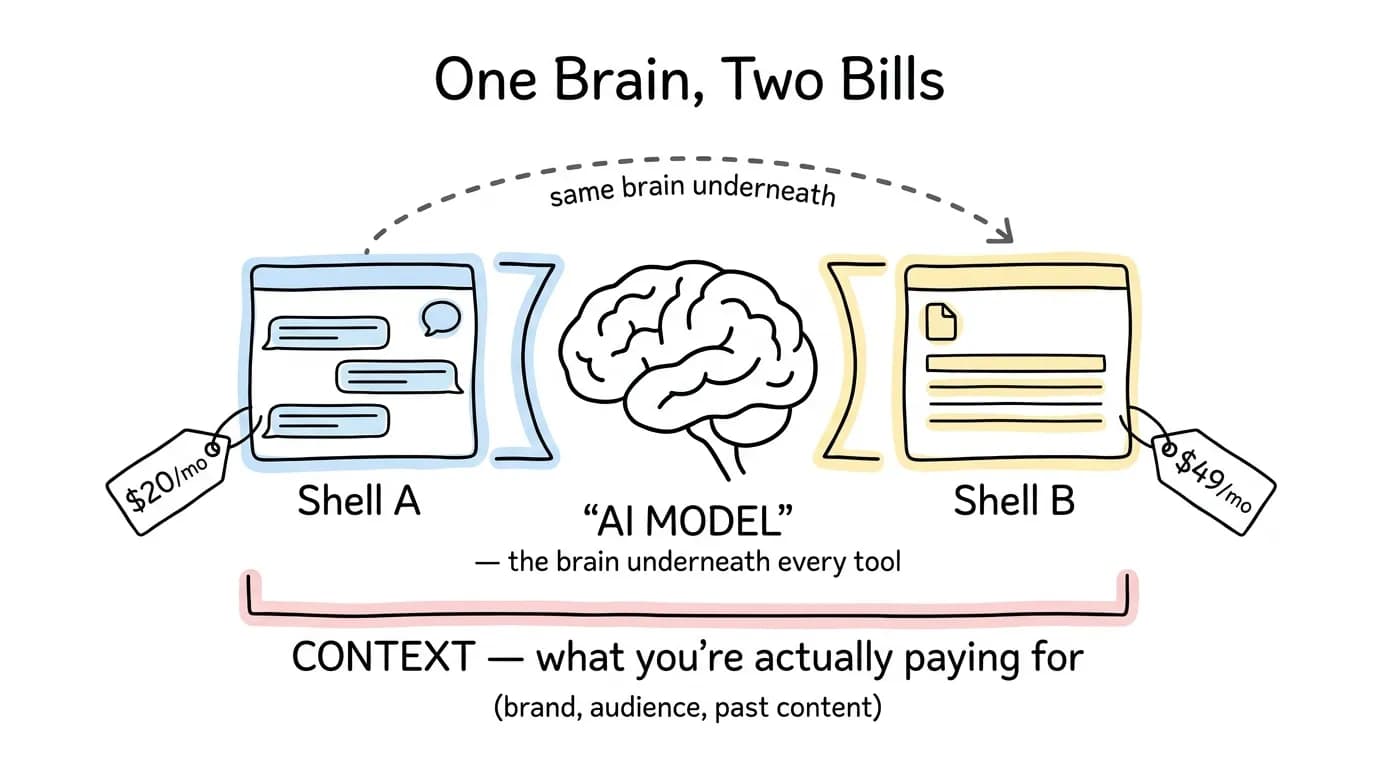
Which AI Should Your Startup Actually Use for Marketing?
A startup marketing guide explaining the difference between AI models and tools, sorting tools by job (writing, research, design, leads, email, video ads), and outlining a 30-day test plan for choosing them. It also covers generative engine optimization and budget trade-offs.
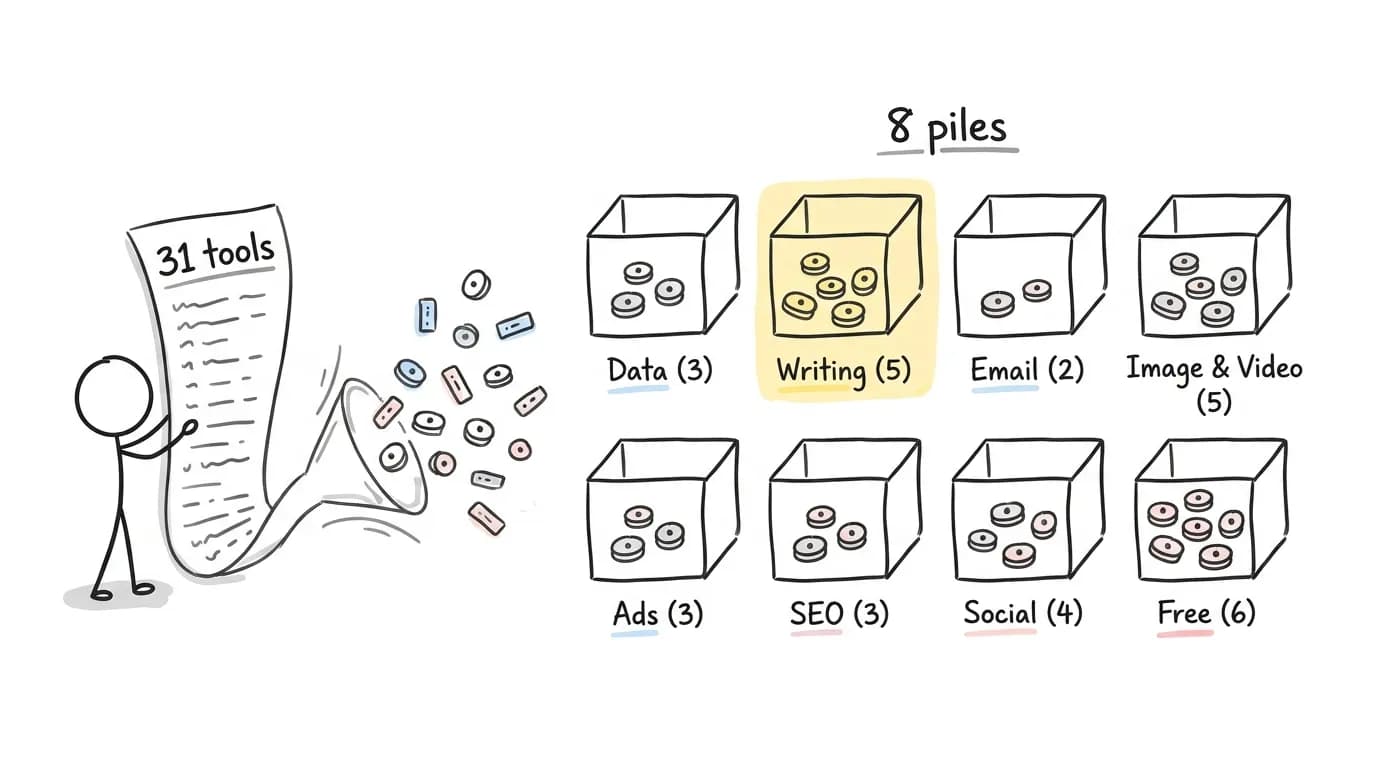
31 AI Marketing Tools, Reviewed One by One: How Exactly Should You Spend the Money?
A review of 31 AI marketing tools grouped into eight categories, covering data, content, email, video, ads, SEO, social, and free options, with guidance on choosing one strong tool for your most frequent task and testing free tiers first.