
Your Clicks Just Skyrocketed — Don't Open the Champagne Yet
A monthly SEO and AI search roundup: anomalous Search Console click spikes that warrant reconciling with logs and sales, Bing's split of AI training versus retrieval permissions, Google AI Mode adding home-services booking, Clarity's agent activity dashboard, and Semrush data showing rising external click share.
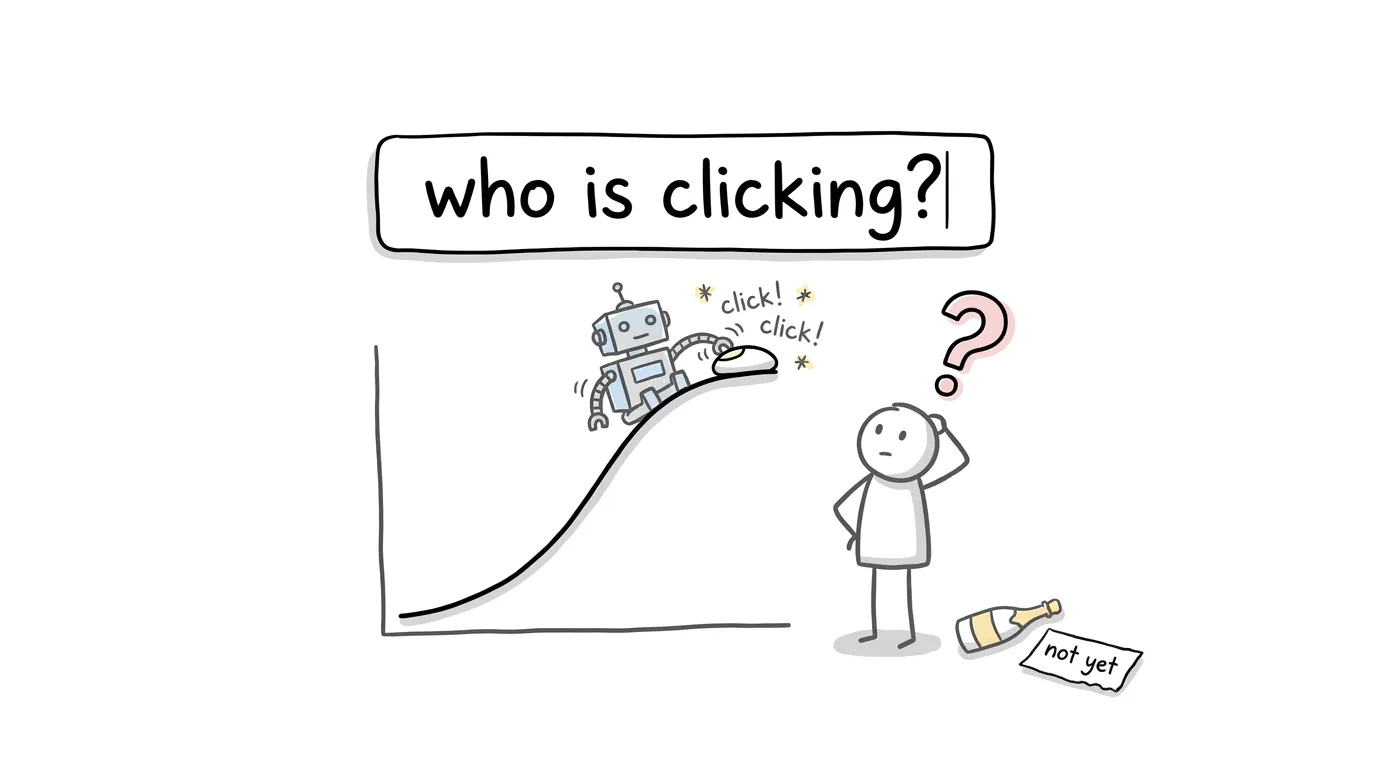
A few days ago, a friend of mine who runs an e-commerce business showed me his dashboard.
The click curve in his Google Search Console had multiplied several times over in a matter of days. He was thrilled and asked me: is this the takeoff?
I told him to hold the champagne and go look at two things first: had impressions gone up? Had real inquiries and orders gone up?
He went and checked. Impressions had barely moved. Neither had orders.
Only clicks were rising.
Now that's interesting. Impressions didn't grow, and no people arrived — so who exactly was doing all that clicking?
And he's not the only one. Lately, plenty of site owners have noticed strange jumps in their Search Console click data: some queries showing absurdly high click-through rates, low-ranking pages suddenly pulling in lots of clicks, desktop and mobile numbers that don't match up, and backend click counts that don't reconcile with the site's own visit logs.
There's still no settled explanation. So my advice is simple: before you make any decision, reconcile the books against Analytics, your server logs, and your actual sales. Data is the raw ingredient of decisions. If the ingredient is off, don't expect the dish to come out right.
Is AI Copying Your Homework or Citing You? That's Your Call
The most important thing to happen lately, in my view, is what Microsoft has done with Bing.
What is AI training? What is AI retrieval (grounding)?
Many site owners assume the two are the same thing. They're not.
Training means using your content to "teach" a model, making it smarter. Retrieval means the model flipping through your material to assemble an answer when it responds to someone's question.
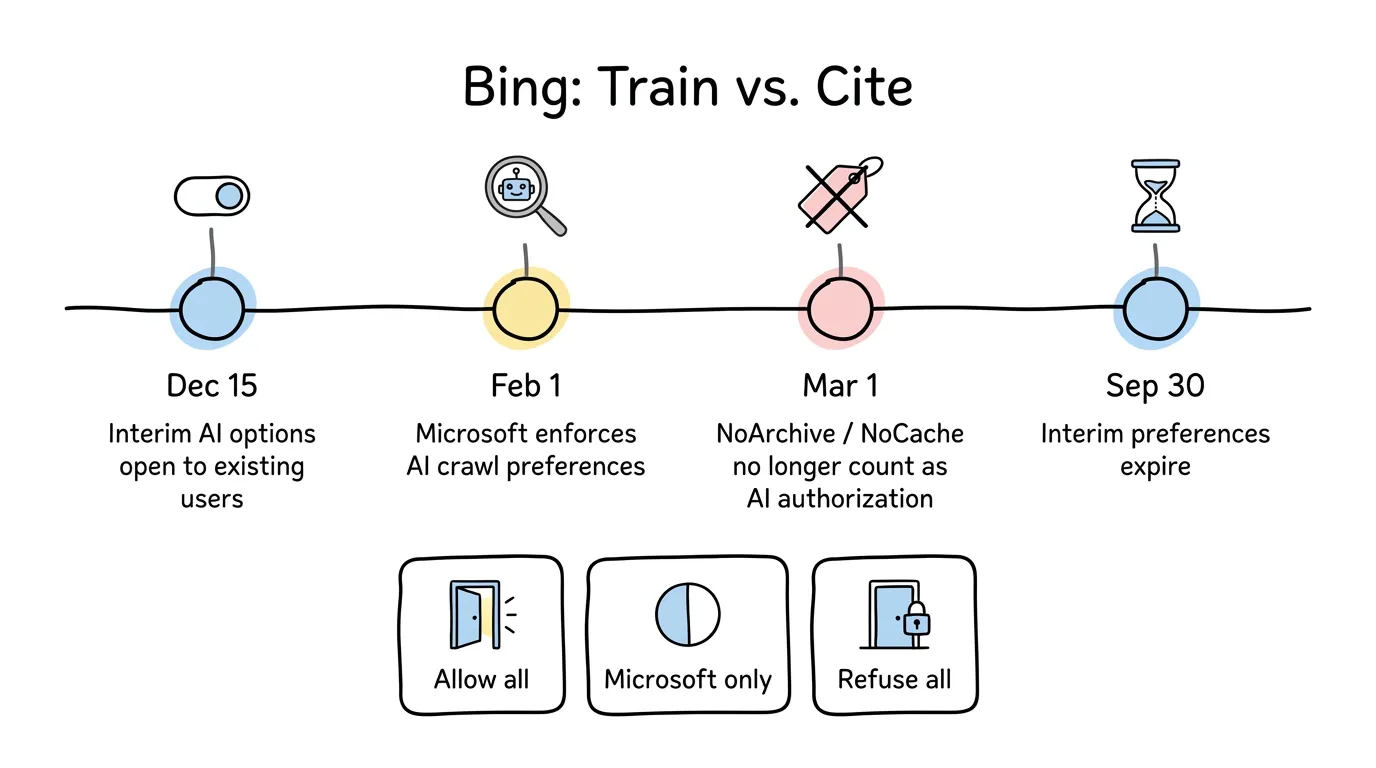
These two used to be bundled into a single permission. Now Microsoft has split them apart. You can allow AI to cite you while banning it from learning on you; or the other way around; or refuse both. There are three options: open everything, open only to Microsoft's own surfaces, or refuse everything.
The timeline is set, too: on December 15, the interim options become available to eligible existing users; starting February 1 next year, Microsoft formally enforces these preferences at crawl time; from March 1, the old NoArchive and NoCache directives will no longer be recognized as AI-related authorization; and on September 30, the interim preferences expire.
My view is blunt: a blanket refusal of AI is equivalent to removing your name from the search results of the future. You can refuse to let others train on your content — but whether to let them cite you when answering questions deserves a decision of its own. That could be the entry point for new traffic.
Search Is Starting to Get Things Done for You
Now look at Google.
AI Mode is no longer satisfied with answering questions; it's moving into transactions. The new home services experience lets you book and request quotes directly inside search, with partners including Angi, Thumbtack, Housecall Pro, and Jobber — and ServiceTitan has announced it's on the way.
That signal matters more than the feature itself.
Think about it: user habits have already changed. It used to be that you asked a question, got ten blue links, and clicked through them one by one. Now you ask a question and the thing gets done. Between "knowing" and "getting it done" sit all those websites — and they may be skipped entirely.
For people running local businesses, this is actually good news. The prerequisite is solid fundamentals: accurate information, clearly described services, a phone that gets answered, a booking system that works, reviews that are real. Sound like a pile of clichés? It is. But those very clichés are what decide whether AI recommends you.
Even Bot Visits to Your Store Now Get a Dashboard
One more thing — a small one, and I think it's underrated.
Microsoft's Clarity rolled out an Agent Activity dashboard dedicated to watching how AI agents visit your website: how many times they came, whether they can fill in forms, whether they can complete a checkout flow. They also shipped branded agents and a feature for querying data in plain language.
Website analytics used to assume every visitor was human. Not anymore.
More and more automated assistants are browsing sites, comparing prices, and filling out forms on people's behalf. A website that is friendly to "humans" isn't necessarily friendly to "bots." I suggest every site owner test one thing: have an AI assistant walk through your most important flow and see if it can get all the way through. If it can't, you've lost an entire customer segment. And don't treat every bot visit as a guest — in the end, what counts is closed deals.
A Small Experiment, and a Rumor
Two things, taken together.
First, your YouTube video descriptions are worth writing with real care. A research outfit called Peec AI ran an experiment: after carefully rewriting the descriptions of a batch of videos, the number of times those videos were retrieved by AI each day rose noticeably — the same in Google's AI Overviews and in AI Mode. The sample was small, so don't treat it as some iron law of ranking. But "describe the video content honestly and clearly, with every annotation it deserves" costs next to nothing and is worth a try.
Second, word is that OpenAI is testing merchant visibility tools inside ChatGPT: impressions, clicks, and business information management may all be in the works. Note: it's a rumor, not a launch — don't take it as gospel. But the direction is worth writing down: AI platforms opening merchant backends, just like the search engines did back in the day, is nearly inevitable.
A Counterintuitive Set of Numbers
Finally, an interesting piece of data.
Many people take it as given: once AI arrives, traditional search dies.
Semrush's Q3 research signals the opposite: in US desktop Google searches, the share that clicked out to an external website rose from 39.74% in July to 46.11% in September; the share of zero-click searches, meanwhile, fell from 24.97% to 22.99%.
To translate: AI search is growing, but real people using traditional search — and actually clicking through — is growing too.
The pie isn't being stolen; it's getting bigger.
While we're here, a word on the algorithm side: no new core update this month, and no new spam update either. The most recent spam update was the September round, which finished running on October 8; the most recent core update still dates back to May. So if your rankings are wobbling, don't blame the algorithm first — it's most likely something else. Go check indexing, content, and technical accessibility.
One Last Thing
Everything this month points in one direction: the endgame of SEO is not getting some keyword to #1 — it is making your business findable, citable, and directly usable anywhere a question is being asked.
Back to my friend. Put the champagne away, settle the books, think through Bing's new options, then have an AI assistant walk through your booking flow.
Rankings will fluctuate; tools will get renamed. But making your information accurate, your content solid, and your flows workable — that will never go out of style.
Here's to your business being found, everywhere.
Continue reading
Related articles

It's 2026: Stop "Buying" AI Tools for Your Marketing Team — Start "Hiring" AI Agents
This learn article explains how AI agents differ from standalone AI tools in marketing, outlines three agent categories — build-your-own platforms, CRM-native agents, and vertical tools — and covers use cases across SEO, social media, advertising, and reporting, plus criteria for choosing one.

What Is GEO? How Your Brand Gets "Mentioned" in the Age of AI Search
An explainer on GEO (Generative Engine Optimization) for e-commerce and DTC brands: how it differs from SEO and AEO, why AI answers shape brand visibility, and eight practices covering question-focused content, consistent brand messaging, structured pages, external evidence, comparisons, and AI mention tracking.

AI Is Already Making Decisions for Your Customers. Are You on the List?
A learn article explains GEO (Generative Engine Optimization): why AI-generated answers now shape which brands customers see, and how SEO fundamentals, entity clarity, citable evidence, and monthly measurement affect visibility in AI answers.