
The Rankings Held. The Clicks Are Gone: The Google Move Every Founder Needs to Understand
Google's AI Overviews now answers searches directly, wiping out clicks even when your rankings hold steady. This piece breaks down the numbers behind the shift and hands founders a five-step playbook for getting their pages cited by AI answers.
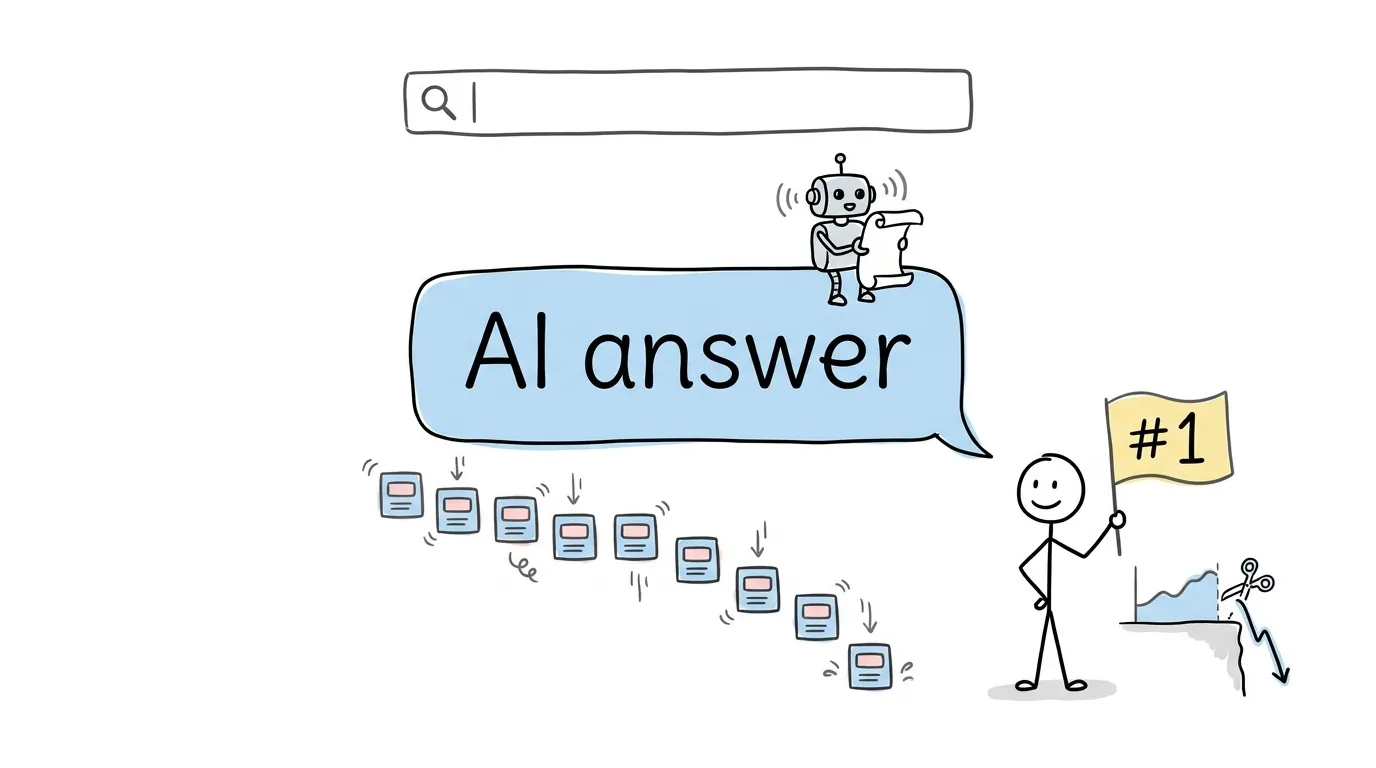
A few days ago, a friend who runs a SaaS company grabbed coffee with me and showed me his analytics dashboard.
His keyword rankings? Rock solid — top three.
But the traffic curve looked as if someone had taken scissors to it — down and down it went.
He was beside himself: I didn't do anything wrong. Content publishing never stopped, the backlinks didn't disappear, we ran the technical health check.
I told him: you really didn't do anything wrong.
Google changed.
Now, when you search for a lot of questions, Google puts a fully written AI answer right at the top of the results page — you don't even have to click anything. It's called AI Overviews.
The commentary in my feed is already full of takes on this, but mostly the same correct-but-empty line: "SEO is about to be upended." Today I want to break it apart piece by piece, run three pieces of math for you, talk about an opportunity most people aren't taking seriously, and hand you a checklist you can start on Monday morning.
First Number: Where Did Your Clicks Go?
First, let's be clear about what AI Overviews actually is.
The way Google used to work, it was like a librarian. You asked where the book was, it pointed at the shelf, and you walked over and flipped through it yourself.
Now, it reads the answer to you.
Google's Gemini model reads a pile of web pages, distills them into a short conversational answer, plants it at the top of the results page with a few source links hanging beside it. You ask, it answers. For a lot of people, the search ends right there.
So whose lunch is this "reading the answer aloud" move eating? Let's run your numbers.
Ahrefs has a stat: whenever AI Overviews appears at the top of a search, the page ranking number one sees its click-through rate drop by 34.5% on average.
34.5%. More than a third.
If you used to get 1,000 visitors a month from that keyword, now you're left with fewer than 700.
SparkToro's research is even harsher: 58% of searches end in zero clicks. The user gets everything done on Google's page, and not a single visitor gets sent to your website.
And AI Overviews itself now covers nearly half of all searches.
Put the three numbers side by side and the conclusion is simple: search is still here, but the visits search used to deliver are disappearing.
If your business depends on users clicking through from Google, this isn't some "industry trend."
This is a cash flow problem.
Second Number: A Counterintuitive Figure
But everything always has another side.
There's one number that stopped me for a few seconds the first time I saw it.
Of the pages cited by AI Overviews, only 38% rank in the top 10 of organic results.
In other words, more than six in ten pages that Google's AI calls out by name rank outside the top 10.
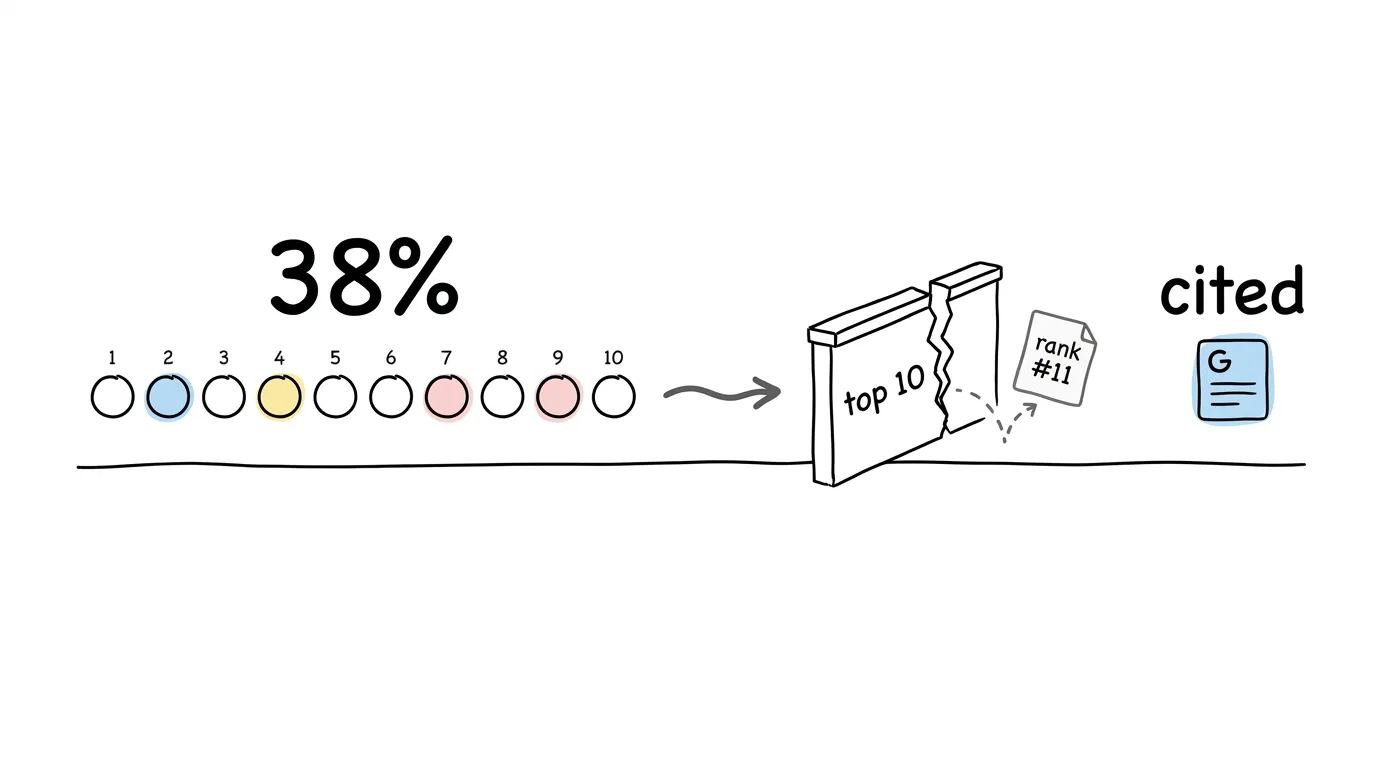
Do you know what that means?
You know what page two of search results used to be? A graveyard. Your content could be brilliant — ranked 11th, it might as well not exist. Nobody scrolls to page two; that iron law hadn't budged in a decade.
Now, that iron law has cracked.
Why? Think about it. What Google weighs when deciding who gets into AI Overviews is no longer "where do you rank" but "can you directly answer this question."
There's a very plain logic inside this. When a language model goes looking through a web page, it's hunting for "an answer that can be lifted straight out." It doesn't appreciate a slow build-up, it doesn't care about your writerly craftsmanship — it wants one passage: question asked, question answered, self-contained, able to stand on its own once lifted out.
And how do most founders write their articles?
The first 400 words are about feelings — how I had this flash of inspiration, how the idea came to me. The answer doesn't show up until paragraph six.
Gemini takes one glance and moves on.
It's not that it looks down on you. It's that it can't extract anything.
So rankings are no longer the only gate. For the first time in ten years, a small site can fight for the microphone on the same results page as the big brands.
Third Number: So How Do You Get Cited?
The opportunity is sitting right there. How do you grab it?
I've compressed it into five moves. One person can do all of it; you don't need to hire an agency.
First, inventory the questions.
List the 30 questions your customers ask before they place an order. Search each one on Google, one by one, and record three things: did an AI Overview appear? Who did it cite? Where does your page rank?
Two hours, and you're holding a set of cards that didn't cost you a cent.
Second, one page, one question.
Don't get greedy. When one page tries to answer ten questions, Gemini will cite the page that answers exactly one. Make the main question your title, break the sub-questions out under subheadings, and let one page grow into the "answer hub" for a single topic.
Third, put the answer first — 40 to 60 words.
Under a question-style headline, the very first paragraph is the answer. Ask what the user asks, answer it, then expand with details, examples, evidence.
This is the inverted pyramid journalists have used for a hundred years. It used to serve humans; now it serves machines. And by the way, it's also how textbooks are written: a good teacher gives you the conclusion first, then tells the story.
Fourth, publish the evidence only you can produce.
Your own data, your screenshots, customers' words in their own mouths, the potholes you've hit.
Of the whole set of moves, I think this one is worth the most. An AI can summarize the entire web in a second, but it cannot fabricate your first-hand data. You have usage records from 200 customers, a real before-and-after comparison from some redesign — these one-of-a-kind things are the strongest citation magnets.
Fifth, re-check every month.
AI Overviews swaps its cited sources far more often than traditional rankings swap positions. Last month it cited you; this month it may have switched to someone else. Re-run the inventory from step one every month. If you dropped out, patch it.
One company has taken this one play and driven it all the way home, and it's worth a look. Postman, which makes API tools, gets cited twice in the AI Overview for the search term "soap api," plus once more in the featured snippet below.
Three appearances on a single results page.
How? Purely by taking one narrow topic and going deeper on it than anyone else on the web.
The Mistakes I See Most Often
Every week I look at a few founders' websites. The following mistakes get more painful one after another.
The most painful is spending thousands on "GEO optimization packages" (GEO — Generative Engine Optimization) and "AI search placement services." Gary Illyes, a spokesperson at Google, put it very bluntly at Search Central Live: no special tactics are needed — just do normal SEO well.
I believe him. But let me add half a sentence: the passing grade for "normal SEO" has gone up.
Back then, you could pile up some keywords and stitch things together and still scrape a ranking. Now "normal" means: answer the intent thoroughly, make the evidence solid, get the structure clean. Plenty of small companies' websites were never at that bar to begin with.
The other pitfalls, quickly:
Burying the answer behind a long story, so the machine can't extract it. Mass-producing filler articles with AI, saying what fifty other pages already say — Google has no reason to cite you, you're just competing with the AI Overview itself for the same lines. And one more type: watching nothing but the click count.
That last one deserves a few extra words.
Stop Counting Clicks
Getting cited is not the same as getting clicked. Plenty of users see your name in an AI Overview, remember it, and search for you directly some other day.
So your dashboard needs a few new dials.
Once a month, count by hand: of your 30 questions, how many cite you? Watch the widening gap between impressions and clicks: if impressions are climbing but clicks aren't, odds are your answer is speaking on your behalf inside the AI. Then check whether brand-name searches are lifting — that's the crowd that read the answer and came looking for you directly.
And there's a crude little method I recommend especially.
Add one question to your signup form: "How did you hear about us?" Among the options, include "Google's AI answer" and "ChatGPT."
Crude, ugly, imprecise. But you'll be surprised how much it tells you.
Who's Losing, and Who's Winning
My read on it, and I won't be polite about it.
The fastest losers are content farms and affiliate sites. Anyone living on generic "what is X" articles is having their lunch eaten by AI Overviews, directly. So are companies that outsource content wholesale and publish piles of AI drafts no human ever edits.
The comfortable winners are the specialists in narrow fields. A founder who writes only about the potholes they've hit themselves, a bookkeeper who lets real client cases do the talking — the AI will cite people like that first. E-commerce sites with clean product data are winning too; free product listings are showing up ever higher inside AI Overviews. And the founders who've built a personal brand — the AI dares to cite an expert with a real name and a verifiable track record.
One more heads-up: paid ads are being pushed down too; the 2025 data already shows it clearly. Shift budget toward the high-intent keywords where AI Overviews rarely appear.
So look at this round of change: which way is the scale tipping?
Toward the small teams.
Big companies' content has to clear legal, clear the brand committee, get sanded down for three months, and what comes out is a smooth, inoffensive piece that leaves every reader unmoved. You? You can publish a sharp, first-hand answer this afternoon.
AI Overviews rewards specificity. And specificity is exactly the thing small teams have the most of.
What You Can Do This Week
Don't stockpile anxiety. Start working. Four things:
- List 30 customer questions, search and inventory each one — two hours.
- Pick your five most important pages and rewrite them: question-style headline, a direct answer of 60 words or fewer underneath, then add one piece of evidence only you can produce.
- Add "How did you hear about us?" to your signup form.
- Put a reminder on the calendar one month out, and re-run the audit.
Finally, Back to That Cup of Coffee
My friend went home and put in two weekends.
Last week he messaged me: of the keywords he's been watching, four now have AI Overviews that cite his pages. The clicks haven't all come back, but in his signup form, people are starting to pick "Google's AI answer."
He said something I've kept with me: turns out I don't need to outrun Google. I just need to be the answer it reads out loud.
The game of search has changed its rules. Before, you fought to squeeze into the ten blue links; now, you have to become the sentence Google reads to its users.
Every extra month you wait, the answer in your future customer's ear belongs to somebody else.
Here's hoping you're the one whose name gets read aloud.
Continue reading
Related articles

It's 2026: Stop "Buying" AI Tools for Your Marketing Team — Start "Hiring" AI Agents
This learn article explains how AI agents differ from standalone AI tools in marketing, outlines three agent categories — build-your-own platforms, CRM-native agents, and vertical tools — and covers use cases across SEO, social media, advertising, and reporting, plus criteria for choosing one.

What Is GEO? How Your Brand Gets "Mentioned" in the Age of AI Search
An explainer on GEO (Generative Engine Optimization) for e-commerce and DTC brands: how it differs from SEO and AEO, why AI answers shape brand visibility, and eight practices covering question-focused content, consistent brand messaging, structured pages, external evidence, comparisons, and AI mention tracking.

AI Is Already Making Decisions for Your Customers. Are You on the List?
A learn article explains GEO (Generative Engine Optimization): why AI-generated answers now shape which brands customers see, and how SEO fundamentals, entity clarity, citable evidence, and monthly measurement affect visibility in AI answers.