
87% of Marketers Are Using AI — Yet Three-Quarters of the Work Is Still Done by Humans
A statistics-driven overview of AI in marketing: surveys cited show most marketers now use generative AI, yet only about a quarter of marketing work is actually handled by AI. The piece reviews adoption data, spending trends, GEO/AEO practices, and 2027 forecasts, closing with practical advice.
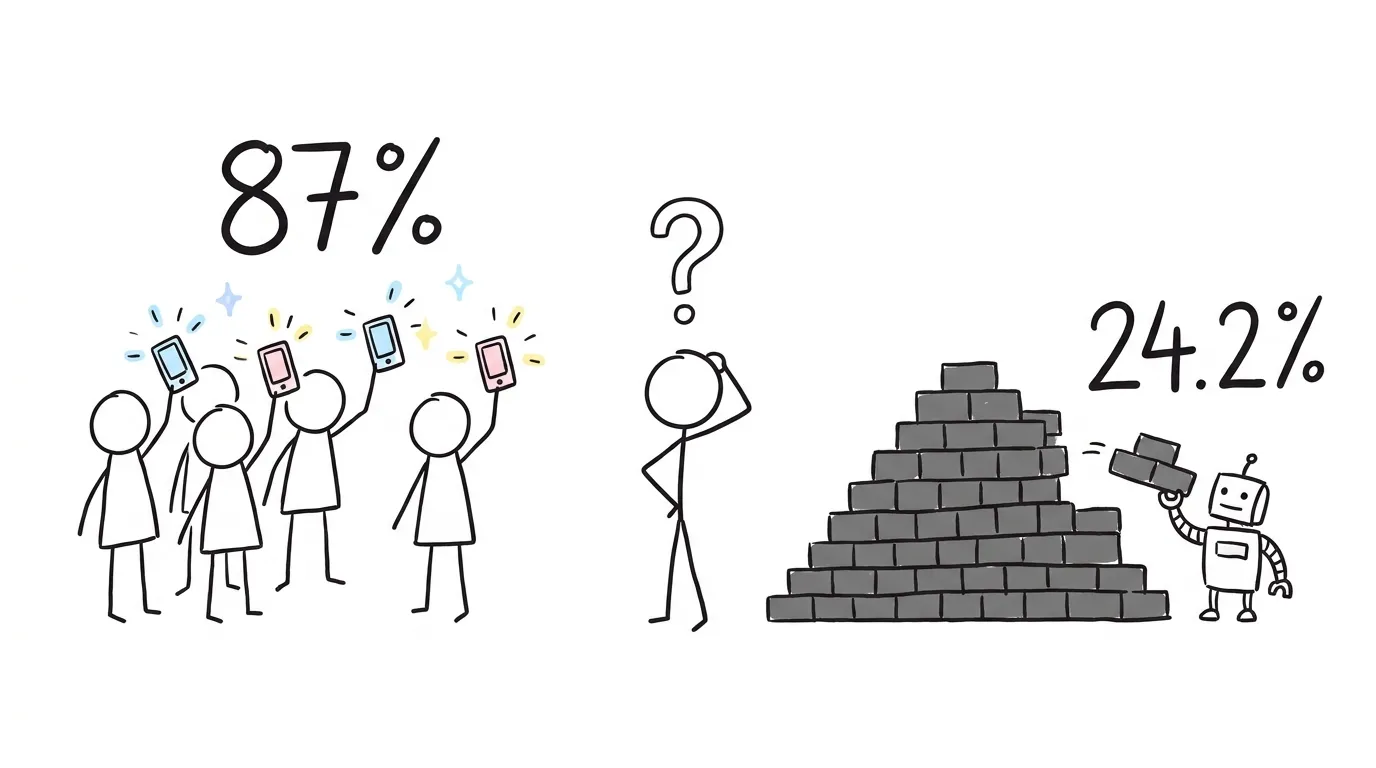
A few days ago, an old friend of mine who runs an e-commerce business asked me: his company has bought a pile of AI tools, the team is using them, yet he still feels uneasy inside. Was this, he wondered, really "using AI"?
I told him: don't rush to a conclusion. Let me show you a few numbers first — you'll understand once you've seen them.
Almost Everyone Is Using It
So how many marketers are actually using AI?
Salesforce's State of Marketing report gives a number: 87% of marketers have applied generative AI in at least one fixed workflow. Keep in mind, that figure was only 51% in 2024 and 76% in 2025. Two years, from half to nearly nine in ten.
For large enterprises with marketing teams of more than 500 people, the number is 94%.
HubSpot's survey is even more striking: 78% of marketers use it every day. Jasper's report says 91% of respondents are actively using it.
Good grief — it's practically universal.
So why is my friend still uneasy? Because he vaguely senses that although the tools are in use, the workload hasn't shrunk.
His instinct is right.
24.2% — That's the Real Number
The CMO Survey, run jointly by Duke University's Fuqua School of Business, Deloitte, and the American Marketing Association, asked a more concrete question: of your total marketing workload, what share has actually been handed to AI?
The answer is 24.2%.
What does that mean? It means nearly 76% of marketing execution is still built by humans, brick by brick.
87% of people are using it, yet AI does only 24.2% of the work. Put those two numbers side by side and you see the true face of AI marketing in 2026: almost everyone is touching AI, but the vast majority are only using it for odds and ends — drafting a bit of copy, retouching an image. Teams that have genuinely rebuilt their entire workflow around AI are few and far between.
Interestingly, in the same survey, executives expect that share to reach 55.9% within three years.
Whether you believe that is another matter. But at the very least, everyone knows in their heart: it's still early.
Oh, and don't be fooled by claims like "over 90% adoption." U.S. Census Bureau data from May 2026 shows that only 19.8% of employer businesses across the country are actually using AI. Different measurement scopes produce wildly different numbers. Before comparing, ask one question first: what exactly is it measuring?
The Efficiency Is Real; the Results Are Another Story
So is using AI actually useful? Yes. The math is easy.
The average marketer saves 6.1 hours per week; heavy users save 11 to 13 hours. People who use AI publish 42% more content per month than those who don't. In 2024, 65% of marketers refused to let AI write blog posts; now only 5% do.
The time savings are real.
But here comes a painful gap. The Content Marketing Institute (CMI) surveyed B2B content teams: 87% said AI has raised my output; only 39% said AI has made my content more effective. Another 34% said no change, and 12% said quality actually got worse. Semrush's survey is colder still: only 19% of practitioners believe AI has genuinely improved content quality.
Output doubled; results didn't. It's like a production line: switch the machines on and twice as many goods roll off the line, but what actually sells stays the same.
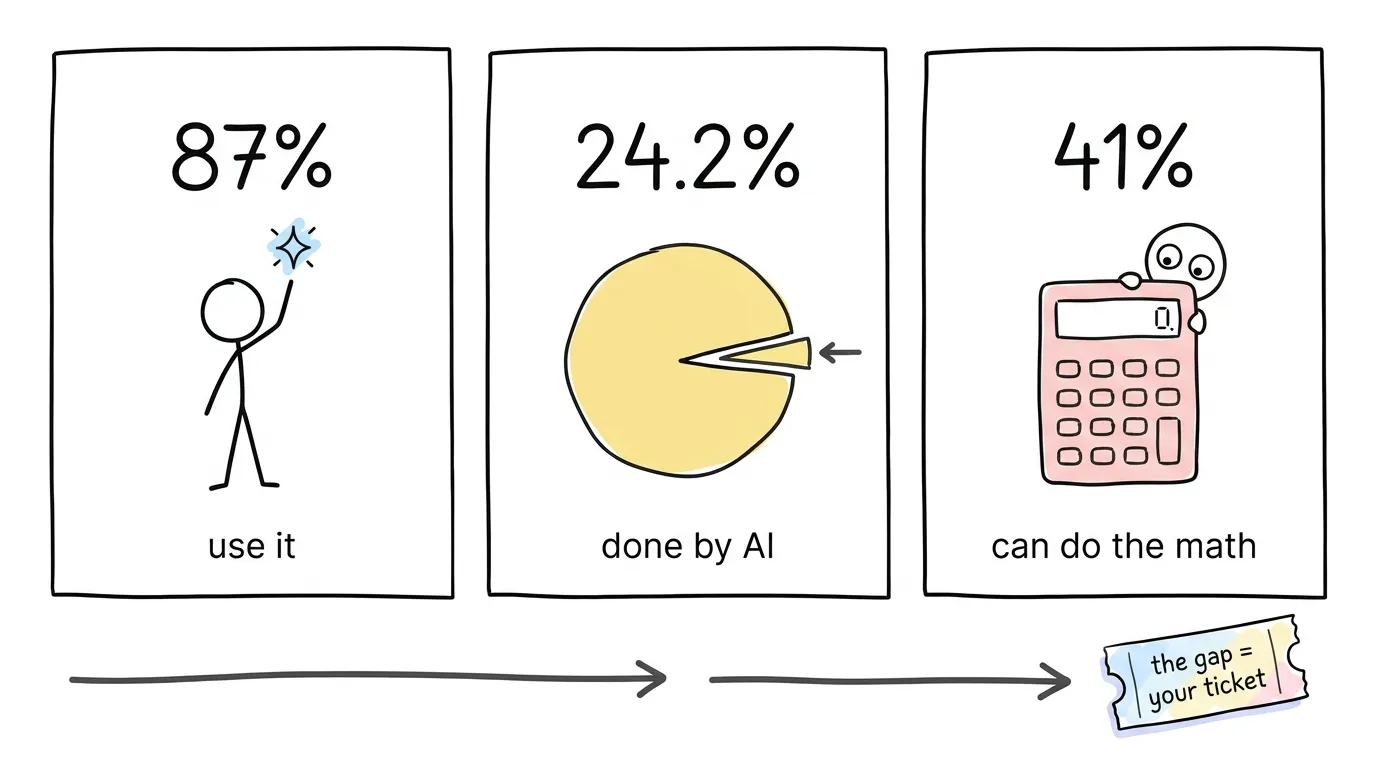
Worse still is reporting upward. Jasper found that 91% of teams are using AI, but only 41% of teams can prove to the board how much return this AI investment has actually generated.
Plenty of people use it; few can do the math.
The Money Is Flowing Deeper
Now look at the money. Precedence Research estimates the global "AI + marketing" market at $57.99 billion in 2026, reaching $217.33 billion by 2034. Working backward from those two figures, the implied annual growth rate is roughly 18%. That's one firm's estimate — take it with a grain of salt; different institutions produce numbers that differ by an order of magnitude.
Gartner's forecast is more worth watching: in 2026, global enterprise spending on AI platforms and models will be $64.25 billion, up 63.4% year over year. The fastest-growing slice is domain-specific large language models (DSLMs) fine-tuned for particular industries, up 210%.
What's a DSLM? Simply put, companies are no longer satisfied with "public large models that know a little of everything"; they want an exclusive model that has digested their own industry data, with lower latency and more controllable compliance.
At the budget level, Gartner asked CMOs: how much of the marketing budget goes to AI? On average, 15.3%. Meanwhile, marketing's share of total company revenue has barely moved (7.8%) — which means the AI money is being shifted from somewhere else, not freshly printed.
The itemized bills are even more striking: mid-sized companies' monthly AI software spend rose from $1,200 to $3,400 within a year — up 183%. Companies with more than 500 employees spend between $13,500 and $50,000 per month on professional AI tool suites.
This stuff isn't cheap, and it's getting more expensive. Remember that line — it'll come back later.
More Tools Are Being Bought, but Companies Only Trust What's "Built In"
At the individual level, marketers use an average of 4.3 AI apps per week. ChatGPT leads with 72% usage, Canva AI at 58%, Claude at 41%, Midjourney at 36%.
And at the company level? TechnologyChecker crawled more than 29 million corporate websites to see what's actually deployed. The results are fascinating: HubSpot appears on 602,953 domains, Mailchimp on 547,029, Klaviyo on 429,474. Direct OpenAI integrations? Only 230,932.
Mailchimp alone is 2.4 times the number of OpenAI's direct integrations.
Behind these numbers lies a very plain truth: companies don't want to install another new tool; they want AI to grow inside the platforms they already have. Salesforce's survey confirms this: 89% of marketing leaders prefer the AI built into platforms like Salesforce, HubSpot, and Adobe over buying another standalone point tool.
Of course, the crawler data has two pitfalls: it can only see the code installed on the front end, not server-side API calls; and it measures "installed or not," not "using the AI features." So don't treat it as a precise value — treat it as a trend.
There's one more detail worth savoring. Chiefmartec's marketing technology landscape grew only 0.79% in 2026, yet the dedicated AI marketing tools within it grew 3.2x over two years, surpassing 3,800. The landscape barely moves, while AI tools grow like weeds.
What does that mean? AI tools aren't being added in a growing market — they're replacing things in an existing one.
The Rules of Search Are Changing
One more change that's happening right now.
Cloudflare Radar data: in Q3 2026, AI crawlers whose purpose is "search" accounted for 8.26% of all AI crawler requests. Doesn't sound like much? A year ago, that figure was 1.32%. In one year, more than a sixfold increase.
What are these crawlers doing? They're "reading" your website on behalf of ChatGPT and friends, deciding whether to feed your content to users who ask questions.
Hence two new terms: GEO (Generative Engine Optimization) and AEO (Answer Engine Optimization). The former is about making your content easier for large models to retrieve and cite; the latter is about making it easier for them to take directly as the answer.
How many are actually doing it? The CMO Survey says 41.5% of companies are running a systematic GEO program; HubSpot says 24% of marketing teams are doing AEO audits.
But you'll also see high figures like 88% and 85%, where companies claim they're "optimizing for conversational search." Where's the gap? In how the question is asked. "We've done something, sort of" and "we have a clearly defined GEO process" are two different things.
Look at 41.5%, not 88%.
The Three Ledgers of 2027
Forrester has three predictions for 2027, and none of them makes for easy reading.
The first is the billing ledger. Marketing technology vendors are moving from "flat monthly/yearly subscriptions" to usage-based billing. Every prompt, every agent action, every generated image is a billable event. It looks cheap during the pilot; at the scale of millions of customer interactions, the bill will teach you a lesson. Forrester predicts that one-third (33%) of B2C brands will cut some of their in-flight AI projects in 2027. Their CMO survey also shows: 82% of U.S. B2C marketing executives plan to scrutinize AI spending more strictly in 2027, 78% say the executive layer wants clearer evidence of value, and 64% expect a brand incident caused by unsupervised AI use within 12 months.
The second is the human-touch ledger. Forrester expects 50% of enterprise brands to re-establish "human-created content" as a core pillar of brand strategy in 2027: putting real domain experts front and center, doing original research, telling real customer stories. Why? Consumer comfort with AI has fallen from 57% to 46%. When content across the whole web starts to taste the same, "written by a human" becomes the scarce commodity.
The third is the agent ledger. Salesforce data: only 13% of marketing teams have AI agents running in production; 81% are still in pilots. The obstacles are concrete: 50% say legacy system data is too fragmented, and 45% say vendor-delivered agents don't deliver the promised performance. Yet Forrester also predicts that by 2027, autonomous AI agents will influence 75% of B2B purchasing decisions. And there's a counterintuitive detail: B2B buyers will double down on direct, human contact with vendors, using real people to verify the solutions their agents recommend.
Machines place the order; humans inspect the goods.
So What Should You Actually Do?
Back to my friend's question: does this count as "using AI"?
My answer: don't look at how much AI you use — look at three things.
-
First, the bills. Make a list of all your usage-based AI subscriptions and set spending alerts before you scale a pilot. Choose platforms with usage tracking; don't wait for the bill to wake you up.
-
Second, search. Make your content readable by AI: structured data, verifiable case studies, clear arguments. AI crawlers grew sixfold in a year — if they can't read you, you might as well not exist.
-
Third, people. Use a hybrid model for content: AI does the research and data processing, while named human experts hold the line on opinions and trust. For data, clean up your CRM before talking about agents — half of all teams are stuck on fragmented data, and you won't be the exception.
There's another way of slicing it that's quite fun: divide enterprise AI maturity into five levels, from experimenting on your own, to assisted processes, process integration, autonomous operations, and finally agent orchestration. Most companies are stuck at level two; 13% have reached the door of level five, and those genuinely running multi-agent collaboration probably number under 5%.
My friend's company is at about level two and a half. Nothing to be ashamed of — 87% of everyone is right there.
Finally, let me lay those numbers out once more: 87% of people are using it, AI does only 24.2% of the work, and 41% can do the math.
Whoever fills the gap between these three numbers first gets the ticket to the next stage.
May every line of your AI bill be money spent with your eyes wide open.
Continue reading
Related articles

It's 2026: Stop "Buying" AI Tools for Your Marketing Team — Start "Hiring" AI Agents
This learn article explains how AI agents differ from standalone AI tools in marketing, outlines three agent categories — build-your-own platforms, CRM-native agents, and vertical tools — and covers use cases across SEO, social media, advertising, and reporting, plus criteria for choosing one.

What Is GEO? How Your Brand Gets "Mentioned" in the Age of AI Search
An explainer on GEO (Generative Engine Optimization) for e-commerce and DTC brands: how it differs from SEO and AEO, why AI answers shape brand visibility, and eight practices covering question-focused content, consistent brand messaging, structured pages, external evidence, comparisons, and AI mention tracking.

AI Is Already Making Decisions for Your Customers. Are You on the List?
A learn article explains GEO (Generative Engine Optimization): why AI-generated answers now shape which brands customers see, and how SEO fundamentals, entity clarity, citable evidence, and monthly measurement affect visibility in AI answers.