
Meta's Fully Automated Ads: The Player, the Referee, and the Scorekeeper Are All the Same Company
An analysis of Meta's fully automated advertising, arguing the platform acts as seller, pricer, creative maker, audience decider, and results reporter at once. It reviews Advantage+ adoption figures, past measurement disputes, and offers five practices for advertisers, plus a view on the agency role.
A while back, I came across something Mark Zuckerberg said last May. It stopped me in my tracks.
He said the advertising of the future should work like this: any business, no matter how small, walks up to Meta, states its goal clearly, tells it how much it's willing to pay for that result, and then connects its bank account.
And then?
And then... nothing. That's the whole arrangement. Meta goes off and does the work itself — and the more results it can bring you, the more it brings.
A few weeks later, The Wall Street Journal dug up the timeline: by the end of 2026, Meta plans to fully automate both the creative and the placement of advertising. When the news broke, the share prices of the big agency holding companies — WPP, Publicis, Havas — promptly fell 3% to 4%.
It is now November 2026. The end of 2026 is right in front of us.
I'd guess a lot of small business owners, agencies, and media folks are carrying around the same question: if it does everything, what's left for me to do?
The Bottom Line First
Automation is a good thing, and for the most part it has already arrived.
But inside Zuckerberg's model hides a fact that rarely gets said out loud:
The one who sells the ad space, the one who sets the prices, the one who writes the ads, the one who decides who sees them, and the one who reports the results at the end — are all the same company.
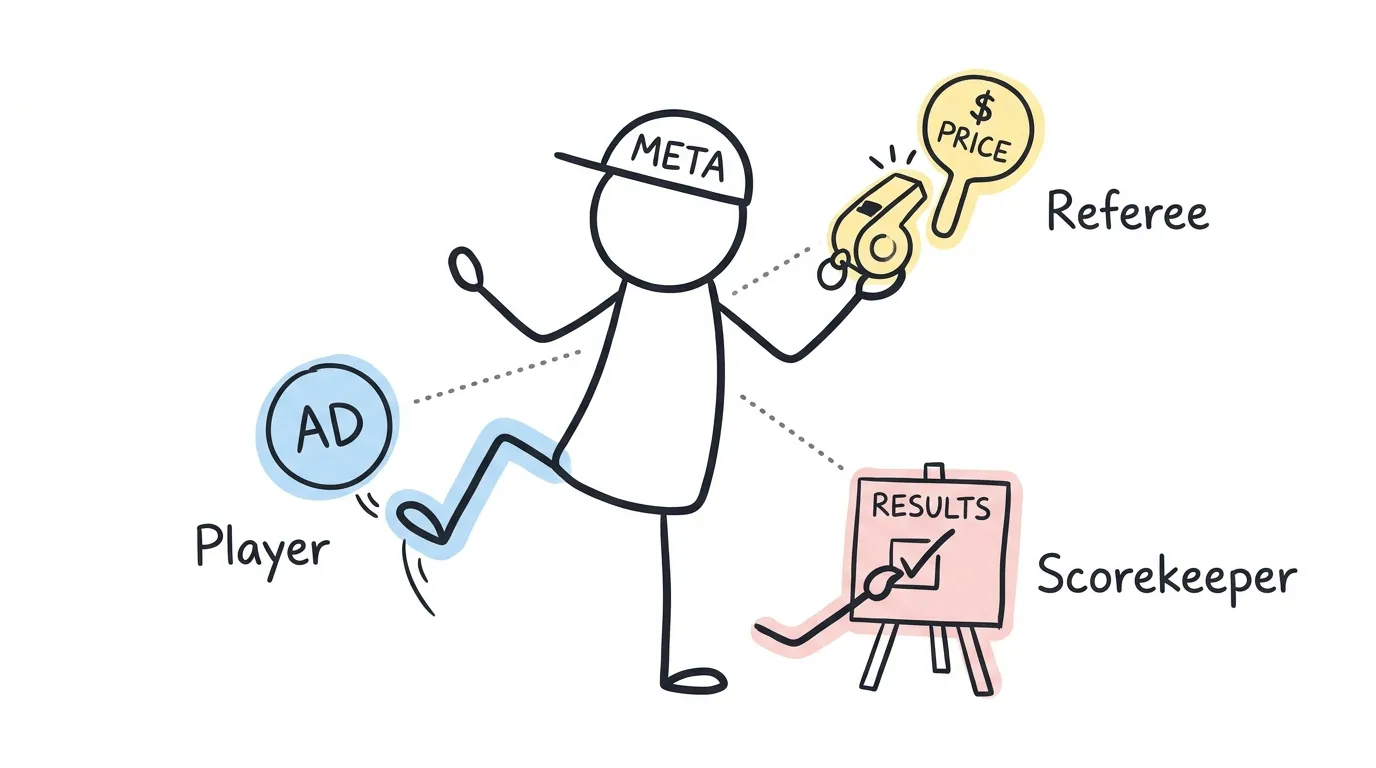
That's not a reason to stop using Meta. But it is a reason not to let Meta be the only one checking Meta.
What Does "Fully Automated" Actually Mean? Most of It Started Running Long Ago
A lot of people treat this as a thing of the future. It isn't. Meta packaged this automation under one name: Advantage+. It picks the audience, it chooses the placements, and it decides how to split the budget.
The numbers are already on the table, too. In Q2 2026, Advantage+'s annualized revenue exceeded $75 billion. More than 9 million small businesses use at least one of Meta's AI creative tools. Image generation alone more than doubled in usage within a single quarter.
One last puzzle piece remains: toss in a URL, and a finished ad comes out. According to reports, Meta is testing this step with a small group of advertisers.
The Benefits Are Real — Don't Pretend Otherwise
First, a fair word.
For a bakery, a renovation crew, or a barbershop with no marketing department, this is real, tangible progress. You no longer need to understand audience targeting, placement mixes, or bidding strategies to get an ad running — the barrier to entry just dropped by a wide margin.
And Meta's AI genuinely does good work. Again, these are the numbers Meta itself reported: in Q2 2026, improvements in ad ranking alone drove clicks on Facebook up 8.3% and conversions up 15.7%.
Note: these numbers, too, come from Meta.
Hold that thought — we'll come back to it.
Automation itself isn't the problem. We do automation ourselves.
The problem lies somewhere else.
Problem One: The Seller Grades Its Own Exam
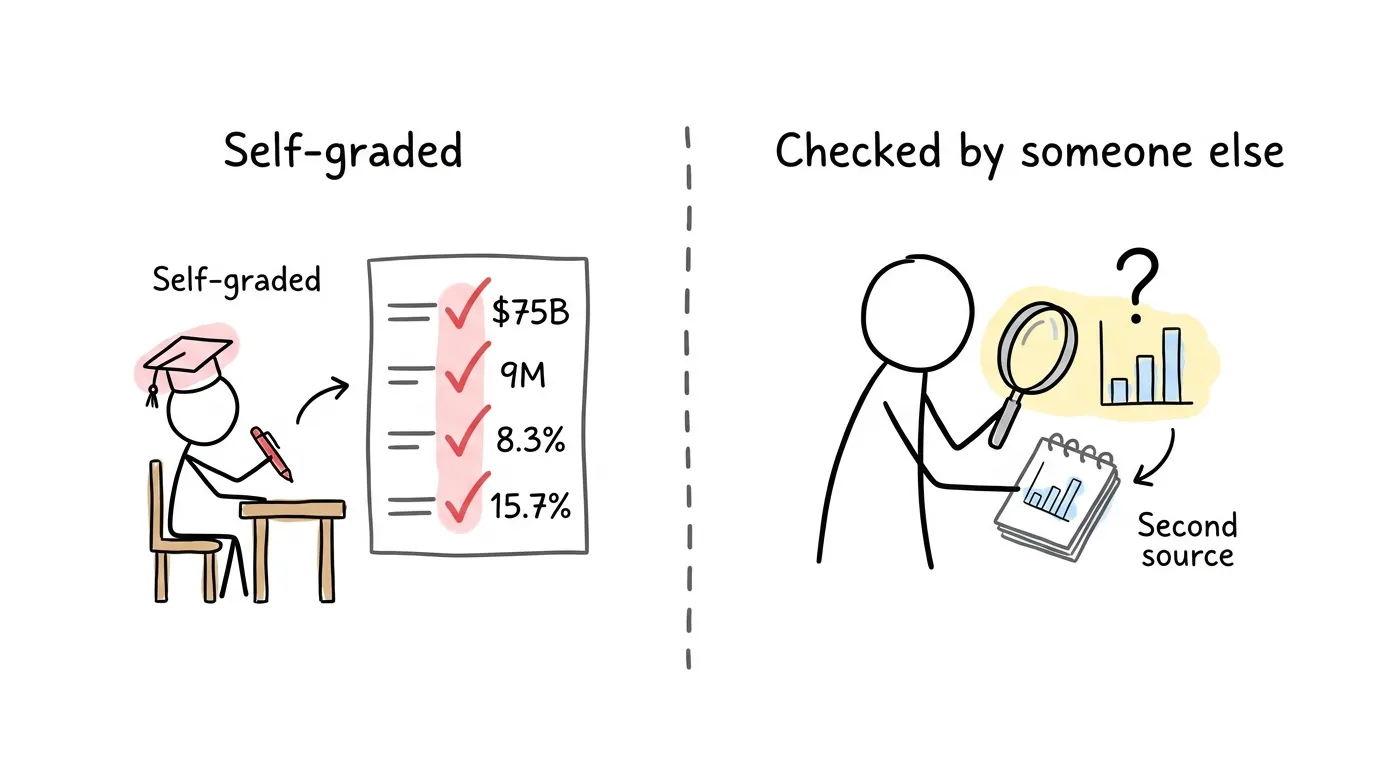
Look back at those numbers again. 75 billion. 9 million. 8.3%. 15.7%.
Every single one came out of Meta's mouth.
That's normal — often there's no other number to look at. But you should know that in a fully automated ad campaign, Meta plays several roles at once: it sells the ad space, it runs the auction that sets the price, it writes the ads, it decides who sees them. And at the end, it shows you a column of data in Ads Manager. The name of that column is Results.
This doesn't mean the numbers are fake. But this set of numbers has genuinely been wrong before.
In 2016, Facebook itself admitted that it had over-reported average watch time on video ads by 60% to 80% — and the error had run for two years, because views under three seconds simply weren't counted. Bloomberg broke that story.
Starting in 2018, a group of American advertisers sued Meta, alleging that its "potential reach" figure counted accounts rather than people, inflating it by as much as 400%. Meta denied the claim. As of the Q1 2026 filing, the case still hasn't finished in court.
Neither of these proves that anyone acted in bad faith.
But they do prove one thing: when a student grades their own exam, the mistakes usually surface only when someone else goes through the paper.
Problem Two: Its AI Only Looks Out for Its Own Backyard
Meta's AI can move your budget back and forth between Facebook, Instagram, and its other apps. But there is one sentence it will never say to you:
"This week, the same money would go further in Google Search."
For many local businesses, this is the calculation that matters most. A person searching Google for "roof repair, come now" has an actual leak; a person who scrolls past you on Instagram doesn't yet know they need you. Which of these two routes is cheaper? The answer is different every week.
There's only one way to see that answer clearly: run both sides, and measure both sides.
And Meta's system will never spend a dollar on the other platform.
Problem Three: The Ads Go Out Under Your Name
Meta can automatically generate images, videos, and copy based on your website. The writing is often genuinely good.
But it doesn't know three things: the prices on your website went stale long ago; you quietly stopped offering that service; and there's a claim your industry simply isn't allowed to make.
And there's one more thing — one we ran into ourselves, in our own campaigns. Honestly, it caught us off guard too:
Creatives generated purely by AI performed worse than the ones made by humans.
More volume doesn't mean better. Our guess: once everyone in the feed is using the same tools to generate the same-flavored images, the thing that makes people stop and look twice is the one where you can tell at a glance that "a person made this with care."
So the oldest rule in the book hasn't aged a day: before an ad goes live, look at it with your own eyes.
And a system built so you can "type in the budget and walk away" is precisely the kind of system that's best at getting that step casually skipped.
How We Handle This Ourselves
Since we're on the subject of checking results, let's lay out how we do it ourselves — so this doesn't read like armchair advice.
We're automated too. You tell us what to promote, where to run it, and what the budget is — the system builds it. Ad copy is suggested based on the content of your website, but before anything goes live, you can see it, and you can change it.
We do use Meta's automation — but selectively. Whichever feature helps this client's particular campaign, that's the one we switch on. Never all on, never all off. It rests on judgment earned campaign by campaign. So whether a Meta feature is actually worth it is not Meta's call to make.
What Meta can't do, we do ourselves. Every day, the system checks which of your ads, on which channel, performs best for the same money, and moves budget there. Google, Facebook, Instagram, LinkedIn — it watches back and forth across all four. If it's a traffic campaign, we optimize toward clicks; if you can measure on your own website what happens after the click, we can also run a conversion campaign, optimizing straight toward inquiries and orders.
As for reporting? Honestly, that data comes from the platforms too. We don't have our own measuring instruments, and we'd never pretend otherwise. The one thing we do differently is put every platform's numbers side by side: take Google's numbers and check them against Meta's — instead of letting each platform grade only its own paper.
And the last thing — also the one we care about most: we don't sell ad space, we buy it for you. When clicks get more expensive, we don't make a single cent off it. The only reason you'd come back to us a second time is that the first time, we genuinely made you money.
So Is There Still a Future in the Ad Business?
If you run an ad agency, or sell advertising services under your own brand, then in the coming months you'll most likely hear this from a client:
"Can't Meta just do this itself any day now?"
The honest answer comes in two halves.
One half: pushing buttons really is worth less and less. If your service is just setting up ads for clients inside Ads Manager, then from now on, you're competing for your livelihood with a free automation. Those 3% and 4% stock drops didn't fall for nothing.
The other half: the more automated the platforms become, the more valuable "the person who isn't a platform" becomes. Your client no longer needs someone to fiddle with targeting. What they need is: someone willing to look at the ad before it goes live, someone who can compare several platforms side by side, someone who understands the local market, someone sitting on their side of the table when the results come in.
This argument isn't weaker than it used to be. It's clearer than it has ever been.
Five Things to Keep in Your Own Hands
-
Try all the automation you like, but keep one control in hand. Whether you use Advantage+, Google's equivalent, or someone else's service, at least keep a second channel running alongside. A number only means something once it has something to be measured against.
-
Write the definition of results yourself. "Results" in Meta's eyes are whatever gets configured when a campaign is set up. Results in your eyes are inquiries, phone calls, people walking into your store. At the start of every month, write it down in your own words: what counts as a good month.
-
Measure on your own website. A simple analytics tool plus a form with tracking will tell you more truth than any platform's dashboard. Every number on a platform deserves a second source to be checked against.
-
Look at every ad with your own eyes before it goes live. Especially the ones the AI wrote.
-
Don't rush to throw out your real photos. In our own campaigns, human-made material has always run better than purely AI-generated material. That real photo from your shop isn't outdated at all.
Finally
Zuckerberg's pitch is actually quite honest: state the goal, connect the account, watch the results. Technically, most of it already runs end to end.
The question it leaves unanswered was never "are the machines any good."
It's who checks the machines.
As long as the answer to that is still "the company that sells the ad space," you owe it to yourself to find a second opinion — to find someone who sits on your side of the table.
Here's to every dollar of your ad budget landing on a ledger you can actually balance.
Continue reading
Related articles

It's 2026: Stop "Buying" AI Tools for Your Marketing Team — Start "Hiring" AI Agents
This learn article explains how AI agents differ from standalone AI tools in marketing, outlines three agent categories — build-your-own platforms, CRM-native agents, and vertical tools — and covers use cases across SEO, social media, advertising, and reporting, plus criteria for choosing one.

Did the Money You Spent on AI Marketing Ever Come Back?
A guide to measuring AI marketing ROI across three layers: ad reports, sales pipeline, and the financial ledger. Covers metrics such as ROAS and CPA, eight dashboard metrics, industry benchmarks, and common measurement mistakes.

How to Pick a Creative Automation Platform: First, Figure Out What These Eleven Actually Do
A learn article sorts eleven creative automation platforms — including Bannerflow, Celtra, Smartly.io, and Storyteq — into four functional groups and proposes five evaluation questions covering publishing reach, automation depth, ease of adoption, team fit, and verifiable evidence.