
AI Marketing Daily · 2026-11-22
AI Marketing Daily for 2026-11-22 rounds up 20 items led by Microsoft opening Bing AI Overviews to ads and Google expanding AI Mode ads to ten countries, plus GEO guides, ad automation delegation guidance, AI Overviews CTR data, and a legal-risk checklist for AI-generated creative.
In the same week, Microsoft and Google both pushed advertising into AI answer slots: ads in Bing AI Overviews went live globally, and AI Mode now shows a fourth ad slot within a single answer. The re-drawing of ad inventory has begun, and how teams run campaign ops, attribution, and compliance has to move with it. Among today's 20 items there is also a cluster of GEO (Generative Engine Optimization) guides and a legal-risk checklist for AI-generated creative — together, a ready-made playbook.
🎯 Today's Top Story
Microsoft opens Bing AI Overviews to ads: AI answer slots become official ad inventory
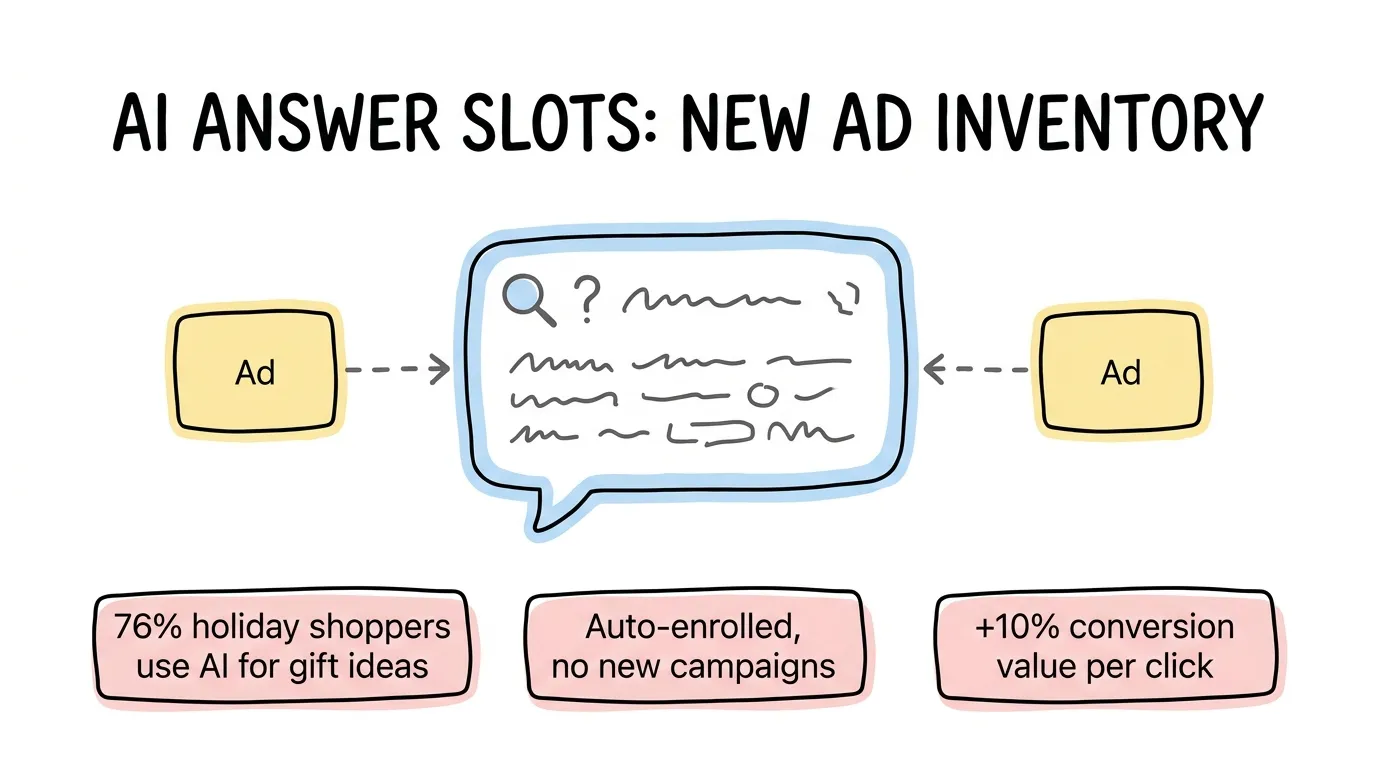
In its November product update published November 19, Microsoft Advertising announced the most consequential change of the batch: ads in Bing AI Overviews are now formally open across every market except China. Advertisers don't need to build new campaigns — existing Performance Max and AI Max campaigns are enrolled automatically, keeping their current bids and creative. Microsoft's case rests on consumer research: 76% of US holiday shoppers plan to use conversational AI for gift inspiration, with Australia at 74% and the UK at 70%. Internal data adds a conversion-side proof point: purchase behavior rises 21% after users interact with Copilot.
The same announcement laid out three new fronts. Discover, an AI-curated content feed, is launching in the Edge new-tab page and on Windows, backed by a network of publishers plus 3,500 creators. Its per-page ad density is 35% lower than classic MSN, in exchange for 35% higher viewability and an 8-to-12-percentage-point CTR lift, rolling out first in the US, Canada, UK, Australia, and India. Xbox Video for Brands serves full-screen, unskippable video ads before cloud gaming sessions, reusing existing video creative. The tooling moves go further: AI Max gains URL inclusion controls, letting advertisers scope which sites final URL expansion and copy customization can draw from; AI content transparency labeling is now broadly available, so AI-generated images and videos can be declared and given visible watermarks; and the Microsoft Advertising MCP server pipes account data into Copilot, ChatGPT, and Claude so performance can be queried in natural language. Earlier this week Microsoft also shipped its biggest bidding-model upgrade in a decade: advertisers using Maximize Conversion Value or Target ROAS (tROAS) are seeing 10% more conversion value per click on average, steadier goal attainment, and nearly doubled reaction speed to target changes.
Why this matters comes down to stacking it against what Google has already done. Google has extended AI Mode ads to ten countries with as many as four ads per answer; Microsoft's move confirms that AI answer slots have graduated from experiment to standing inventory. The implications for the ad ecosystem run two layers deep. First, intent is being re-sliced by AI answers: the gap between the words users type and what they actually want gets bridged, and ads can catch adjacent demand right beside the answer. Microsoft's example is a traveler asking Bing about an itinerary in Snowdonia National Park, Wales, with a hotel ad appearing directly alongside the answer. Second, the participation barrier is gone: automatic enrollment means every PMax and AI Max advertiser became a default participant in AI answer slots overnight, ready or not.
For marketers, the most immediate consequence is this: your ads may already be showing inside AI Overviews. There is no opt-in step and no separate reporting toggle, so changes to your impression mix are yours to discover. Media teams need to re-audit landing-page quality on AI Max campaigns, since answer-adjacent ads appear only when relevance is high. For the first time, the match between page and query intent directly determines whether you capture any of this traffic. Brand and creative teams pick up a new routine: disclosure and watermark management for AI-generated assets becomes standard workflow. For agencies, Discover and Xbox are two incremental channels — the former fits brand-awareness budgets, the latter picks up teams already investing in CTV (connected TV), with no need to rebuild creative.
On execution, here are four moves for this week. First, log into your accounts and see which PMax and AI Max campaigns already show AI Overviews-channel impressions, then add your holiday gift-guide pages to AI Max URL inclusion so traffic lands where you want it and copy customization draws from those pages. Second, re-check your bidding targets — the bidding model just got upgraded, so tROAS and Maximize Conversion Value targets deserve a fresh calibration. Third, connect the Microsoft Advertising MCP server to your usual AI assistant and test the data link with a single question about week-over-week performance changes, saving yourself the back-and-forth of switching between tabs. Finally, inventory your library of AI-generated images and videos and apply disclosure labels in bulk; don't wait for the platform or a regulator to do it for you.
My read: what's actually worth remembering in this announcement is how complete the accompanying controls are — the feature list itself comes second. URL inclusion, AI labeling, and MCP queries all point at the same question: will advertisers trust automation with more of their budget? The platform is trading controllability for trust, which is smarter than simply plastering ad slots everywhere. Bidding in AI answer slots will most likely still be in a low-competition window of advantage through Black Friday — early accounts buy cheap intent-rich traffic while latecomers pay the usual premium. These windows are measured in quarters, so don't let this slide into next year's annual planning.
🔗 Further reading: Read the full article
🏷 Product Launches
The aftershocks of August's platform changes: tCPA and tROAS stop spending past target
In newage agency's roundup of August ad-platform updates, the easiest item to miss is a change to how Google Ads target-type bidding behaves as of August 17: tCPA (Target CPA) and tROAS now deliver results that hew much closer to their targets, and campaigns accustomed to spending past their targets may fall back. The same batch of updates brought Gemini-powered analytics into Google Ads and Analytics through four entry points: anomaly attribution summaries, Ask Advisor follow-up questions, text-generated reports, and anonymized same-industry benchmarking. Meta pushed forward C2PA content credentials, TikTok Smart+ strengthened search-campaign automation, and platforms now auto-label assets with AI involvement under AI Info-style tags.
💬 Don't file August's news as stale. If your account's conversion costs have climbed for no obvious reason since September, check the target-bidding recalibration before blaming the market. Re-review any budget-constrained campaigns — the end of over-delivery means the volume-grabbing logic has to change.
🔗 Further reading: Read the full article
Google AI Mode ads expand to ten countries, up to four ads per answer
OxD PR's weekly roundup flags several changes that will shape Black Friday campaigns. After its October 28 earnings call, Google announced AI Mode ads expanding to ten new countries, with follow-up ads launched in the US; Search Engine Roundtable reports up to four ads appearing within a single AI answer, and industry sources say the UK will follow within the year. Google also admitted to investors that AI Mode's revenue pressure has dragged on search revenue growth, so scaling ads is a set course. Three more items from the same week: Amazon launched an Ads Agent that plans, launches, and reports campaigns on your behalf; UK startup Obsero raised roughly £1.2 million for AI brand-citation monitoring; and ChatGPT Images 2.6 rolled out to all users.
💬 The last thing to do before Black Friday is bank a baseline: archive this month's clicks, CPC, and conversions so you have a comparison once AI Mode ads scale up. For campaigns on broad match and AI Max, go through your negative keywords. And for something like Amazon's Ads Agent that is referee and competitor at once, build independent attribution in your own CRM or GA4 — no exceptions.
🔗 Further reading: Read the full article
🏷 Marketing Tools
The quantified ledger on AI Overviews: position-one CTR down 58%
Progress's hands-on SEO and GEO guide pulls together several key datasets: Ahrefs measured a 58% drop in position-one organic CTR after AI Overviews appear, across a 300,000-keyword sample; Seer Interactive's longitudinal study of informational queries shows organic CTR down 61%; and BrightEdge counts AI Overviews covering about 48% of Google queries and still climbing. The reverse data is the more telling number: brands cited by AI Overviews see 35% higher organic CTR on those same queries. The guide argues for switching metrics, replacing CTR with reference rate (the share of answers that mention and cite you) as the primary KPI, and cites research that targeted optimization can lift visibility in generative answers by 40%. The accompanying fixes: 50-to-150-word answer blocks, schema structured data, and entity consistency.
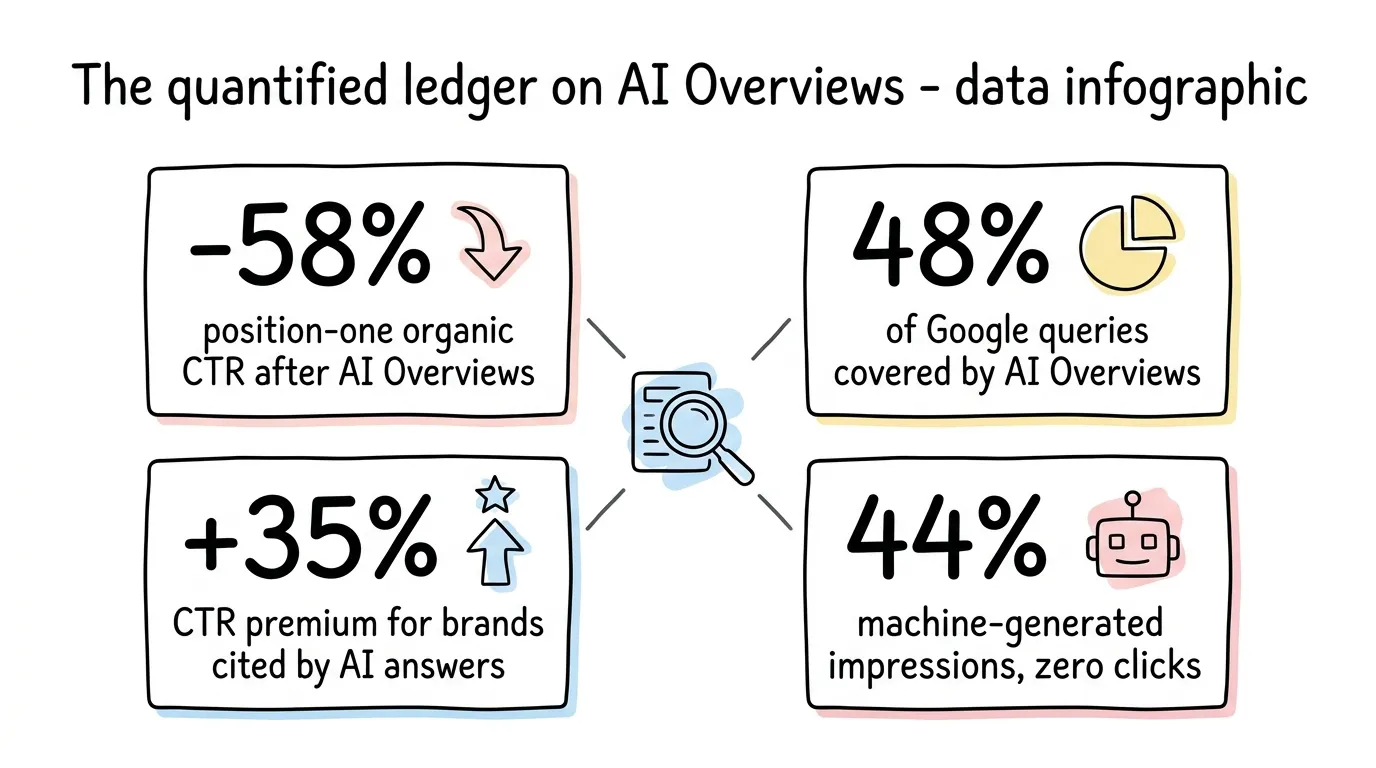
💬 Start with your top-10 traffic pages: rewrite the key passages into excerpt-ready 50-to-150-word answer blocks with schema attached — doable this week. Add a reference rate column to your reports, using tools like Profound or Scrunch, or just sample-test directly. A 35% CTR premium for being cited means GEO isn't a purely defensive game.
🔗 Further reading: Read the full article
Ten GEO tactics: test your brand appearance rate before you act
ClickForest's GEO strategy piece lays out ten executable moves covering answer-style content structure, schema structured data, brand entity consistency, high-authority third-party citations, and FAQ blocks — the idea being to let AI lift concise answers verbatim. Third-party corroboration gets top billing: reviews, listicles, and media coverage carry more weight in the AI citation chain than anything a brand says about itself. Drawing on European market data, it notes that AI search habits differ sharply across countries, so multi-market brands need region-by-region plays rather than one playbook copied worldwide. On monitoring, the advice is to regularly test brand appearance rates across AI platforms with your target questions, treating citation-rate movement as a trackable metric.
💬 Don't just run the ten plays. Run a baseline test first: list 20 questions real buyers would ask, run them through ChatGPT, Gemini, and Perplexity, and record how often your brand appears — that's the control group for every GEO move that follows. Multi-market teams should test country by country; the differences inside Europe are bigger than you'd think.
🔗 Further reading: Read the full article
E-commerce GEO: turn product pages into the answer source AI recommends
ShopOS's GEO best-practices guide pushes the question past "how do I get cited" to "how do I get recommended," with eight practices for DTC and e-commerce brands: question-oriented answer structure, schema and entity reinforcement, trust signals like reviews, deep product content, third-party validation, and prompt-level visibility monitoring. The piece splits the AI purchase journey into ask, compare, and recommend — each stage calling for a different content asset. Compared with generic guides, it stays focused on the purchase decision chain, treating reviews and rankings as direct variables in recommendation rate. Its thesis: by 2026 GEO belongs in the mandatory layer of content pages, product pages, and technical SEO — no longer a trend forecast.
💬 E-commerce teams should do two things first: add question-style headings with direct answers to product pages, and structure your review data. For monthly monitoring, test each platform's recommendations with real shopping questions — how often you get recommended predicts AI-channel sales better than organic rank ever will.
🔗 Further reading: Read the full article
The tracker page that scans a month of industry news in one scroll
Keywords Everywhere's AI marketing news tracker is updated through November 20, with a rolling roundup by platform: 42 AI Overviews updates logged over 90 days, 52 for ChatGPT, 29 for Gemini, 16 for Google algorithms, plus categories for Instagram, social platforms, Copilot, Claude, Grok, and more — each entry with a short note and source link. The SEO section is broken out separately, with dedicated entries for confirmed Google algorithm updates, Search Console changes, AI Overviews, AI Mode, and Discover; Google Discover gets its own list of 7 items. For anyone who needs a daily glance at industry movement, a structured index like this saves the cost of switching between a dozen information sources.
💬 Treat it as your five-minute daily scan source and limit yourself to the two or three categories relevant to your business — don't get greedy. For major changes, go back to the original source to verify details; the index's interpretations stay deliberately measured, built for cross-checking rather than direct citation.
🔗 Further reading: Read the full article
A timeline for anomaly attribution across 148 Google updates
SearchAtlas's algorithm and ad-platform update tracker has logged 148 Google Search updates to date, distinguishing officially confirmed changes from community-observed ones, while also covering policy and algorithm shifts across Google Ads, Meta Ads, Microsoft Ads, and TikTok Ads. It specifically flags traffic-volatility records triggered by the launch and expansion of AI Overviews and AI Mode, filterable by platform and time. Its real use is anomaly attribution: when rankings or conversions move, work backwards through the timeline to check whether a confirmed update landed within 7 days on either side — turning attribution from guesswork into verification.
💬 Add one step to your team's process: before any traffic-anomaly report discusses causes, it attaches a screenshot of the update timeline. That one step blocks half of all misattributions before the meeting, and the meeting time it saves is worth more than the tool's subscription fee.
🔗 Further reading: Read the full article
Choosing creative ad tech: separate generative from agentic first
Innovid's 2026 cross-review of creative ad tech platforms leans on three data points: a Forrester Q2 2026 report naming creative the most effective lever for lifting ROAS, a Gartner survey finding 88% of CMOs expect generative AI to deliver positive marketing ROI, and Mediaocean counting 60% of marketers planning to increase AI media investment. The piece splits platform capabilities into generative AI (producing assets) and agentic AI (taking over trafficking, QA, and optimization), comparing eight platforms across six dimensions including channel coverage, production personalization, and measurement. Bear in mind this is vendor-authored content with Innovid itself among the eight — discount the conclusions accordingly.
💬 Use its six-dimension framework, not its conclusions. Step one of any selection is deciding whether your gap is production or execution: short on asset capacity, look generative; short on campaign-operations hands, look agentic. For any vendor cross-review, always cross-check a set of G2 reviews before deciding.
🔗 Further reading: Read the full article
Cross-review of 11 creative automation platforms: picking the wrong category costs more than the wrong brand
Bannerflow's cross-review compares 11 creative automation platforms, and its argument is blunt: the most common enterprise selection error is category misplacement — creative production, media buying, and DAM (digital asset management) enhancement are three different kinds of tools. Celtra and Smartly target enterprise media scale; Storyteq is DAM plus an automation layer; The Brief and Viewst take the small-team self-serve route; Abyssale leans on templates plus API; Bannerflow itself sits in the middle, connecting to 100+ delivery platforms. The piece distinguishes creative automation (producing variants) from creative intelligence (predicting performance plus attribution feedback) as two separate layers, draws its evidence from public G2 and Gartner data, and discloses its own position up front while conceding competitors' strengths.
💬 Use its category-diagnosis method internally first: is your bottleneck variant capacity, distribution channels, or asset management? Match the diagnosis before drawing up a brand shortlist. For small and mid-size teams, starting with self-serve tools costs far less than jumping straight to enterprise grade.
🔗 Further reading: Read the full article
🏷 AI Agents & Automation
The ad automation division-of-labor table: hand over bidding, keep negative keywords in human hands
Cascade's guide to ad management automation breaks tasks into a three-layer framework — platform-native features, cross-platform tools, and conversational AI agents — with the degree of delegation set by budget and team structure. The task-level division-of-labor table inside is worth archiving on its own: bidding, budgets, targeting, and asset generation can be partially delegated to AI and rules, while brand compliance, final review of negative keyword lists, and business interpretation must stay with humans. Citing official data, the guide notes that search campaigns using AI Max saw average conversion value rise about 14% with CPA and ROAS roughly flat, and warns that Smart Bidding re-enters its learning period after goals change or structure is adjusted.
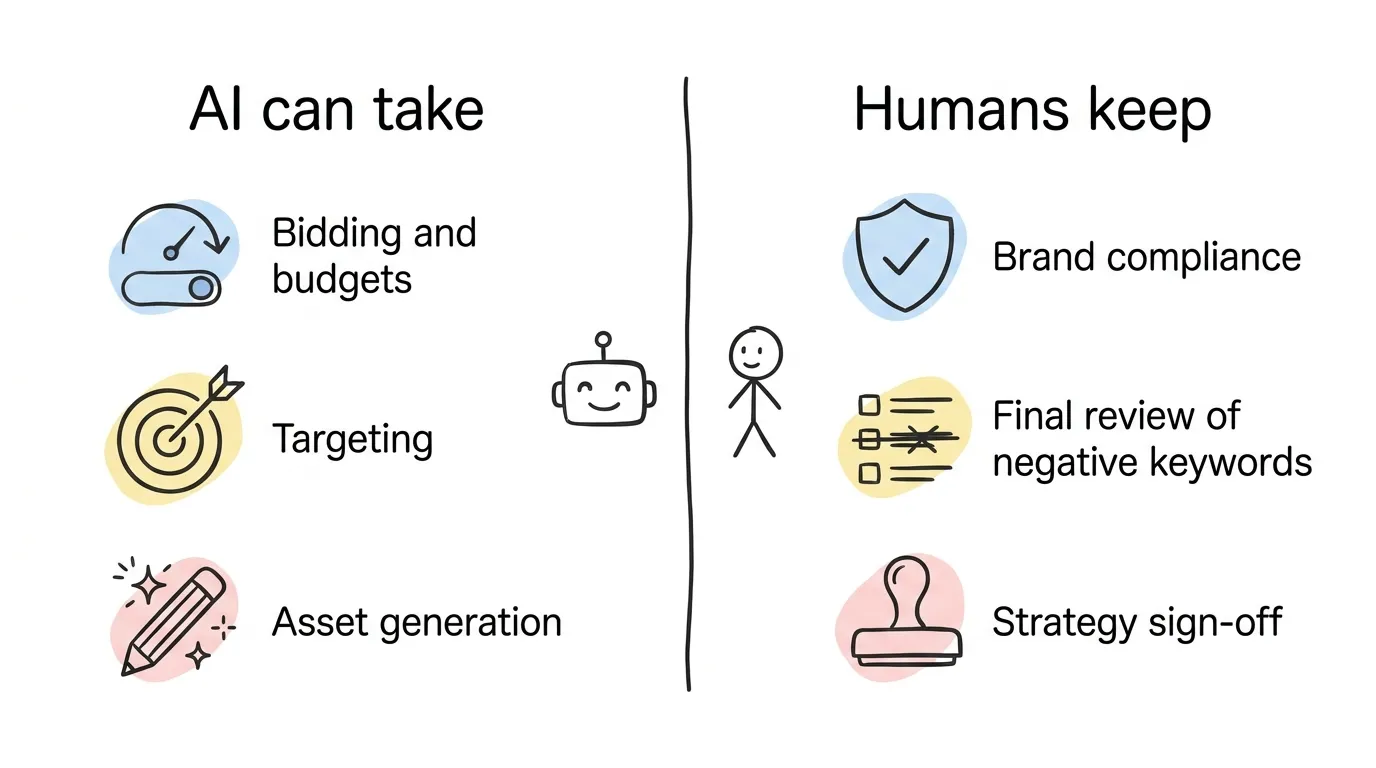
💬 Copy the division-of-labor table into your team wiki and mark your own delegation status line by line. The task most often handed over by mistake is final review of negative keywords — one wrong negative list can burn through budget during a learning period. Before changing targets, price out the relearning cost, and never adjust bids and swap creative in the same week.
🔗 Further reading: Read the full article
The right definition of an AI marketing agent: goals, tools, and boundaries
codesoftic's explainer offers a pragmatic definition of an AI marketing agent: a system that pursues goals, executes across tools, and operates within boundaries and human approvals — distinct from automation that follows preset instructions. Using next week's campaign prep as its example, it walks through multi-step execution: analyze the information, qualify the lead type, choose the action, update the CRM, draft the follow-up, request human sign-off. Citing how Google Cloud and Shopify describe agent use cases, the author recommends starting delegation with repeatable, data-dense, multi-step processes, keeping brand and strategy sign-off with people. The article's value is expectation management: an agent doesn't take over the marketing department — it takes over the part of the workflow that repeats reliably.
💬 Useful for internal alignment: in meetings, separate the two words "automation" and "agent" and you erase half the argument about who gets replaced. Start with a multi-step process like lead follow-up, get one running end to end, then expand — don't hand your whole content pipeline to an agent on day one.
🔗 Further reading: Read the full article
What a fully managed marketing agent actually looks like
Enrich Labs' AI marketing automation guide, updated through November 20, breaks down use cases for AI marketing agents by industry across six categories: e-commerce, B2B SaaS, local services, healthcare, agencies, and independent creators. Its product narrative is a single agent handling fully managed operations across content, ads, SEO, and email, with role-based agents including Helena (digital marketing), Sam (SEO and GEO), Kai (social listening), Angela (email), and Paul (paid ads). The content is fairly comprehensive but carries an obvious vendor slant, and its data is unverified by third parties; read it as a specimen of the product form, not as conclusions.
💬 Take the fully managed narrative with a grain of salt; the genuinely borrowable idea is slicing use cases by industry. When evaluating products like this, ask one hard question: when the agent's output is wrong, who is on the hook, and what does the approval flow look like? A fully managed product with no approval flow gets zero budget, every time.
🔗 Further reading: Read the full article
The hub of the agent stack is CRM, not the model
bakedwith's selection guide splits 2026's marketing AI agents into two camps: the platform layer — ChatGPT Agent Mode, Claude Computer Use, n8n, Make, and Zapier AI — and the enterprise tier of HubSpot Agent Hub and Salesforce Agentforce. Each platform-layer option has its lane: ChatGPT Agent Mode suits rapid prototyping, Claude Computer Use excels at browser-level research flows, and n8n wins on deep customization. On the enterprise side, Agent Hub spans content, social, prospecting, and data agents, while Agentforce is deeply bound to Salesforce customer data. The argument: an agent only delivers full value when connected to real customer data — CRM is the brain of the modern agent stack, and an agent cut off from customer data is a demo toy.
💬 Run the selection order in reverse: inventory what data your CRM holds first, then choose an agent that can plug into it. Don't watch a dazzling demo and only then wonder where the data comes from. HubSpot and Salesforce users have a head start; every other stack should fix its data pipelines first.
🔗 Further reading: Read the full article
🏷 Industry Data
ChatGPT business profiles and SERP pollution: three search developments this month
Arc Intermedia's November monthly report covers three developments worth tracking. ChatGPT has launched business-profile-style capabilities, making brands' official information slots inside AI answers a new optimization target. SERP pollution gets named as a risk: low-quality and fabricated content is mixing into the AI citation chain, so the sources AI cites for your brand need active monitoring. And GA4's AI-related measurement updates affect attribution and reporting definitions. The report is organized as what happened, why it matters, and what to do, with each item converting directly into an action item — granularity that suits teams with no time to chase every headline.
💬 Two things to do this week: check whether your brand's business profile information in ChatGPT is complete and accurate — it's a free AI visibility entry point. Then set up a monitoring list and spot-check monthly which sources AI answers cite for your brand; when you find a fabricated source, dispute it promptly.
🔗 Further reading: Read the full article
44% of GSC impressions are machine-generated queries — with zero clicks
Technova Partners, using its own Google Search Console data, offers a striking number: in October 2026, 44.1% of the site's GSC impressions with visible queries came from machine-generated queries — prompt-style queries, rank-tracker probes, and scraping queries — and not one of them produced a click. On that basis the article argues that brands need to optimize for both chains at once, being cited by AI and clicked by humans, rather than picking one over the other; the concrete moves include entity consistency, FAQ structure, and third-party corroboration, with execution priorities attached. The value of the consultancy's perspective is that the numbers come from first-party data on a real site, not vendor estimates.
💬 Go pull your own GSC query report and check your machine-query share and click rate — ten minutes is enough for your own baseline measurement. If the share is anywhere near 44%, AI citation rate belongs in your content team's KPIs.
🔗 Further reading: Read the full article
A three-layer attribution framework: proving AI marketing ROI to finance
Hovi Digital Lab's ROI guide proposes a three-layer attribution framework: the campaign layer tracks ROAS, CPA, CTR, and conversion rate; the pipeline layer tracks MQLs, SQLs, and pipeline velocity; the business layer tracks revenue lift, CAC, CLV, and marketing efficiency ratio. On the data side it cites a HubSpot survey: only about 36% of marketers can prove campaign ROI, and fewer than four in ten teams can demonstrate returns on AI investment; McKinsey's figures have AI adopters reporting 3-to-15% revenue lift and 10-to-20% marketing ROI improvement. The guide's industry reference points include ROAS up 30-to-50%, CPA down 20-to-40% within the first 90 days, and CTR averaging 41% higher for AI-driven campaigns — with the reminder to evaluate over a 90-day learning period.
💬 If your CFO only accepts campaign-layer reporting, fill in the pipeline layer first: tag AI-assisted leads and track the conversion differential down to SQL. Ninety days is a reasonable window for judging AI investment; demanding payback in week one is an expectation that fails on its own terms.
🔗 Further reading: Read the full article
After the cost of copywriting goes to zero, where does the marketer's value move?
UCD Professional Academy's analysis maps AI's penetration across the full social media marketing workflow: creative generation, visual variants, social listening, audience pattern recognition, and paid optimization are all now handled by AI — while stating its limits just as clearly: output can be inaccurate, generic, or carry hidden bias, and it flattens brand voice. The conclusion points to capability migration: when the production cost of competent copy approaches zero, the center of value shifts to strategic judgment, creative judgment, and genuine audience understanding. The analysis distinguishes generative, recommender, predictive, listening, and moderation classes of AI systems, and its balanced view makes it a good discussion draft for team skills planning; the weakness is a shortage of original data.
💬 Use it for a team skills inventory: have everyone self-assess which of their tasks AI already covers and which judgments AI can't replace — the gap is next quarter's learning list. Shift training budget from tool operation toward audience research and strategy simulation; that money is cheaper spent now than next year.
🔗 Further reading: Read the full article
93% vs 53%: the 40-point gap between marketer confidence and consumer experience
Braze draws on its own 2026 Global Customer Engagement Report: 93% of marketing leaders believe AI delivers sharper audience insight, but only 53% of consumers believe brands truly understand what they want — a 40-percentage-point gap between what marketers predict and what consumers actually feel. The piece systematically contrasts rules-based automation with AI decisioning: triggers shift from preset rules to real-time predictive signals, segmentation from static to continuously adaptive, optimization from manual A/B testing to continuous learning. AI decisioning uses reinforcement learning to optimize message, channel, timing, frequency, creative, and incentives simultaneously, deciding at the individual level — while still conceding that rules-based automation keeps a place in highly deterministic workflows.
💬 A 40-percentage-point gap is consumers voting with their feet. Don't rush to roll out AI decisioning everywhere — pilot one high-value scenario first, say individual-level optimization of message timing, prove the increment, then expand. Keep rules for deterministic workflows: cheaper and more stable.
🔗 Further reading: Read the full article
🏷 Policy & Funding
The legal bill for AI creative assets: FTC scrutiny, copyright exposure, and automation as an amplifier
MarTech's long-form piece systematically maps the risk surface of AI-generated creative assets. On the regulatory side, the FTC is tightening scrutiny of exaggerated claims and fake demonstrations in AI ads, brands bear full responsibility for AI output, and improper disclosure of AI content is itself a compliance risk. On the copyright side, ownership remains unsettled: the US Copyright Office's 2025 report takes the position that whether training use constitutes fair use is judged case by case, the EU AI Act imposes separate copyright obligations on general-purpose model providers, and stylized prompts can still produce protected elements or consumer confusion. The article's sharpest point is automation as an amplifier: one flawed asset entering an automated workflow gets replicated across ads, email, product pages, and localized campaigns — by the time anyone notices, it's everywhere. It also punctures a common misconception: adding a label is not a liability shield, and disclosure cannot rescue a misleading claim. The governance checklist: human review, provenance records, use-case tiering, and legal pre-review.
💬 Set three rules this week: every externally published AI asset passes human review, the asset library records the generating tool and prompt provenance, and high-risk claims about efficacy, pricing, and comparisons get legal pre-review. Add a spot-check gate to automated workflows — flawed assets now spread two orders of magnitude faster than in the manual era.
🔗 Further reading: Read the full article
💡 Today's Takeaways
The through-line today is the commercialization net closing on AI answer slots. Microsoft opened Bing AI Overviews to ads and paired the move with controllability tooling; Google spread AI Mode ads across ten countries with all four ad slots filled. Both have turned AI answers into formal ad inventory ahead of Black Friday. The supporting data is arriving too: AI Overviews cover 48% of queries, position-one CTR is down 58%, machine-generated queries take 44% of GSC impressions — numbers that move GEO from concept discussion to a budget-line item.
The second through-line is the boundary of delegation being drawn. The agent and automation pieces cluster together today, yet the consensus is strikingly consistent: bidding and asset production can be handed over; brand compliance, negative keywords, and strategy sign-off must stay with people. Braze's 93-versus-53 gap is the best footnote to it — between AI's capability ceiling and what consumers actually experience sits execution quality, so treat fully managed narratives and products missing approval flows with care.
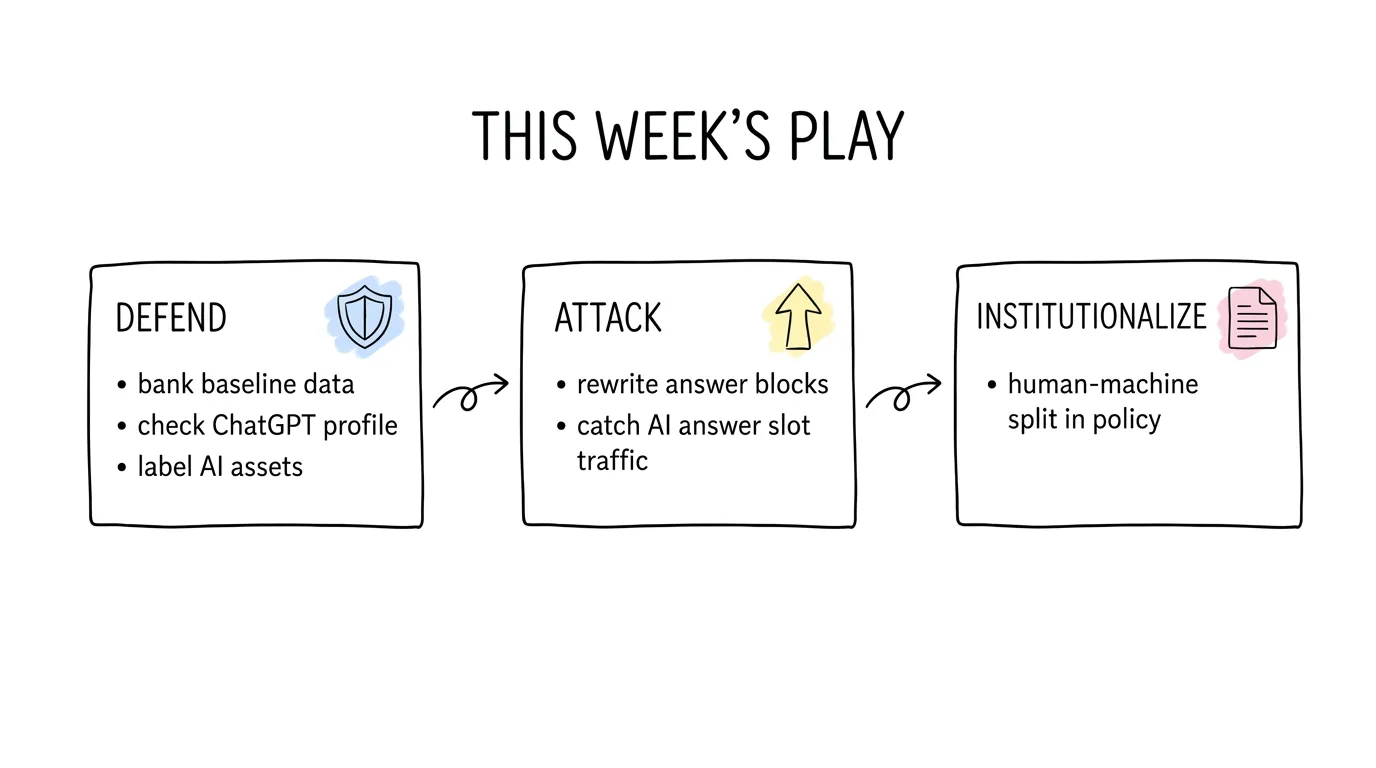
For marketers, the action order: play defense this week — bank baseline data, check your ChatGPT business profile, inventory disclosure labels on AI creative assets; then go on offense — capture the answer-block rewrites and the traffic window in AI answer slots; and organizationally, write the human-machine division of labor into policy rather than leaving it to good intentions. The competition in AI marketing is shifting from who knows how to use the tools to whose governance and attribution get working first.
Continue reading
Related articles
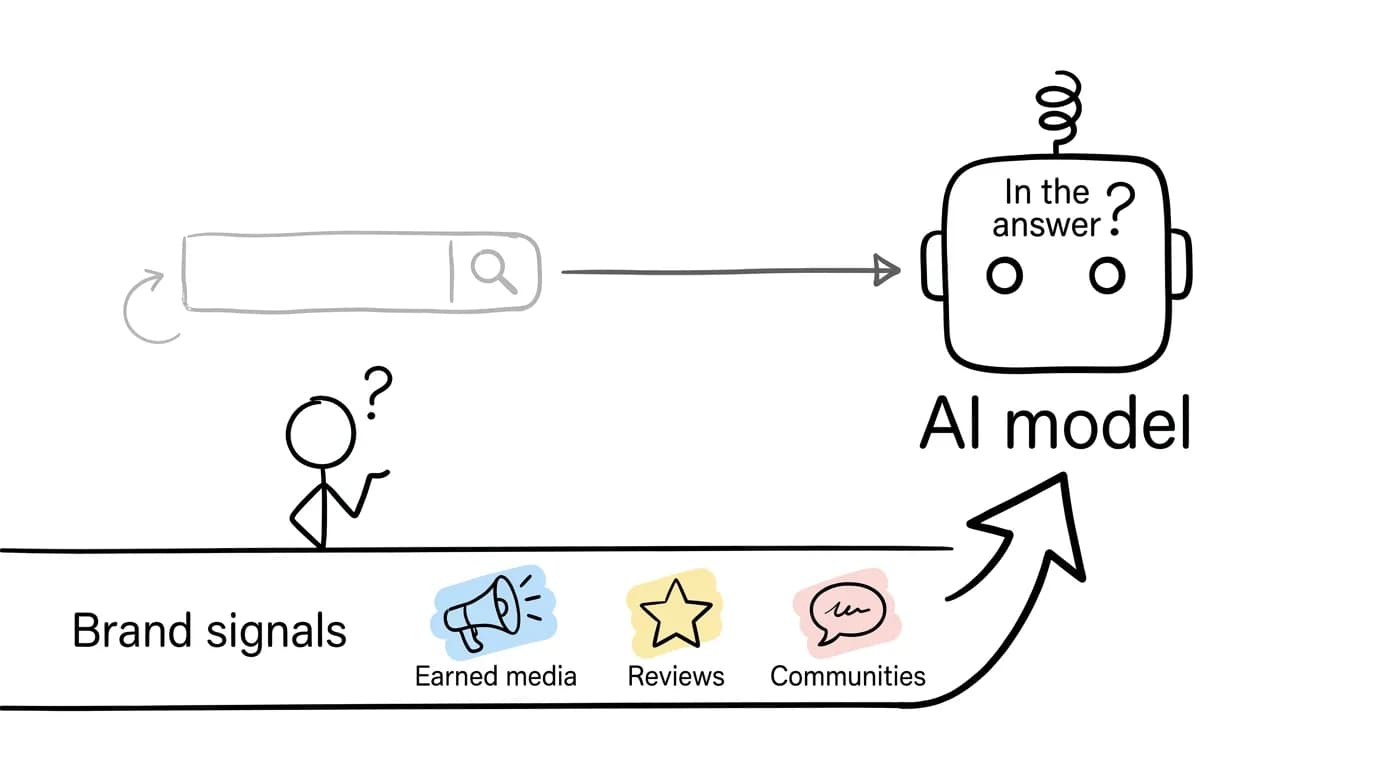
AI Marketing Daily · 2026-11-21
A November 21, 2026 AI-marketing daily covering AI search visibility, GEO methods, Google AI Mode ads expanding to ten countries, Meta's pre-Black Friday changes, agentic shopping, and industry adoption and ROI data.
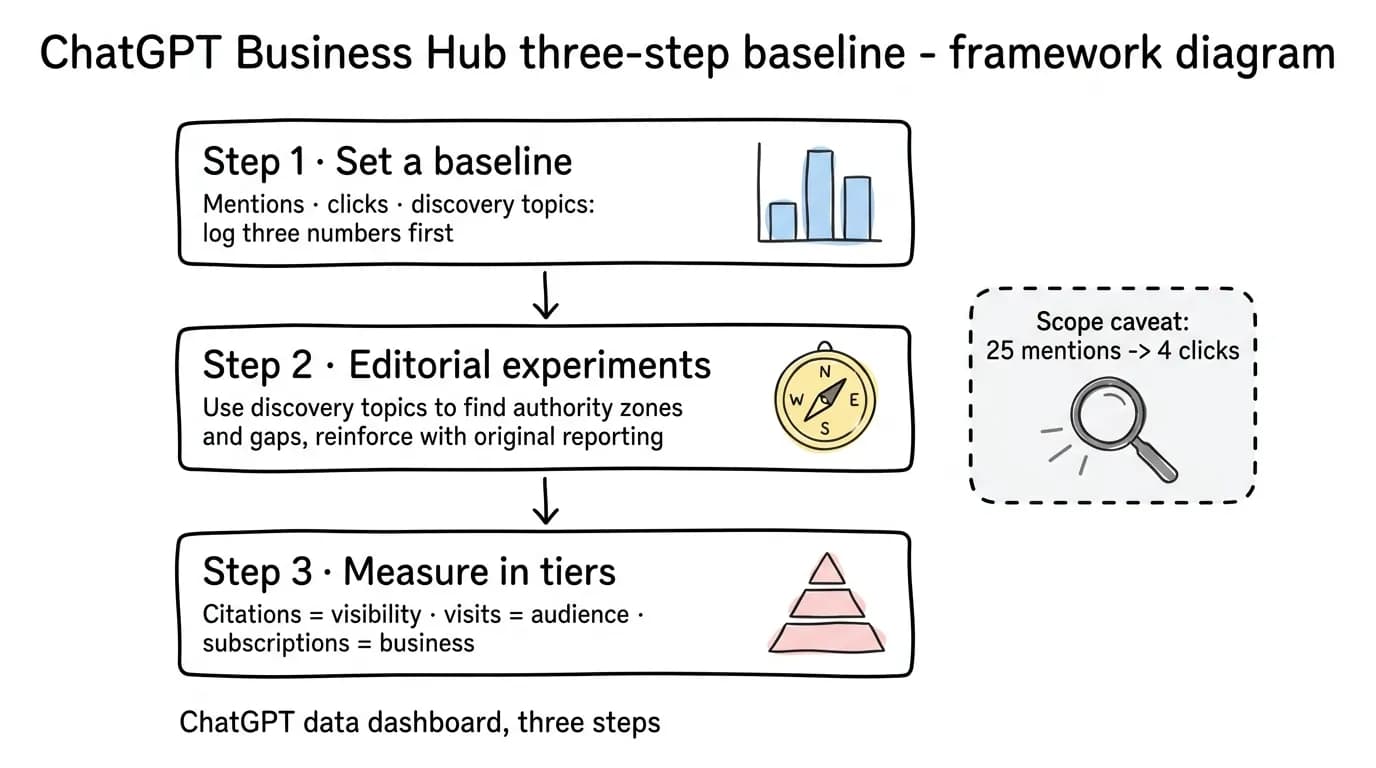
AI Marketing Daily · 2026-11-20
AI Marketing Daily for 2026-11-20 rounds up 19 items centered on measurement: OpenAI's ChatGPT Business Hub dashboard, EU rules for agent-mediated purchasing, Meta pausing four AI terms, and B2B data on shortlists and the dark funnel, each with action advice.
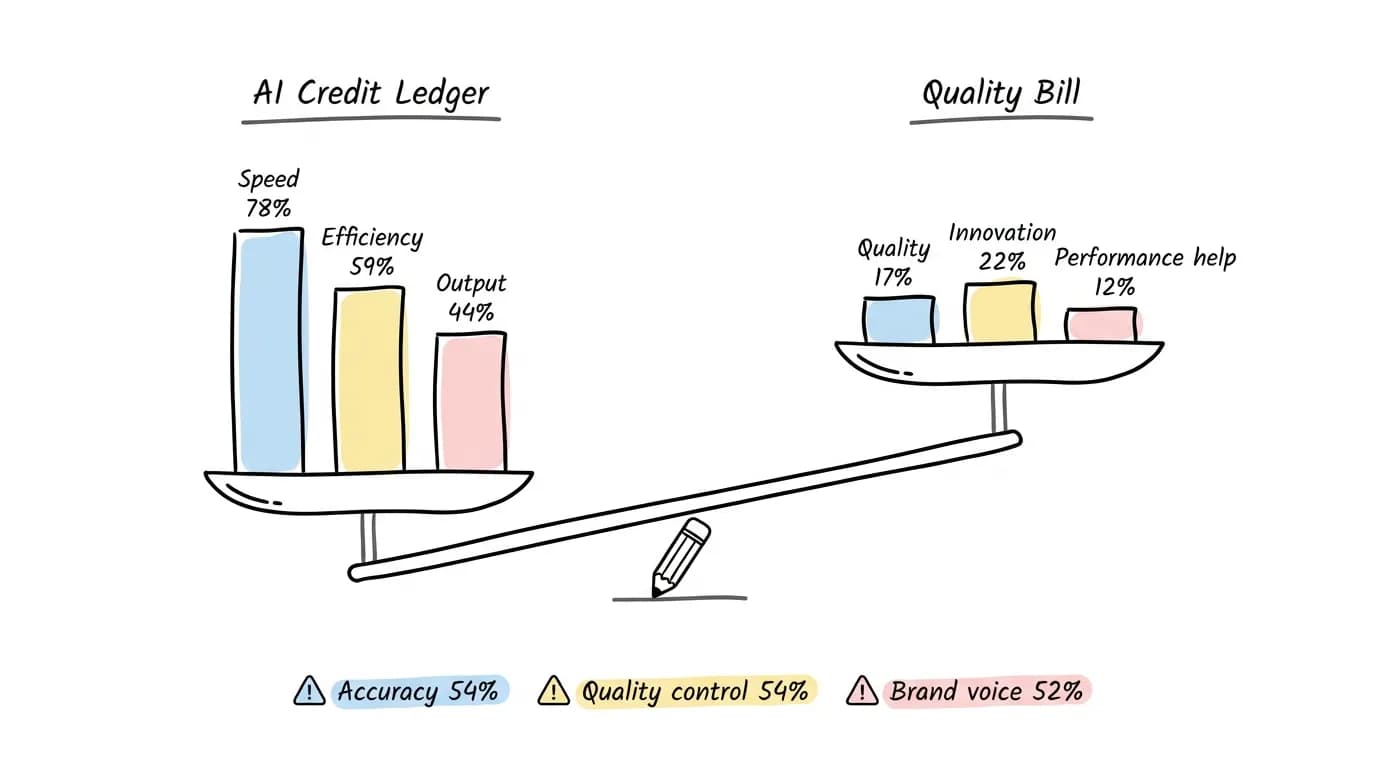
AI Marketing Daily · 2026-11-19
AI Marketing Daily for 2026-11-19 compiles twenty items led by CMI's B2B content marketing report on AI content speed versus quality, with sections on GEO and AI search citations, agent tools and pricing, platform launches, playbooks, and industry data.