
AI Is Reshaping Marketing. So Why Hasn't Marketing's Own Turn Come?
Commentary on a BCG survey of 300 CMOs on AI reshaping marketing, covering the gap between AI investment and agentic adoption, talent as the main bottleneck, and the report's advice to build connected agentic systems rather than buying tools one by one.
A few days ago, I was flipping through a report from Boston Consulting Group (BCG). They surveyed 300 chief marketing officers around the world and sat down for in-depth conversations with 50 of them. One number stopped me cold.
96%.
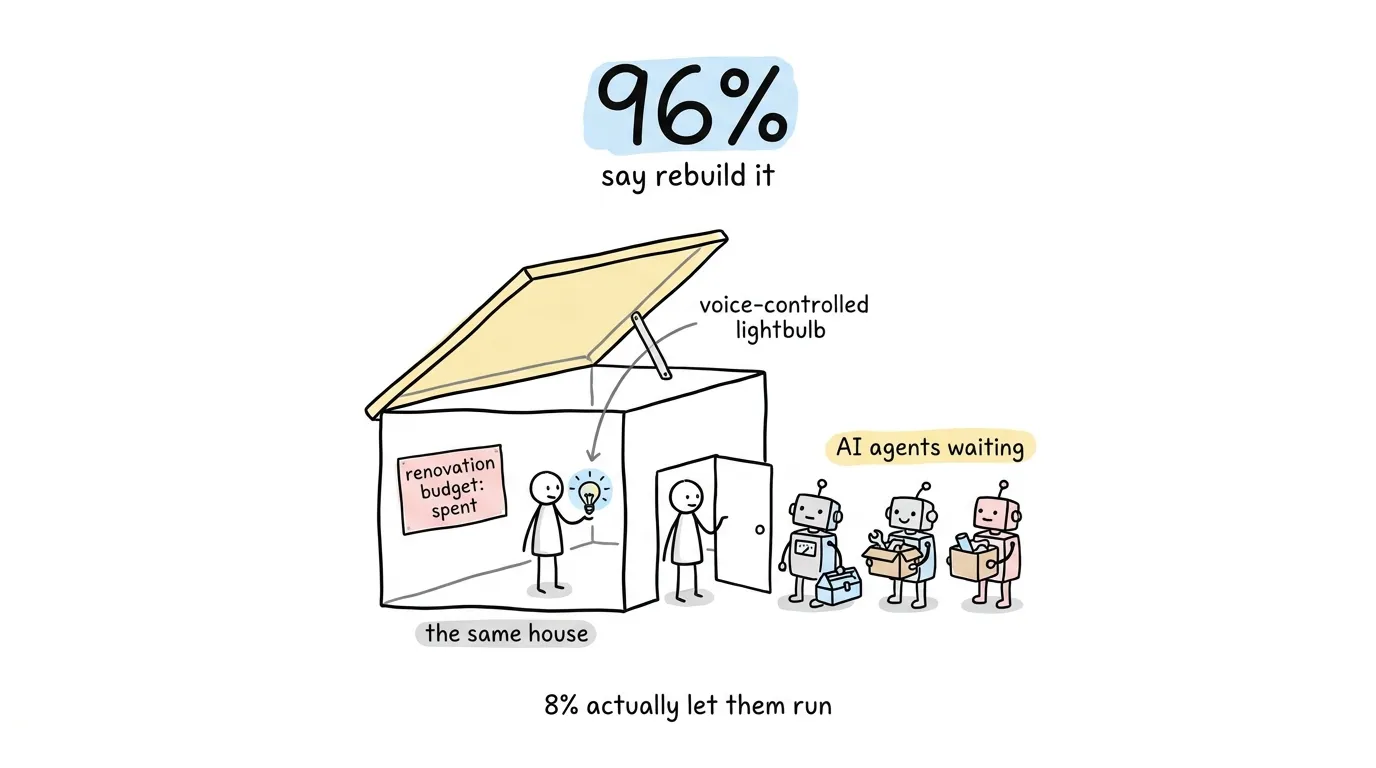
96% of CMOs say AI is reshaping the marketing function end to end.
What does end to end mean? From head to toe. From finding users, making content, and placing ads, to measuring results — the entire pipeline, rebuilt from scratch.
96% of them see it clearly.
But.
The ones actually letting multiple AI agents run autonomously and carry a full marketing campaign from start to finish: only 8%.
Those who have used agents to overhaul some important parts of their function: fewer than a third.
And 42%? Stuck right where they started — treating generative AI as an assistant. It helps people write a line of copy here, retouch an image there, run the odd errand.
It's like paying a fortune for a designer, tearing down the walls, buying a full suite of smart appliances — and then only using it all to swap the living-room light for a voice-controlled one.
The money's spent. The house is still the same house.
The Pressure Is Real
Why does everyone talk about reinvention, yet never act on it?
First, look at the weight they're carrying.
94% of CMOs say that over the past two years, the CEO's expectations of marketing have clearly risen.
Expectations are up — and what about ownership? Here's an interesting mismatch. For AI investment inside the marketing function, about half of CMOs say marketing itself already makes the final call. But looking across the whole company, 72% of CEOs say: when it comes to AI, the first decision-maker is me.
That is to say, marketing wants to run a big play of its own, but the company's steering wheel is still in someone else's hands.
Fortunately, the money is actually flowing in.
43% of companies are spending more than $15 million on AI in marketing this year. Last year, that share was only 28%.
Among the CMOs spending most aggressively, 41% are betting big on one thing: end-to-end workflow orchestration. The number-one investment destination is marketing technology and data, up 11 to 12 percentage points from 2025.
The returns are real too. 31% of B2C marketing leaders and 20% of B2B marketing leaders say the agentic marketing transformation has already brought in real, measurable revenue.
So you see: the pressure is real, and the money is real.
The money has arrived. The people haven't.
The Hardest Part Isn't the Technology. It's the People.
So where's the bottleneck?
The report makes one call I strongly agree with: the hardest part is talent.
80% of CMOs have invested heavily in AI skills training. Roughly the same share have added training on responsible AI and ethics — 10 percentage points more than in 2025.
Why are they so willing to spend on training?
Because this kind of talent can't be hired on the market. More than one CMO interviewed put it bluntly: you can't recruit this capability, you can only build it yourself.
What does "build it yourself" mean? It's that you can't buy a "head of agentic marketing" on the talent market, move them into the organization, and call it done. You have to develop your existing people, one by one. You also have to set up new roles, assemble new teams, redraw the org structure, and rewire the processes.
This is no longer buying tools. This is renovation.
The wall-smashing kind.
The Next Step Isn't Buying More Tools
So which way forward?
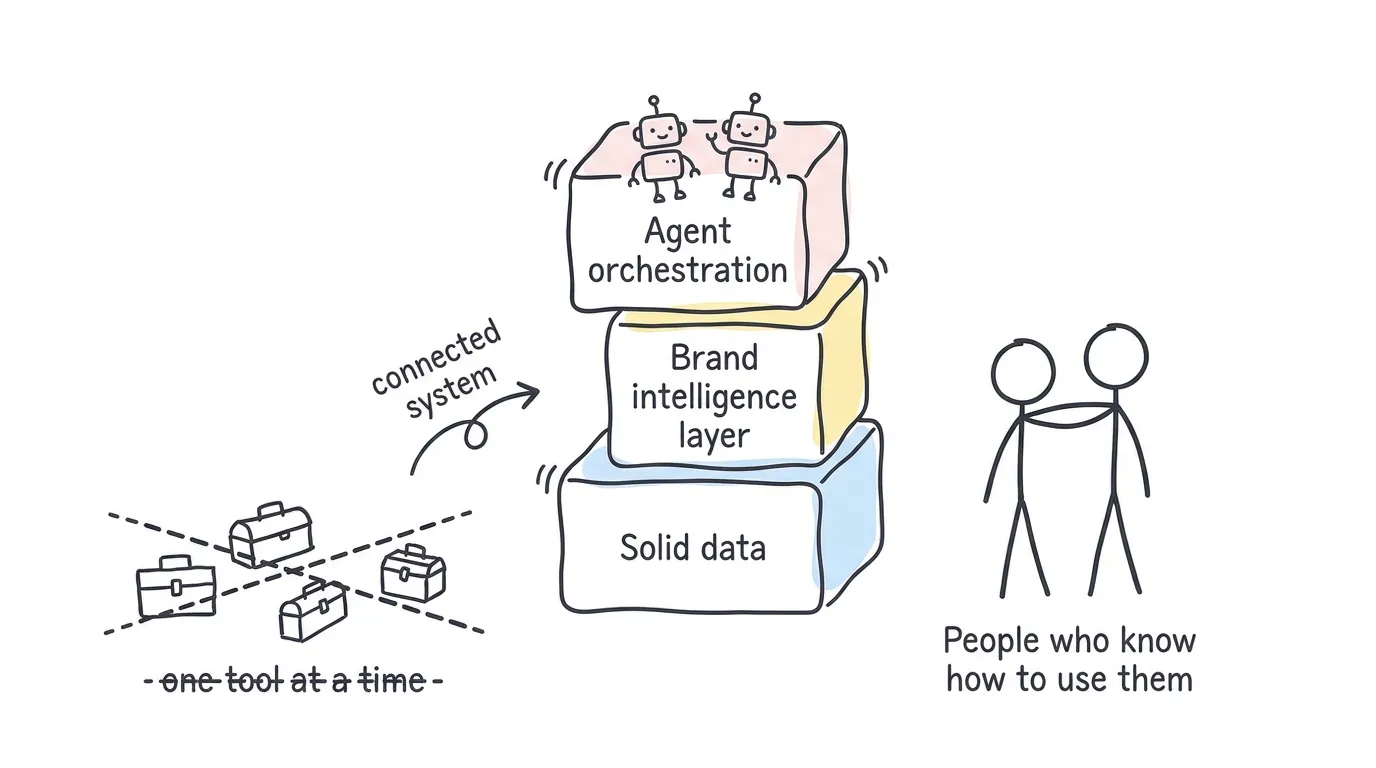
The report's advice, stripped to its essence: stop buying AI tools one at a time. What should be built is a connected agentic operating system.
What goes underneath? Solid data. What sits in the middle? The brand's intelligence layer. What runs on top? The coordination of multiple agents. Who stands alongside? People who know how to use them.
Sounds a bit abstract? Let me put it another way.
Using AI tools in the past was like hiring a batch of consultants. You ask one question, they answer one question, and when they leave, the skill leaves with them.
Building an agentic system now is like cultivating a team of employees. You set the goal, and they divide the work themselves, run the whole process, deliver the results. And the team gets better the longer you lead it.
90% of CMOs admit it: generative AI is already reshaping the way consumers discover and compare brands. Your customers have already started discovering you in a new way.
Yet most marketing organizations are not yet ready for that world.
One more warning in the report stuck with me: if established brands don't build themselves up first, the new brands — born and raised on agents — will do the building for them.
In other words, if you don't reinvent yourself, you'll be reinvented by someone else.
Finally, Back to You
If you're also one of that 96% — saying the right things about reinvention while still using AI to polish a little copy — here's what I want to say:
No rush. But don't stop.
When it comes to moving house, the most exhausting step is deciding to start packing. You already know where the new house is; what's left is to move it one cabinet at a time.
Build the people first. Then connect the systems. Don't wait.
Here's to moving into the new home soon.
Continue reading
Related articles

What Is GEO? How Your Brand Gets "Mentioned" in the Age of AI Search
An explainer on GEO (Generative Engine Optimization) for e-commerce and DTC brands: how it differs from SEO and AEO, why AI answers shape brand visibility, and eight practices covering question-focused content, consistent brand messaging, structured pages, external evidence, comparisons, and AI mention tracking.

AI Is Already Making Decisions for Your Customers. Are You on the List?
A learn article explains GEO (Generative Engine Optimization): why AI-generated answers now shape which brands customers see, and how SEO fundamentals, entity clarity, citable evidence, and monthly measurement affect visibility in AI answers.

Google Is Stuffing Ads Into AI Search: These Recent Stories Are Really One Story
A news roundup linking recent AI marketing stories—Google adding ads to AI Mode, Amazon's Ads Agent, ChatGPT image updates, a UK startup tracking brand mentions in AI answers, and an AI ransomware warning—arguing that control over ad data and visibility is shifting toward platforms.