
The Truth About GEO: AI Doesn't Look at Your Ads — It Runs a Background Check
This learn article explains GEO (generative engine optimization) and how it differs from SEO. It debunks common checklist-style GEO tactics, outlines how AI systems find and evaluate sources, and recommends first-hand, evidence-based content plus ongoing measurement of brand visibility in AI answers.
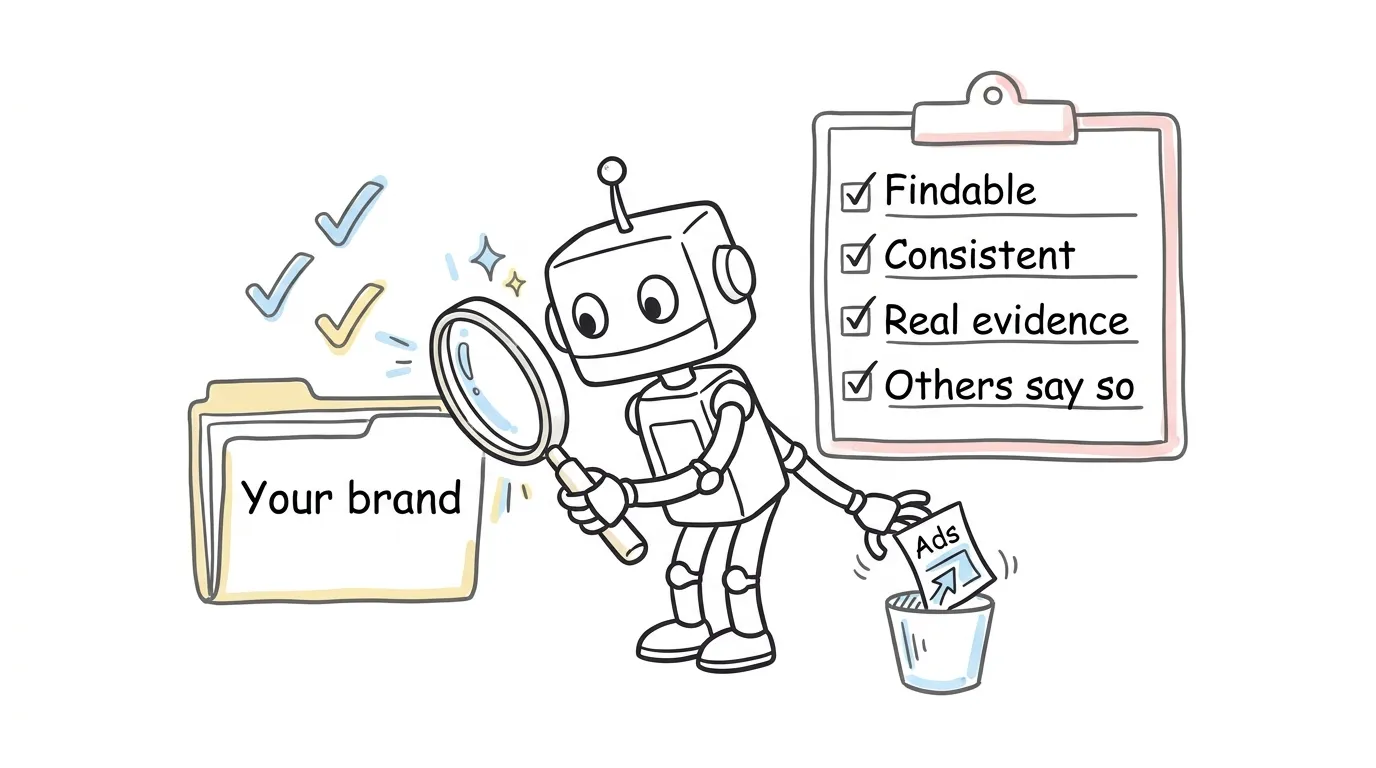
A few days ago, in a marketing group chat, I saw someone share a "GEO checklist."
The checklist wasn't long: publish 40 articles first — only then will ChatGPT treat you as an authority. Then, for every question a user might possibly ask, build a separate page. Sprinkle FAQ schema markup across the entire site. Finally, use tools to bulk-"farm" a batch of AI mentions for yourself.
Below it, a row of replies: Saved, thanks for sharing.
I stared at that checklist for a long while, and all I could think was one thing:
This isn't optimization. It's bribery.
The problem is, AI doesn't take bribes. Ever.
First, Let's Get the Term Straight
What is GEO?
GEO — Generative Engine Optimization. In the past, when you went looking for something in a search engine, you were picking a web page. Today, when you ask ChatGPT or Google's AI summaries, you want a ready-made answer. GEO is about exactly this: when AI writes the answer for your customer, does it find you, does it trust you, and is it willing to name you?
Some say, isn't this just SEO (Search Engine Optimization) with a new coat of paint?
It really isn't the same thing. SEO fights for position — where you rank on the results page. GEO fights for trust — whether the answer includes you, and how well it represents you.
SEO competes on who ranks higher. GEO competes on who holds up under scrutiny.
A Bucket of Cold Water First: There Is No New Magic Here
Plenty of articles out there pitch GEO as a brand-new secret martial art — memorize the incantations, and tomorrow AI will worship at your feet.
Just listen to what Google itself says.
Google's official position is clear: generative experiences like AI Overviews and AI Mode are built directly on top of its core search systems. Want visibility there? Still the same SEO playbook: crawlable, indexable, and genuinely useful to humans. Microsoft, for its part, has openly written GEO into its webmaster guidelines — but flip through the remedies it prescribes, and it's the same old friends: crawlers, sitemaps, clear content.
So don't count on a second algorithm hidden inside AI search for you to game. There is only honest evidence for you to accumulate.
Why did that group-chat checklist make me uneasy? Because it imagines AI as a character who can be sweet-talked.
It's exactly the opposite.
How Does AI Run Your Background Check?
You ask AI a question. What happens behind the curtain?
It doesn't just take your exact words and run one search. It breaks the question apart — into several smaller questions — and goes looking for each piece separately. Google calls this move "query fan-out." It then sifts through the pile of material it fetched, picks out the passages that are clearly argued and reliably sourced, assembles them into one answer, and — almost as an afterthought — pins citations at the end.
Here's an example. Someone asks: how do I choose a wig for someone over sixty, with a small head circumference, that isn't too voluminous, and can still handle heat styling?
To answer that well, AI has to investigate on separate fronts: the materials of heat-resistant fibers, the cap bands for smaller head sizes, how popular mature styles are, how much hair is the right amount, what buyers say in reviews, how the brands compare.
One question so specific it borders on fussy, split into an entire fan.
What does this mean for you? You can no longer ask "which keyword should this page rank for." You have to ask it differently: for AI to answer my customer's question, what materials does it need to find first? And in those materials — am I there?
Held up against that standard, AI's vetting of a company comes down to roughly four gates.
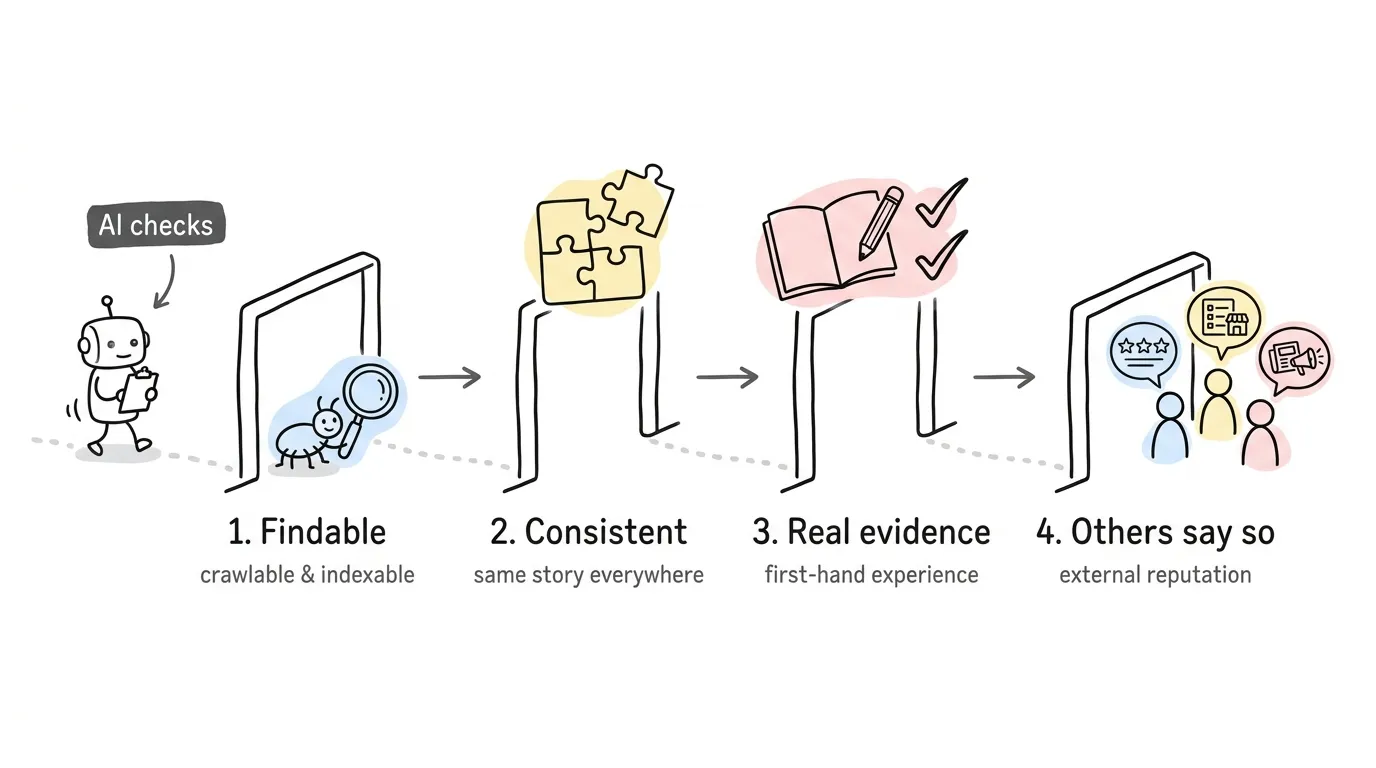
Gate one: can it find you? Being crawlable and indexable is the entry ticket. A side warning while we're here: some companies' CDNs and firewalls treat AI crawlers as malicious traffic and block them at the door. To AI, their websites are invisible — and they have no idea. Take OpenAI, for example: the crawler that handles search and the one that handles model training are two different crawlers. Block the wrong one, and the loss is all yours.
Gate two: can it recognize who you are? Your official website, your business profiles, your professional profiles, your industry directory listings — they all need to tell the same story: what you're called, what you do, where you are, who the experts are, and why you should count. AI assembles its picture of a company like a jigsaw puzzle. One piece that doesn't fit, and the whole picture won't come together.
Gate three: do you have the real goods? This one matters most — it gets its own section below.
Gate four: does everyone else say so too? Saying you're good yourself is a confession; others saying you're good is testimony. Real user reviews on review platforms, legitimate listings in industry directories, mentions in media and podcasts, wholehearted recommendations in forums — these statements scattered across the web together form your external reputation in AI's eyes. Google has specifically warned: don't manufacture mentions. Faked word-of-mouth is like doctored bank statements — one audit and it falls apart. Where you should go is wherever your customers and peers actually gather: answer questions in earnest, show up in good faith.
The Most Valuable Evidence Is the Part Nobody Can Copy
In Google's official guidance, one line deserves real thought. It advises creators to make non-commodity content built on first-hand experience.
What's commodity content?
Open ten random articles about GEO right now, and nine of them look the same: a definition, a GEO-versus-SEO comparison table, a few schema tips, a lump of FAQ. AI can write all of that itself. Pouring effort into it is like laying one more towel on an already packed beach.
So what's non-commodity?
Your own experiment logs. The pits you fell into serving clients. That dataset in your hands nobody else has. The insider's know-how of your trade that outsiders simply don't know.
Take a company that sells enterprise software. Its website says "a powerful AI platform that empowers every team" — a sentence carrying zero information, one any company could paste on unchanged. Replace it with what? Write out exactly which specific scenarios you solve, which systems you integrate with, where your security documentation lives, how your pricing works — and be frank enough to spell out which customers you're not right for.
That page, competitors cannot copy. If AI wants to answer that question, it has no choice but to come to you.
Take a law firm, another example. Instead of writing "professional immigration legal services," answer — honestly — the question that actually keeps your client up at night: after a layoff, what happens to my immigration status and the stock options in my hands?
Content anyone can write, AI doesn't lack. Content only you can write, AI cannot route around.
One writing detail worth flagging. When AI draws material from your article, it often doesn't take the whole piece — it takes a small passage. So every section has to stand on its own: subheads that speak plainly, each section leading with its conclusion, no making readers flip back five paragraphs to figure out what this one is about. But don't turn this into a new formula — Google has said explicitly that you don't need to chop your content into forty-character fragments. Write clearly — clearly for humans to read, and machines will follow along just fine.
Rumors, Research, and Mysticism — Keep Them Sorted
Claims about GEO fly everywhere. When a new one flies at you, I suggest sorting it into a bucket first.
Layer one: documented fact. Written in black and white in official docs.
Layer two: data-backed observation. Someone tested it, the method is public, the results are reproducible.
Layer three: reasonable speculation. The logic holds, but nobody has verified it yet.
Layer four: marketing mysticism. Feels great to hear, no evidence to be found.
The items in that opening checklist — publish 40 articles to be recognized, a page per question, FAQ schema getting ChatGPT to cite you — every one of them lives in layer four.
What actually stands on layer two is the 2024 paper by a Princeton team — the very paper that formally established the term GEO, published alongside a benchmark of ten thousand questions. The conclusion was plain: putting citations next to key claims, using relevant statistics, and quoting experts where appropriate measurably raised content's visibility in generative answers — the best-performing methods lifted visibility by about 40% in the experiments. Keyword stuffing, meanwhile, was essentially useless; on one metric it even performed worse than doing nothing at all.
But keep it straight: 40% is a lab number. The experimental environment was simplified, and today's systems have long since changed shape — don't treat it as a "use it and watch it rise" cheat code. What that paper handed down was a principle, not an algorithm: make the important claims sourced, quantified, and checkable. That principle still stands today.
Oh, and there's also the crowd agonizing over whether to put an llms.txt file on their website. Google settled it in June 2026: not needed, and it doesn't affect rankings. Rather than chase the newest fad, first get your homepage's "what is it we actually do" written clearly.
Don't Mistake Screenshots for Assets
Did you do GEO right? How would you know?
In 2026, this finally stopped being pure guesswork. Google Search Console now offers dedicated generative-AI reporting — how many impressions AI summaries brought you is finally visible. On Microsoft's side, Bing Webmaster Tools can show which pages AI cited and which queries triggered the citations; in October 2026 it added topic-grouped reports that can even tell you: in which questions your competitors got cited and you didn't.
The platform gives you a map. The road, you still walk yourself.
My advice is unglamorous: list a set of questions your customers would genuinely ask, fix the wording, and periodically ask them one by one across the major AI systems. Who got mentioned, who got cited, what tone AI used to describe you — write it all down. Ask another round later, and look at the change.
Why fix the wording? Because the same question, rephrased, may change the star of the answer. Concluding from a single ask is rolling the dice once and calling it fate.
A single ChatGPT screenshot is an anecdote. A fixed set of questions, tested over and over, is a decision.
Back to That Group-Chat Checklist
Later, I replied in the group. The gist: of everything in that checklist, the only item worth doing is "write more genuinely useful content." The rest are either useless or harmful.
Every day, AI writes answers for hundreds of millions of people. It has seen more tricks than we've seen sights. It doesn't take the flyers, it doesn't listen to the sweet talk — the only thing it recognizes is evidence: findable, consistent, able to survive a check.
So stop asking "how do I make AI like me."
Ask yourself instead: when AI sits down to write the answer for my customer, what will it find when it looks for me?
In front of AI, scripts expire. Evidence doesn't.
Here's to holding up under scrutiny.
Continue reading
Related articles

It's 2026: Stop "Buying" AI Tools for Your Marketing Team — Start "Hiring" AI Agents
This learn article explains how AI agents differ from standalone AI tools in marketing, outlines three agent categories — build-your-own platforms, CRM-native agents, and vertical tools — and covers use cases across SEO, social media, advertising, and reporting, plus criteria for choosing one.

What Is GEO? How Your Brand Gets "Mentioned" in the Age of AI Search
An explainer on GEO (Generative Engine Optimization) for e-commerce and DTC brands: how it differs from SEO and AEO, why AI answers shape brand visibility, and eight practices covering question-focused content, consistent brand messaging, structured pages, external evidence, comparisons, and AI mention tracking.

AI Is Already Making Decisions for Your Customers. Are You on the List?
A learn article explains GEO (Generative Engine Optimization): why AI-generated answers now shape which brands customers see, and how SEO fundamentals, entity clarity, citable evidence, and monthly measurement affect visibility in AI answers.