
87% of Marketers Are Already Using AI. So What?
A learn article on AI marketing in 2026, arguing that with most marketers already using generative AI, advantage comes from rebuilding a few key workflows end to end. Covers agentic AI, generative engine optimization, AI video production economics, and consumer attitudes toward AI-made ads.
Last week, I had dinner with a friend who has spent over a decade in marketing.
He told me something pretty deflating: "Three years ago, when I started using AI to write copy, I felt like I was ahead of the curve. Now? The tools I use, the intern at the next desk is using too."
I laughed when I heard that. Because that one line happens to nail the biggest truth about AI marketing in 2026.
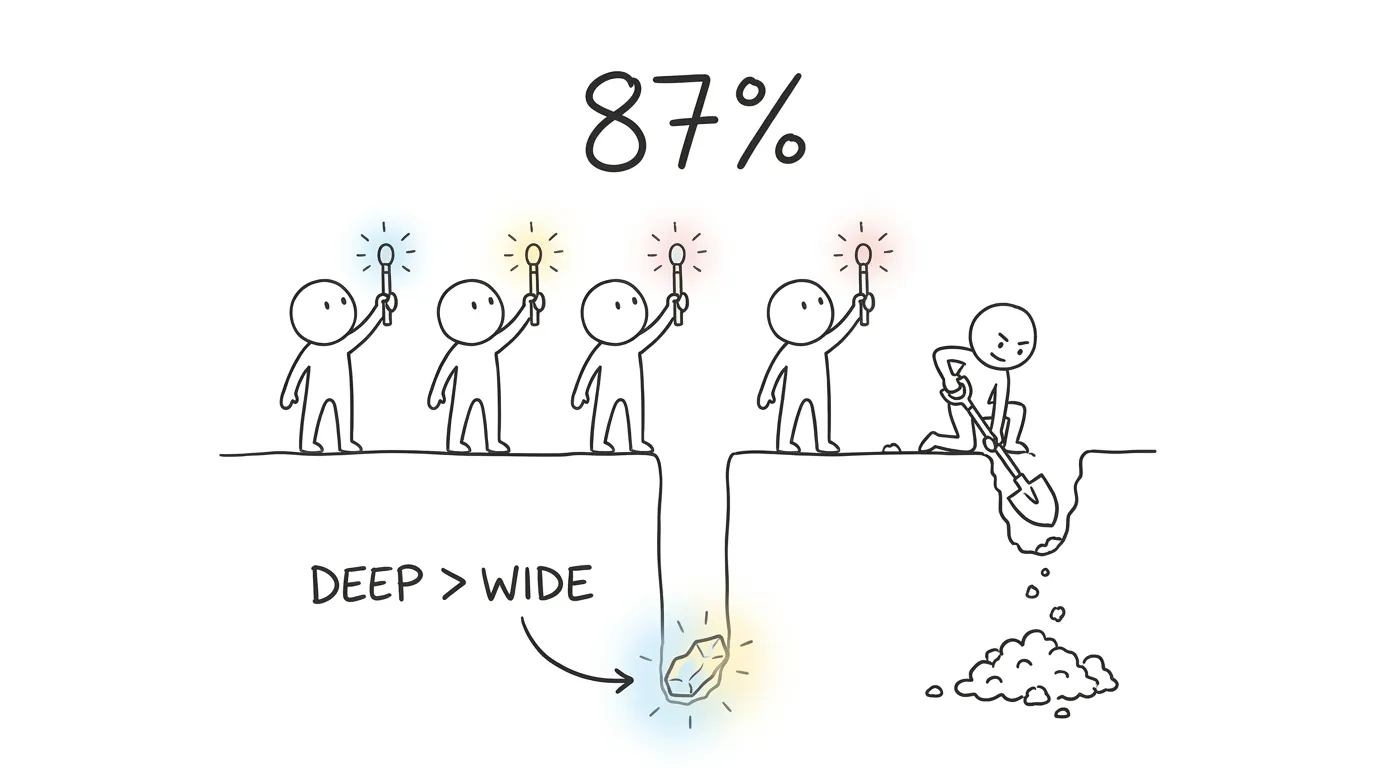
Salesforce's State of Marketing 2026 report has a number: 87% of marketers are already running generative AI in at least one fixed workflow. Two years ago, that number was only half that.
87% — what does that mean? Think of it as the barcode scanner at your corner store's checkout: not a novelty anymore — infrastructure.
When everyone holds the same weapon, the weapon is no longer what decides the fight.
So what decides the fight in 2026? Let me first walk you through the most painful gap, then a few things that are happening right now. By the end, you'll get it.
First, the most painful gap
McKinsey's 2025 global survey says 88% of organizations are using AI in at least one business function, and marketing and sales are among the ones jumping highest.
Sounds like boom times all around, right?
But.
In that same survey, two-thirds of companies are still stuck at the pilot-and-experiment stage; only about a third have actually scaled. What stings more: over 80% of companies admit that generative AI, up to now, hasn't left any measurable trace on the P&L (profit-and-loss statement).
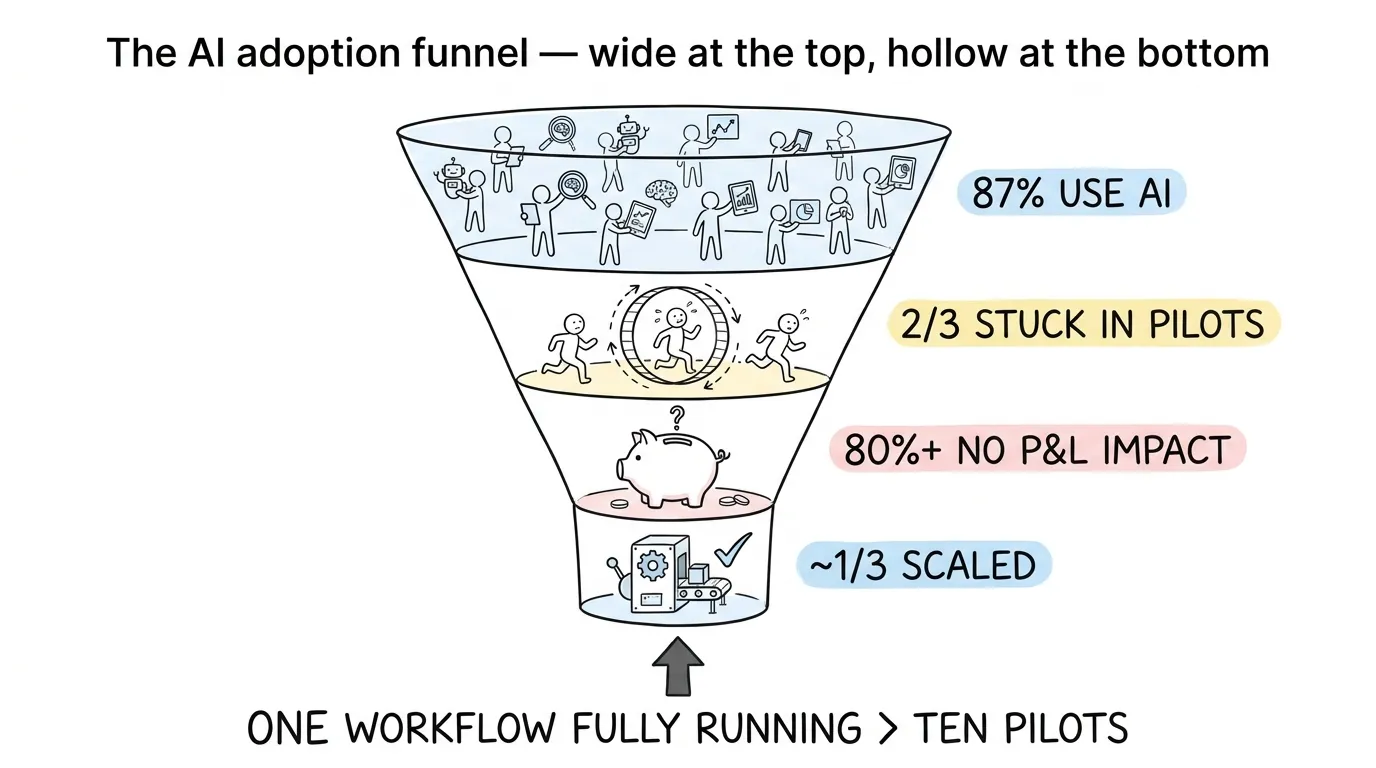
The tools got smarter. The output stayed put.
Marketing is the same story. Salesforce's data: 75% of marketers are using AI in their marketing, but what they send out is still the same one-size-fits-all blast ad for everyone.
Honestly — a good hand of cards, played straight into shouting at the void.
Where's the problem? It's in the "spreading." You spread AI thin across twenty things, dabble in each, and never go deep on any.
The fix runs the opposite way: pick one or two workflows genuinely stuck on "volume" or "speed" — ad creative, personalization, performance reporting — and rebuild one of them properly around AI. One workflow that fully runs beats ten pilots abandoned halfway.
AI went from "helper" to "colleague"
What was AI like before? Waiting for orders. You write a prompt, it turns in the homework. If you don't push, it doesn't move.
2026 is different.
What is Agentic AI? It's AI that starts doing the work itself: give it a brief, and it researches the brand on its own, studies competitors and trending content, writes the script, picks the digital avatar, generates the shots — and at the end, it checks its own work against the brief, and if it's not up to standard, it sends its own work back for a redo. From taking the job to delivering it, you never have to hold its hand along the way.
McKinsey called 2025 the year the conversation shifted from generative tools to agents. Google calls 2026 the "agentic leap": AI no longer does one thing at a time — it orchestrates an entire end-to-end workflow.
Does the market buy it? Salesforce's data: only about 13% of marketers are actually using agentic AI right now. But among those using or planning to use it, 82% expect positive returns, and 73% of teams plan to expand usage before entering 2027.
But here comes the bucket of cold water. McKinsey found that agents typically go live in only one or two functions of a company; fewer than 10% of companies have truly scaled agentic deployment in any single function.
Too early. This is what early looks like. Don't let the big words dazzle you.
Take ad production as an example. Creatify's agent system, Creatify Agent, is the kind that runs the whole pipeline from a brief: checks the brand, looks at competitors, writes the script, picks the avatar, generates shots in parallel — then there's a vision-based quality check that verifies everything item by item against the original brief; on top of that, a dedicated "critic model" goes scene by scene looking for off-track visuals and fabricated selling points, and anything it catches gets sent back for a redo.
Why bring up that last piece? Because an autonomous agent without a quality gate is just a machine that produces mistakes faster.
So how should you use it? First give agents clearly bounded, highly repetitive work, keep a human watching the output, and once enough trust builds up, loosen the leash little by little.
The people who buy from you now come in through a different door
Search is splitting in two.
Half of people still type keywords into Google. The other half just ask an AI, take the answer, and go.
How fast is it splitting? Adobe Analytics data: in early 2025, traffic to US retail sites from generative AI sources grew about 1200% year over year; then across the entire 2025 holiday season, it grew another 693% year over year.
What stings even more is conversion. During the holiday season, these visitors hopping over from AI converted at a rate about 31% higher than other channels, and revenue per visit kept climbing too.
Some will say: the absolute volume is still small. True, still small. Pew's survey: only 9% of US adults "occasionally" get news from AI chatbots. But note this: the people who use AI for purchase research — their conversion is just plain good. Small crowd, premium quality. These customers are worth chasing right now.
Which brings up a new term: GEO — Generative Engine Optimization. You used to study how to get Google to rank you near the top; now you also have to study how to get AI models to cite you and recommend you in their answers. What kind of content do AI models favor? Original data, clear structure, a direct answer right at the top — the kind that a model can lift out cleanly and quote.
Take it one step further. These AI assistants will gradually do more than look things up for you — they'll comparison-shop for users, shortlist for them, even place the order. Which means your marketing audience now includes a "machine buyer."
What to do? Two things. Measure AI-driven traffic as its own channel — don't bury it in organic traffic where it becomes unreadable; and write your product content — specs, evidence, selling points — in a form machines can read and lift, so that when the AI is building its shortlist, it remembers to write you in.
The math of making videos has changed
"Personalization" used to mean: split users into a few groups, then remember to swap in the right name when you hit send.
AI is compressing it into something else: one version per person.
McKinsey found that the revenue lift from AI shows up most often in marketing and sales use cases, and personalization engines are one of the high-ROI applications. Yet the reality is, most teams clearly have the capability and are still sending everyone the same asset.
Where's the real lever? The money that used to buy one ad now buys 30 versions — each version aimed at one audience, one angle, one platform. Then let the performance data pick the winner, instead of letting the meeting room pick the winner.
Video is where this math pays loudest.
IAB data: 86% of ad buyers already use or plan to use generative AI for video ad creative. US digital video ad spending will top $80 billion in 2026, growing about 20% faster than the overall ad market. Coca-Cola, Volvo, Kalshi — all of them ran AI-generated ad films in the past year.
Why is everyone crowding into video? Because the math adds up.
Creatify's Tec-Do 2.0 case: this digital marketing service provider with more than 80,000 clients swapped human on-camera talent for AI avatars. The result? Cost per video dropped from $20 to $2 — cut by 90%; production time compressed from 3 days to under 1 hour. AI video ads pulled 3 times the plays of image assets and delivered 80% of what live-action video does.
Good grief — 80% of the performance, at 10% of the cost.
What this math means: "a big pile of good-enough videos" beats "a few perfect videos."
Creatify runs its own business this way too: paste a product link in, and in under a minute, out comes a batch of ad variants ready to run on each platform, backed by more than 1,500 avatars in 75 languages. What it wants is exactly that volume: enough to run a decent round of testing.
So stop asking "should we do video?" What you should do: ship more versions, kill the losers fast, and pour the money into the winners.
Consumers aren't fools — there's no hiding it
After all that praise for AI, now for the other side.
Advertisers love AI to bits. Consumers? Not necessarily.
IAB's 2026 research measured this crack precisely: 83% of ad executives say their companies are already using AI in the creative process — in 2024, that number was 60%. And of those executives, 82% believe Gen Z and millennials view AI ads positively — when in fact, only 45% of consumers actually feel that way.
You think they like it; they actually don't. That perception gap was 32 percentage points in 2024, and by 2026 it had widened to 37 points.
Gen Z is the sharpest: 39% are put off by AI ads, nearly double the millennials (20%). And the broader public mood? Half of US adults feel "more concerned than excited" about AI in daily life, while those who feel the reverse — "more excited than concerned" — are only 10%.
Why do advertisers love using AI so much? In 2026, the No. 1 reason became saving money, at 64%. That's exactly where the danger lies: things produced for the sake of saving money are precisely the kind of cheap, cookie-cutter, soulless "AI slop" that consumers can smell a mile away.
So what's the fix? You might find it counterintuitive: come clean.
IAB found that 73% of Gen Z and millennial consumers say that knowing an ad was made by AI either makes them more willing to buy, or makes no difference. Disclosure even ranked top three among the factors that "make people notice an ad."
Hiding it costs more than owning up.
So use AI to raise creative quality, not just to slash costs. And especially with video and images — if you used AI, say so openly.
Back to my friend
At the end of the meal, I asked him: so what are you going to do now?
He said he'd figured one thing out — he'd been treating AI like a toy, fiddling here, poking there, trying all twenty features one by one, and not a single one truly ran end to end.
Everything we talked about over that dinner is really the same one thing: the tools are in everyone's hands now, and the money is starting to flow to the teams that truly rebuild a few key workflows. Few and deep beats many and shallow. Ship more versions, test fast and kill fast, tell consumers the truth.
The teams running out front all share one habit, and it sounds anything but sexy when you say it out loud: take one boring process — usually creative production — and rebuild it around AI, then let volume and fast feedback do the work for them. Not much to do with big words like "autonomous agents."
But 2026's payoff is buried in exactly that un-sexy place.
Here's to you being the one who gets one workflow fully running first.
Continue reading
Related articles

When AI Does the Creative, Mistakes Come in Batches Too
A learn article on the risks of using generative AI for marketing creative across brand, legal, compliance, and operational layers, with case examples and seven practices for review, rights clearance, documentation, and vendor governance.
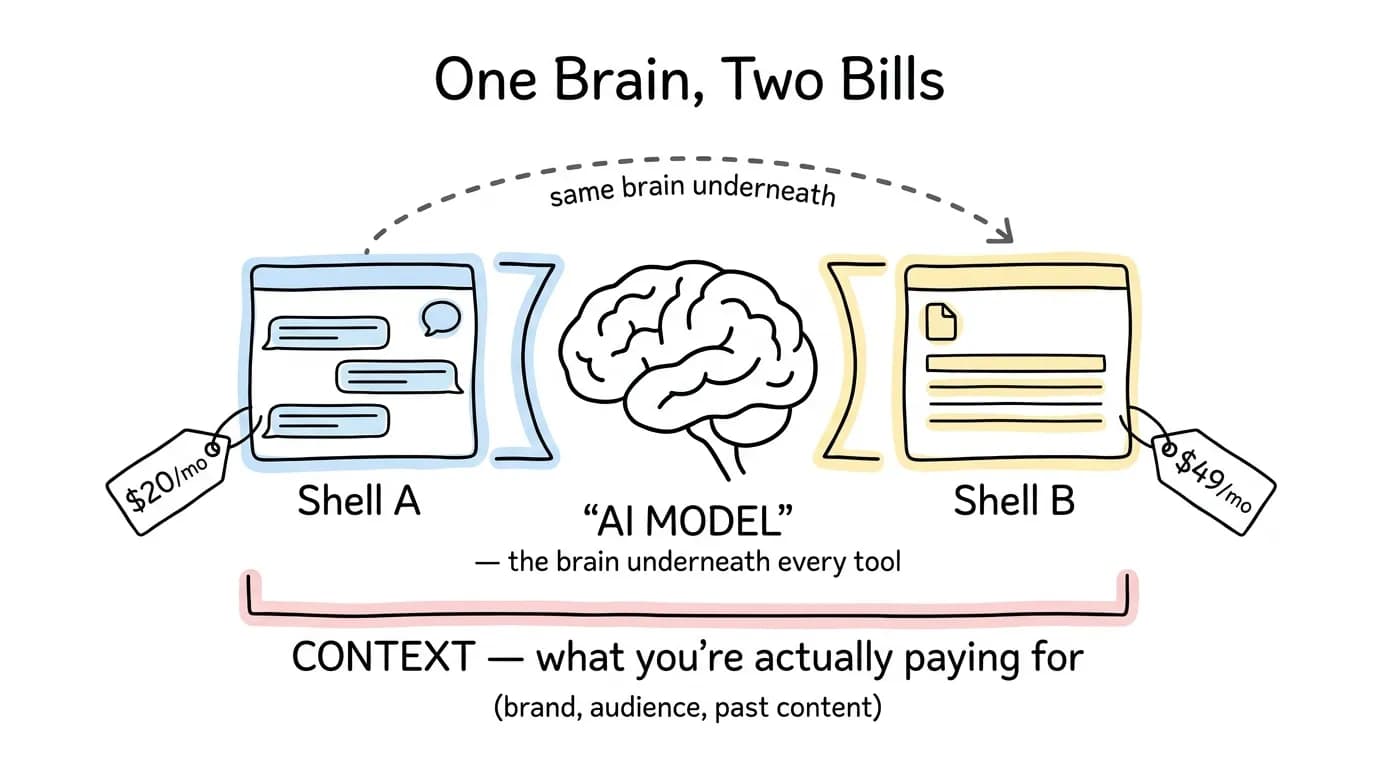
Which AI Should Your Startup Actually Use for Marketing?
A startup marketing guide explaining the difference between AI models and tools, sorting tools by job (writing, research, design, leads, email, video ads), and outlining a 30-day test plan for choosing them. It also covers generative engine optimization and budget trade-offs.
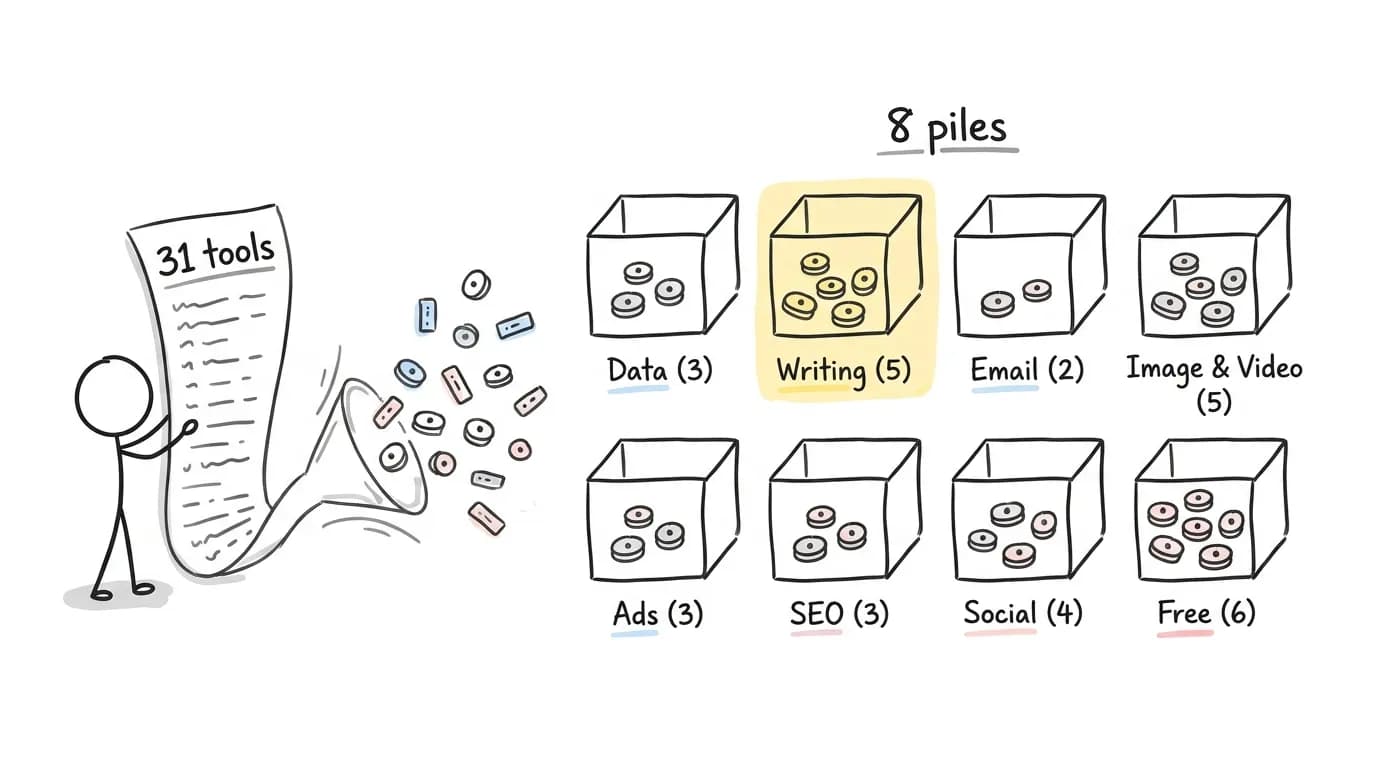
31 AI Marketing Tools, Reviewed One by One: How Exactly Should You Spend the Money?
A review of 31 AI marketing tools grouped into eight categories, covering data, content, email, video, ads, SEO, social, and free options, with guidance on choosing one strong tool for your most frequent task and testing free tiers first.