
AI Marketing Daily · 2026-11-21
A November 21, 2026 AI-marketing daily covering AI search visibility, GEO methods, Google AI Mode ads expanding to ten countries, Meta's pre-Black Friday changes, agentic shopping, and industry adoption and ROI data.
The Black Friday countdown is on: AI Mode ads have spread to ten countries, Meta has turned creative-edit rights into a default permission, and agentic shopping has moved from concept into Google's universal cart. Dashboard data sets up a stark contrast—91% of marketers use AI, yet half of American consumers are more likely to trust brands that don't. The one item among today's 20 that most deserves a second read is a 33× gap: whether a brand shows up in model answers depends mostly on brand signals beyond retrieval. AI visibility is brand engineering, not a stack of tricks.
🎯 Today's Lead
AI search is fusing SEO and brand marketing back together: no shortcuts to model availability
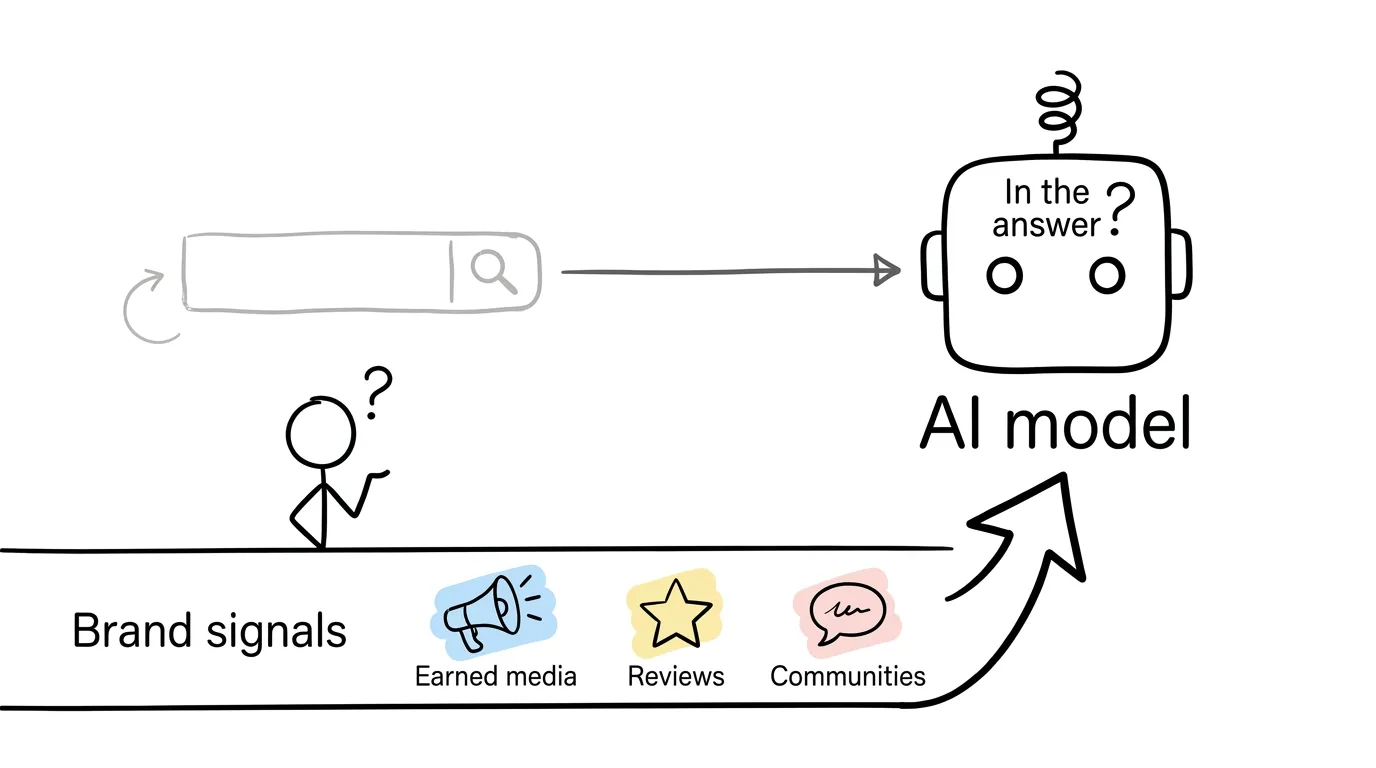
Search Engine Land carries a long-form piece by Ben Wood, performance director at Hallam, arguing that AI search is forcing SEO and brand marketing to converge again. Mike King previously made the case that AI search is a brand channel; Wood takes it a step further: the signals that decide whether a brand appears in AI answers are largely the same signals that build the brand. He splits LLM knowledge into two layers. One is parametric knowledge, baked into model weights during training; changing it requires new training cycles measured in months to years, and advertisers have almost no control over it. The other is RAG (retrieval-augmented generation), which retrieves live at query time while the weights stay unchanged—traditional SEO can still work here. The persuasive part is a set of observations: Suganthan Mohanadasan examined 27 real ChatGPT sessions, and in 21 of them the first retrieval query already surfaced brand names the user never mentioned. Brands that made the candidate list appeared in 68.9% of final answers; brands scooped up by retrieval alone were cited only 2.1% of the time—a gap of roughly 33×. Most of the GEO (generative engine optimization) tricks being hawked around act only on that 2.1% column.
Why it matters: several datasets all point the same way. Ahrefs analyzed 75,000 brands: the correlation between brand web mentions and AI Overviews visibility is 0.664, while classic backlink metrics sit at just 0.218; in follow-up research, YouTube mentions score roughly 0.737—the strongest in the entire table. Muck Rack's What Is AI Reading report shows 82% to 89% of AI citations come from non-owned, non-paid sources, with news accounting for about a quarter. Trustpilot commissioned Seer Interactive to analyze 800,000 AI answers: brands without a review profile have a median citation rate of 1%, while well-run brands hit 75%. The conclusion is uncomfortable: the territory SEO teams can't reach has become the dominant variable in AI visibility.
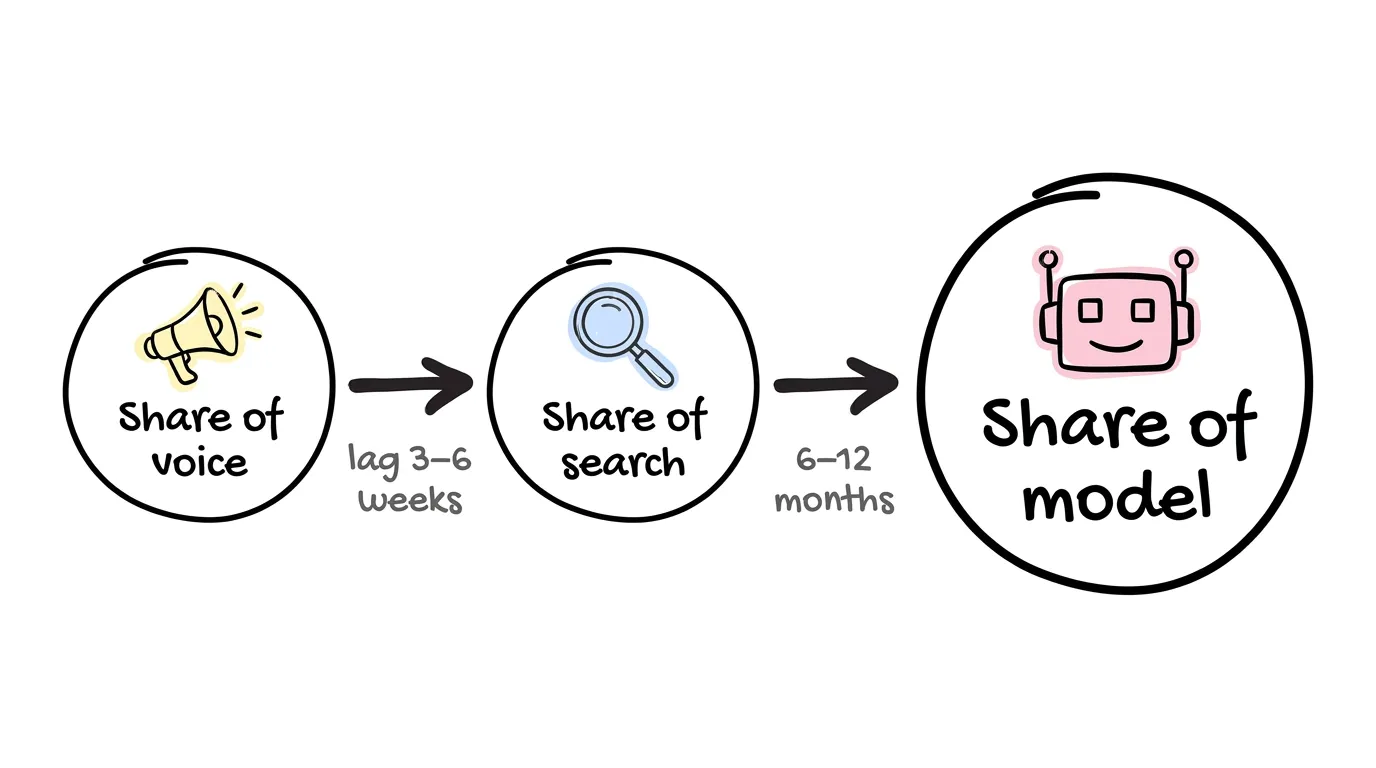
For marketers, it all collapses into one new term: model availability. Mental availability means buyers think of you when they enter the category; model availability means AI mentions you when asked. Both are driven by the same set of inputs, and each reinforces the other. Similarweb clickstream data shows brands recommended by AI are 2.5× more likely to get a visit within seven days, with most arriving via brand search. Wood chains communications to search with three links: share of voice, share of search, share of model. Binet and Field's classic finding is that brands tend to grow when share of voice exceeds share of market; IPA research shows share of voice drives share of search first, with a lag of three to six weeks; share of model moves on a cycle of six to twelve months. Tracksuit's research completes the awareness link: at roughly 30% brand awareness, every 5-point rise in awareness tracks with about a 5-point rise in share of search. One new variable is emerging: agentic shopping. When AI agents make choices on the user's behalf, model availability is the decision itself.
For execution, Wood's playbook is called Total Search, in four blocks. Category authority: first define the answer you want to own—the best position is one tier below a big category—then map category entry points with purchase scenarios, not keywords. The article's example is a cybersecurity company that turned proactive (offensive) testing into a category term and organized content around scenarios like pre-audit, board reporting, and M&A reviews. Content authority: build reference-grade assets that serve as the standard answer—original research is the most valuable—and don't stick to text only, since YouTube mentions carry the highest correlation, and transcripts, chapters, and structured descriptions are all readable by models. Earned authority is the hardest: digital PR, awards, talks, G2 and Trustpilot reviews, Reddit discussions—all live where you don't control the narrative. Technical authority is the floor: don't accidentally block AI crawlers; keep Bing indexing healthy, since ChatGPT search leans on it heavily; organize content by paragraph rather than page, with the answer at the start of each section; use Organization schema to connect Wikidata and Crunchbase; and in server logs, watch for ChatGPT-User crawls—that's live retrieval of real buyer questions.
My read: the most valuable thing here is framing AI search as brand engineering and pulling visibility measurement back onto the share-of-voice, share-of-search, share-of-model chain, instead of circling page elements forever. For teams on a budget: fix the technical floor first, then carve a slice of the ad budget to feed earned media and review operations—far better value than chasing quick-hit GEO tricks. One more caveat: AI's impact may never show up in traffic reports—the author's client data shows AI-referred visitors view roughly twice as many pages per session as other visitors. When the engine changes, change the yardstick first.
🔗 Further reading: Read the full article
🏷 AI Search & GEO
16,000-plus sites measured: AI referral traffic up 44.6% in a year, Google organic clicks still falling
SEOcrawl's own panel delivers a GEO guide with numbers attached: across 16,661 websites, Google organic clicks fell 15% year over year and are still accelerating—by August the decline had reached 21.8%; over the same period, AI referral sessions rose 44.6% across 3,949 GA4 properties. Every 100 Google organic visits now come with 1.25 AI visits, versus 0.70 a year ago—but Google's absolute volume is still about 80× that of AI. In the referral mix, ChatGPT dominates at 83.3%, Gemini 6.0%, Perplexity 4.7%, and Claude 3.7% but up 6.6× in a year, while Perplexity was cut in half. The author tested six engines on the query "GEO software" and counted 29 cited domains in total—six different best-tools roundups, wikis, the original arXiv paper, and Reddit all made the list; engines like to cite places where the topic has been discussed and compared. The author also lays out a 90-day roadmap, with tactics hinging on extractability: an answer buried in the eighth paragraph loses to a structured first paragraph. A closing reminder: measured AI traffic is only the floor—the ChatGPT app often sends no referrer, and AI Overviews clicks get booked into Google organic traffic.
💬 How marketers should use this: recalculate your AI channel's true share using this methodology—don't just look at GA4's Referral report. Within 90 days, put answers in the first paragraph with structured tables, and stake out positions on wikis, roundups, and Reddit; external placements work faster than revamping your own pages.
🔗 Further reading: Read the full article
Google publishes crawl timelines for the first time—and admits feeding fake results to rank tools
In Marketing Miner's November SEO and AI roundup, the densest block is Google's Gary Illyes publishing search pipeline timelines for the first time: new URLs are discovered in about 20 hours, a full recrawl cycle takes roughly 30 days, indexing itself takes about 1.5 hours, title and snippet updates 1–2 days, canonical changes 1–3 weeks, major redesigns 1–3 months, and recovery from a Core Update 3–6 months—with these stages stacking when run in sequence. Search Console performance reports now support aggregated filtering across multiple countries and devices, so multi-market reporting no longer requires manual stitching. The same period brought link-display adjustments in AI Overviews and AI Mode, though whether more links will actually drive more traffic remains in doubt, and Google has set up a separate UGC Fresh Data Program to speed up indexing of user-generated content. And the sharpest one: since mid-September, Google has been feeding fake search results to rank-tracking crawlers, undermining confidence in all crawler-based ranking and AI-visibility data.
💬 How marketers should use this: paste the crawl timelines into your planning docs and manage expectations monthly and quarterly after a redesign—don't grill engineering over weekly reports. Also check whether your rank tracking has ingested poisoned data, and cross-verify AI-visibility reports with two different tools before trusting them.
🔗 Further reading: Read the full article
ChatGPT users now look up information as much as they write, and AI citations favor pages that lead with answers
aimarketers' weekly AI-marketing roundup bundles several studies. An analysis of 193,507 ChatGPT, AI Mode, and AI Overviews responses shows 23% of cited pages open with a direct answer, versus only 14% of uncited ones. OpenAI Signals data puts information seeking by ChatGPT consumer users at 20.7%, nearly catching up with writing at 20.6%—writing had just overtaken it, reaching 21.4% in September—and user behavior is clearly shifting from generation to retrieval. In a survey of 279 SEO practitioners, 43.7% are more worried about AI than a year ago, with German respondents noticeably more concerned than American ones. Organic traffic losses are uneven across industries—publishers hurt most—and AI-driven traffic is still a small slice overall. On the product front, GPT-6.1 Terra emphasizes visual reasoning and computer use, and DeepMind released a research preview of the Genie 4 world model.
💬 How marketers should use this: both findings translate straight into content guidelines—state the conclusion within the first three sentences of every piece and cut the throat-clearing. With ChatGPT usage shifting from writing to retrieval, comparison and review pages beat piling up long posts.
🔗 Further reading: Read the full article
A systematic GEO methodology built on nine levers
OtterlyAI's GEO research guide is a rare long document with real structure. Background numbers: Gartner predicts organic traffic will fall 50% by 2028, zero-click searches in the US have hit 60%, and Seer's report has some brands' organic traffic down 40%. The guide distinguishes AI Search from LLM modes and lays out nine levers: owned content, structured schema markup, PR-driven brand associations, citing data statistics in content, optimizing autocomplete prompts, technical GEO to protect indexing, getting into Wikipedia, running Reddit and UGC operations, and feeding models feedback. The methodology lands on studying entities rather than keywords: a brand's asset inside AI is its entity association across independent sources. It closes with Kelsey Libert's line—the future of SEO is mentions, authority, and AI relevance.
💬 How marketers should use this: score yourself against the nine levers as a checklist and schedule the zero-score items into your quarterly plan. It's published by a monitoring platform vendor—the framework is worth referencing, but the procurement recommendations need separate verification.
🔗 Further reading: Read the full article
🏷 Ad Platform Updates
AI Mode ads expand to ten more countries, with multiturn ads entering follow-up turns
Google Ads' November update centers on AI Mode ads. Coverage expands to ten countries—Australia, Canada, India, Kenya, Malaysia, New Zealand, Nigeria, Pakistan, the Philippines, and Singapore—while the US gets multiturn ads, which can appear in users' follow-up turns, the moment of strongest purchase intent. Channel priority and budget-allocation controls ship alongside, addressing the pain of not knowing where the money goes; the author suggests setting them once for the Black Friday season, watching for a week, then judging by actual GA4 sales. The author's pre–Black Friday checklist: keep at least one healthy Search campaign on broad match or AI Max to catch multiturn traffic. Two metric changes to note: AI Mode queries average 3× the length of traditional search, and the threshold for a qualified video view moves from 5 seconds to 10.
💬 How marketers should use this: launch an experimental Search campaign to catch multiturn traffic this week, then rewrite product titles and landing pages for 3×-longer queries. The 10-second view threshold will shrink everyone's reporting numbers—align expectations with management in advance.
🔗 Further reading: Read the full article
ChatGPT ads reach 89 countries and 100,000 advertisers, but AI exposure clicks still at just 0.9%
socioshoot's early-November performance-marketing weekly delivers three data points. ChatGPT ads have expanded to 89 countries with over 100,000 cumulative advertisers; India is not in the new batch of 26 countries and still goes through managed buying. On the Q3 earnings call, Google officially confirmed that ad monetization inside AI Mode is lower than traditional search ads—a different metric from the earlier claim that AI Overviews ad revenue stayed flat. A single-site case study estimates the click-through rate on AI Overviews exposure at just 0.9%—limited sample, not an industry benchmark—but the judgment that visibility and traffic must be assessed separately holds. The piece also carries a migration countdown: OpenAI will fully replace Max Bid and Max CPC with tCPA and tCPC before January 1, 2027.
💬 How marketers should use this: judge AI-channel performance only with your own GA4 and GSC data—don't treat a single study as a benchmark. You can trial tCPA on small accounts right now; don't wait for the system to force the migration on you.
🔗 Further reading: Read the full article
Meta before Black Friday: first sort out which changes move the business and which only move the reports
With 15 days to Black Friday, Meta ships five changes, and the first job is telling them apart: which ones move the business and which only move the reporting numbers. Starting November 12, eligible accounts enable on-device conversion measurement—attributed conversions may rise while real sales don't, so reconcile against orders. Starting October 28, on-site product browsing is on by default for existing ads and can be turned off; Meta cites an experiment across roughly 117,700 advertisers showing a 3% average conversion lift, with no guarantee of individual results. Manual placement selection continues to be removed for Sales, Leads, Engagement, and App promotion. The new advertising terms, originally effective November 20, were paused on November 5 after publisher and advertiser pushback. Creative Breakdown reports now offer per-asset estimated performance—note these are estimates.
💬 How marketers should use this: five steps in order before Black Friday—audit tracking, validate conversion metrics against business records, check placement and product-browsing toggles, don't overreact to estimated data, and watch costs and revenue together. Better-looking attribution is not a better business.
🔗 Further reading: Read the full article
Meta's new terms are paused, but the audit of default AI creative-edit rights still needs doing
Common Thread's e-commerce response piece, written for Meta's new ad terms effective November 20: AI creative-optimization rights expand into a default permission across all campaign types—previously only Advantage+ Creative had them—letting Meta auto-adjust colors, aspect ratios, and background compositions without a separate opt-in; conversion event data retention extends from 180 days to 365, deepening the optimization pool and sharpening models, but ROAS reporting baselines may drift; and first-party data uploaded via CAPI and Custom Audiences is explicitly cleared for use in Meta's broader ad-delivery algorithms, not just for the advertisers who uploaded it. Multi-product catalog ads are hit most directly, with background removal, scene addition, and cropping all running on autopilot. The piece prescribes five actions: confirm the terms account by account, audit creative enhancements, review CAPI sharing levels, verify attribution windows, and brief creative teams on upload specifications.
💬 How marketers should use this: the terms are paused, but the actions aren't obsolete. From now on, brand visual standards protect themselves by uploading compliant assets—don't count on opting out. EU and California businesses should recheck Events Manager sharing levels and get privacy settings aligned.
🔗 Further reading: Read the full article
Image-to-video opens to everyone, and the AI business assistant gains memory
In the batch of Meta updates announced at Advertising Week, image-to-video—where small merchants benefit most directly—leads the list: static product images generate short videos, available to all advertisers in Advantage+ Creative, with Ads Creative Studio supporting batch production from product catalogs. The AI business assistant gains memory: it can read historical campaign data, seasonality, and goals, can ingest brand-voice documents, and scheduled reports are in testing. A customer-lifecycle strategy tool splits campaigns into three tiers: new customers, engaged visitors, and existing customers. Two developer-side items to watch: Marketing API v24.0 expired on October 6, so legacy CAPI plug-ins may lose data, and starting December 16, AI chat signals will be used for ad personalization.
💬 How marketers should use this: use image-to-video on your bestseller catalog to produce ten test clips first, run them for 5 to 7 days, and benchmark cost per purchase against human-made creative. Schedule the v24.0 upgrade this week—losing data costs far more than staged upgrades. Budget and bid changes still get manual review.
🔗 Further reading: Read the full article
November Meta ecosystem roundup: element-level Breakdown and rapid-fire Muse iterations
SocialBee's Meta ecosystem tracker was still updating on November 16. On the ads side, new element-level Breakdown analysis shows how individual creative elements perform rather than just group-level rollups; retail advertisers get Promoted Products Optimisation and Product events tracking; and manual placement selection is removed for Leads, App promotion, and Sales campaigns. On the creator side, Facebook launched Creator Fast Track in Brazil, and Creator Assistant adds six features including storyboards, shot lists, and niche-trend alerts. The Meta AI assistant Muse rolled out Email addresses, Spaces, Expressive Avatars, and Voice Mode in quick succession, evolving toward a personal shopping assistant.
💬 How marketers should use this: use element-level Breakdown for creative diagnosis before scaling—cutting a single underperforming element beats replacing the whole asset set. Muse's iteration pace is worth tracking; once it connects to checkout, it becomes one of the entrances to agentic shopping.
🔗 Further reading: Read the full article
🏷 E-commerce & Agentic Shopping
Channel dials, a 730-day exclusion window, and low AI Mode monetization: five big e-commerce ad stories before Black Friday
Bigflare's November e-commerce advertising roundup covers five big stories. Google launched channel priority controls for Display and Search Partners—from an on/off switch to a dial—announced by Ginny Marvin on October 14 with 726 upvotes, the most of any platform announcement that month. Meta's default window for automatically excluding existing customers is 730 days—categories with long repurchase cycles will treat customers from over a year ago as new ones, and exclusion accuracy is constrained by the quality of Purchase event tracking, so check Events Manager first. AI Mode ads expanded to ten countries at even lower monetization; Google's Q3 Search ad growth slowed from 17% to 12%, and shrinking premium ad inventory is pushing up CPCs. TikTok Buy Direct launched one-click checkout, connecting Shopify, Stripe, Salesforce, and Shoplazza, with the holiday promo running through November 30. Agentic checkout is getting started: Google Universal Cart supports cross-store carts, and Shopify has opened Catalog and Shop Pay to AI agents.
💬 How marketers should use this: pull a 90-day network-segmented report before Black Friday and set poor traffic to low priority rather than shutting it off; shorten Meta's exclusion window for long-repurchase categories; leave headroom in BFCM ROAS targets for CPC inflation; and judge TikTok's performance by total revenue and brand-search volume—don't trust the platform's panel.
🔗 Further reading: Read the full article
Placement exclusion shifts from hard blocking to bid adjustment, as the agentic shopping era nears
Rockads reviewed the September changes across the three big platforms; looking back in November, several still need handling. Meta removed ad-set-level placement exclusions, replacing them with Value rules that cut bids by up to 90%—real restrictions now belong in account-level Advertising Settings. Google began automatically migrating campaign-level broad match and auto-created-asset Search campaigns to AI Max on September 1; brand exclusions are preserved, DSA is pushed to February 2027, and search terms reports need watching for query expansion. Meta's Muse personal AI agent has landed in WhatsApp, with payments available through Link by Stripe single-use cards. Holiday agentic-commerce updates include Merchant Center AI insights, the YouTube Business Agent beta, and Universal Commerce Protocol cart transfers. Meta also launched a One subscription starting at $14.99/month for verification badges and business tools; some advertisers report promo credits stopped working.
💬 How marketers should use this: two governance moves come first—rebuild brand-safety rules in account-level Advertising Settings, and review the search terms report weekly after the AI Max migration, vetoing off-brand automatic expansions promptly. Complete the conversational attributes and member-price fields in product feeds; that's the infrastructure for AI shopping discovery.
🔗 Further reading: Read the full article
TikTok Ad Network hits US general availability: half of users aren't on the main app, so manage both the incremental reach and the risk
TikTok Ad Network (formerly Pangle) opened to US advertisers on October 5, covering nearly 400,000 apps and over 1 billion daily active users as the 48th market; officially, about half of those users aren't on the main TikTok app, positioning it around incremental reach, with post-verified measurement from DoubleVerify and IAS. Smart+ moved from all-or-nothing to three levels—full automation, partial, and manual—with delivery, budget, and creative selectable by module, plus new Smart+ Search Ads and Creative Selection. TikTok Shop's holiday promo runs November 11–30; qualifying sellers can display the 3-day delivery badge, which lifts both organic and paid conversion—provided fulfillment keeps up. The author's hands-on checklist: put Ad Network in its own ad set, load exclusion lists on day one, optimize with real Purchase events, and judge results by CRM and store data.
💬 How marketers should use this: teams wanting to try Ad Network should open a separate ad set with exclusion lists immediately and judge the first week by post-verified conversions only—ignore click metrics. For Smart+, partial automation is the safest choice: AI manages bids while humans manage audiences and creative, so control doesn't slip away.
🔗 Further reading: Read the full article
🏷 Industry Data & ROI
91% of marketers use AI, yet half of consumers prefer brands that don't
Blaze's November 2026 statistics roundup collects 119 AI-marketing figures, each attributed to a primary source, refreshed monthly. The sharpest tension is the gap between insiders and consumers: 91% of marketers use AI at work, up from 63% a year ago, but half of American consumers prefer brands that don't use generative AI in their advertising. AI penetration in marketing campaigns rose from 7.0% to 22.4% over two years. 83% of ad executives say AI is already in their creative processes, yet only 45% of Gen Z and millennial consumers feel favorable toward AI ads. In Kantar's testing library, AI-made ads average the 54th percentile, below the 65th percentile for non-AI creations. Another set stings: only 41% of marketers can prove ROI on their AI investment, down another 8 points year over year; 18% of marketing managers have already cut some roles because of automation, while 16% have created new ones.
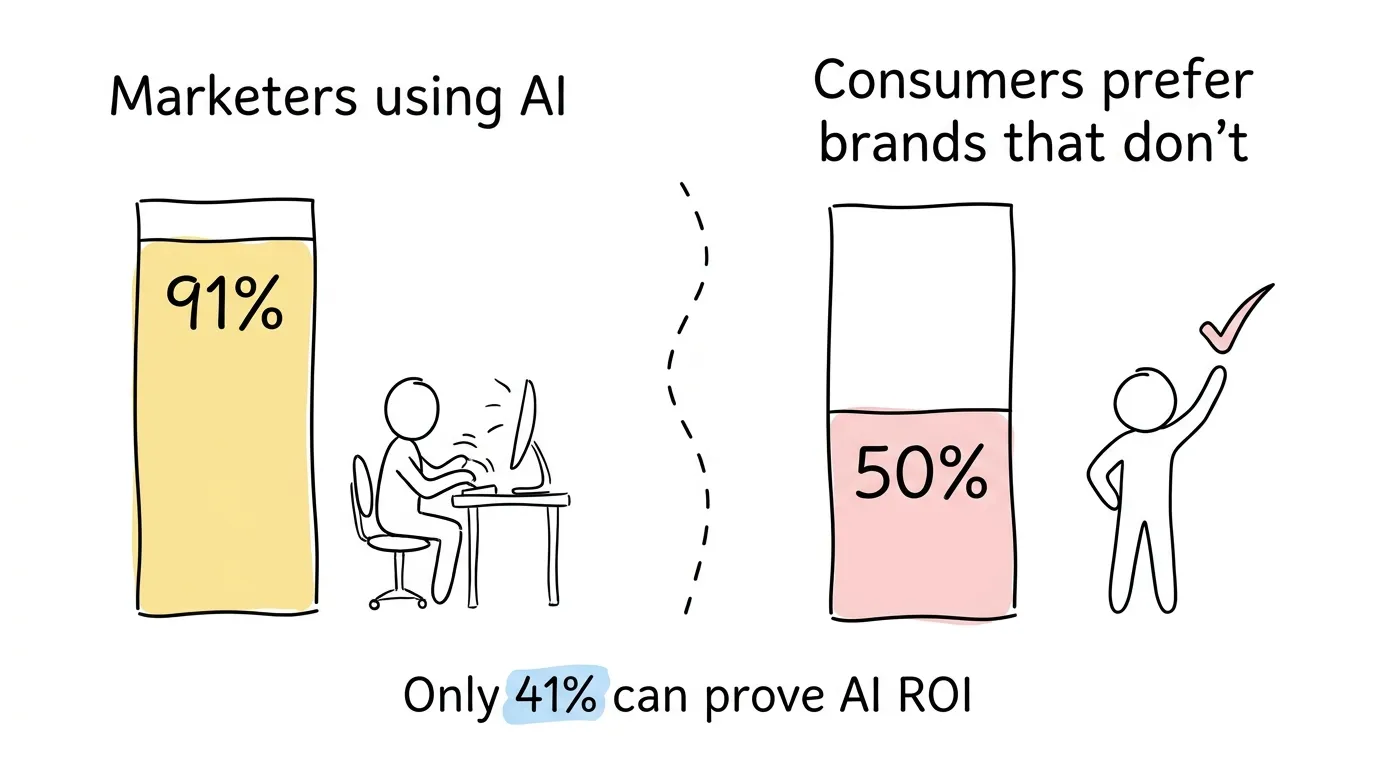
💬 How marketers should use this: keep this roundup as your citation base—check the numbers here before writing any proposal. B2C teams should watch the consumer-attitude data: use AI for internal efficiency, be careful with external exposure, and know that creative-quality perceptions are still low.
🔗 Further reading: Read the full article
The truth behind the 88% adoption rate: on average it covers only 22% of marketing activities
The roundup's methodology is the most rigorous part: every figure is tagged with its evidence type—self-reported survey, controlled experiment, platform-reported, or company self-claim. The CMO Survey's January 2026 data from 308 US marketing executives: 88.2% of companies use generative AI at least partially, but on average it covers only 22.4% of marketing activities; 47.1% of companies cover less than 15%, and only 6.4% cover more than half. Gartner estimates AI automation covers 16% of marketing work this year, projected at 36% by 2028. HubSpot's numbers run hotter—98% using, but only 10% at transformation-level maturity; Salesforce's State of Marketing reports 75% using and 13% already on agentic AI. The credible controlled studies all point at productivity: a preregistered Science experiment shows writing time down 40% with quality up 18%; QJE has customer service resolving 15% more issues per hour; BCG finds tasks 25.1% faster; GDN display ads fully AI-generated show a 19% CTR lift. The author also adds a hype-inflation warning: the claim that AI will do half of marketing by 2029 should be treated as a forecast, not a result—in McKinsey's survey, expected headcount cuts were 32% while actual cuts ran 14%. Not a single controlled study has measured end-to-end ROI.
💬 How marketers should use this: use evidence tiering to protect yourself in reporting—when asked about the 91%, answer with the 22.4% coverage; that alone saves a year of internal friction caused by inflated expectations. Never use productivity numbers to endorse revenue gains.
🔗 Further reading: Read the full article
Board pressure up 52% in two years, and CMO attribution systems can't carry the accountability
funnel.io argues CMOs face an ROI reckoning in 2026. The CMO Survey data: board pressure has risen 21% over two years, with CFO pressure up 52% and CEO pressure up 20%; on Gartner's measure, marketing budgets are flat at 7.7% of company revenue, and 59% of CMOs say their budgets can't execute the strategy. Four root causes make attribution hard: third-party attribution broke down with privacy regulations and the exit of cookies; AI ad platforms' black-box algorithms can't be reproduced; marketing teams run an average of 19 point solutions, whose inconsistent fields and time lags scramble the data; and budgets are flat while accountability escalates. The fix is a unified data layer—using server-side APIs to send high-quality conversion signals back to ad platforms—and Bain research says marketing experimentation can deliver ROI gains above 20% for Allianz-scale companies.
💬 How marketers should use this: first map GA4's cross-device attribution flaws—one cross-device purchase gets logged as two people and two conversions, and platform panels systematically overestimate. Take the CFO-pressure-up-52% figure and use it to get the unified-data project approved—it works better than a mission statement.
🔗 Further reading: Read the full article
🏷 Marketing Tools & B2B Playbooks
Six of eight AI tool roundups are vendor self-ranking, and a 30-day blind test helps you unsubscribe
This startup AI-marketing guide concludes there's no single best model—choose by function: Averi for content execution, ChatGPT or Claude for writing, Perplexity for retrieval, Canva for visuals, Pipedrive or HubSpot for CRM, Gumloop for automation. Going deeper, it audits eight best-tools roundups one by one, warning that tools sell context while running on what may be the same underlying brain—before paying, ask which model is running and what's layered on top: at least six of the roundups are vendor self-rankings, Averi ranks itself first, and Pipedrive, HubSpot, and Salesforce all push their own products. On cost, it issues the Frankenstack warning: a three-tool stack runs $95–138 a month, and 47% of martech buyers say tool fragmentation is their biggest pain. The 30-day test: blind-test three tools on the same brief, and unsubscribe if any saves you less than 4 hours a week.
💬 How marketers should use this: before reading any roundup, ask who's talking. At pre-seed, hold the monthly budget to $0–50 until a workflow is proven to save real time and bring in client calls—then spend more.
🔗 Further reading: Read the full article
Seven MCP ad tools compared: official MCPs are read-only, third-party starts at $29
Adsap compared 7 AI tools that operate Meta and Google ads, with prices and features drawn from public pages. Dual-platform Adsap runs $29/month with batch Ad Sheets plus copilots for Claude, ChatGPT, and Perplexity; Adspirer is pure chat-driven with six-platform MCP, priced $0–199 by task volume; AdManage.ai covers 10 channels starting at £199.99. Meta-only options include Rapid Ads for bulk uploads and Adstellar's autopilot management. The two official servers deserve separate attention: Meta Ads MCP is in beta with 97 tools, and since July 16 admins can set permission rules for AI agents; Google Ads MCP is open source but deliberately read-only—creation and edits stay with humans. The author also names the field's weakness: most tools lack approval gates and audit logs.
💬 How marketers should use this: make approval gates and audit logs hard requirements before buying. The safest combination: official MCPs for reporting diagnostics, third-party tools purchased only with approval gates, starting from read-only permissions.
🔗 Further reading: Read the full article
67% of buyers don't want to see sales, so B2B shifts from publishing content to manufacturing evidence
Vord's B2B strategy piece argues 2026 shifts from output volume to usable evidence. Gartner data: 67% of buyers prefer sales-free self-service research, 45% already use generative AI in their buying journey, and generic AI content nullifies the advantage of publishing more. Four plays: let buyers experience value earlier, via no-login sandboxes and diagnostic tools; in ABM, be useful before personalized—build substantive assets like competitive positioning snapshots for 10 high-value accounts; turn client outcomes into proof assets clients will forward internally; and don't bet on a single channel. The stop list is equally specific: publish nothing without original judgment or first-party data, no forms on foundational education content, and event metrics must attach to pipeline.
💬 How marketers should use this: set one new rule for the content team—before publishing anything, ask whether AI could have written it; if yes, don't publish. Within 90 days, building a no-login sandbox or one client benchmark report gets you into AI citation pools far better than ten tweets.
🔗 Further reading: Read the full article
💡 Today's Synthesis
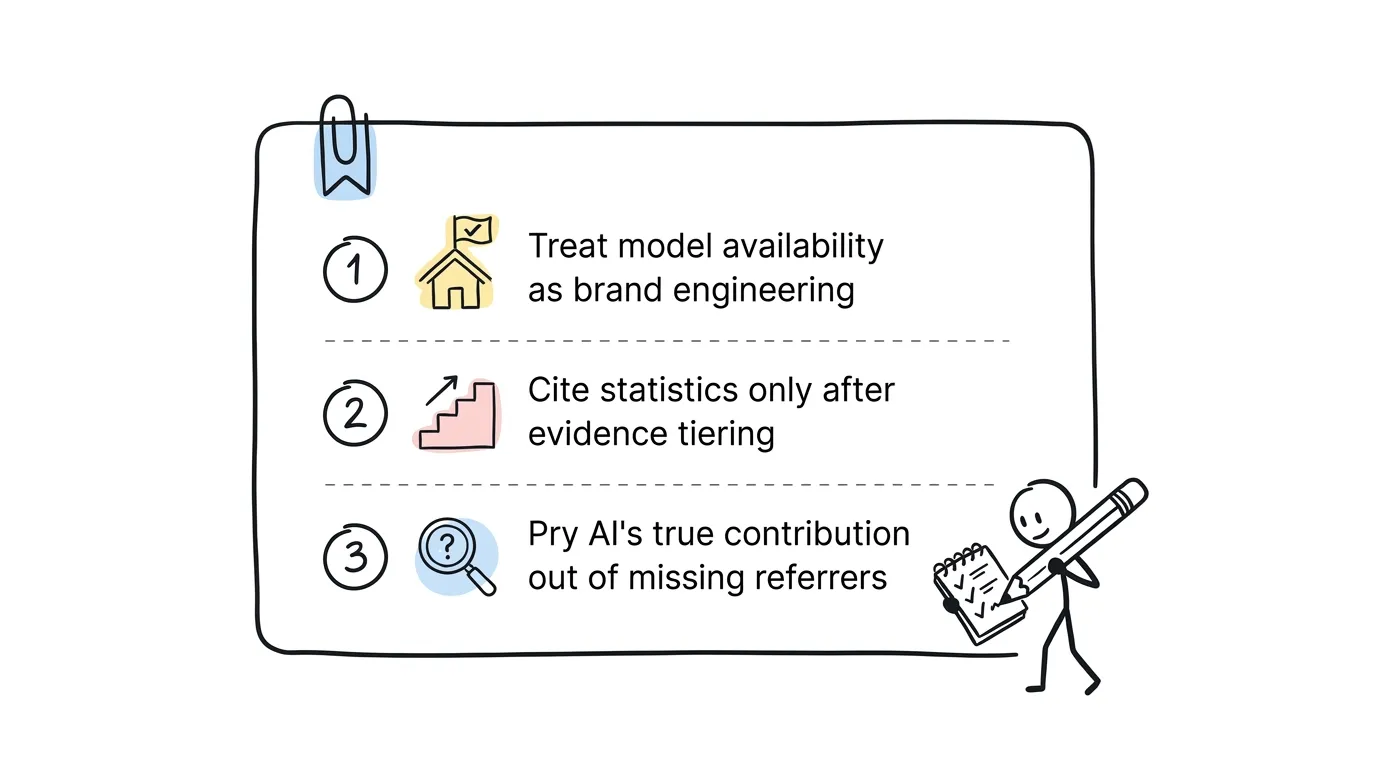
Read together, today's 20 items surface one throughline: the traffic entry point is shifting from search boxes to models, while the industry's measurement and accountability systems haven't caught up with the gear change. On the entry-point side, AI referral traffic is up 44.6% in a year, AI Mode ads have spread to ten countries, and agentic shopping has moved from concept into Google's Universal Cart and Meta's Muse. Brands appear in models not through page tricks but through off-site signals—earned media, reviews, communities—with leading research already pushing the correlation to around 0.7, and even a cybersecurity company's self-coined category term can make the model's candidate list. The measurement side, though, is all cracks: AI traffic is systematically undercounted in reports, Google is feeding fake results to rank tools, CMOs face CFO pressure up 52% in two years, and only 41% of marketers can prove ROI on their AI investment—8 points fewer than last year. The gap between the two lines is next year's homework: treat model availability as brand engineering, cite statistics only after evidence tiering, and pry AI channels' true contribution out of missing referrers. None of the three can be rushed, but all three go on the calendar starting this week. Black Friday is at the door—fix tracking and metrics first, talk scale-up later.
Continue reading
Related articles
AI Marketing Daily · 2026-11-22
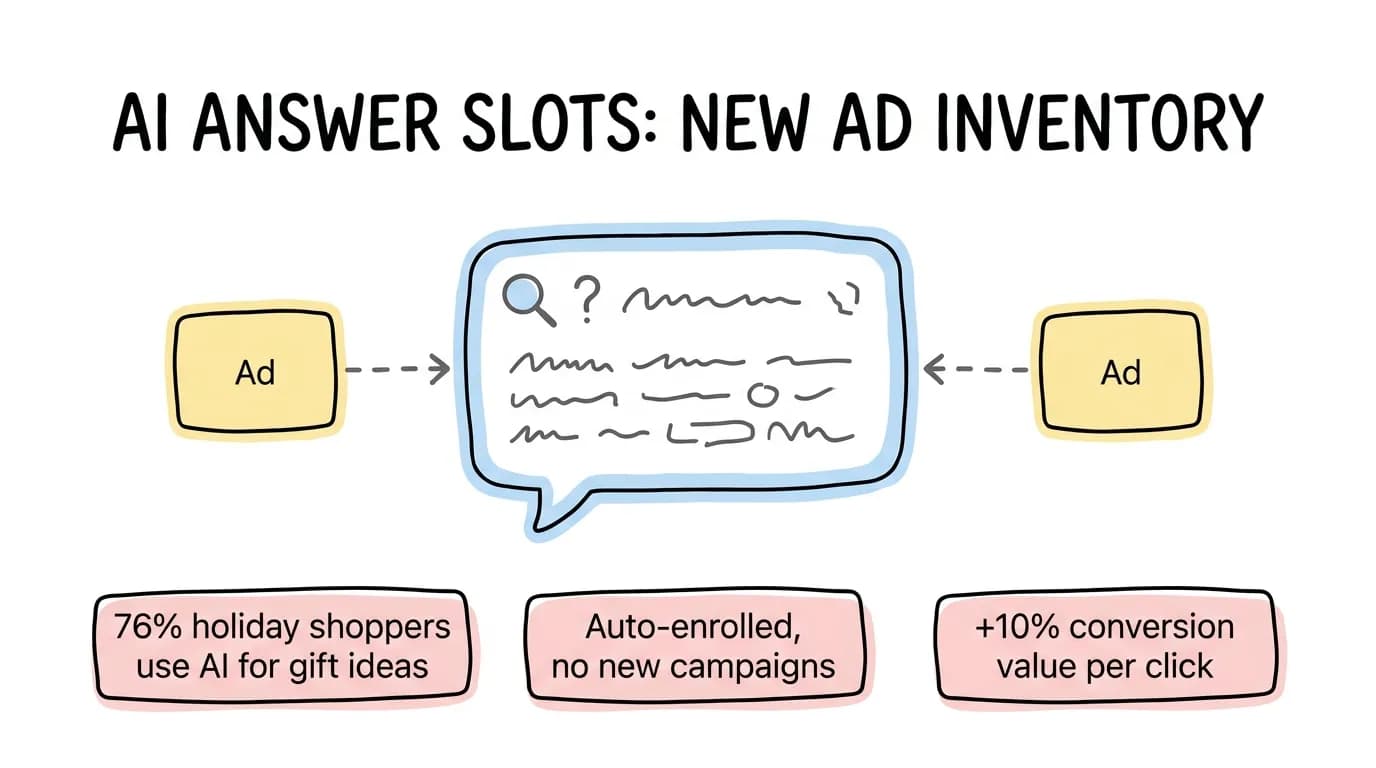
AI Marketing Daily for 2026-11-22 rounds up 20 items led by Microsoft opening Bing AI Overviews to ads and Google expanding AI Mode ads to ten countries, plus GEO guides, ad automation delegation guidance, AI Overviews CTR data, and a legal-risk checklist for AI-generated creative.
AI Marketing Daily · 2026-11-20
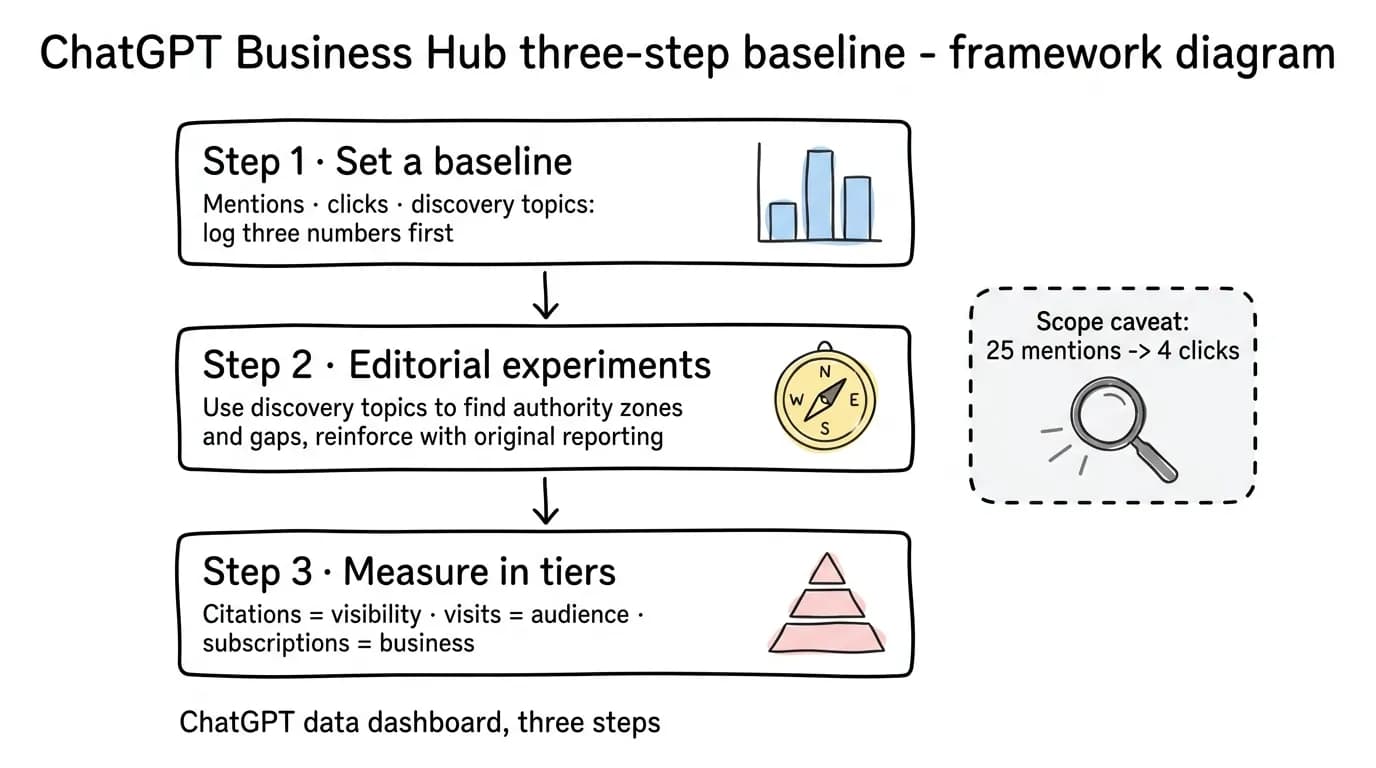
AI Marketing Daily for 2026-11-20 rounds up 19 items centered on measurement: OpenAI's ChatGPT Business Hub dashboard, EU rules for agent-mediated purchasing, Meta pausing four AI terms, and B2B data on shortlists and the dark funnel, each with action advice.
AI Marketing Daily · 2026-11-19
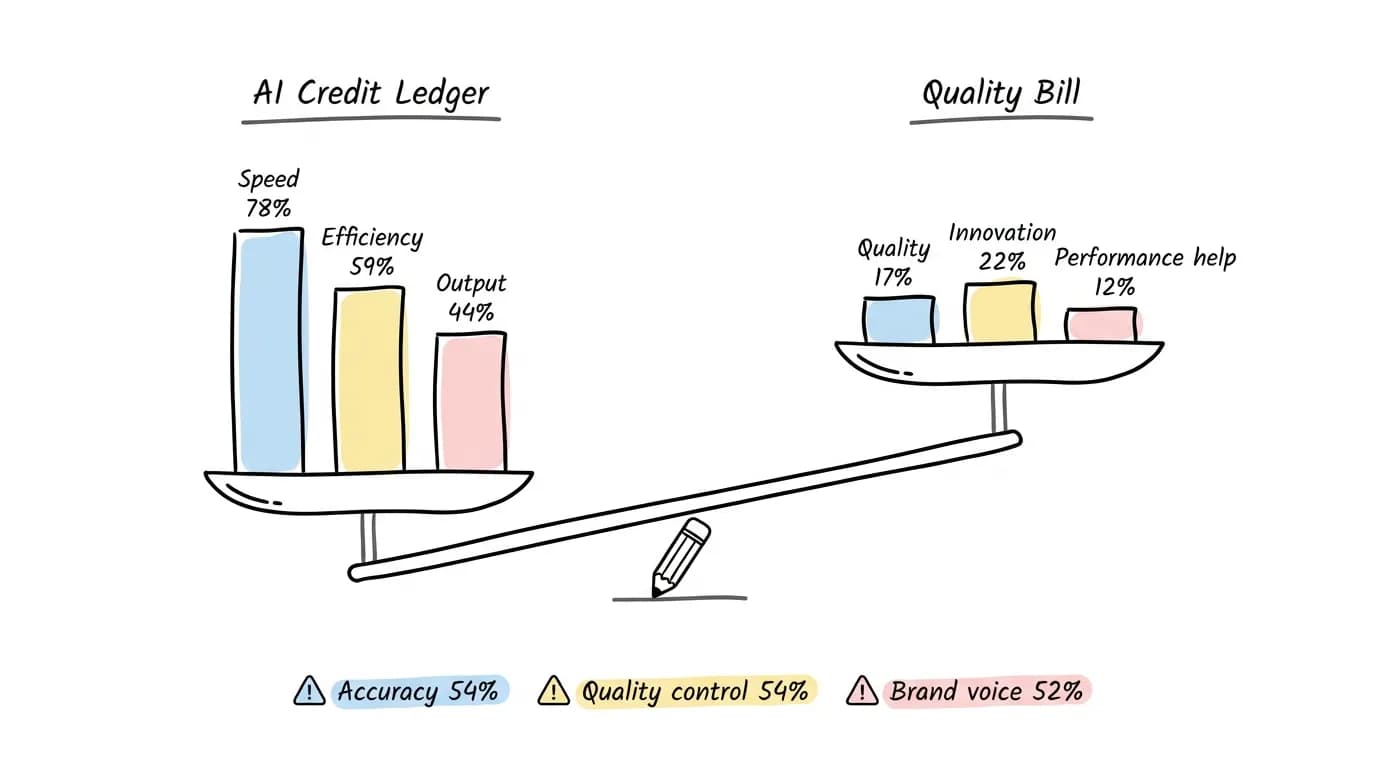
AI Marketing Daily for 2026-11-19 compiles twenty items led by CMI's B2B content marketing report on AI content speed versus quality, with sections on GEO and AI search citations, agent tools and pricing, platform launches, playbooks, and industry data.