
The EU Has Finally Had Enough of the Tricks You Fall For Online
The EU's proposed Digital Fairness Act targets 'dark patterns' such as hard-to-cancel flows, undisclosed paid influencer posts, AI-generated virtual influencers, and addictive autoplay design, with fines of up to 6% of global annual turnover.
A news story came across my feed the other day, and the more I think about it, the more interesting it gets.
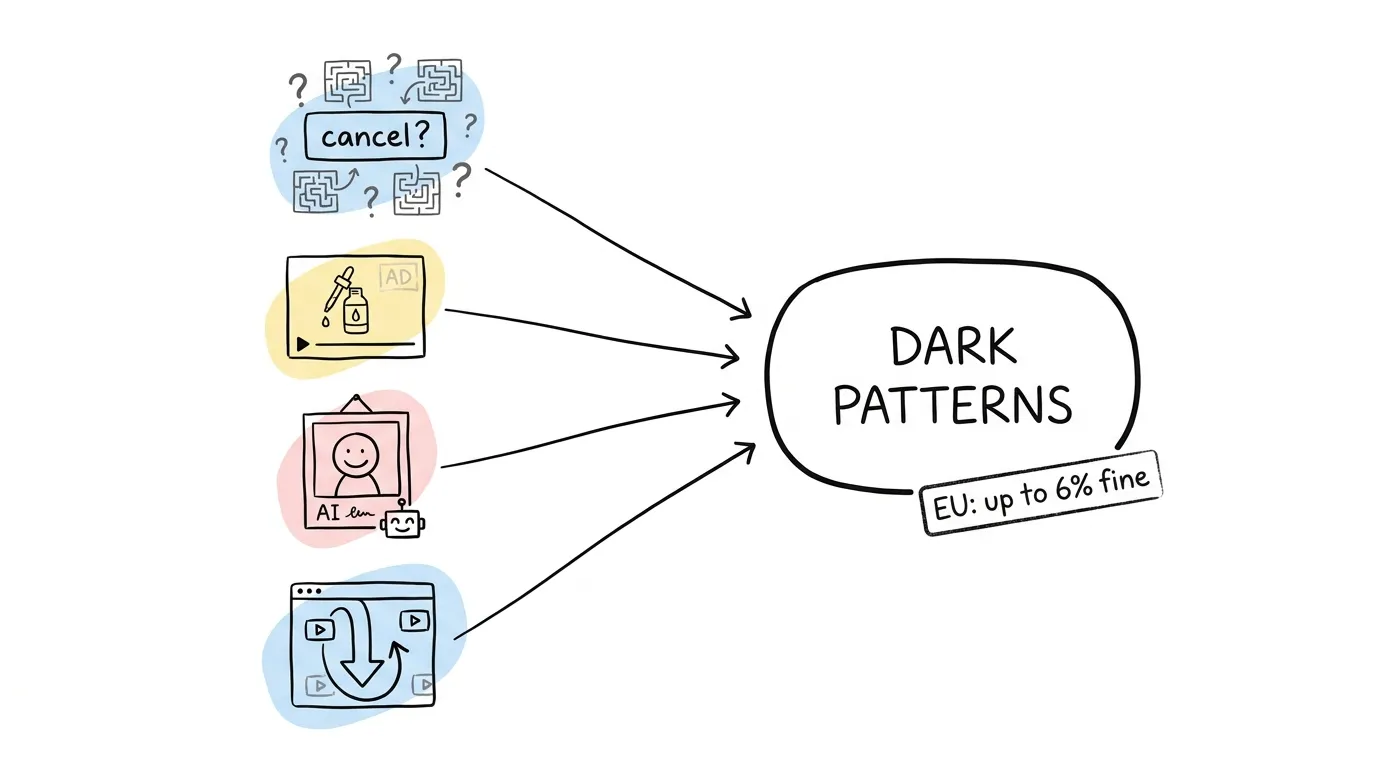
The European Commission has put forward a new piece of legislation called the Digital Fairness Act.
What does it cover?
Those little "tricks" you run into online every day.
What tricks? Let me give you a few examples. You've almost certainly run into every single one of them.
First. You want to cancel a membership. Where's the button? You spend three minutes hunting for it. And once you find it, you have to click through four confirmations, with every pop-up along the way urging you to "think it over one more time." But when you signed up? One button, two seconds, done.
Second. You scroll past an influencer, bare-faced, sincerely recommending a bottle of serum she says she's been using for three months. You believe her, so you buy it. Only later do you find out the video was paid for. She never said so, and the page never flagged it either.
Third. A model with a beautiful face and flawless skin, landing one ad deal after another. Except she doesn't exist at all. She's an AI-generated image, retouched into being by a designer, picture by picture.
The first time I learned about "virtual influencers," I sat there stunned for a while. The person isn't real. The money is.
And then there's the plainest trick of all: the endless scroll, the next video that always autoplays. You meant to browse for five minutes — you look up, and an hour is gone.
Surely these things deserve one umbrella name?
The EU's umbrella term for them is "unethical tricks" (what the industry usually calls "dark patterns"). Interface designs that trick you into clicking, the hidden games of influencer marketing, AI-made images you can't tell from real ones, the addictive design that keeps you from stopping — it all counts.
You might say, aren't these just "marketing tactics"? Does this really need legislation?
Yes. It does.
Because each of these tricks is tiny on its own — too small to bother fighting over. But they happen to you every single day, and they make money.
So how would the fines work?
The harshest provision in the proposal is how the fines are calculated: companies that break the rules could be fined up to 6% of their global annual turnover.
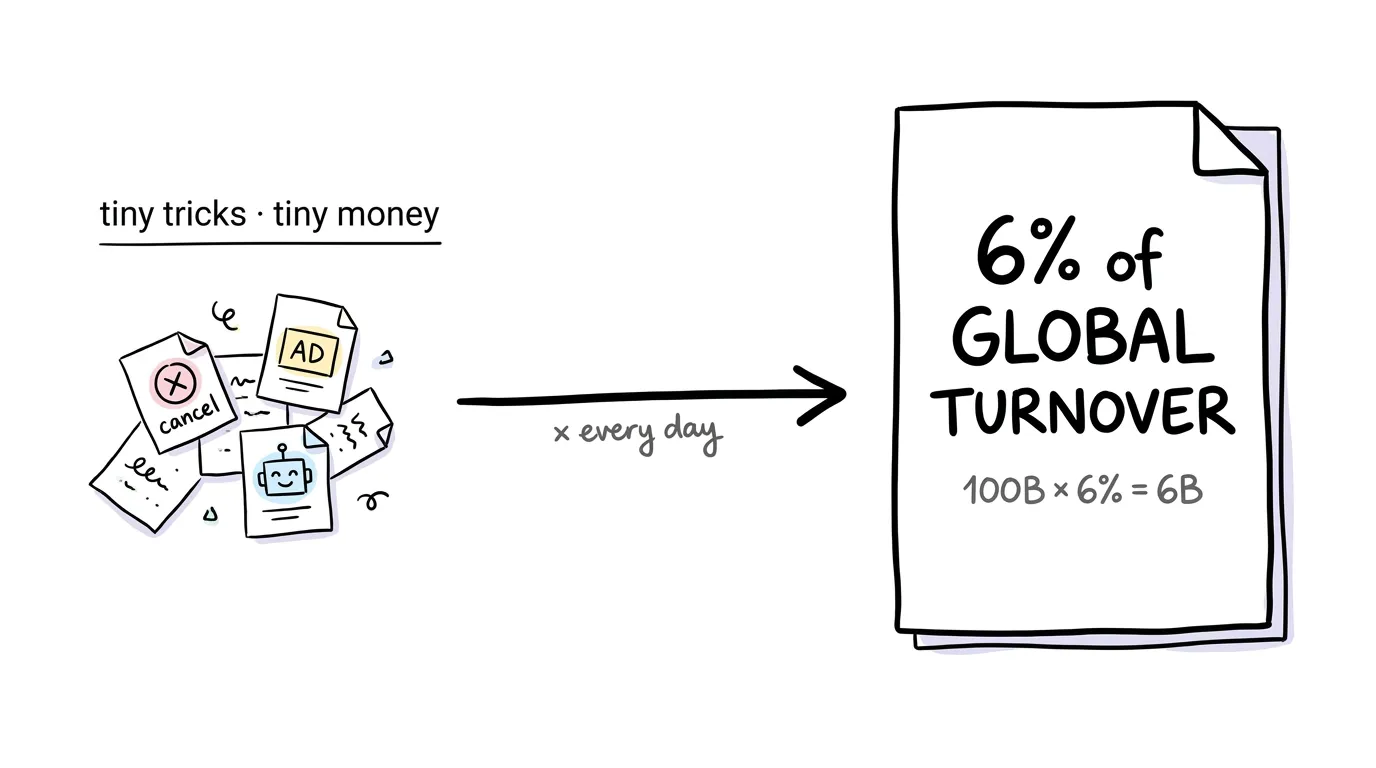
Let me do the math for you. Say a company does 100 billion in business worldwide in a year. Six percent of that is 6 billion.
What does 6 billion mean? Plenty of companies grind through an entire year without their net profit ever touching that number.
And note this: it's global turnover, not just the European slice. Where you trick users doesn't matter; how much money you made does.
By the way, the European Commission behind this proposal is the EU's executive body, responsible for drafting laws for its 27 member states. In recent years it has taken on privacy, taken on platforms — and now it's taking on "whether you treat your users decently."
So the next time you see a face too perfect to be real, a "heartfelt recommendation," a pop-up you just can't close, think about this:
On the other side of the planet, there are people writing these things into law, clause by clause.
Little tricks earn little money. But pile them up, and they become a bill invoiced against your global turnover.
And here's wishing that when you run a business of your own, you never have to study this law.
Continue reading
Related articles

It's 2026: Stop "Buying" AI Tools for Your Marketing Team — Start "Hiring" AI Agents
This learn article explains how AI agents differ from standalone AI tools in marketing, outlines three agent categories — build-your-own platforms, CRM-native agents, and vertical tools — and covers use cases across SEO, social media, advertising, and reporting, plus criteria for choosing one.

Did the Money You Spent on AI Marketing Ever Come Back?
A guide to measuring AI marketing ROI across three layers: ad reports, sales pipeline, and the financial ledger. Covers metrics such as ROAS and CPA, eight dashboard metrics, industry benchmarks, and common measurement mistakes.

How to Pick a Creative Automation Platform: First, Figure Out What These Eleven Actually Do
A learn article sorts eleven creative automation platforms — including Bannerflow, Celtra, Smartly.io, and Storyteq — into four functional groups and proposes five evaluation questions covering publishing reach, automation depth, ease of adoption, team fit, and verifiable evidence.