
Your Customers Stopped Searching. They Started Asking AI
A bilingual guide to generative engine optimization (GEO), covering how AI engines select sources, how GEO relates to SEO, and a three-pillar approach spanning technical access, content structure, and brand reputation, plus measurement methods and a 90-day rollout plan.
A while back, an old friend who runs an enterprise software company invited me out for tea. He looked miserable: his website traffic had dropped thirty percent, yet his keyword rankings hadn't budged.
The rankings held. So where did the people go?
I asked him: had he checked ChatGPT? He froze. He went back and tried it. For the question his customers always ask — "which recruiting system is right for a retail chain?" — the AI recommended a string of competitors, and his name wasn't on the list.
Not because he was doing badly. He had simply never put his products on this new shelf.
That new shelf has a name: GEO.
What Is GEO?
GEO stands for Generative Engine Optimization. In plain terms: making sure your brand is present in AI answers — mentioned, recommended, cited as a source. When a user asks ChatGPT, Gemini, Claude, or Google's AI Overviews a question, whether the answer includes you is GEO's business.
The term wasn't coined by the marketing world. A Princeton research paper first used it in 2023, and one of its findings is striking: adjusting how your content is written and argued can lift visibility in generative answers by as much as 40%. You may also run into AEO or LLM SEO — different names for the same thing. Don't let the different labels confuse you.
How Does AI Pick Its Sources?
To play this game, you first need to know the rules. An AI engine answering a question goes through roughly five steps.
The user asks in plain language; the engine breaks the question into several sub-questions and sends them out to research; it searches web indexes — Google's, Bing's, and its own; then, from the pile of material retrieved, it keeps the passages that are clearly written, credibly sourced, and fresh; finally it writes a synthesis and attaches a few citations.
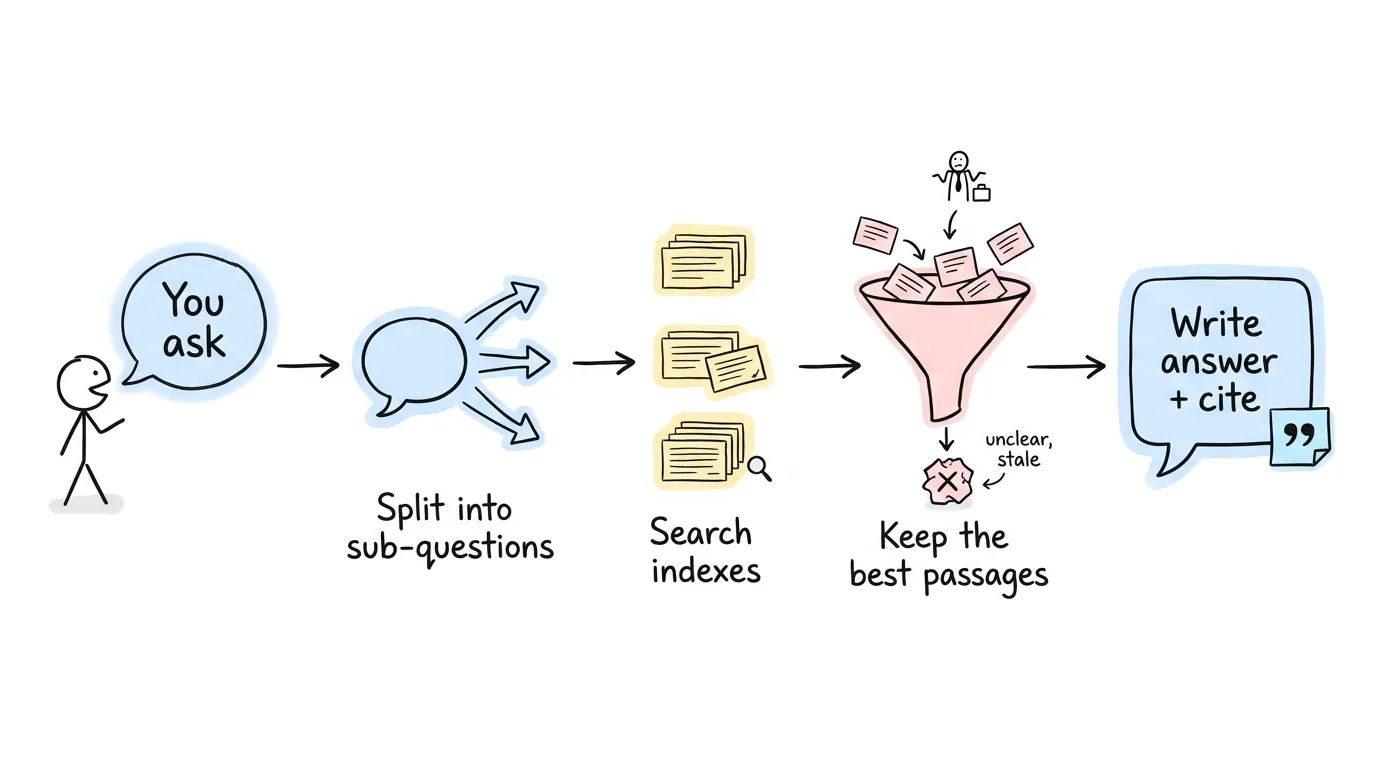
Picture the AI as a very busy consultant. A client asks him a question; he turns around and dispatches eight assistants to dig up material, keeps only the sharpest clippings, assembles them into one paragraph for the client, and notes the sources.
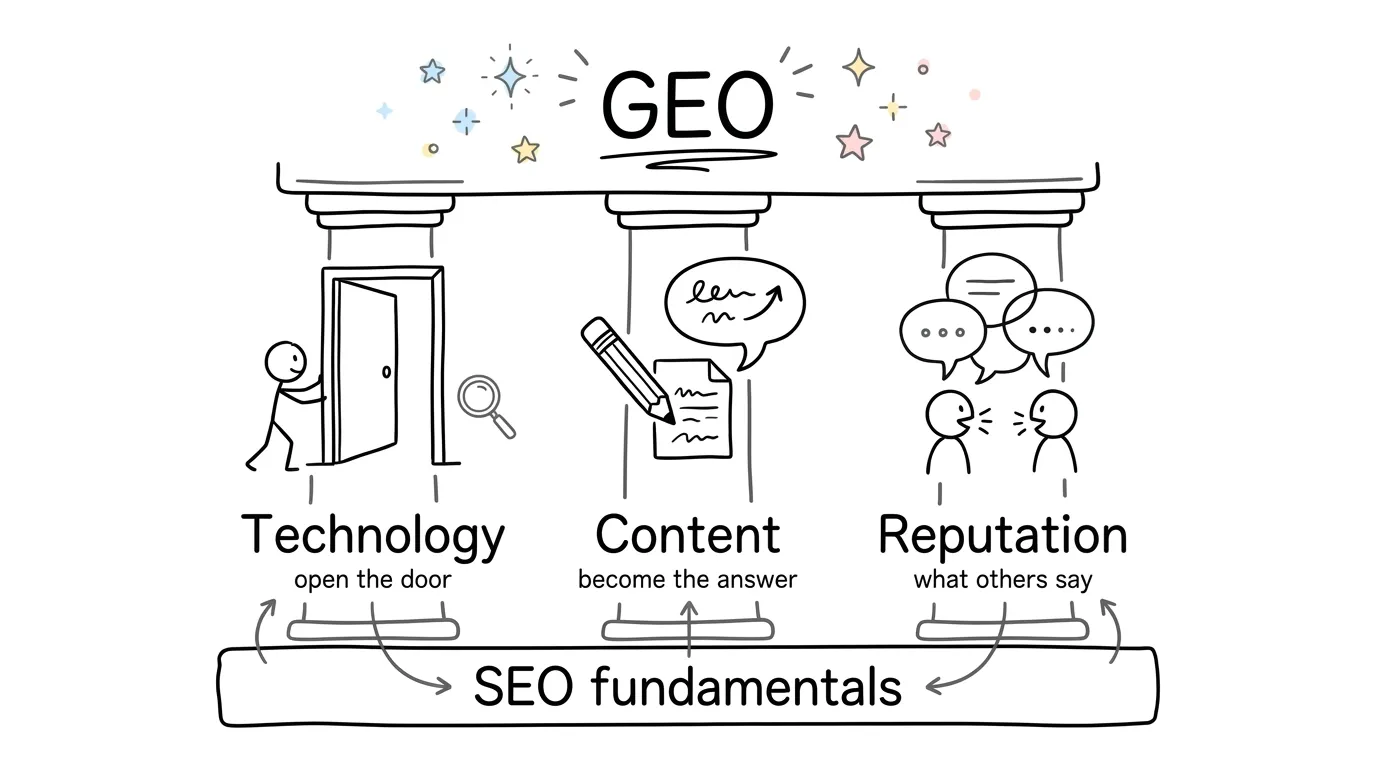
In this pipeline, technology decides whether you can be found at all, content decides whether your passage gets selected, and external reputation influences whom the consultant picks and how he describes you. Three factors, each stuck at its own checkpoint.
GEO and SEO: What's the Relationship?
Many people panic the moment they hear this: was all that SEO for nothing?
No. Look at the differences. SEO competes for keyword rankings, and its unit of measure is the keyword; GEO competes for mentions inside answers, and its unit of measure is the prompt — one complete, contextual sentence of human speech. SEO's authority signal is backlinks; GEO's authority signal is how others talk about you. SEO rankings are basically stable from today to tomorrow; GEO's answers roll the dice every single time.
But the foundation is the same: pages must be indexed, and content must genuinely help people. Good SEO gives GEO its fuel. GEO doesn't replace SEO. It's a new layer built on top of SEO.
Why Act Now?
Three numbers.
In February 2026, ChatGPT reached 900 million weekly active users. In July 2026, AI Overviews and AI Mode launched in France. The digital barometer from Arcep (France's telecommunications regulator), published at the start of that year, told the same story: 48% of people in France had used generative AI, and 73% of them used it to look up information.
Now consider the cost. A 2025 survey by Pew Research Center found that for the same query, once an AI summary appears on the results page, the share of users clicking a source link falls from 15% to 8%, and only 1% are willing to click the citation inside the summary. Ahrefs tested it too: when an AI summary is present, the number-one result's click-through rate drops 58%.
That's the bad news. Now for the good news. Seer Interactive's data shows that brands cited in AI summaries get 120% more clicks per impression. And this traffic is high quality: in Similarweb's statistics, visitors arriving from ChatGPT convert at 7% on transactional websites, versus 5% from Google.
One mention inside an answer is worth more than ranking first on a results page.
Of course, stay calm. When people in France look up information, 59% still use search engines while only 28% use generative AI — a gap of more than two to one. So this isn't switching tracks; it's opening a second track.
Where to Start?
Don't rush into writing content. The first task is measurement.
If you don't even know where you rank in AI's eyes, any talk of strategy is premature.
Here's a counterintuitive fact. SparkToro ran an experiment: the same question asked nearly 3,000 times across ChatGPT, Claude, and Google, and the probability that the same brand list reappeared unchanged was under one percent; identical order was under one in a thousand.
What does that mean? One query is one roll of the dice. It proves nothing.
So build a prompt list and ask it daily to compute appearance rates. How to build it? Start from the SEO keywords that bring you conversions and rewrite them as the complete questions customers would actually say; cover four intent types: how to choose, which of two candidates wins, what's best, and what people say about a particular brand; tag by product line and audience; scale to your business volume — 50 to 300 prompts, asked every day on the engines you care about.
Track five metrics: AI visibility rate, share of voice versus competitors, recommendation position, citation rate, and the tone used when your brand is described. A quick word on traffic: GA4 (Google Analytics 4) underestimates AI-driven visits — some visitors arrive without a referrer and stay invisible in your analytics.
Pillar One: Technology — Open the Door
Three pillars; start with the fastest-acting one: technology. You don't have to ask anyone for help — it all lives on your own website, and you can see changes within weeks.
Open the door first. Every AI company keeps several kinds of crawlers, each with its own job. Take OpenAI: OAI-SearchBot governs whether ChatGPT search can find you, and ChatGPT-User governs access when a user asks a live question — both must be let in; GPTBot is used to train models, and whether to allow it is your editorial call. The same logic applies to Anthropic, Perplexity, and Microsoft's crawlers. Here lies a colossal misunderstanding: blocking the training crawler does not affect whether you appear in answers; blocking the search crawler is what truly makes you disappear.
While you're at it, check your CDN and firewall. Since July 2025, Cloudflare has blocked AI crawlers by default on new domains. Plenty of websites are invisible to AI and don't know it.
Next, the glass. The crawlers of ChatGPT, Claude, and Perplexity don't execute JavaScript; only Google's and Apple's do. If your price list, specs, or FAQ load in the browser, they simply don't exist for those crawlers. It's a shop behind frosted glass: however beautiful the merchandise, passersby see nothing. Key information must go directly into the initially returned HTML.
Don't neglect Bing. Microsoft's and OpenAI's engines both lean on Bing's index. Seer Interactive analyzed this: 87% of ChatGPT search citations match Bing's top 20. Register your site on Bing Webmaster Tools and turn on IndexNow (Microsoft's instant-indexing protocol) so updates get crawled quickly.
What about structured data? Google says officially that AI features don't require it; Microsoft says explicitly that schema helps models read your content. So do it — prioritize the types that describe "who you are and what you sell," such as Organization, Product, Article, and FAQPage, and the markup must match what's visibly on the page.
Finally, the SEO fundamentals carry on as before. AI Mode splits one question into dozens of sub-searches, which is why only 38% of AI Overviews citations currently come from Google's top 10. For smaller players this is actually good news: long-tail pages can get cited too.
As for llms.txt — proposed in 2024, and to this day not a single mainstream engine uses it. Google's John Mueller compares it to the old keywords meta tag. Publishing it costs nothing, but don't spend your energy there first.
Pillar Two: Content — Become the Answer Itself
Technology opens the door; content decides whether guests come in.
Change your starting point: begin from prompts, not keywords. Pull out every question on your list where you're absent and ask one thing: which page of content should answer it? If none exists, that's number one on your production list.
One key insight about the writing: AI excerpts paragraphs, not pages. So under every subheading, lead with a 40-to-60-word direct answer that makes sense on its own once pulled out of the page, then elaborate. Write headings in the shape of questions, use tables for comparisons, lists for steps.
The evidence must be hard. Back to that Princeton study: adding citations to sources raises visibility 27%; adding statistics raises it 25%; stuffing keywords actually drags it down. Numbers with their sources attached, named expert opinions, your own first-party data — that's what AI is willing to excerpt.
Genre matters too. Ahrefs counted: 43.8% of the pages ChatGPT cites are "the 10 best X" style listicles. BotRank, a vendor that specifically monitors AI visibility, has starker data: in the French market for GEO tools, of the 30 pages most cited by AI over the last 30 days, 27 were comparisons or listicles, while the vendors' own product pages were rarely mentioned at all. Guides, definition pages, honest comparison pages (including ones that put you side by side with competitors), and research with original data all do well.
And freshness. Pages cited by AI assistants are on average 25.7% fresher than ordinary search results, and ChatGPT is the most sensitive to freshness. Mark pages with their real update dates and review core pages each quarter.
Ecommerce, take note: when AI recommends products, half the job rides on product data feeds. ChatGPT connects to product feeds and the Agentic Commerce protocol; Google relies on its shopping graph. Fill in materials, dimensions, and uses completely; keep prices and stock real-time; keep reviews visible; keep your Merchant Center feed spotless.
One last thing: say clearly who you are. Write a proper About page, keep the one-line self-description consistent across your website, LinkedIn, and directory sites, and make expert bylines verifiable. AI must be able to say in one sentence what you do and whom you serve.
Pillar Three: Reputation — AI Is Listening to What Others Say About You
The slowest pillar — three to six months to show results — but no less weighty.
Ahrefs pulled data on 75,000 brands: the correlation between a brand's total web mentions and AI Overviews visibility is 0.66, while the number of backlinks is only 0.22. The old game was recommendation letters; the new game is neighborhood word of mouth. Links still count, but one mention in the right context now weighs more.
So who exactly is AI listening to? Every industry is different — don't memorize a generic list. In insurance, the cited sources are insurers' own websites, comparison sites, and government service sites; for chain real estate, brand websites, directories, and listing platforms; for B2B software, comparison reviews and rankings on specialist blogs. First find out who gets cited in your industry, then decide where to show up.
A few platforms are worth naming. YouTube is the most-cited domain in French AI Overviews in BotRank's statistics, at 8.4%; Ahrefs also measured it as the signal most strongly correlated with AI visibility. Reddit and forums: join with your real name, no disguised advertising. LinkedIn: the fifth-largest source for B2B questions. Google Business Profile ranks second in France — life or death for local businesses.
Treat reviews as a serious operation. Trustpilot ranks 4th in BotRank's top 100 LLM sources. Much of the time, when AI describes your brand, it is summarizing your user reviews. Regularly invite customers to leave reviews, reply to negative ones in good faith, and check now and then whether the strengths AI attributes to you are your real strengths.
PR and original data are levers. Journalists want substance to cite; one small industry study with exclusive data beats ten press releases.
Wikipedia — with caution. Models do read it heavily, but its inclusion standards are strict. Don't write your own entry; if your brand qualifies for one, just verify the facts are accurate and the sources complete.
Ninety Days: Here's How to Walk It
First 15 days, measure and audit: build the prompt list, take a baseline visibility reading, run a technical AI audit.
Days 15 to 45, fix and produce: clear out technical issues, build 5 to 10 priority pages, refresh key older pages.
Days 45 to 90, build reputation: get into the rankings and comparisons that AI cites, build up your review base and a YouTube presence, publish one data study of your own.
After that it's steady operation: check metrics weekly, review content quarterly, keep adding new prompts to the list.
Does this method actually work? BotRank has opened the books on three clients: one called Smash raised its appearance rate in AI answers on key questions from 45% to 70%; the HR program under IGENSIA saw its visibility on questions like "which HR apprenticeship bachelor's degrees are most recognized" rise from 25% to 55%; and one called Conectic+ grew traffic from AI engines by 70% in six months, and revenue closed through ChatGPT, Gemini, and Claude by 120%.
Not everyone can replicate the numbers, but the path is sound: measure, open the door, fill in content, build reputation.
Five Traps to Steer Clear Of
Basing decisions on a single answer. As said above: that's a dice roll.
Starting out by fiddling with llms.txt. The door isn't even open — who's going to read the sign?
Rewriting the whole site for AI. Content is ultimately written for people; what people love to read, AI loves to cite.
Watching only ChatGPT. Each engine's sources and results differ widely.
Buying fake mentions. Faked reviews and hidden advertorials will boomerang on the brand sooner or later.
Closing Thoughts
Back to my friend. He went on to do three things: let the crawlers in, rewrote his product pages so they could directly answer customer questions, and had his team answer questions under their real names on industry forums for two months. When we tested again three months later, his appearance rate had more than doubled.
The rankings were still the same rankings. But when customers asked AI, his name was on the list.
In the age of search, people competed on who ranked higher; in the age of asking, they compete on who gets remembered. Before AI decides on a human's behalf, it first has to remember you.
Here's to becoming the name that gets remembered.
Continue reading
Related articles

It's 2026: Stop "Buying" AI Tools for Your Marketing Team — Start "Hiring" AI Agents
This learn article explains how AI agents differ from standalone AI tools in marketing, outlines three agent categories — build-your-own platforms, CRM-native agents, and vertical tools — and covers use cases across SEO, social media, advertising, and reporting, plus criteria for choosing one.

What Is GEO? How Your Brand Gets "Mentioned" in the Age of AI Search
An explainer on GEO (Generative Engine Optimization) for e-commerce and DTC brands: how it differs from SEO and AEO, why AI answers shape brand visibility, and eight practices covering question-focused content, consistent brand messaging, structured pages, external evidence, comparisons, and AI mention tracking.

AI Is Already Making Decisions for Your Customers. Are You on the List?
A learn article explains GEO (Generative Engine Optimization): why AI-generated answers now shape which brands customers see, and how SEO fundamentals, entity clarity, citable evidence, and monthly measurement affect visibility in AI answers.