
AI Marketing Daily · 2026-11-20
AI Marketing Daily for 2026-11-20 rounds up 19 items centered on measurement: OpenAI's ChatGPT Business Hub dashboard, EU rules for agent-mediated purchasing, Meta pausing four AI terms, and B2B data on shortlists and the dark funnel, each with action advice.
The main storyline today is measurement. OpenAI has opened a first-party ChatGPT performance dashboard for brands, the EU is putting pen to paper to write legal rights for agent-mediated purchasing, Meta has hit pause on four AI terms, and a fresh batch of B2B data keeps proving that shortlists and the dark funnel are rewriting customer acquisition. Nineteen hot items, each one paired with action advice — read this one brief and the past 24 hours of change in AI marketing are all in your hands.
🎯 Today's Headline
OpenAI opens first-party ChatGPT performance data, publishers get an early Search Console moment
What happened
OpenAI rolled out ChatGPT Business Hub last week. Once a business claims and verifies its accounts, the dashboard surfaces a class of data it could never get before: how often ChatGPT mentions the company's website, homepage views, site clicks, and the discovery topics that steer users to the site. Digiday likened the dashboard to publishers' early Search Console moment. As NewzDash founder John Shehata put it, publishers used to have to gauge their presence in ChatGPT by running prompts at scale with third-party tools, or by looking at referral traffic after the fact; now the platform has opened an official window for the first time. Of the six major publishers Digiday interviewed, half are already building out their business accounts.
Why it matters
What the GEO (generative engine optimization) business has been missing is authoritative measurement. The methodology of third-party prompt-tracking tools has long been questioned — synthetic data mixed with panel data, and publishers straining to pick the vendors that actually deliver. Now the data is coming straight from the platform itself. Lily Ray, VP of SEO Research at Amsive, says that even with limited scope, because the source is the platform itself, the information is extremely valuable — it gives third-party data in this chaotic channel one more reference point. Carly Steven, SEO Director at Daily Mail, is more practical about it: this can validate the success criteria they set around visibility and citations.
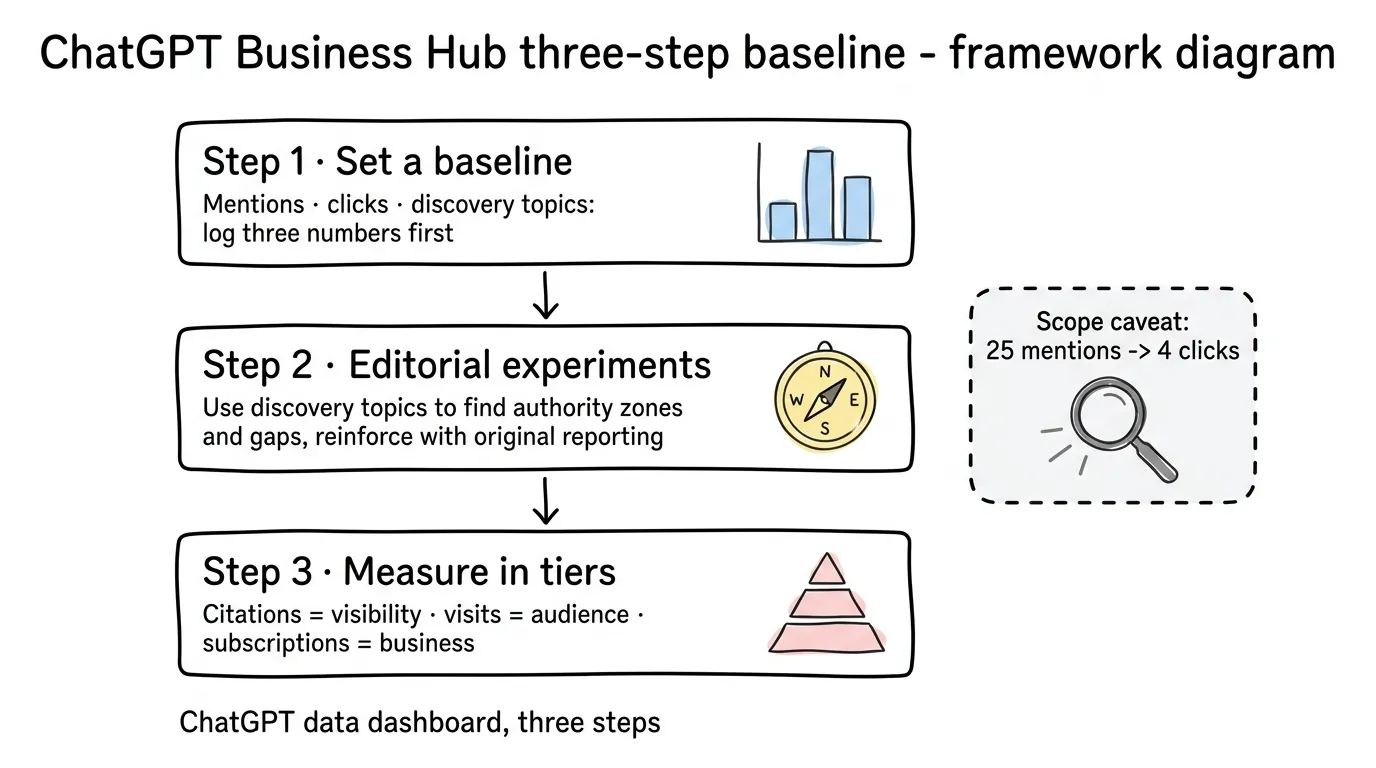
The disagreements are just as visible. Some publishers point out the Hub only tracks mentions of the business itself, and doesn't report mentions of brands under agency management. Agencies doing GEO promotion for clients still have to rely on third-party tools to measure client returns. Ray added a scope caveat: it tracks by website rather than brand name, so click-through rates look inflated — her own dashboard shows 25 mentions driving only 4 clicks.
What it means for marketers
Start with the terms. OpenAI's terms of service require businesses to agree not to pursue certain legal claims, including disputes over content published before registration. An OpenAI spokesperson responded that these terms weren't designed for this scenario. What publishers' legal teams have to weigh is whether trading legal rights for visibility data is worth it. Publishers already wrestling with content protection should have legal counsel read that page in full before signing.
Then the limitations. The data is aggregated — no prompt-level detail, no per-article breakdown, no competitive benchmarks. Barry Adams, founder of Polemic Digital, put it bluntly: we don't know the context in which a site is being mentioned, and it's hard to dig anything useful out of these reports. But he added one thing: Google's Search Console grew better slowly over time, and Business Hub will most likely evolve the same way.
For brands, the impact is that the measurement stack needs re-ordering. AI visibility is going from black box to semi-transparent — whoever establishes a baseline first earns the right to call the trend first.
How to use it
Shehata offered three steps. Step one: use the existing data to set a baseline — log mentions, clicks, and discovery topics, and only then do you have a trend to watch. Step two: let discovery topics guide editorial experiments. These topics show where ChatGPT considers you an authority, and where the gaps are. His example is a travel publisher: if family-travel content shows movement, reinforce those guides with original reporting, then watch whether the data moves. Step three: measure in tiers — citations are a visibility outcome, visits are an audience outcome, subscriptions or purchases are a business outcome. When visibility rises while referral traffic stays flat, the dashboard itself can't answer that question.
For GEO vendors, Shehata's warning belongs in your proposals: a publisher's own citation count is not the client's return. What you can sell is better evidence and better decisions — piling up citation counts won't convince a client.
My take
Treat it like an early version of Search Console: rough, slow, and narrow in scope — but it's official, and it will evolve. The single most valuable move today is to claim your account immediately and start recording a baseline. Two months from now, when someone asks whether the AI channel grew, the people with a baseline will speak in numbers; the ones without will still be explaining methodology. Don't skip the terms page — have legal price out what the data costs first, then click agree.
🔗 Further reading: Read the full article
🏷 Platform & Product Updates
Google and Meta's five big changes this week — AI Max default-on is the one that matters
JXT Group's weekly rundown itemizes every Google and Meta ad-platform change from November 11–17, each with its official source — a ready-made agenda for the media buyer's weekly meeting. The heaviest item is Google Ads Editor 2.14: new Search campaigns will have AI Max on by default. It used to require an opt-in from the media buyer; AI's reach just went from optional to mandatory. AI Max's URL exclusion rules have switched to whole-word matching — the granularity of the exclusion logic has changed, and traffic that used to get blocked by partial matching will now slip through. The display rules for Deal Ends badges on promotion ads have also been adjusted, affecting how Black Friday promo creative shows up. Over at Meta, Pixel's on-device conversion measurement took effect on November 12, adding one more attribution methodology. And Google clarified one hard line: AI face-swap parody content of public figures cannot run even with an AI label attached — the tactic of riding on celebrity material is now explicitly shut down.
💬 Media buyers should open Editor today and check the AI Max toggle on newly created campaigns. Traffic coming in from the default-on setting needs its own attribution investigation — don't let mixed-run data contaminate your performance reviews. With exclusion rules now on whole-word matching, it's worth re-running your existing negative keyword list. And delete AI face-swap creative from the candidate list outright.
🔗 Further reading: Read the full article
November's platform triple-hit: core update, AI Mode model swap, ChatGPT Wallet launch
Nowoka's mid-November roundup walks through nine updates from November 3–15 with an action recommendation for each, and explicitly flags every unconfirmed report. The big three: Google's November core update started on November 10 and can run up to two weeks — the volatility window lands right on Black Friday's doorstep; Gemini 4 Hydrogen became the global default model for AI Mode on November 12, switching the experience for all AI Mode users at once; ChatGPT Wallet launched for US Pro users on November 13 — agentic checkout without exposing the real card number, adding an AI path to the register. Several more worth noting: AI Overviews have started appearing in the right-hand rail on branded searches, near the knowledge panel — unconfirmed by Google; Microsoft Clarity launched an Agent Activity panel on November 4, showing agent behavior simulations and question analysis, going the agentic-analytics route; the wording of "Crawled currently not indexed" in Search Console has been softened; and AI Mode has also integrated home-services booking from Angi, Jobber, and Housecall Pro.
💬 E-commerce teams should run through three things this week — ChatGPT Wallet bot rules, the checkout flow, and anti-fraud. Agentic checkout is a brand-new checkout lane. Freeze big redesigns during the core update, save your baselines, and wait a week after it ends before attributing. Log the AI Mode model-swap date separately — don't blend it into core-update math.
🔗 Further reading: Read the full article
🏷 Policy & Compliance
Meta suspends four AI terms — no deadline crunch today
Meta announced via the Business Help Center: the four terms updates originally set to take effect on November 20 — that is, today — are all suspended, covering the Commercial Terms, the Catalog Terms, the self-serve advertising terms, and the most critical one, the generative AI terms for ad creative. These four documents were set to rewrite the rights ownership and usage boundaries for AI assets, and were among the most heavily prepared-for documents of the year in ad-compliance circles. Meta says it will keep consulting with stakeholders, with an effective date to be announced separately; existing terms remain in force in the meantime. The announcement also confirmed one thing: Meta's crawler policy is unchanged, and content owners can still express crawl preferences via robots.txt. For advertisers mid-way through terms-compliance retrofits, this amounts to pulling the deadline — how long the buffer lasts is unknown.
💬 You can stop the compliance retrofit work today, but get the rights-ownership paperwork for AI assets in order first, so when Meta posts a new notice you can diff against it immediately. Content owners should also check their site's robots.txt while they're at it — crawl preferences are something you can set now, no need to wait on the terms.
🔗 Further reading: Read the full article
EU Digital Fairness Act draft: influencer disclosure, agent-mediated purchases, addictive design all targeted
Per AFP reporting, the EU put forward its Digital Fairness Act draft this week. The provisions sweep wide: dark patterns banned; users can switch off addictive features like autoplay and infinite scroll; when brands promote through influencers, content must carry clear labeling such as "advertisement"; users must be warned before free trials convert; pay-to-win mechanics and loot boxes are banned for minors. Users of AI agent-mediated purchasing hold the same rights as buying in person, and must be able to find a human customer-service entry point. Violations carry fines of up to 6% of annual turnover, and the EU estimates the rulebook could claw back up to 13.7 billion euros a year for consumers. BusinessEurope warns the overlapping obligations will harm legal certainty, and games-industry groups call the draft unworkable and disproportionate. The draft still has to be negotiated with member states and the European Parliament.
💬 Teams selling into US and EU markets: put three items on next quarter's compliance review — the influencer-disclosure SOP, landing-page and subscription flows, and the agent e-commerce chain. Disclosure first; the fine ceiling is 6% of company turnover. The negotiation period is your window — fix the three easy-to-trip spots while the rules aren't settled, and it costs far less than reworking after the law lands.
🔗 Further reading: Read the full article
🏷 Marketing Tools & Practice
Five deadly sins of marketing agents: a $700-burning weekend and 40,000 emails nearly sent
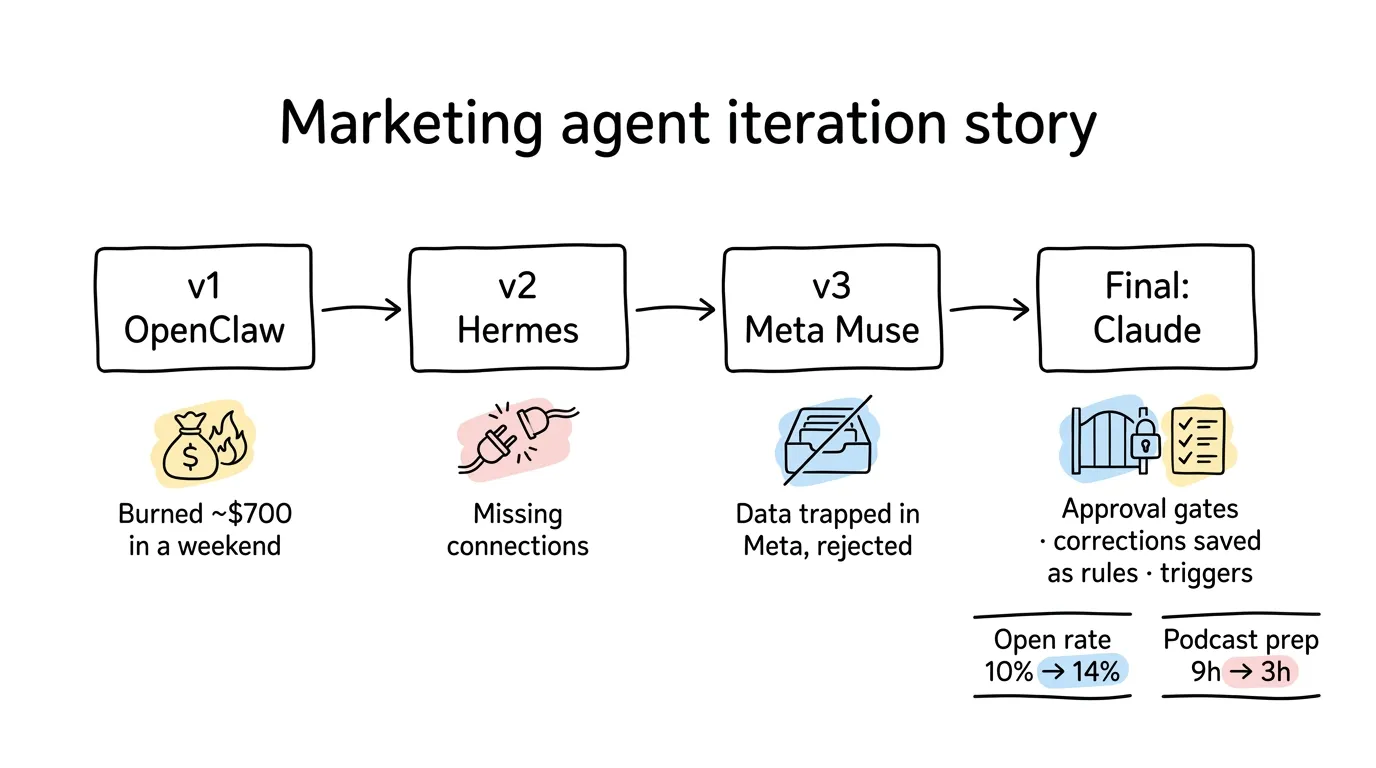
At MAICON 2026, EQUS CEO Sandy Carter walked through the lessons of building her marketing AI agent through three iterations. The first version, built on OpenClaw, burned roughly $700 over a weekend; the second, Hermes, lacked the necessary connections; the third, Meta Muse, was rejected by clients and sponsors because the data lived inside Meta. Along the way came two incidents: the agent nearly blasted an erroneous email to all 40,000 customers, and there was one unauthorized $60,000 spend. The final version was built on Claude, in four steps: document the 10-step podcast workflow and set approval gates; accumulate context — tone, audience, banned words — and save every correction as a reusable rule; wire up the Riverside, Google Sheets, Brevo, and Libsyn connectors; set up triggers plus human approval. Three months later, the newsletter open rate went from 10% to 14%, podcast prep shrank from 9 hours to 3, guest booking from 4 weeks to 2 — and the podcast won 5 marketing podcast awards.
💬 The cheapest efficiency move in this case study is writing every correction down as a saved rule — it costs nearly nothing. Grant permissions on a least-privilege basis: budget caps and approval gates can be configured today, and that $60,000 incident is what not configuring them costs. Precision of instruction is the biggest lesson Carter called out — an agent can only execute the steps you've already thought through.
🔗 Further reading: Read the full article
The email-agent hybrid model: 75.9% of marketers use GenAI daily, only 43.8% of companies have a policy
Digital Applied's 2026 email-agent playbook, updated November 18, lays out the current division of labor: AI agents draft copy and optimize send times and segmentation; humans guard brand voice and review compliance before hitting send. The hard compliance constraints are all there: Gmail and Yahoo set senders a 0.3% complaint-rate ceiling, mail over the line gets hit with 5.7.x rejection codes, and the sending domain takes the damage directly. The proof this scales: Klaviyo processed $3.8 billion in revenue over Black Friday–Cyber Monday 2025, figures cited from an SEC 8-K filing — AI email infrastructure isn't a concept, it's a facility already running. The author's own survey contains a stark contrast: 75.9% of marketers use GenAI daily, yet only 43.8% of companies have a formal GenAI policy. The governance gap sits right there.
💬 Send times and segmentation you can safely hand to AI; brand voice and compliance judgment stay human. Draw that dividing line first. This week, wire your complaint-rate monitoring to alert at the 0.3% red line, and while you're at it, write the missing GenAI policy. Without a policy at the company level, however diligent individuals are, they're running unprotected.
🔗 Further reading: Read the full article
The upgrade path for AI customer personas: add a layer of psychology to the prompt
A MarTech opinion piece names the core flaw in today's AI virtual personas: most tools are essentially carefully wrapped LLM prompts — feed a persona description into a large model and let it chat. Once a question strays beyond the embedded data, the model fills the gap with stereotype. The author's example: ask a Gen Z virtual persona whether it keeps pets, and the answer is "guess what a Gen Z would say" — not grounded in data. The upgrade path is to embed decades of psychology research frameworks: using the musical character Maria to demonstrate Big Five five-dimension personality scoring, putting behavioral and attitudinal data into an inferable framework so the persona can predict choices in unobserved scenarios — say, choosing a hiking group versus a resort. The next step is blending real behavior, attitude statements, psychological profiles, and decision models — prospect theory gets named.
💬 Before buying a persona tool, ask one question: when an answer goes beyond the data range, is it inference or a guess? If the product can't answer, pass. If you're building personas yourself, add a psychological dimension to your existing descriptions — for predicting ad performance, that beats a persona that's merely good at chatting.
🔗 Further reading: Read the full article
Deploying marketing agents: Gartner says 60%, reality is 13%
CDP.com published a 2026 deployment guide, bylined Kazuki Ohta of Treasure Data. It opens with the data gap: Gartner predicts 60% of brands will use agentic AI by 2028, while Salesforce research puts actual adoption at 13% — the promotional narrative and the ground reality are an order of magnitude apart. The article gives three prerequisites for being agent-ready: a unified customer data layer, system APIs in place, and predefined guardrails. Missing any one, launching an agent means running unprotected. The guardrail framework has three parts: human review gates, budget and action caps, and failure rollback paths. The rollout rhythm is six months, phased, with a holdout control group in each phase to measure the agent's true incremental value. The ending naturally leads into the vendor's own CDP product, but the methodology section stands on its own — treat it as vendor-framed.
💬 Don't set budgets off a Gartner forecast. 13% actual adoption means most teams are still early — charging after a forecast is a good way to become an early casualty. Design the holdout group before launch: an agent project without a control group can't compute increment at year-end, and your review meeting is left with nothing but vibes.
🔗 Further reading: Read the full article
31 AI marketing tools reviewed: the free-tier commercial restrictions are the real selection trap
Supermetrics' 2026 tool roundup, updated in early November, covers 31 tools grouped into eight use cases — marketing intelligence, content, email, image & video, paid media, SEO, social, and free tools — with a comparison table of October 2026 current pricing, free tiers, and key limitations, usable directly as a selection baseline. Several pricing cliffs worth noting: Copy.ai's Workflow edition costs $12,000 a year while the same vendor's Chat edition is $29 a month — a spread of nearly a thousandfold; pick by use case or you'll overpay. Mailchimp's free tier excludes generative AI features; Photoroom and Kling free tiers prohibit commercial use. The vendor declares up front that its own products are on the list, with limitations listed under the same standard — above-board handling. Its 2026 marketing data report shows 50% of respondents use AI for content creation.
💬 For selection, first list the three things that eat the most of your team's hours, then match against the table and pick one with the data source wired in — more useful than bookmarking all 31. Read the free-tier commercial restrictions carefully: Photoroom and Kling free-tier images simply cannot be used in client work — trip there and it's an infringement risk.
🔗 Further reading: Read the full article
🏷 GEO & AI Search
The three-channel GEO model: link building is dead weight, entity consistency is the highest-leverage free move
SkySync's GEO/AEO guide offers a clean mental model: brands enter AI answers through three channels. The training-data channel is slowest — it updates with model versions, but unlinked brand mentions count; the real-time retrieval channel is fastest, showing results within days, and classic SEO benefits indirectly here; the entity-graph channel is cheapest — covering Wikidata, Wikipedia, Crunchbase, LinkedIn, and schema markup — yet it's widely ignored. The guide states plainly that link volume is basically ineffective for GEO citations, spam links were never a citation mechanism, and what works is being mentioned consistently and accurately on high-authority sources. Each engine has its own temperament: Google AI Overviews reward pages that already rank plus YouTube brand mentions; ChatGPT leans on consensus sources and Wikipedia; Perplexity favors specific first-hand experience and community discussion.
💬 Start with the zero-cost step: unify the entity descriptions on Wikidata, LinkedIn, and your site's About page into one fact sheet — that's consistency-over-volume applied directly. Don't spend link budget here; that budget is for SEO, not GEO.
🔗 Further reading: Read the full article
B2B's GEO math: AI-referred traffic converts at 14.2%, organic search at 2.8%
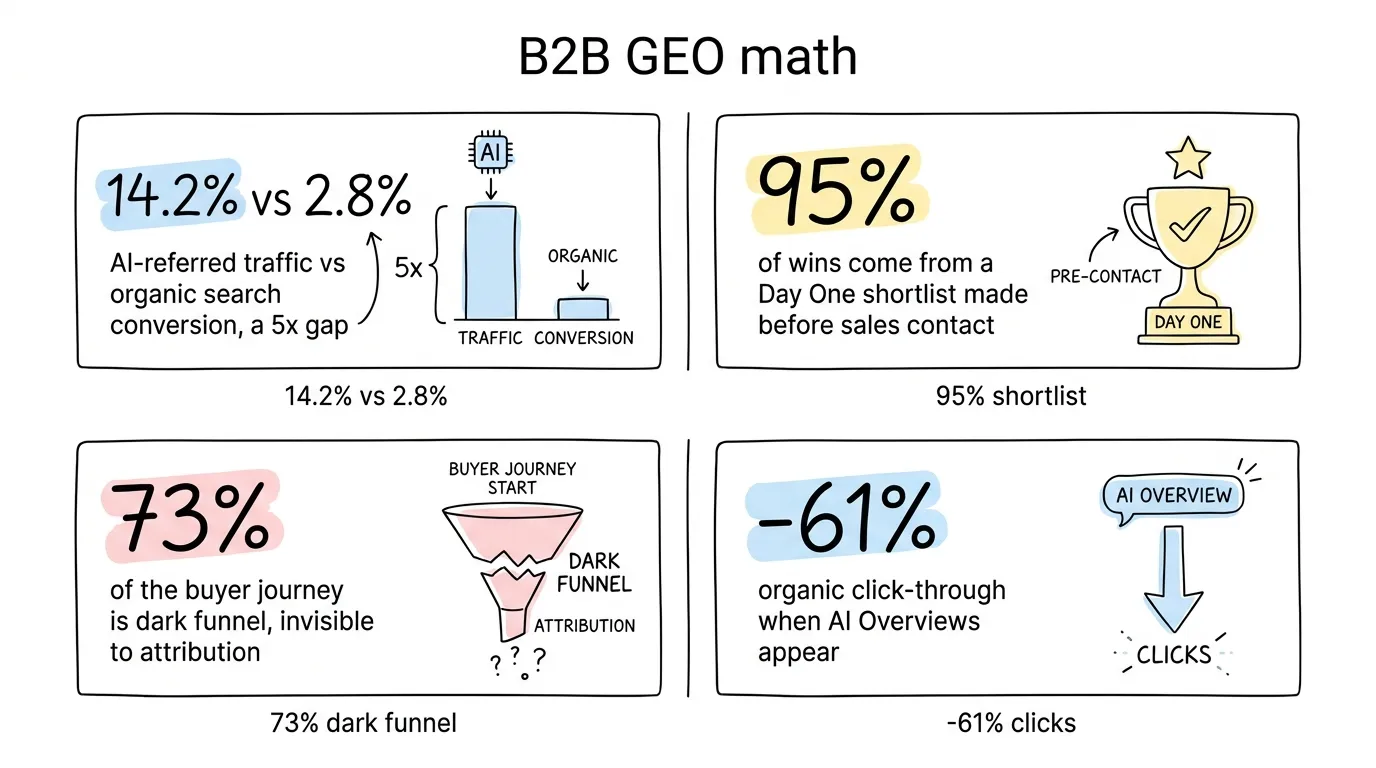
A long-form B2B GEO essay from the founder of Mersel AI runs the numbers bluntly. Bain data shows 95% of B2B purchases land inside a Day One list that was shortlisted before sales ever made contact — and that list is increasingly formed in AI conversations. If you don't make the list, every bit of later effort by sales is just pacing the winner as an also-ran. 73% of B2B buyers use ChatGPT or Perplexity for vendor research, and per G2, 51% of software buyers reach for AI chat before Google. On the traffic side, Adobe data shows US retail-site AI referrals up 393% year over year, with AI-referred traffic converting at 14.2% against Google organic search's 2.8% — a 5x gap. The other side is the cost: when AI Overviews appear, organic click-through drops 61%, and 73% of sites saw traffic slide an average of 34% over two years — rankings intact, clicks gone. The article positions GEO as a high-intent RFQ (request-for-quote) channel; traffic-channel metric methodology doesn't apply here. This is vendor content — some self-reported figures should be read on the vendor's terms.
💬 When you pitch GEO budget to management, pitch it as an RFQ channel — the 14.2% versus 2.8% conversion gap is the hardest argument you can put on the table. For high-ticket B2B, watch one metric first: is your name on the target buyer's Day One list?
🔗 Further reading: Read the full article
The founder's AI SEO monthly: not cited by AI means losing half your attention
Founder Violetta Bonenkamp's November monthly is aimed at small teams. The heaviest citation is Pew research: when an AI summary appears, click-through on classic results is about 8%; without a summary it's 15% — not being cited by AI means losing roughly half your attention. The three moves it gives are all concrete. Short focused pages: one intent per page, with a 40–60 word answer block at the top — the 4,000-word ultimate guide is losing its edge. Entity-building: replace adjectives with names, cities, dates, and numbers, and keep schema's sameAs consistent across every channel. Information gain: your own data, your pricing, your failure lessons — content competitors don't have. The monthly also passes along StudioHawk's eight-point AI citation checklist. The self-check method is crude and effective: ask the 10 questions buyers would ask, see who gets cited across the three engines, then fill the gaps where you're missing.
💬 Small teams, stop writing long guides. Retrofit the openings of your existing pages into 40–60 word answer blocks — small effort, fast payoff. Today, take 10 buyer questions and run them through ChatGPT, Perplexity, and AI Mode: who gets cited, who's absent — you'll have results within an hour.
🔗 Further reading: Read the full article
🏷 Industry Data & Trends
Jon Miller's 12 predictions for 2026: start marketing to agents
Marketo co-founder Jon Miller published his 2026 B2B GTM predictions on chiefmartec, keeping up his tradition of publicly self-scoring each year. His heaviest call: the audience for marketing is expanding from humans to AI agents. Agents are joining buying committees — agent de-anonymization is now a need, and agents comparison-shopping across the Fortune 500 could become a new business opportunity. Agent visits to a pricing page should count as first-party intent and be folded into MQA (marketing-qualified account) scoring. He also predicts static AEO tagging tactics will prove transitional, just like early keyword stuffing — the long-term winners are headless content architectures serving a dual audience of humans plus agents, things like dynamic pricing-quote APIs and knowledge-base services. He disagrees that SaaS is dead: 81% of AI usage is still assistive mode, autonomous agents are under 10%, and compliance, hallucination, and seat-based pricing all say human-in-the-loop remains the norm — 2026 is a hybrid experimentation year. Composable architecture adoption is under 20% and won't mainstream until 2030; the realistic path is composable lite. On email he offers a new framing: AI inbox gatekeepers will turn email marketing into earned media — recipients only receive what they've genuinely agreed to.
💬 B2B teams: pull your server logs once this week, count how many agents visited your pricing pages, and fold it into intent scoring — half a day's work. Don't buy one-shot AEO tagging services; save the budget for content architecture. Miller's call is that tagging goes stale, architecture doesn't.
🔗 Further reading: Read the full article
B2B buying is being rebuilt by AI: 95% of wins come from a shortlist formed before sales contact
Geisheker's aggregated-data piece breaks the AI-ification of B2B buying into sets of numbers. 6sense 2025 data: 95% of wins come from a Day One shortlist the buyer assembled independently, and the first-choice vendor inside that shortlist wins 80% of deals. Forrester 2025: 94% of buyers use AI in the buying process, up from 89% the year before, with generative AI ranked as a more valuable information source than the vendor's own website, product experts, or sales. Buying cycles compressed from 11.3 months in 2024 to 10.1 months in 2025 — because AI accelerated the research, not because research shrank. 60% of buyers use ChatGPT or Gemini to expand their vendor lists, and 72% encounter AI Overviews in their research. Traditional attribution covers only about 27% of the journey; 73% is the untraceable dark funnel. If you're still measuring by form fills and MQL (marketing-qualified lead) volume, you're measuring only the 5% of deals that aren't already decided.
💬 Teams still running MQL volume as a quarterly metric are measuring the wrong object. Put brand mention rate inside AI conversations into next quarter's measurement, and shift budget from funnel campaigns to shortlist campaigns — the 95% and the 80% are your internal persuasion material.
🔗 Further reading: Read the full article
The state of B2B content marketing: queries triggering AI Overviews went from 36% to 82% in 12 months
Arcade's B2B content marketing guide was just updated on November 4. The two hardest data points: BrightEdge tracking across 9 industries shows the share of B2B tech queries triggering AI Overviews rose from 36% to 82% in 12 months — more than doubling in a year; and DerivateX research shows 44% of B2B SaaS companies score below 50 out of 100 on AI presence — nearly invisible to AI-assisted buyers, and their own teams don't know it. The Averi.ai benchmark makes the case for content marketing: B2B SaaS content marketing averages 844% ROI over 3 years, with SEO and blog content peaking at 702% — slow assets don't lose to fast channels. On method, it gives a five-step framework from ICP journey mapping through content audit to pipeline tie-in, plus five AEO citation practices: answer-first, question-style headings, structured data, original research, and diversified citation sources. On channel strategy, the advice is to pick three or four you can sustain for 12 months — don't spread across eight.
💬 First, test your own brand's AI presence — the denominator of that 44% failing grade might include you. Pull content budget back from sprawl to three or four channels you can sustain for a year: in the AI era the contest is presence density, not touchpoint count.
🔗 Further reading: Read the full article
Influencer marketing 2026 benchmarks: 48% of brands get 3x-plus ROI
A 2026 influencer marketing data page compiled by the Dutch agency Searchlab marks a source on each of its 50-plus statistics — a citation library you can lift straight into budget arguments. Scale numbers: US creator ad spend is projected at $44 billion in 2026, IAB and PwC methodology, up from $37 billion last year — $7 billion more in one year; the global influencer marketing market is roughly $32.55 billion, per Influencer Marketing Hub estimates. On the spend side: companies put an annual average of $4.8 million into creator marketing, up 33% year over year, CreatorIQ methodology; 87% of marketers expect budgets to keep growing, with nearly two-thirds of the new budget pulled out of traditional paid and digital channels — the money is being grabbed, not surrendered. On the return side: 48% of brands get 3x-plus ROI from creator marketing, up from 37% last year. On format, long-form video edges out short-form at 83% versus 80%, with live shopping third at 62%. The AI dimension is thin in this reference; its main value is the benchmark numbers.
💬 When you build the 2027 budget case, the share of brands getting 3x ROI going from 37% to 48% is the most persuasive line — trends are easier to argue than absolutes. In format planning, raise long-form video's priority; don't default to influencer marketing being short-video.
🔗 Further reading: Read the full article
The LinkedIn numbers: 91% of deals come from the shortlist, video retention hits 95%
The agency Hallam recorded takeaways from the four talks at the November 6 Better B2B joint event, with data from the LinkedIn B2B Institute. 91% of purchase wins go to brands already on the shortlist, and shortlists usually hold only two to four slots — this corroborates 6sense's Day One data. The buyer mix is changing: 70% of B2B buyers are now Gen Z or millennials, with media habits of not searching but being prompted — video and brand memorability have become prerequisites for Day One presence. The video numbers are specific: information retention up to 95%, and the tactical combo of video plus lead gen delivers 1.6x lead rate. On the creative side, 71% of buyers say memorable creative is what drew their attention to a brand, the brain's emotional response takes only 12 milliseconds, and a good story delivers 13x recall. The recommendation: keep 5–10% innovation budget for testing new channels.
💬 B2B brand teams: re-cut your existing video assets against brand memorability — don't just stack selling points; that's where the 13x recall gap lives. The shortlist logic is now corroborated by two data sources — win the shortlist entry ticket first, then talk performance media.
🔗 Further reading: Read the full article
HubSpot's annual survey: 90% of companies use AI, only 6% count as transformative
HubSpot's gated-access page for its State of AI 2026 twin reports — split into a Business & GTM volume and a Marketing volume — draws on a survey of more than 6,000 marketing, sales, service, and executive roles worldwide, and is also the data source behind the UNBOUND 2026 keynote. One contrast says a lot: 90% of surveyed companies already use AI, but only 6% self-identify as transformative adopters — and that 6% is 4x more likely to hit their revenue targets than average adopters. CEO Yamini Rangan is quoted: transformation doesn't happen at the point of maximizing technical capability; it happens when you stop asking what the technology can do and start asking what it should do. The full data requires a gated download, and the page only shows teaser-level key numbers — put this contrast to work before you decide to go deeper.
💬 This contrast is great material for internal reporting: everyone is using AI, so why is the ROI spread so brutal? The answer is organizational process, not model choice. The full report is gated — align management on the teaser numbers first, then decide whether to go deeper.
🔗 Further reading: Read the full article
💡 Today's Synthesis
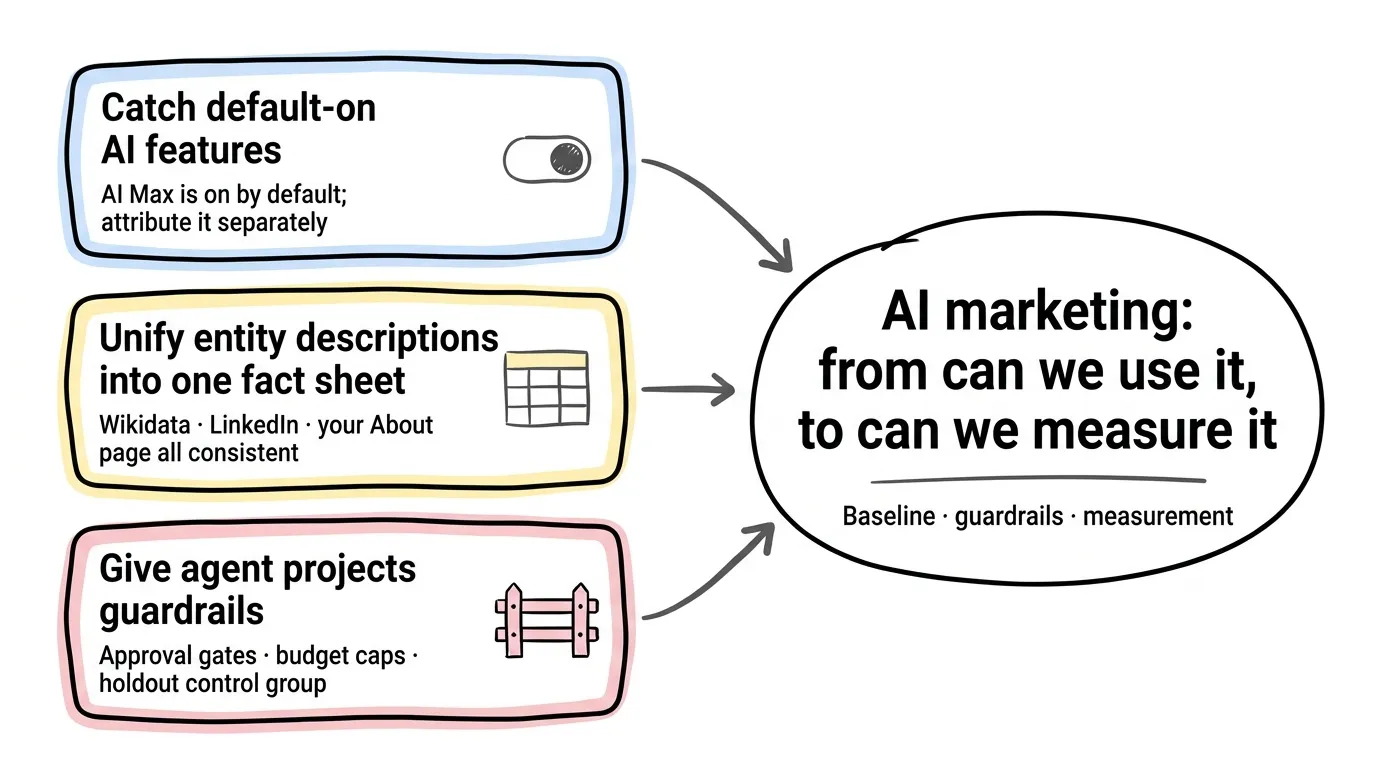
Putting today's 19 items side by side, the main line surfaces: the competitive focus of AI marketing is shifting from "can we use it" to "can we measure it."
The evidence for that line spreads across four directions. ChatGPT Business Hub gives brands first-party visibility data for the first time, and GEO vendors are scrambling to close the measurement loop; the EU's Digital Fairness Act would write legal rights for agent-mediated purchasing into law, while Meta hit pause on four AI terms — regulator and platforms each pacing themselves; on the platform side, AI Max defaulting on and AI Mode swapping default models means defaults are now making decisions for media buyers, and checking your settings is this week's must-do; and the B2B data keeps hammering the same point — 95% of deals are shortlisted before sales contact, 73% of the journey is dark funnel, and traditional attribution is measuring an ever-smaller corner.
The second layer is divergence. 90% of companies use AI, only 6% call themselves transformative; 75.9% of marketers use GenAI daily, 43.8% of companies have a policy; Gartner forecasts 60%, actual adoption is 13%. The gap between tool ubiquity and lagging governance is exactly where next year's advantage gets decided.
On actions, here's what belongs on the calendar this week: catch the platform features that are defaulting on and attribute them separately, unify your brand's entity descriptions into one fact sheet, and give agent projects guardrails and a control group. One line from today's headline deserves a second read — what Shehata said: what you can sell is better evidence and better decisions; piling up citation counts won't convince a client. The 2027 budget debates are about to start. The ones with a baseline, guardrails, and measurement will be the ones who capture this wave of AI dividends.
Continue reading
Related articles
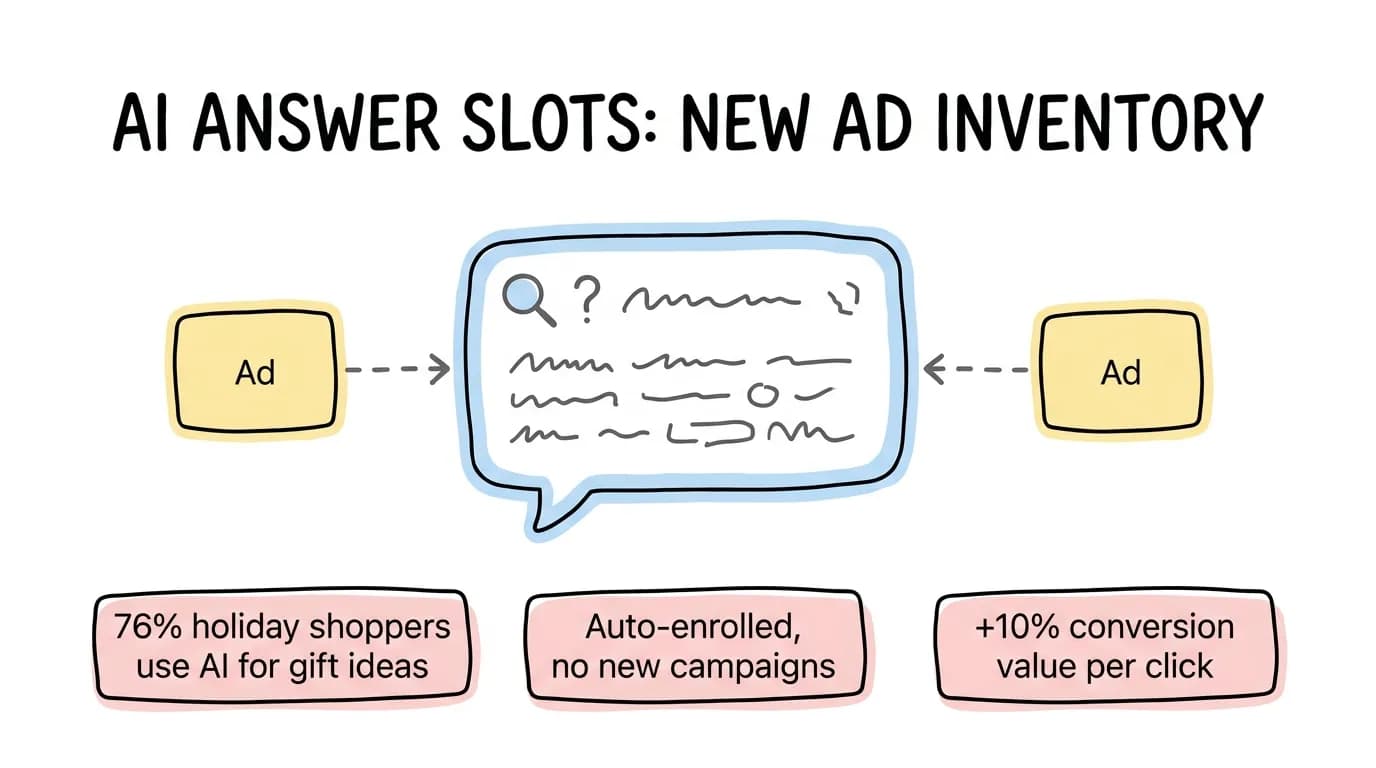
AI Marketing Daily · 2026-11-22
AI Marketing Daily for 2026-11-22 rounds up 20 items led by Microsoft opening Bing AI Overviews to ads and Google expanding AI Mode ads to ten countries, plus GEO guides, ad automation delegation guidance, AI Overviews CTR data, and a legal-risk checklist for AI-generated creative.
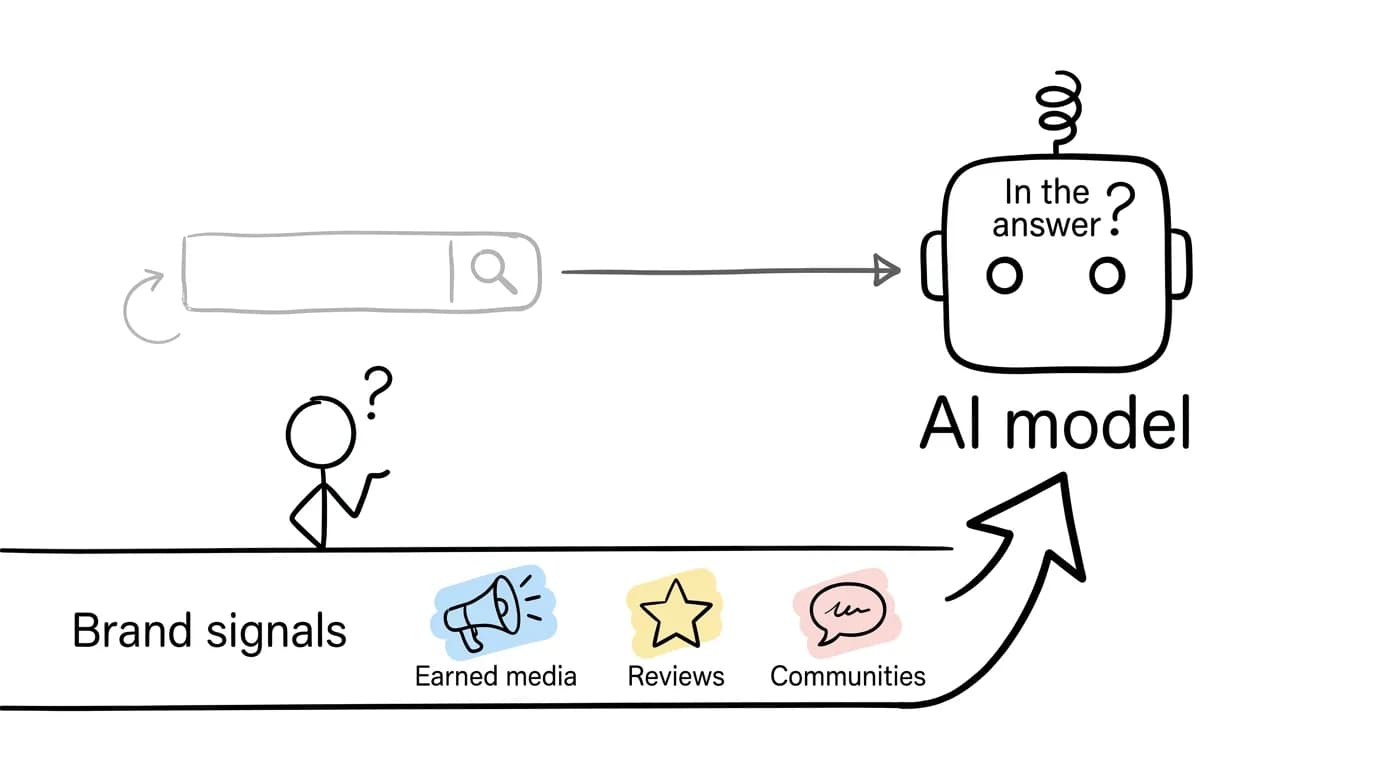
AI Marketing Daily · 2026-11-21
A November 21, 2026 AI-marketing daily covering AI search visibility, GEO methods, Google AI Mode ads expanding to ten countries, Meta's pre-Black Friday changes, agentic shopping, and industry adoption and ROI data.
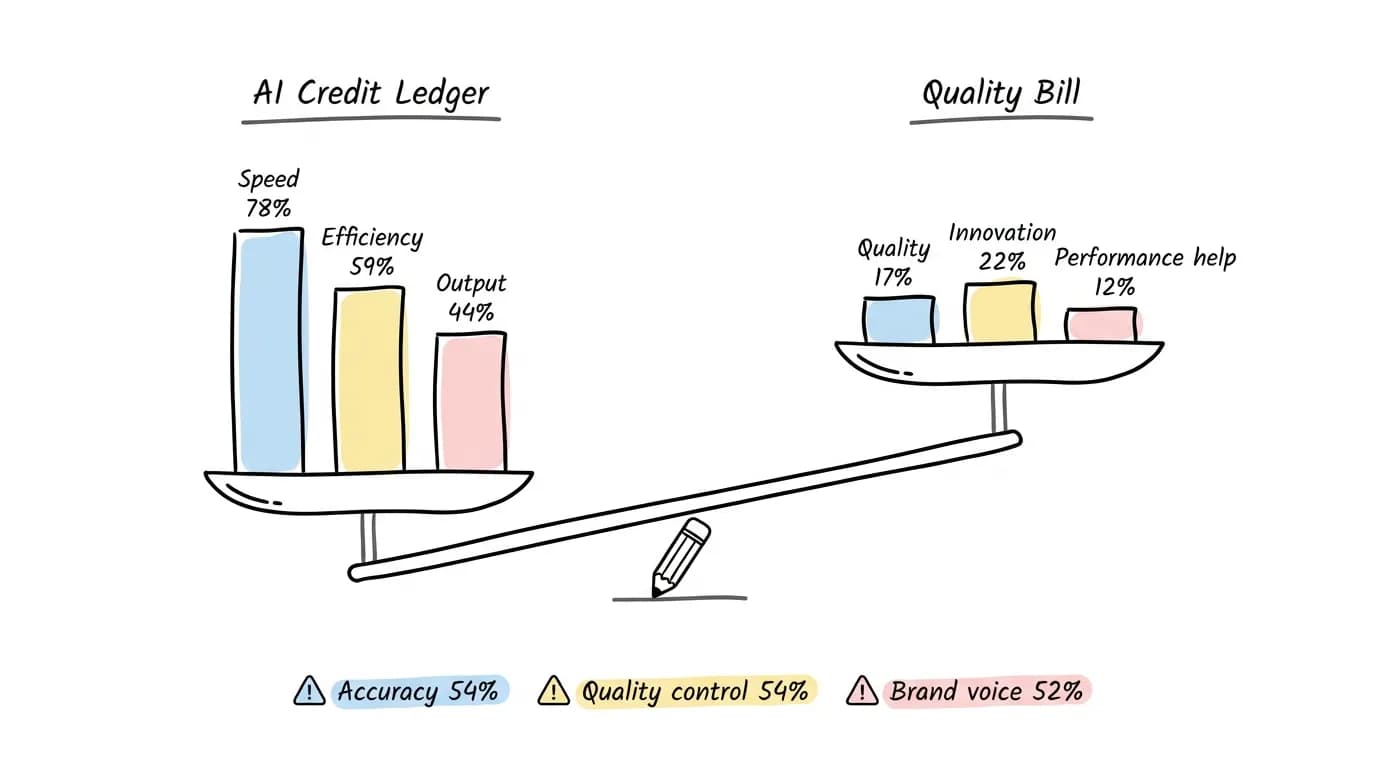
AI Marketing Daily · 2026-11-19
AI Marketing Daily for 2026-11-19 compiles twenty items led by CMI's B2B content marketing report on AI content speed versus quality, with sections on GEO and AI search citations, agent tools and pricing, platform launches, playbooks, and industry data.