
AI Marketing Daily · 2026-11-17
Daily AI marketing briefing covering a publisher selling GEO ad placements, ads entering ChatGPT and Google AI Mode conversations, citation-share measurement, and FCC unsubscribe rules effective November 25.
Publishers have begun selling ad placements priced in AI citations, ChatGPT and Google are stuffing ads into conversations, and the FCC's new unsubscribe rules take effect in one week. Today's 20 items come with real campaign data, compliance deadlines, and a 90-day plan you can copy outright. The headline is how BDG lifted Innisfree's AI visibility by 30% across 200 skincare prompts — a playbook worth studying for every company that does content marketing. Read this single briefing and you'll hold every key shift in AI marketing from the past 24 hours in your hands, with the deadlines worth remembering already flagged for you.
🎯 Today's Headline
A publisher steps up to sell GEO: BDG turns AI visibility into an ad product
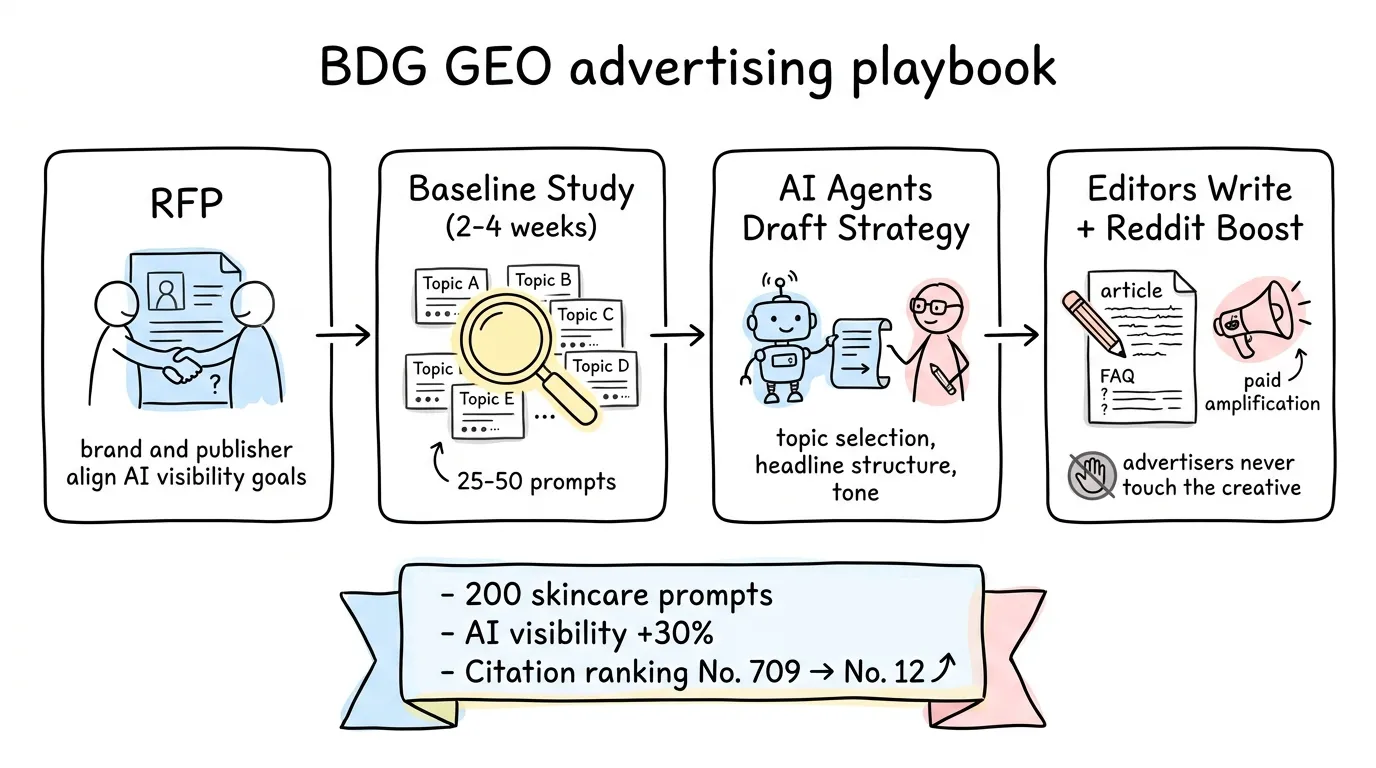
Digiday's November 16 exclusive reports that publisher Bustle Digital Group has launched a GEO advertising product built on the AI-visibility measurement company Profound, under the internal codename ECHO. BDG's portfolio includes Bustle, Nylon, Elite Daily, Scary Mommy, and other outlets. The setup combines Profound's analytics with a set of AI agents trained on BDG's own content: these first produce creative briefs and writing guidelines for brands, and BDG's editorial team then creates content to those guidelines with the explicit goal of being cited by AI. At least three brands have already paid. Graham Howes, SVP of Distribution and AI Intelligence, says a rise in client inquiries this year is what pushed the product into existence.
First, the numbers from two case studies. For Korean beauty brand Innisfree, the placement ran August 11 through September 30; across 200 tracked skincare prompts, AI visibility rose 30%, and Bustle's citation ranking climbed from No. 709 to No. 12. In the words of Innisfree US general manager Julien Bouzitat, combining trusted editorial environments, answer engine optimization (AEO — the practice of earning citations inside AI answer engines), and prompt-level measurement makes AI visibility something that can be measured, can be optimized, and ultimately becomes a competitive advantage. The other case is Pampers: after a September 4–17 placement, a Scary Mommy explainer on fragrance-free diapers pushed AI visibility for relevant questions from No. 2 to No. 1. Howes says there is no off-the-shelf playbook in this business — BDG found its way in through DIY trial and error, understanding the space first and talking productization second.
Why this matters. BDG is currently the only publisher partnering with Profound on a product of this kind. GEO used to be a consulting service inside the SEO world; now a publisher has packaged it as an extension of custom content, delivering results with prompt-level data — effectively opening a new invoice line for advertisers. Ad budgets are starting to follow AI citations, and that is a pivot in the media business model.
The process can be taken apart piece by piece. Step one: an RFP aligns the brand's AI visibility goals. Step two: a 2-to-4-week baseline study breaks the themes where the advertiser wants to raise visibility into 8 to 10 topics, each topic broken down into 25 to 50 prompts, mapping the competitive positioning and who answer engines are citing right now. Step three: BDG's AI agents produce an editorial strategy — topic selection, headline structure, tone — and hand it to the advertiser for review. Step four: Profound's agents design the creative brief, which goes to BDG editors who write independently, with FAQs at the end of each article and listicle or explainer formats. Howes makes a point of saying advertisers never touch the creative: heavily advertorial content rarely gets cited by AI. After content goes live, it gets paid amplification on Reddit, because Reddit remains a major citation source for answer engines.
Measurement rests on three metrics: brand visibility in AI answers, citation share (a site's share of total citations across a set of AI answers), and citation ranking, tracked mainly across ChatGPT, Gemini, and Google AI Overviews. Profound's Josh Blyska says typical citation-share values run from 0.1% to 3%, so a move of a few percentage points means a major reshuffle in the rankings. Profound flags which articles are pulling in citations, BDG optimizes in real time on that basis, and the advertiser receives a final report with results. Ashish Jacob, GEO director at Go Fish Digital, adds one thing: sustained measurement matters more than tool choice — the same set of prompts can return different results when you switch tools, so you need to understand the prompts, platforms, and sampling methods behind the data.
The impact for marketers comes in two layers. Brand side: AI recommendation slots have become the new shelf — whoever gets cited enters the consideration set, and this can now be bought outright; at least three brands have paid. Media side: publishers gain another monetization path and can lean on the data to act as AI consultants to brands; Howes says explicitly that GEO should support an expansion of partnerships next year. The trap worth flagging is attribution: Blyska himself admits the link from the influence layer to the transaction layer doesn't connect yet — a user makes up their mind inside ChatGPT and completes the purchase on Google, and that accounting can't be reconciled cleanly.
If you want in, copy these three steps. Step one: spend two weeks splitting your category into 8 to 10 topics of 25 to 50 prompts each and record who is being cited right now — a zero-cost baseline audit. Step two: rewrite your high-authority content into a direct-answer-plus-FAQ structure, and don't make it read like an advertorial. Step three: track citation share monthly; for seasonal categories like beauty and fashion, evergreen placements are the way to go. BDG is also negotiating 2027 renewals and full-year campaigns with clients; Howes says content of this kind has a half-life — it decays the moment you stop, and only evergreen holds the seat.
My take: a publisher selling GEO has one more layer of advantage than an agency selling it — their own domains carry natural citation weight, and the editorial team is production capacity ready to go. Howes says custom content is already BDG's largest revenue source, and GEO is an extension of that line, positioned as a complement rather than a replacement. The risk sits entirely in measurement methodology: from citation share rising to visibility rising to business rising, the two steps in between are still a black box. Buy this kind of product as a content-asset investment, not as a performance ad with ROI math. Within six months a batch of publishers will follow and copy; early movers are buying a time window on citation share.
🔗 Further reading: Read the full article
🏷 LLM Watch
AI agents turn customer experience into an acquisition variable
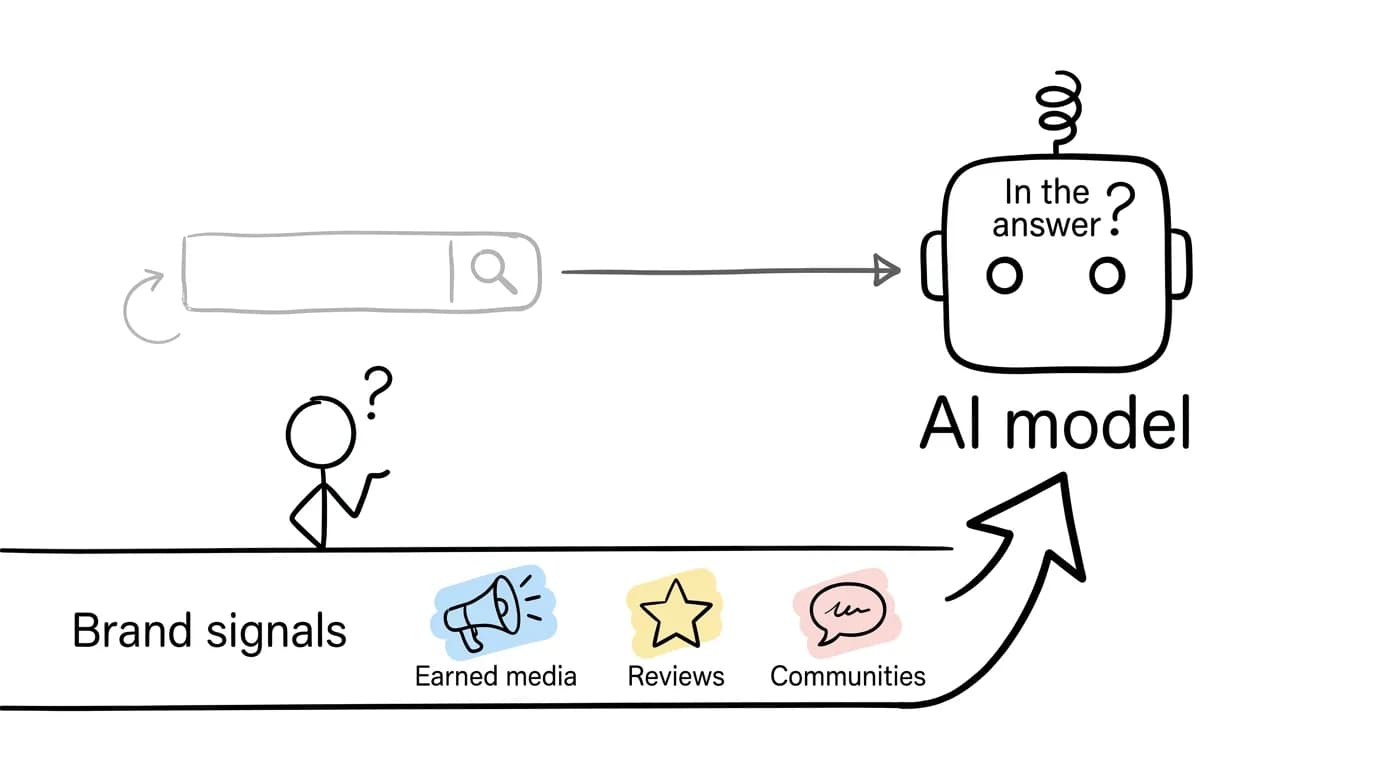
MarTech's November 16 opinion piece examines what AI purchasing agents mean for marketing. When agents comparison-shop and filter on consumers' behalf, what they rely on is real fulfillment data: product performance, satisfaction, complaint rates, service responsiveness, reliability. Perception advantages piled up by ad budgets get diluted, and operational weaknesses get punished directly at the recommendation step. The article's judgment: customer experience is influencing acquisition and retention at the same time for the first time — before, it only handled retention — and the era of perception advantage is drawing to a close. Marketing effectiveness therefore has to be redefined: the job shifts from persuading consumers to believe in the brand to pushing the organization to run operations well, replacing brand promises with brand proof. The author also cautions that agent recommendations are not fully objective — data quality and agent design can both skew the results.
💬 Bring support tickets and return rates into your acquisition review meetings, on the same sheet as your campaign metrics. In the agent era these metrics are your ad creative — fix the data before talking spend.
🔗 Further reading: Read the full article
Google I/O 2026 search outlook: being cited by AI beats ranking No. 1
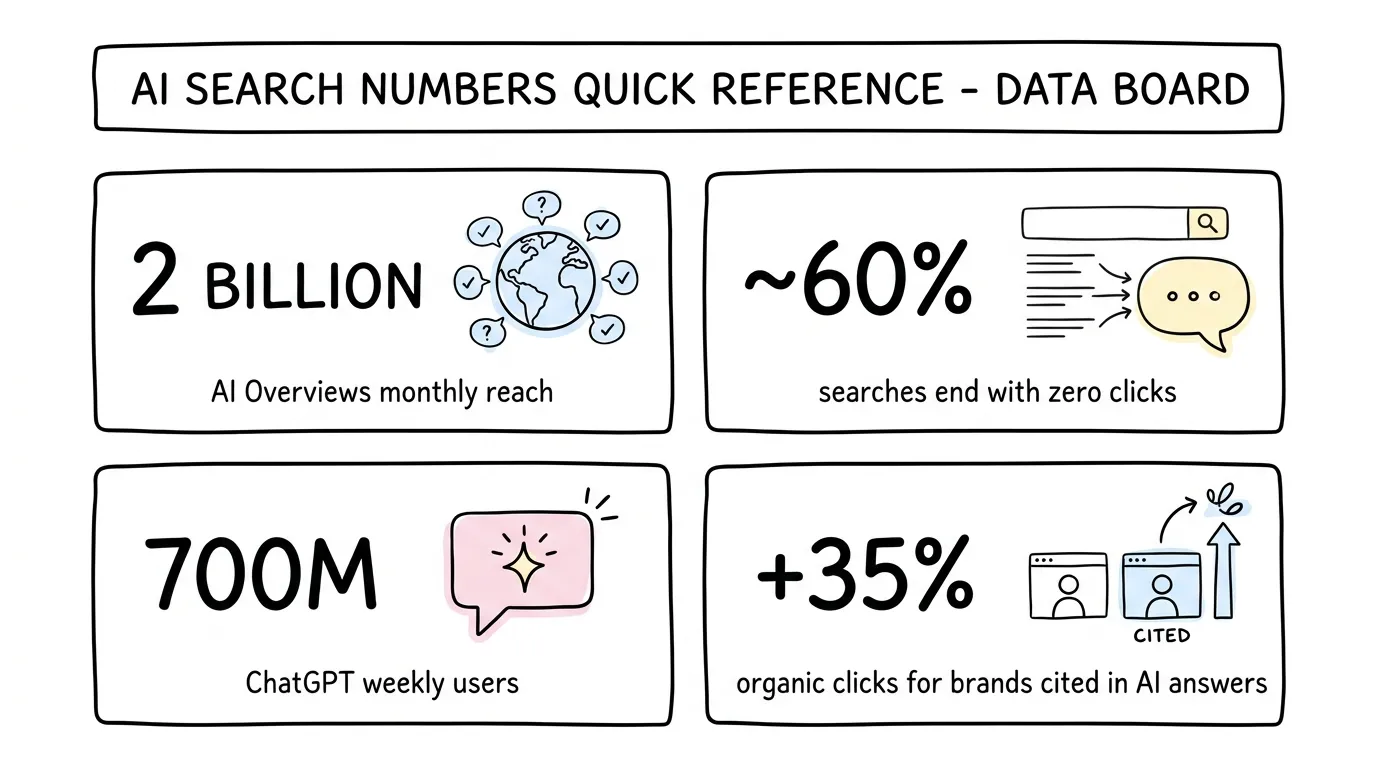
Launchcodex's long-read systematically maps four changes I/O 2026 brought to search visibility. In its first year, AI Mode passed 1 billion monthly active users, with query volume doubling every quarter — conversational search has become mainstream behavior. Background search agents run without prompts; users don't type, tasks run on their own. Personal Intelligence now covers 200 countries. On commercial value: brands named in AI answers get 35% more organic clicks than competitors that go uncited — that slot is worth more than ranking No. 1 organically. The fingerprint inside GSC (Google Search Console): impressions rise while clicks and click-through rate fall — hard evidence of traffic being absorbed by AI. Google's official line confirms AEO and GEO are not independent disciplines; the foundation is still SEO plus exclusive content. The piece closes with a 12-month visibility-protection action checklist.
💬 In your monthly reports, split GSC impressions from clicks — don't judge SEO health on CTR alone. Set citation rate as the new north star; rankings are just a process metric.
🔗 Further reading: Read the full article
🏷 Product Launches
Ads tested inside ChatGPT images; always-on agents enter the field
JumpFly's October 29 monthly roundup gathers the month's five big advertising-platform events. OpenAI is testing visual ads inside ChatGPT image generation, initially open to Free and Go tier users in the US, while wiring in conversion integrations from Hightouch, Tealium, and LiveRamp, and launching Negative Phrases so advertisers can exclude trigger words — the campaign toolbox is filling in. A WeightWatchers case shows ChatGPT ads ran at a 15.3% lower CPA (cost per acquisition) than a blended search benchmark — one of the few publicly available measured numbers. On the agent side, xAI's Grok Bot pilot spans the full chain from demand research to budgeting to monitoring, and OpenAI's dots claims connections to 4,000+ apps; always-on agents are turning from chat tools into media-buying colleagues. The author recommends preparing creative for ChatGPT's new ad slots early: one set each of lifestyle images, product images, and text graphics.
💬 This week, set up a small dedicated test budget for ChatGPT ad slots and start accumulating first-party CPA data. Hand agents reporting and monitoring tasks first; keep platform actions sitting in draft for several weeks before releasing them.
🔗 Further reading: Read the full article
Google's next-generation Search ad formats: four cards dealt by Gemini
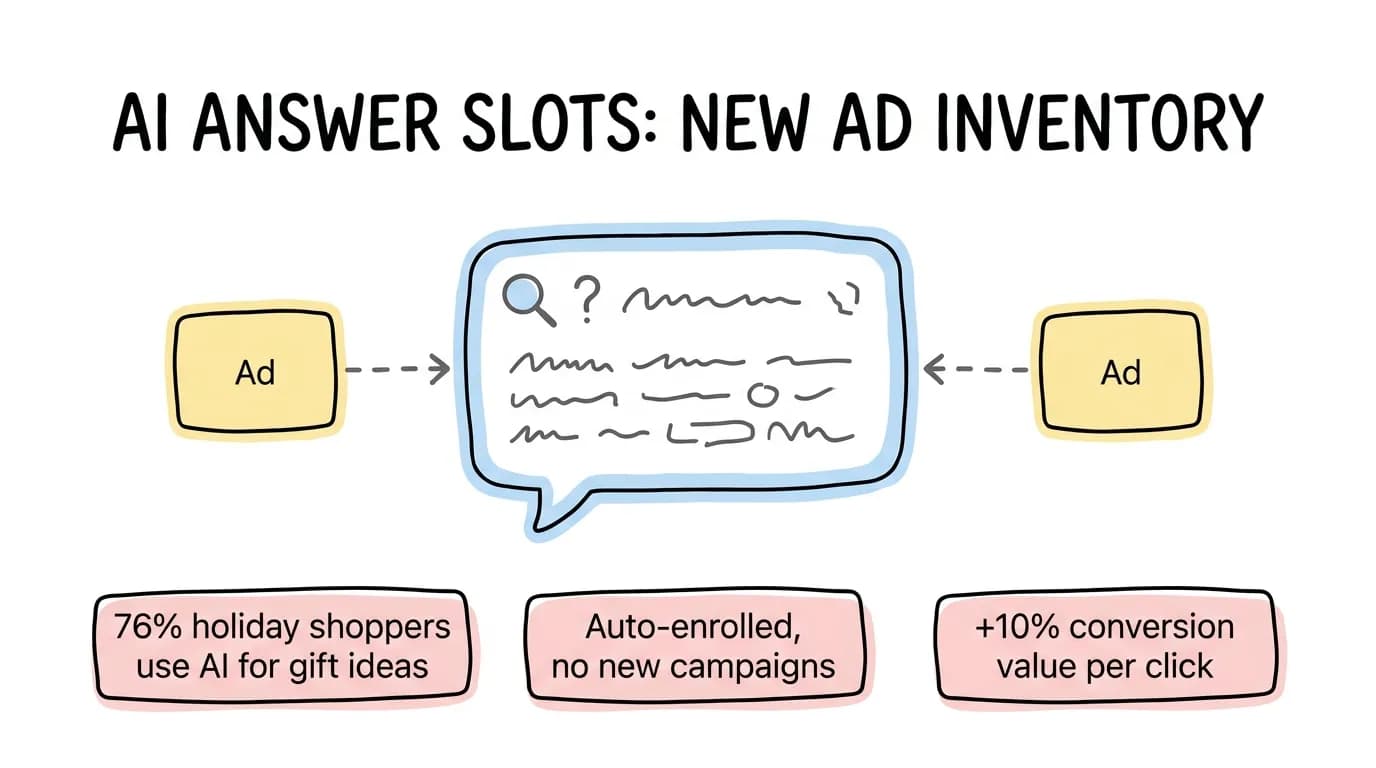
Google's official blog discloses that next-generation Search ad formats built on Gemini have entered testing. Conversational Discovery ads evolve with the user's follow-up questions — within a single conversation, ad slots track the topic; Highlighted Answers embeds ads into the key points of AI answers; AI-powered shopping ads surface products directly in conversation; Direct Offers expands its pilot to native checkout and travel deals, letting users complete an order without leaving the conversation. The official preparation path for advertisers is direct: use Performance Max and AI Max to lay coverage first and feed assets fully, and the new formats will be picked up automatically at full rollout. Published in May, this remains the foundational document for understanding AI Mode ad formats — October's AI Mode follow-up-question ads are precisely the continuation of this line.
💬 Topping up PMax and AI Max assets now is not too late. Get product catalogs, structured offer data, and multi-scenario creative into this month's plan — at full rollout, your account is the one eligible to be picked.
🔗 Further reading: Read the full article
Meta brings creative editing into Ads Creative Studio
The heaviest item in LinkedIn's November 9 monthly social media roundup is Meta. At Advertising Week, Meta expanded Ads Creative Studio: changing opening hooks, swapping audio, adjusting length, and adding captions all happen in-platform, no third-party editing, and one asset can fan out into a full set of variants. Meta's roadmap: advertisers supply only budget and objectives, and AI handles the rest. The same roundup also covers Instagram testing 90-minute long videos and live-stream boosting, TikTok Shop's Black Friday tools launching in the UK, and Reddit rolling out a For You feed — 9 updates in total — a monthly checklist social teams can run themselves against. The author's caution: pilot some of the AI tools with small budgets first.
💬 Use Creative Studio to batch-generate hook variants for A/B testing — it will cut designer hours roughly in half. Don't hand the main budget to full automation yet; keep human final review on AI-generated hooks for two weeks, then release once the data is stable.
🔗 Further reading: Read the full article
🏷 Marketing Playbooks
Brand reputation under AI search: Fortune 1000 companies control only 25% of the shelf
MarTech's November 16 practical piece cites Terakeet research: Fortune 1000 brands control only 25% of Google's organic results, and the remaining 75% is dominated by third parties — media outlets, review sites, social accounts, and the like. AI search magnifies this gap: stakeholders form their judgment of a brand through third-party sources before they ever reach your site. Reputation strategy has to shift from control to influence. The article lays out a reputation operating system approach: start from the audience's real questions, publish evidence-based content, keep company information current, place expert commentary in credible media, and proactively request corrections when factual errors turn up. Recurring criticism usually points at a real business problem — fixing the business itself is part of reputation management.
💬 Today, run the main questions in your category through AI search and check who the answers cite; screenshot and archive it as your baseline. If none of the top three citations is your domain, reputation budget should move a slice from buying ads to third-party content partnerships.
🔗 Further reading: Read the full article
Making AI adoption stick: the bottleneck is psychological safety
Field notes from a MarTech Conference panel, published November 16. The common root cause of AI tools going unused after deployment: team members don't dare expose what they don't know, and leaders modeling their own ignorance is the antidote. Tinuiti's solution combines small tasks, step-by-step videos, and hackathons to build a ladder for newcomers — and avoid praising only the stars, because over-celebrating top performers deepens the anxiety of those falling behind; the more people learn, the faster adoption moves. The panel recommends a monthly demo session where whoever found a workflow bottleneck — Spotters, Testers, builders — gets recognized, everyone in their rightful place. On long-term responsibilities: set up oversight roles to watch the output quality and data drift of automated flows. Learning and oversight are both long-term jobs — don't let incentives flow only to the people writing the automations.
💬 Add one item to next week's team meeting: everyone names one AI feature they haven't figured out, and the leader goes first. That single step will lift adoption more than buying another tool.
🔗 Further reading: Read the full article
A recipe matrix for swapping 12 manual tasks over to agents
Digital Applied's May 23 hands-on manual compresses mid-May releases from four vendors into a single matrix: Copilot Studio's computer use going GA, Gemini Spark, Google Managed Agents API, and Anthropic's self-hosted sandbox. The manual's anchor is worth learning from: organize by the manual task being replaced, not by vendor. The 12 recipes cover SEO briefs, weekly KPI summaries, lead enrichment, and more, each tagged with time saved, per-run cost, and failure modes: CAPTCHA interrupts computer use, Spark Beta covers the US only, the managed path doesn't support MCP. Rollout runs in three phases — reporting first, then drafts, finally platform actions — each phase fitted with governance guardrails.
💬 Copy its ordering in your quarterly planning: let agents do reports first, run stable for a month, then hand over draft rights. Write each recipe's failure modes into the on-call handbook — knowing where to look when something breaks is worth more than the hours you saved.
🔗 Further reading: Read the full article
AI SEO 2026: what still works, what's already dead
Robus Marketing's September 11 practical piece takes stock of SEO tactics in the AI search era. Search results have turned from lists into answers delivered directly by AI, and three old plays are now dead: writing for keyword density, mass-producing low-quality content, and trading purely on backlinks for rankings. Still working are four fundamentals — technical health, brand signals, genuine experience content, and structured data — and first-hand experience under E-E-A-T is gaining weight in AI citations. The recommendation: rewrite your priority pages into a direct-answer-plus-supporting-evidence structure so AI engines can lift whole passages. A quick-reference piece well suited for small and mid-size teams calibrating direction.
💬 Pick your top 20 pages by traffic and rewrite them in the answer-plus-evidence structure, updating the requirements template for outsourced copywriters in sync. Don't renovate the whole site — validate the citation-rate change on these 20 pages first, and push sitewide only if it works.
🔗 Further reading: Read the full article
Frontline media-buying signals: AI Mode multi-turn ads, hook rate, and Business Hub (thin)
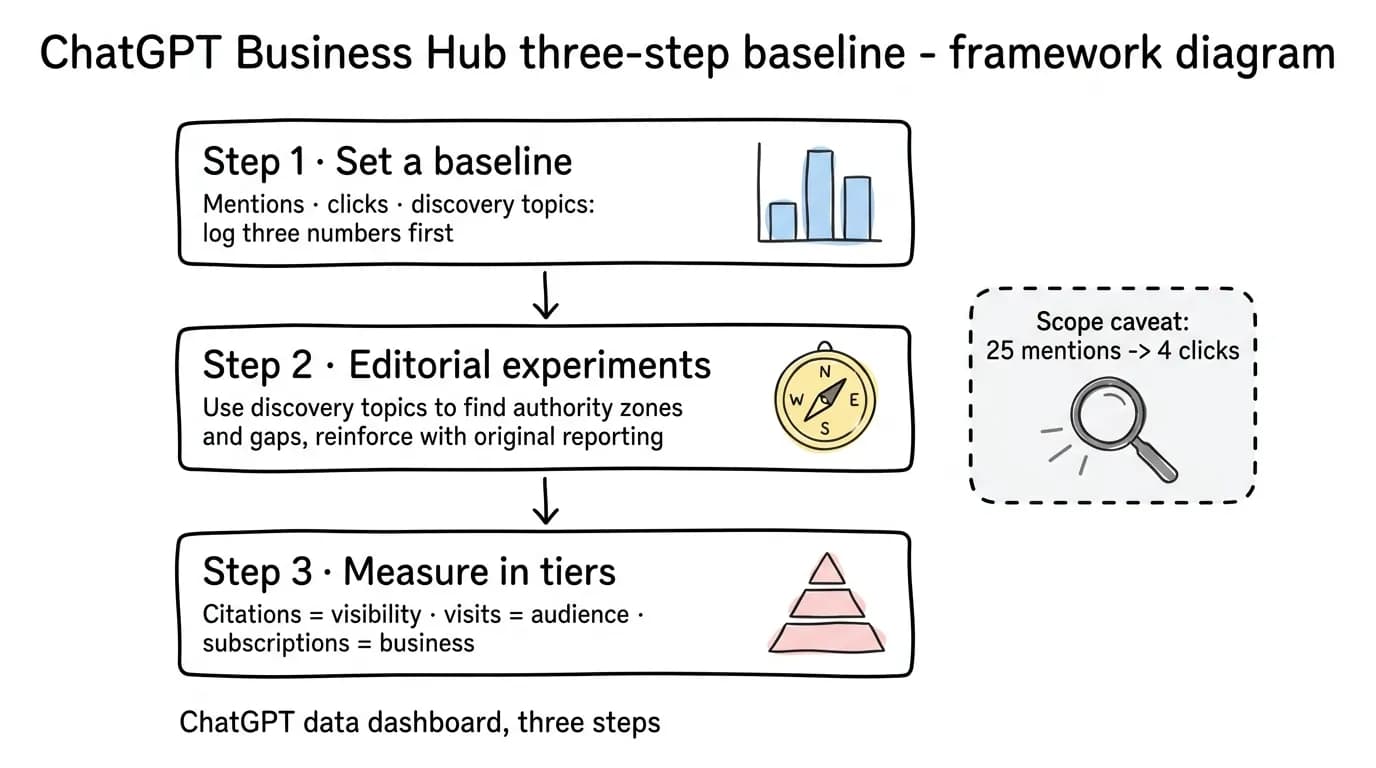
Transcript of the PPC practitioner show PPC in the Trenches, November 13 episode — a few frontline signals worth noting. Sponsored ads are now appearing across multiple consecutive turns inside Google AI Mode: within one session, ads reappear with every follow-up question — AI ad slots are an established fact. AI agents can assemble Google Ads campaigns, but defaults such as channel distribution still need human review — letting an agent self-configure is an easy way to burn money for nothing. Meta video creative adds two metrics, hook rate and hold rate, making it easy to compare opening grab and mid-video retention across assets. The show also recommends claiming your business listing in ChatGPT Business Hub as soon as possible. Two-host chat with plenty of talk and scattered practical points; written up by key takeaways.
💬 This week, re-rank your Meta video creative by hook rate — anything with a weak first three seconds gets swapped out directly, instead of just watching completion rate. Claiming ChatGPT Business Hub takes only half an hour; claim the spot first, optimize later.
🔗 Further reading: Read the full article
A 90-day plan to put GEO on the ground
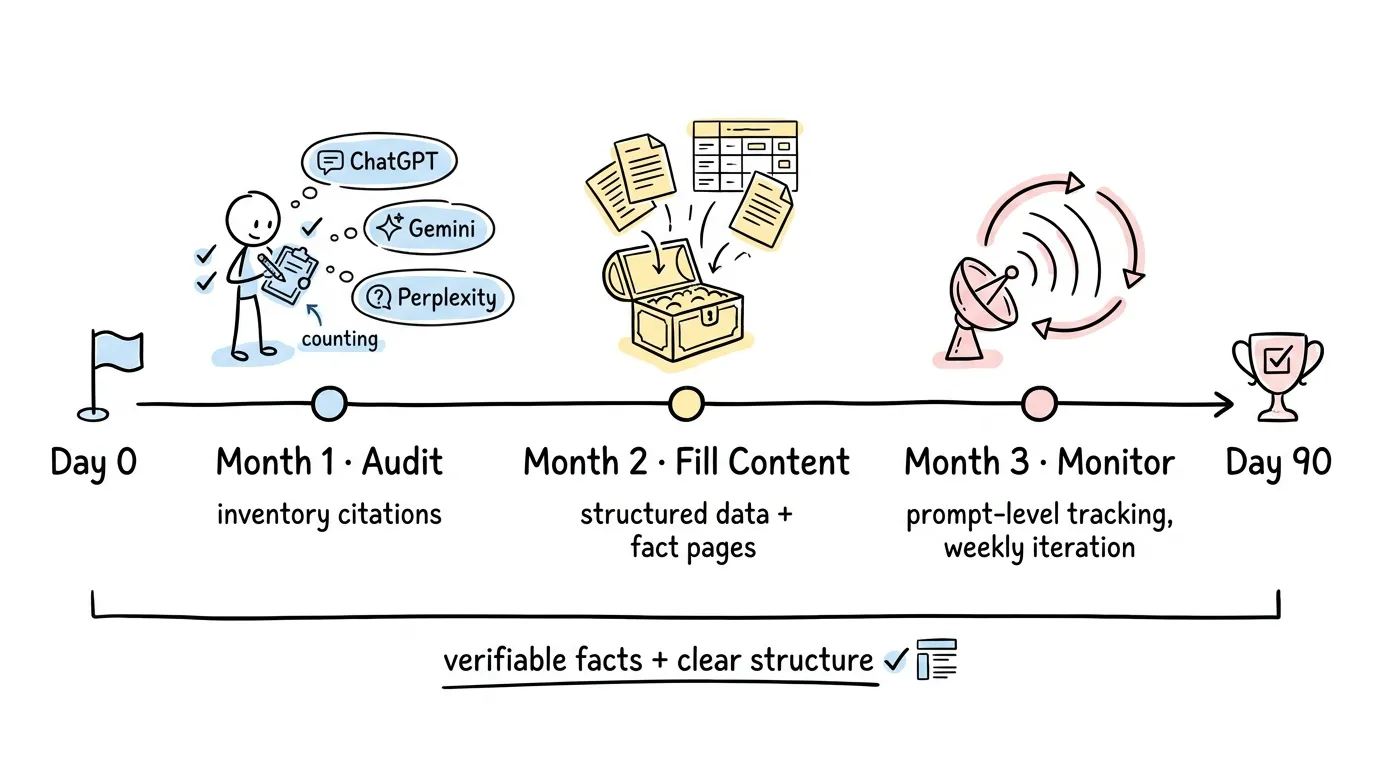
TechieHub's October 31 updated GEO comprehensive guide lays out a three-phase, 90-day plan. GEO's goal is landing in the citation slots of answers in ChatGPT, Gemini, Perplexity, and the like; traditional rankings are only the runway. Month one: audit the status quo — inventory your brand's appearance rate and citation sources across the major answer engines. Month two: fill in structured data and fact-based content. Month three: build prompt-level monitoring and iterate weekly. The guide stresses that the two variables behind getting cited are verifiable fact density and clear structure; keyword stuffing has no effect under this logic. Not much different from comparable guides; its strength is complete structure.
💬 Turn the 90-day plan into a department OKR: the audit produces a citation-source list, the content phase produces 10 fact pages, monitoring produces a weekly report template. Three months later you speak with data in hand — and budget requests stand on firmer ground.
🔗 Further reading: Read the full article
🏷 Industry Data
SAP report: 90% of CX leaders call themselves agent-ready, but only 6% have systems that are actually connected
MarTech's November 16 piece cites SAP's AI in Customer Experience Report: more than 90% of customer experience leaders believe they are ready for the AI agent era, yet only 6% of US companies (3% in Germany) actually have the connected systems required to support AI agents — a massive perception gap. Consumers are moving faster: 51% to 58% of consumers and more than 95% of B2B buyers already use AI to research and compare products, pushing brand touchpoints forward to the AI research stage. Nearly 80% of CX decision-makers admit customers have to re-enter their information across channels. The article names AI readability and cross-channel data handoff as the new tasks of marketing ops: product specs, prices, inventory, and multimodal assets all have to be structured to the point where AI can parse them, so external agents can understand and recommend them when they come in — and intent must carry through unbroken from AI consultation to brand channels to closed deals.
💬 Start with a system-connectivity inventory: how many systems does an AI agent cross from inquiry to order, and how many places does it break? The breakpoint list is this quarter's MOps schedule — more useful than buying yet another tool.
🔗 Further reading: Read the full article
100 advertising executives look at 2026: AI sinks into the infrastructure
Ad Age's 2026 business forecast collection, republished by Triton Digital, gathers the judgments of 100 advertising and marketing executives. Consensus clusters on four points: AI is sinking from visible tool into the infrastructure layers of data, targeting, and measurement — invisible to users, at work everywhere; hourly billing may be replaced by performance-based agency fees, and the search box cedes ground to AI agent purchasing — the agency's gatekeeper role changes hands; the creator economy keeps expanding, with top influencers starting to demand equity, no longer satisfied with one-off fees; and the agency business, after M&A and layoffs, is reorganizing around specialized craft and verifiable results. Republished from paid content, original publication date unknown — cite as executive predictions.
💬 When citing it in annual planning, label the data as executive forecasts — don't use it as baseline data. On budget structure, rehearse the negotiation language for performance-based billing in advance, and keep long-term revenue splits on the table as an option in creator partnerships.
🔗 Further reading: Read the full article
B2B quotas shift to revenue: 33.3% of marketing departments now carry revenue targets directly
DemandGen Report's B2BMX Insights benchmark survey, published October 20. Revenue-based quotas rose from 25.3% in 2025 to 33.3% in 2026 — up 8 percentage points in one year — with marketing held directly accountable for revenue. Pipeline influenced (the revenue pipeline marketing has touched) has become the top performance metric at 44%, with MQLs (marketing qualified leads) relegated behind it. The share of organizations running joint brand-and-demand campaigns rose from 29.3% to 41.7% — the organization is converging on unified revenue goals. Mind the sample when reading the numbers: 44.4% are software and tech companies, and 52.8% have annual revenue below $50 million.
💬 In next year's KPI design, put pipeline influenced on the first line and treat MQLs as a process metric only. Merge the brand and demand budget pools into one discussion — the era of running separate campaigns is ending.
🔗 Further reading: Read the full article
Deloitte blind evaluation: AI copy draws even with humans
Deloitte Digital's controlled experiment is cleanly designed: two human copywriters and two LLMs wrote from the same brief, and real consumers judged blind. The experiment answered three questions: can LLMs capture brand tone, can GenAI content move real consumers, and how should the technology enter a team without damaging existing capabilities. The result: GenAI content quality is roughly on par with professional writers — faster and cheaper. The accompanying survey shows that by the end of 2024, 29% of brands had already put GenAI to work in marketing operations; of those, 41% achieved content cost reductions, and heavy users beat their revenue targets by an average of 22%. The conclusion assigns each use case its position: AI assists, and human creativity remains the lever. Published December 2025; the data is a bit dated but the method is credible.
💬 When the internal debate over whether AI copy works flares up, replicate its blind-test method directly: same brief, two drafts, clients pick blind — you can run it next week. A one-hour test is more convincing than ten meetings.
🔗 Further reading: Read the full article
Semrush data quick reference: 2 billion monthly reach and 60% zero-click
Semrush's statistics collection (November 2025 edition) works well as a numbers base for citing in reports. Google AI Overviews reach 2 billion users monthly, and roughly 60% of searches now end with zero clicks. ChatGPT has 700 million weekly active users and over 5 billion monthly visits — the world's fourth-largest website. AI Mode has passed 100 million users in the US and India. Nearly 70% of enterprises report improved ROI after bringing AI into SEO. Nearly 35% of US Gen Z use chatbots for search — the search front door for young users has already moved. Semrush predicts AI search traffic may overtake traditional search by 2028, leaving teams less than two years to retool. The collection was published November 2025; some figures have already been surpassed by newer data.
💬 For reporting to management, take this set of numbers directly and save an afternoon of verification. Tag each key figure with its statistics month, so you don't get caught out when the numbers refresh next year — AI-related figures turn over every six months.
🔗 Further reading: Read the full article
2025 year in review: three threads of AI rebuilding marketing
The Current's year in review (December 29, 2025) sorts AI's reconstruction of the marketing system into three main threads. Top brands turned AI from pilot into standard equipment: Disney invested $1 billion in OpenAI, letting Sora and ChatGPT users generate videos featuring characters like Mickey; Mondelez put more than $40 million into building its own generative production engine, with capacity spanning everything from social media assets to TV-grade commercials; Coca-Cola ran an AI Christmas campaign for the second consecutive year and opened it to user co-creation — AI is now inside the creative operating system. The agency business is reorganizing around automation, with WPP launching Open X among other moves. LLM search keeps siphoning publisher referral traffic, and media business models are under strain. Read it as background reference, to give the team macro coordinates.
💬 Use it to give the team a macro briefing: the three threads map to three budget flows — in-house engines, platform partnerships, citation optimization. Compare against your own budget and fill in whichever line is missing.
🔗 Further reading: Read the full article
🏷 Policy & Funding
FCC's seven unsubscribe keywords take effect November 25; Meta's full-liability clause delayed
Sneeze It's weekly (the week of October 26 through November 1) condenses several compliance milestones, with dates and sources attached, ready to execute against directly. The FCC's new rules take effect November 25: seven reply words — stop, quit, end, revoke, opt out, cancel, unsubscribe — all constitute legal unsubscribes, and merchants must execute within 10 business days; your SMS marketing keyword list needs to be aligned immediately. Meta has postponed, to after November 20, its new clause making advertisers fully liable for AI-generated content; AI features keep running as normal while the liability boundary stays hanging. On October 28, Google announced ads inserted into AI Mode follow-up questions, with existing Search, Shopping, and PMax campaigns opted in by default; the same day it disclosed that AI Mode ad revenue runs below regular search ads, and search revenue growth slowed to 12%. TikTok launched Must Eat, a local restaurant ranking generated from more than 40 million posts — and it's free of charge.
💬 Before November 25, run a test pass of your SMS keyword auto-unsubscribe flow, covering all seven words — the fine costs far more than the retrofit. Check the AI Mode opt-in status on your PMax accounts; if you don't want in, switch it off manually.
🔗 Further reading: Read the full article
Meta stacks Product Browsing onto legacy ads by default — remember to opt out manually
A warning post from Reddit's r/FacebookAds, mid-October: starting October 28, Meta automatically enabled Product Browsing on legacy ads — after the click, users first land on an in-app product browsing page and only then consider visiting your website, and it stays in effect until the advertiser actively opts out — a unilateral change by the platform. The impact has two layers: the conversion path is rewritten, and asset-level performance analysis is distorted, because traffic through the browsing experience is not reported separately — the creative data advertisers see has platform pages mixed into it. The timing lands squarely in the biggest sales season of the year: once Black Friday–Cyber Monday attribution data gets mixed with this variable, the post-mortem is worthless. The post includes self-check and opt-out paths — time-sensitive intelligence produced spontaneously by the buying community.
💬 Go into Ads Manager today and go through the Product Browsing status on your legacy ads — a ten-minute task. If you need clean attribution for the Black Friday season, opt out directly; don't let the platform rewrite your funnel for you.
🔗 Further reading: Read the full article
💡 Today's Synthesis
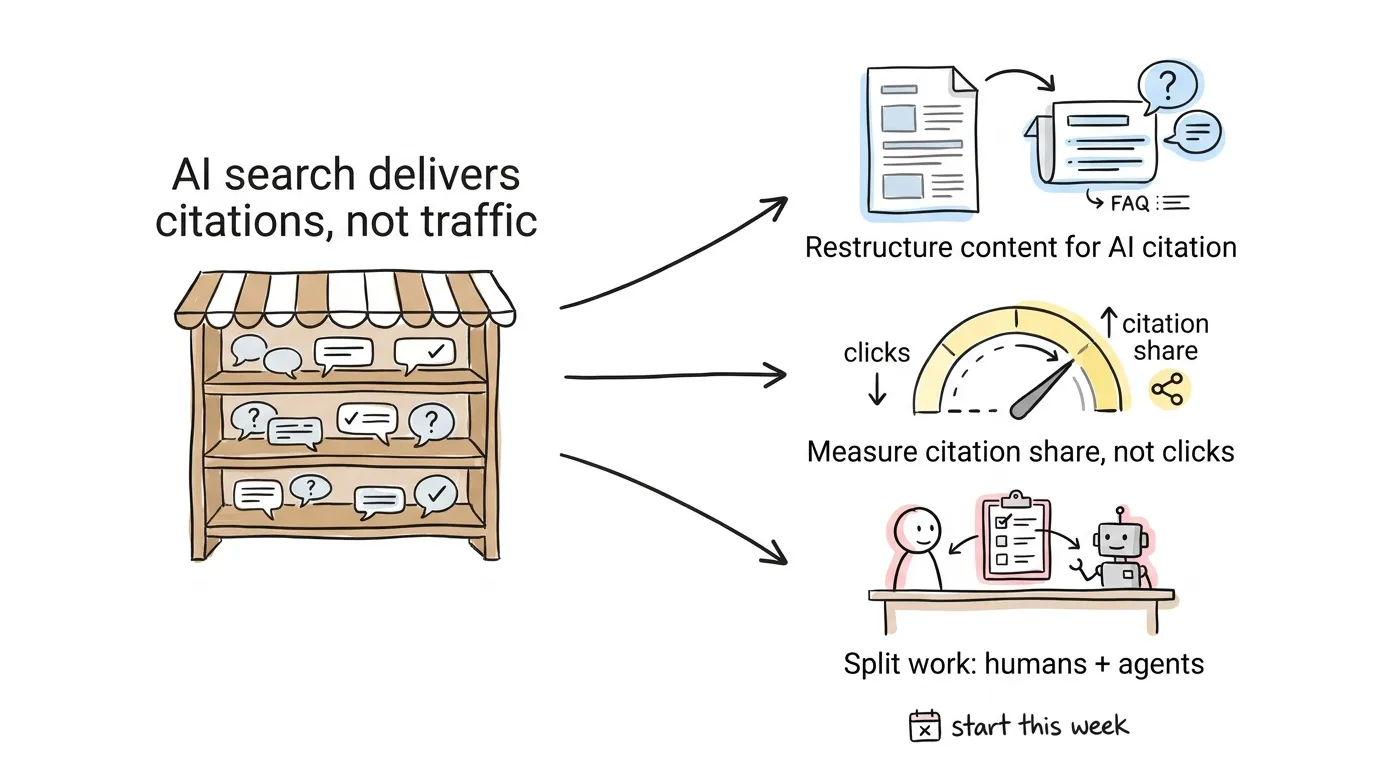
Put the 20 items side by side and today has exactly one theme: AI search is changing marketing's deliverable from traffic into citations. In the headline, BDG turned being cited by AI into a clearly priced ad product, and the Innisfree and Pampers numbers prove citation share can be bought, can be measured, and can open up gaps within a few weeks. Upstream platforms are cooperating with this shift: Google turned AI Mode follow-up questions into ad slots, ChatGPT is testing ads inside images, Meta handed creative production to AI, and always-on agents have started watching campaigns in place of humans. The data-side signals line up just as neatly: roughly 60% of searches end in zero clicks, brands cited by AI get 35% more organic clicks, B2B marketing now directly carries revenue quotas, and in the SAP report the gap between the 90% who consider themselves ready and the 6% who are genuinely ready is the most jarring number of all. On the compliance side, the FCC's new unsubscribe rules and Meta's platform clauses remind everyone that rule changes run ahead of marketing changes — get the billing terms and deadlines into your calendar first.
For marketers, the action list really comes down to three things: restructure content so AI can lift it, switch measurement from clicks to citation share, and rework the team's workflow into a human-agent division of labor. None of the three requires waiting for full platform rollout — you can start this week, run small steps first and then scale, and don't commit the main budget all at once. Compliance deadlines go into the calendar first; everything else can be scheduled after testing. The one line most worth remembering today: the search shelf is still there — only the way it is merchandised has changed — from links to answers.
Continue reading
Related articles
AI Marketing Daily · 2026-11-22
AI Marketing Daily for 2026-11-22 rounds up 20 items led by Microsoft opening Bing AI Overviews to ads and Google expanding AI Mode ads to ten countries, plus GEO guides, ad automation delegation guidance, AI Overviews CTR data, and a legal-risk checklist for AI-generated creative.
AI Marketing Daily · 2026-11-21
A November 21, 2026 AI-marketing daily covering AI search visibility, GEO methods, Google AI Mode ads expanding to ten countries, Meta's pre-Black Friday changes, agentic shopping, and industry adoption and ROI data.
AI Marketing Daily · 2026-11-20
AI Marketing Daily for 2026-11-20 rounds up 19 items centered on measurement: OpenAI's ChatGPT Business Hub dashboard, EU rules for agent-mediated purchasing, Meta pausing four AI terms, and B2B data on shortlists and the dark funnel, each with action advice.