
A Few Days Ago, Ads Officially Moved Into AI Conversations
A practitioner's notes on ads appearing inside AI conversations, including ChatGPT ad campaigns, Google Ads default channel settings, AI-built accounts, and Meta's new controls and metrics. It also covers the ChatGPT Business Hub claim process and platform automation trends for media buyers.
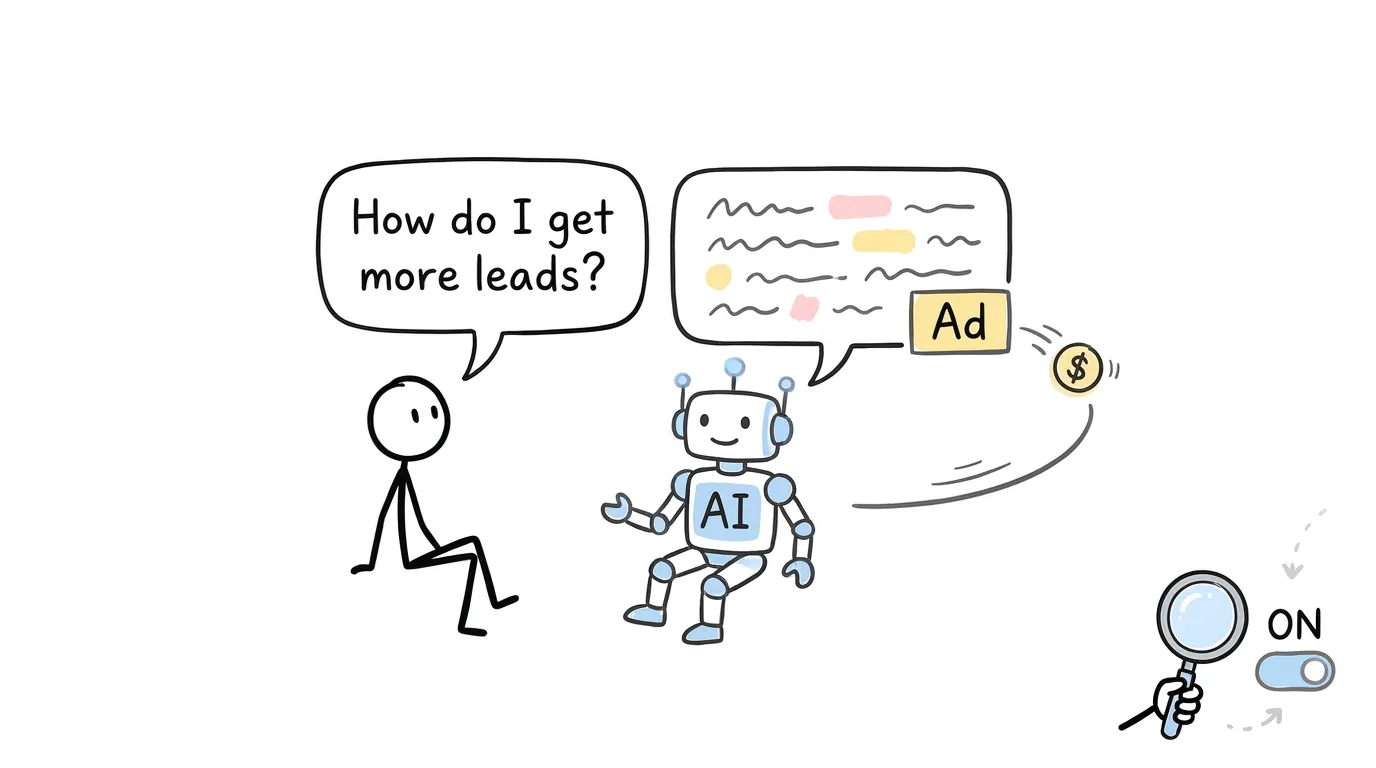
A few days ago, I came across a demo and watched it several times over.
Someone asked a question in Google's AI Mode. At the end of the answer sat a sponsored ad. They asked another question, and the new answer carried another one.
Unbelievable.
Ads have officially moved into AI conversations.
This isn't just a change of placement. From now on, newcomers learning media buying will learn "how to run ads inside conversations," while those of us already in the trade get to start telling "back in my day, ads were just a list of search results" stories.
Why ChatGPT's Ads Look So "Retro"
For a while, I kept muttering to myself: ChatGPT has been working on ads for so long — why is it still the same old text-ad formula? Not a trace of novelty.
Last week, a friend in programmatic advertising cleared it up for me with one sentence.
He said: if ChatGPT's ads look exactly like search ads, marketing managers dare to touch them. Carve 20% or 30% out of the existing search budget to give it a try — it's still the same ledger, no new budget request to file.
Turn it around: come up with something nobody has ever seen, and the marketing manager first has to persuade the boss to set aside a brand-new budget. People fear the unfamiliar. And what people fear, they won't use.
It finally clicked.
The more a new thing resembles the old world, the more easily it slips into the new world.
Why are AI platforms in such a rush to build advertising? The answer is blunt: training and inference burn cash, tokens are expensive, and ads have to foot the bill. Advertising is AI's business model — the puzzle is being filled in, piece by piece.
I Ran a Test Myself
Talk is cheap. Last week, I got ChatGPT ads up and running. One account, one campaign, thirty US dollars a day. Nothing big — just to get a feel for it.
No search terms report yet; the feature is probably still catching up. They ship updates fast. Just days ago, ChatGPT ads rolled out target CPA and target CPC bidding, and the old max bid is only being kept until January 1, 2027.
At this pace, they are dead serious about growing this into a full-blown ad platform.
A Default Setting Is Quietly Spending Your Money
This next one: if you run Google Ads, drop what you're doing today and go check your account.
Google Ads has a channel distribution setting, and a recent update flips its default: Search Partners and the Display Network — the two channels we always switch off by hand — have been quietly turned on.
You never clicked agree, yet your money is already going where you don't want it.
More annoying: it isn't a one-time thing. Every time the platform updates, it may quietly flip them back on. So don't check once and call it done — from now on, dig this up and look at it every quarter.
A default setting is, at its core, a decision the platform makes for you.
Just How Far Has AI Gotten at Building Accounts?
These days you can say a few words to Telegram and have AI build out an entire Google Ads account. Google's official MCP (Model Context Protocol, the standard that lets AI tools act on external software) can write to accounts directly, too. This is not a rumor.
A peer of mine recently ran into a salesperson selling "AI-built accounts" as a service. At first he thought the guy was boasting. Two weeks later, AI-built campaigns were landing on his desk one after another for review.
He told me the builds were fairly decent. What's mostly missing is details like negative keywords. And there are two things that, at this stage, still require a human:
One, ad copy. Copy written by AI carries too much of an AI flavor; someone has to work in a bit of human warmth.
Two, auto-apply recommendations at the account level. Right now there seems to be no prompt clever enough to make AI turn them off for you — you have to go into the backend and switch them off yourself.
My take: AI builds the skeleton, humans put in the soul. That division of labor isn't changing anytime soon.
A Few Smaller Items on the Google Side
When Demand Gen duplicates a campaign, it quietly messes with your budget. After duplicating, go back and verify.
Performance Max has started filtering brand searches; the threshold to kick in is 15 conversions in 30 days. My advice: don't spread it thin — consolidate and run.
Asset scheduling has gotten finer-grained: set it by day, by hour, and by weekend. Clearly getting ready for Black Friday.
Auto-apply recommendations in the account have piled up to 47, and shutting them all off is nearly impossible. The platform wants to make more decisions for you than you think.
Meta: Handing You the Wheel While Quietly Taking It
On the Meta side, what puzzles me most is a contradiction.
With one hand, it gives control back to you. You can now assign a budget to a single ad. Media buyers have waited years for this — finally able to play favorites with precision. Lead campaigns dropped placement selection — another step toward simplicity.
With the other hand, it quietly decides for you: a certain placement turns on automatically by default; an image has been altered by AI and you were never told; a click-nudging button gets bolted onto the bottom of Messenger ads, and you can't even find the switch to turn it off. Promotional messages on business pages — it auto-detects and auto-displays those too.
When you're publishing 30 or 40 ads at a time, you have no bandwidth to inspect each one.
So my stance is: use the control Meta hands you; watch the calls Meta makes for you.
The good news: Meta finally shipped official hook rate and hold rate. What's hook rate? In the first 3 seconds, how many people your opening hooks. What's hold rate? Looking further on, how many didn't swipe away.
Before, we pieced these two numbers together ourselves from play and completion data, and every team pieced them differently, so nothing could be compared side by side. Now there's an official yardstick. Two video creatives — which opening is stronger, which holds people better — pull them up and compare.
Should have been this way all along.
And one true little numbers story. I run ads for a gym — Messenger campaigns in the Philippines, 70 pesos a day, about 2 US dollars. Every day it brings in at least 10 inquiries. Users there do business right inside Messenger. Tell me — for anyone running Messenger video, aren't metrics like hook and hold a lifeline?
Meanwhile, Meta's Pixel has started measuring conversions across devices. iOS tortured it for years; over the past year it has been slowly reclaiming its data, and this fills in another piece of the puzzle.
We plugged Claude into our data pipeline, with a third-party tool layered in between — after all, we'd rather not let AI touch ad accounts directly, and security is not something we skimp on. Once it was connected, reporting got roughly three times faster, and it can turn out charts while it's at it.
ChatGPT Business Hub: Go Claim Your Business Now
I'm pulling this one out on its own, because it's the kind of thing that costs money if you're late.
ChatGPT launched a Business Hub. You search your business name, then claim it.
I tried it. After clicking claim, the message was: you're on the waitlist. That simple — no stack of documents to submit.
The problem lies precisely in "that simple." Simple means anyone can claim. You can see where this goes: someone will claim-squat on someone else's business page, then sell it back to the owner. This exact thing happened in the Google Business Profile era — how many business pages got casually registered away by an employee with a Gmail account.
The situation right now: if you don't claim it, someone else claims it for you.
So my advice is blunt. Today, take your client list and claim them one by one. Better to be waiting in line than to be fighting with support later.
Two Final Notes
One: data says ChatGPT's ad revenue is still only a bit over thirty percent of Google's. No surprise. People aren't used to pulling out a credit card mid-conversation yet — today's conversations are still about the big topics. Habits can't be rushed.
Two: for ChatGPT, negative prompts carry twice the weight of positive ones. What does that mean? When users ask things like "how do I get a refund" or "who do I complain to," the damage to a business is doubled. Keep an eye on what people are asking beneath your own brand terms.
Closing Thoughts
Black Friday is right around the corner. Several clients' promo campaigns are ready, and from here it's nonstop all the way to mid-December.
Running an ads service this year really is harder than last year. AI has inflated client expectations, account performance swings up and down, and many peers are reworking their models.
But zoom out, and here's the bigger picture: platforms keep taking more and more decisions away from you. Channels default to on, creatives get auto-edited, recommendations get auto-applied. The speed at which AI builds accounts will only keep climbing.
What's left for the media buyer?
I think it's that pair of eyes that walks through the default settings every quarter, and that bit of human warmth AI hasn't learned yet.
The more automated the tools, the more the human touch is worth.
May your business page be claimed before the land grab begins.
Continue reading
Related articles

What Is GEO? How Your Brand Gets "Mentioned" in the Age of AI Search
An explainer on GEO (Generative Engine Optimization) for e-commerce and DTC brands: how it differs from SEO and AEO, why AI answers shape brand visibility, and eight practices covering question-focused content, consistent brand messaging, structured pages, external evidence, comparisons, and AI mention tracking.

AI Is Already Making Decisions for Your Customers. Are You on the List?
A learn article explains GEO (Generative Engine Optimization): why AI-generated answers now shape which brands customers see, and how SEO fundamentals, entity clarity, citable evidence, and monthly measurement affect visibility in AI answers.

Google Is Stuffing Ads Into AI Search: These Recent Stories Are Really One Story
A news roundup linking recent AI marketing stories—Google adding ads to AI Mode, Amazon's Ads Agent, ChatGPT image updates, a UK startup tracking brand mentions in AI answers, and an AI ransomware warning—arguing that control over ad data and visibility is shifting toward platforms.