
Saving Brands a Seat in AI's Recommendations: A Publisher's New Business
A learn article on BDG's ECHO service, which uses generative engine optimization to help brands like Pampers and Innisfree appear in AI answers, covering baseline research, editorial strategy, Reddit promotion, and metrics such as AI visibility and citation rank.
A few days ago, a friend of mine in consumer goods asked me: do young people these days just not search anymore?
I said: you've hit on exactly the right question.
They don't search anymore. They ask AI directly. "Recommend a diaper that works for newborns." "What's a good Korean toner for around two or three hundred RMB?" AI answers on the spot — and casually recommends three or five brands along the way.
Here's the problem: whoever AI recommends gets the business.
So how do you get AI to recommend you?
Recently I came across a fascinating case. Let me share it with you.
There's an American publishing group called BDG, home to outlets like Bustle, Nylon, Elite Daily, and Scary Mommy. This year, they got a new business off the ground: helping brands show up in AI answers and recommendations. The client list includes Pampers and Innisfree. At least three brands are paying for this service so far.
Internally, they gave the service a codename: ECHO. The industry calls this kind of play GEO (generative engine optimization — optimizing content so AI engines will cite and recommend it).
What is GEO?
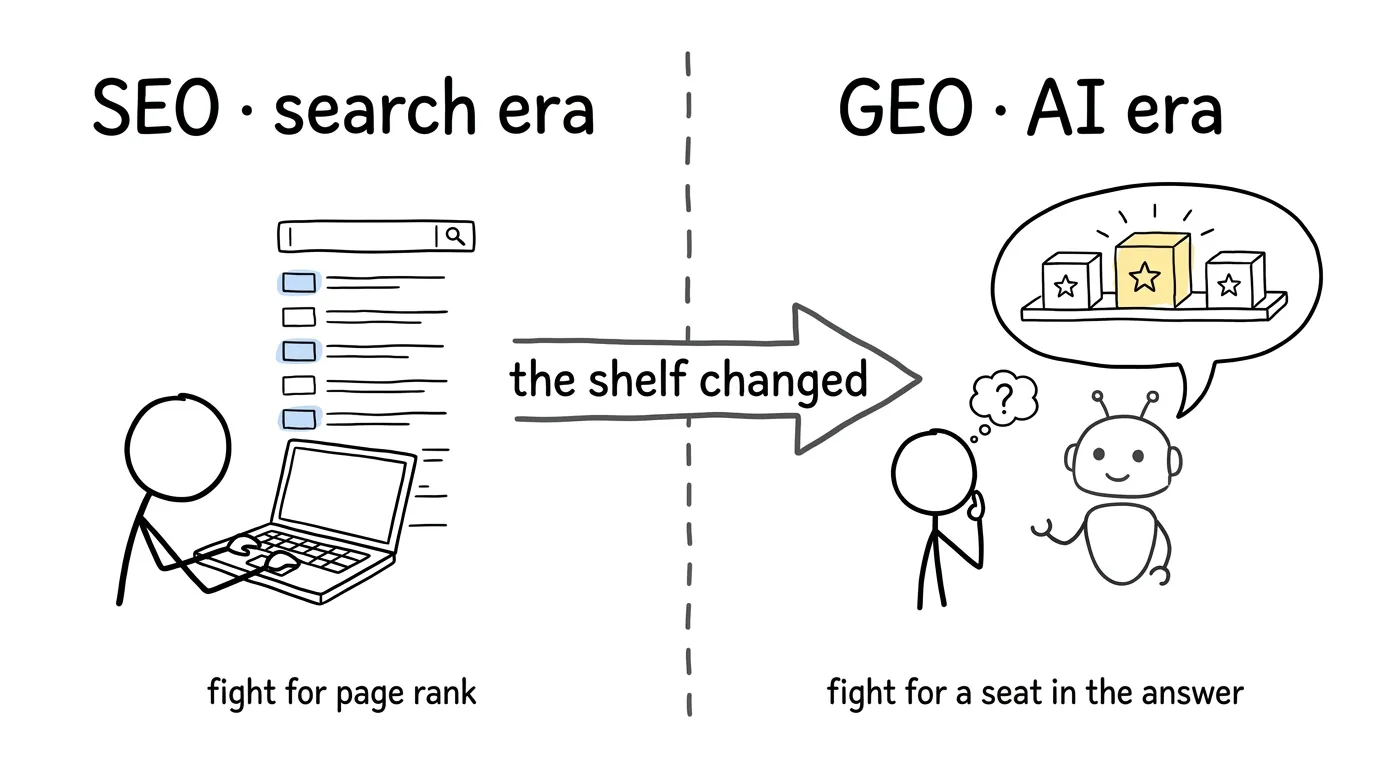
You surely know SEO — racking your brains to get search engines to rank your pages at the top.
GEO is the AI version of the same game: getting AI to cite your content and recommend your products when it answers user questions.
In the search-engine era, you fought for positions on the results page. In the AI era, you fight for positions inside AI's answers.
The shelf has changed. The business of fighting for that shelf is worth doing all over again.
How exactly? Let me break it down for you.
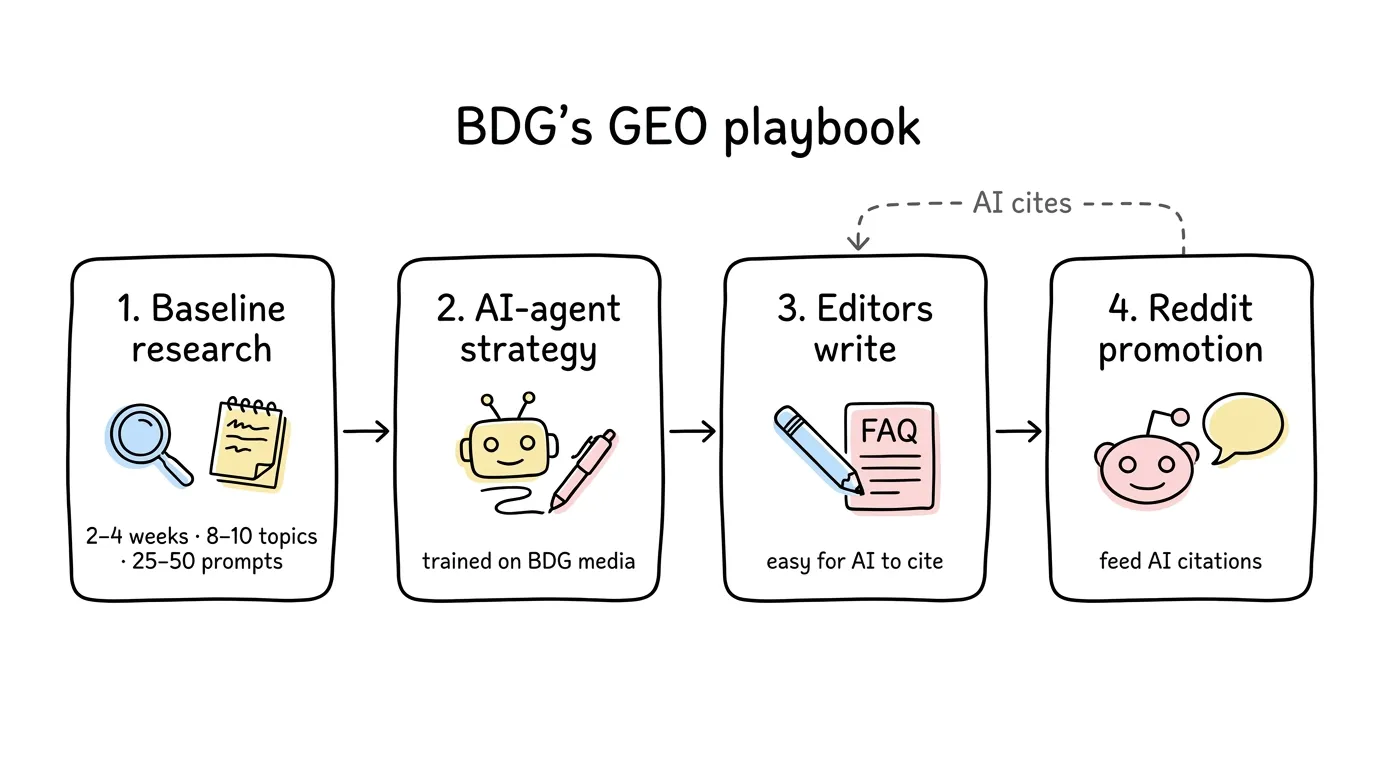
Step one: baseline research.
The brand comes in with its requirements, and BDG works through them with the brand: in which AI answers do you want to be seen? Then they spend two to four weeks on baseline research. They pick 8 to 10 topics, and under each topic list 25 to 50 prompts that real users might actually ask an AI. For Innisfree, that meant skincare topics. Then they look at two things: where does this brand currently rank? And who is AI citing right now?
Read the table before you take your seat.
Step two: strategy.
BDG uses a fleet of AI agents to produce editorial strategy. These agents were trained on years of content from BDG's own media brands. What's in the strategy? Which topics to write, how to craft headlines, what tone of voice to use. Once it's built, it goes to the brand for review.
Step three: writing.
The strategy becomes a creative brief, handed to BDG's editorial team. Editors write in their own voice, but under one set of rules: "easy for AI to cite." For example, end articles with an FAQ. For example, decide whether a piece should be a listicle or an explainer.
Here's where it gets interesting: brands are completely barred from touching the creative work.
Graham Howes, BDG's SVP of distribution and AI intelligence, puts it bluntly — in essence: content that smells too much like an ad, AI simply won't cite. So creation is left entirely to the editors.
Think about it: the client pays the money, yet can't change so much as a word of the copy. That kind of restraint is rare.
Step four: after publishing, run paid promotion on Reddit.
Why? Because Reddit remains a major citation source for AI answer engines. Get users in the relevant communities to see it and discuss it first, and the odds of AI citing you go up. Throughout the campaign, BDG keeps watching how these pieces perform.
How well does it work? Here are two numbers, both from BDG's own case reviews.
First, Innisfree. From August 11 to September 30 this year, across 200 tracked skincare prompts, the brand's AI visibility rose 30%. BDG's citation rank jumped from 709th to 12th.
709 to 12. That's a stunning jump.
The word from Innisfree's US team, in essence: AI visibility is measurable, optimizable, and can ultimately become a real competitive advantage.
Pampers' case was even more decisive. Scary Mommy published an explainer: why Pampers Swaddlers switched to a fragrance-free formula. It went live September 4 and came down September 17 — roughly ten days. After that, on the "fragrance-free diapers" question, Pampers' AI visibility went from 2nd place to 1st.
A ten-day explainer pushed the brand straight to the top of AI recommendations.
Impressive.
But watching the show isn't enough. How it's measured and how it gets paid — that's what really matters.
BDG uses measurement tools from a company called Profound to track three metrics, covering mainly ChatGPT, Gemini, and Google's AI Overviews (Google's AI-generated summaries above search results).
First: AI visibility. Whether the brand shows up in AI answers at all.
Second: citation share. Across a batch of AI-generated answers, of all citations combined, the proportion that goes to your website. Typically between 0.1% and 3%.
Third: citation rank. On the same question, how your citation count stacks up against competitors — where do you rank?
Josh Blyska, who leads insights at Profound, said something that stuck with me: you have to turn analysis into action. Reports alone are useless. BDG watches in real time which articles are being cited, adjusting and optimizing on the fly.
But there's one hurdle that, for now, no one can get around.
AI influences purchase decisions, but that pathway can't be measured cleanly. Blyska puts it candidly: from the influence layer — where ChatGPT and the like help people make up their minds about what to buy — to the transaction layer — the hop that usually goes through Google and lands on a website — the data currently doesn't connect cleanly.
In other words: AI's recommendation really did win you over, but where you actually placed the order is, for now, anyone's guess.
How does this business get paid?
Two ways to sell: standalone, or bundled into custom content packages. How much revenue — BDG won't say. Profound, the tool provider, doesn't take a cut of these deals either. Howes' positioning is clear: this is an extension of the custom content business. Clients can still reach readers through BDG's websites and social channels; there's just one new scenario now — readers are taking their questions to AI.
What do third-party players think?
Go Fish Digital, an agency offering GEO services — their GEO director Ashish Jacob once said, in essence: which tool you measure with doesn't matter; measuring continuously and consistently does. The metrics that really matter: how often the brand shows up in relevant AI answers, which sources get cited, whether the tone is praise or criticism, and how its share of voice versus competitors shifts over time. Also, first-party data reports are becoming more and more valuable.
What's next?
On the Profound side, 2027 renewals are already under discussion. They're also mulling one thing: stretching one-off campaigns into year-round, always-on programs.
Why?
Because content has a half-life. How do you hold your position in AI recommendations? Keep restocking. Beauty and fashion brands especially run campaigns that follow the seasons. If you don't keep pushing out new content, AI's recommendations will quietly shift to someone else.
And this work naturally demands speed. AI answer engines' algorithms keep changing, so GEO means constant monitoring and constant adjustment. Howes, for his part, sees this as an opportunity: publishers can be more than content suppliers — they can be knowledge advisors to brands, helping them read the AI recommendation game.
Keep in mind: custom brand content has always been BDG's biggest source of revenue. Welding that old business onto the new AI engine — that's their bet.
Finally, a couple of thoughts of my own.
When users ask AI "which one should I buy," they are essentially outsourcing their trust to AI. And whoever AI cites catches that trust.
Publishers used to sell space on the page. Now, publishers sell the ability to be cited by AI.
Every time the shelf changes hands, the first to make new money isn't necessarily the one shouting loudest — but it's always the one whose old craft is most solid. Writing content people believe — that's the craft publishers have honed for decades.
Next time you ask AI "which one should I buy," think about this: people are already fighting for seats on the list it reads out.
And among those fighting for seats, the old players who came up making content are stronger than you'd think.
Continue reading
Related articles

What Is GEO? How Your Brand Gets "Mentioned" in the Age of AI Search
An explainer on GEO (Generative Engine Optimization) for e-commerce and DTC brands: how it differs from SEO and AEO, why AI answers shape brand visibility, and eight practices covering question-focused content, consistent brand messaging, structured pages, external evidence, comparisons, and AI mention tracking.

AI Is Already Making Decisions for Your Customers. Are You on the List?
A learn article explains GEO (Generative Engine Optimization): why AI-generated answers now shape which brands customers see, and how SEO fundamentals, entity clarity, citable evidence, and monthly measurement affect visibility in AI answers.

Google Is Stuffing Ads Into AI Search: These Recent Stories Are Really One Story
A news roundup linking recent AI marketing stories—Google adding ads to AI Mode, Amazon's Ads Agent, ChatGPT image updates, a UK startup tracking brand mentions in AI answers, and an AI ransomware warning—arguing that control over ad data and visibility is shifting toward platforms.