
GEO: It's Not Rankings You're Fighting For — It's a Citation Inside an AI Answer
A learn article on GEO (Generative Engine Optimization): why AI answers cite only a few sources, what raises citation odds — crawler access, self-contained passages, statistics and quotes, third-party corroboration — how GEO relates to SEO and AEO, and a 90-day framework for tracking and refreshing content.
A few days ago, I had dinner with an old friend who runs a SaaS business.
His product is a project management tool, and his content team is formidable. For the search term "best project management software," his site has sat on page one of the results for years.
By all rights, the business should be rock solid.
But he looked miserable. Lately his sales team keeps coming back with the same line. On the phone, buyers tell them: I asked ChatGPT about this before, and it gave me a list. You guys weren't on it.
Ranked number one — yet you can't even squeeze into an AI's answer.
When I heard this, my first reaction was: this thing has a name. And there's already a playbook for it.
What Is GEO?
GEO, Generative Engine Optimization.
Put simply, it means getting AIs like ChatGPT, Perplexity, and Google AI Overviews to do more than read your content when they generate an answer — getting them to cite you by name.
This isn't a term some marketing account invented. In 2023, a group of researchers from Princeton University, Georgia Tech, IIT Delhi, and the Allen Institute for AI ran controlled experiments on roughly 10,000 queries to test one specific question: which changes actually raise the odds of being cited by an AI? The research was later published at the ACM KDD conference in 2024 — and GEO is the name they gave it.
Some people call it AEO, or LLMEO. Different labels, same thing.
Why Does This Need Your Attention Right Now?
You might say: I've been doing search for ten years. Do I really have to learn a whole new system?
First, look at three numbers.
ChatGPT has more than 900 million weekly active users. Google's AI Overviews cover more than 200 countries and regions, reach over 2 billion people a month, and show up in roughly half of all searches.
My God. Half.
It means that today, when a potential buyer of yours searches for something, there's a fifty-fifty chance they won't see ten blue links — they'll see an answer an AI has already written for them.
The market can smell it too. According to Dimension Market Research, the GEO market is worth roughly $848 million today and is projected to reach $33.7 billion by 2034 — a compound annual growth rate of 50.5%.
The ship has left port.
The Brutal Truth: There Are Only Seven Seats
So what is GEO, at its core?
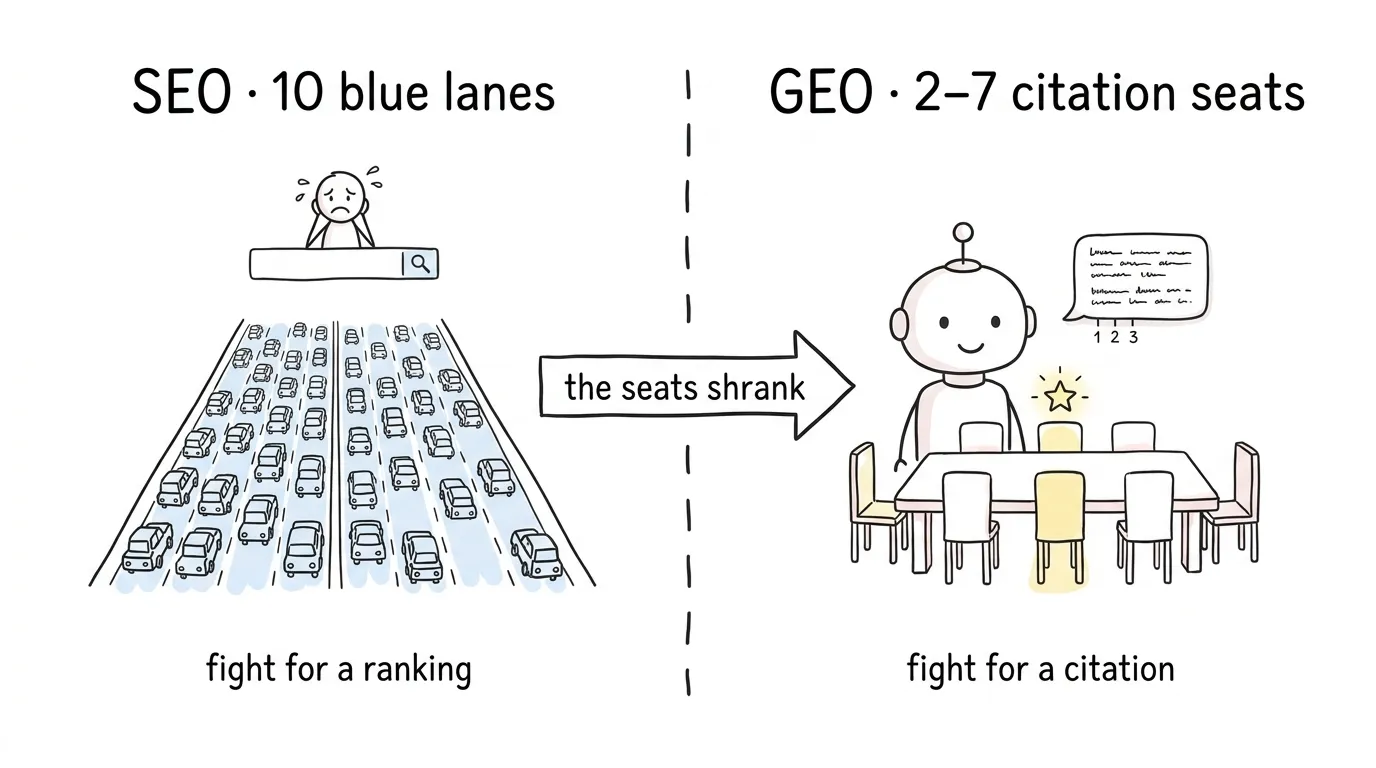
Think about it. Google is a ten-lane highway. However bad the traffic, with ten lanes, one of them can be yours.
But an AI answer is not a highway.
It's a private dining room.
A single AI answer cites, on average, only 2 to 7 sources. Even Perplexity — the most citation-happy of them all — averages just 8.2.
From ten seats, down to seven. What you're fighting for isn't a ranking. It's a citation.
So what makes an AI write your name into its answer?
Digging into the research, it comes down to four things, in this order.
First: can the AI even reach you? Most AI crawlers don't execute JavaScript. If your body copy only renders after code runs in a browser, then to an AI it's a blank page. And if robots.txt shuts those crawlers out, you don't even qualify to sit the exam.
Second: can it carry your content away? What a model extracts is "a self-contained passage," not the whole page. Under a subheading, if the first forty to sixty words state the answer clearly, that beats burying the same point in the ninth paragraph.
Third: does what you say have evidence behind it? This is the single strongest lever, verified in research. The Princeton-led paper measured it: adding statistics, direct quotes, and named sources to content raised the odds of being cited by as much as 30% to 40% — with quotes contributing about 41% and statistics about 31%. Keyword density? Did nothing. Because AIs compare meaning, not literal repetition.
Powerful. Of the four, that one's my favorite.
Translated into plain English: adjectives don't get cited. Numbers do.
Fourth: is anyone else saying it too? Before a model speaks, it cross-checks. If your own website says "we're the best," that's just you tooting your own horn. But if someone on Reddit recommends you, someone on G2 rates you highly, and an industry report mentions you by name — when several unrelated voices line up, the AI finally dares to write your name into its answer.
The hardest one to fake — and the most valuable.
GEO, SEO, AEO: What Exactly Is the Relationship?
Hearing a new buzzword, many people immediately ask: so does that mean I can stop investing in SEO?
Quite the opposite.
Here's an analogy: SEO is the foundation. GEO is the house built on top of it. AI engines still read the same internet, and they cite plenty of pages that already rank high. Lose the foundation and the house floats in midair — no matter how beautiful it looks, the whole thing collapses.
One benchmark study produced a counterintuitive number: 83% of the content cited by AI Overviews comes from outside the natural top 10. So rankings still have to be earned, and your content still has to be built to be quoted. You can't skip either end.
And AEO? AEO competes to be excerpted: your paragraph gets lifted out whole and dropped into an answer box. GEO goes one step further and competes to be cited: the AI writes its own paragraph, then hangs your name on the end of it.
One wins the paragraph. The other wins the byline.
How Do You Even Know If You've Been Cited?
This is genuinely the trickiest part.
Traditional tools go collectively blind in front of AI. Rank trackers report positions in search results; Analytics reports clicks. Whether ChatGPT mentioned you, or mentioned how many competitors — none of these tools has a clue.
So how do you measure it? The method is unglamorous. Three steps.
Step one: pick your questions. Write down 20 to 40 questions your buyers would actually type — full sentences, like "what project management tools work well for remote teams."
Step two: run them on a schedule. On the same day every month, feed the same set of questions to ChatGPT, Perplexity, and Google AI Mode, and record: did it mention you, did it include a link, which third-party sources did it cite, how many slots did competitors take.
Step three: don't change the questions. This is the most common trap. Thirty questions last month, a different thirty next month, and your data loses comparability — you might as well not have run it.
Where to start? Perplexity. Of the three engines, it's the most transparent: every answer comes with numbered citations, like an open-book exam.
Oh, and one more thing. Clicks from AI answers are pitifully few — wildly out of proportion to how often AI crawls your site. So don't treat AI mentions as traffic. Treat them as brand equity.
A 90-Day Action Framework
Now for the most practical part.
Why 90 days?
Because AI citations have a "90-day cliff": if content you publish goes unmaintained for three months, then in roughly 90 days it quietly slips out of the AI's answers. Nobody notifies you. It's just gone.
So 90 days is exactly one complete cycle — from getting started, to seeing results, to expiry. Break it into four stretches.
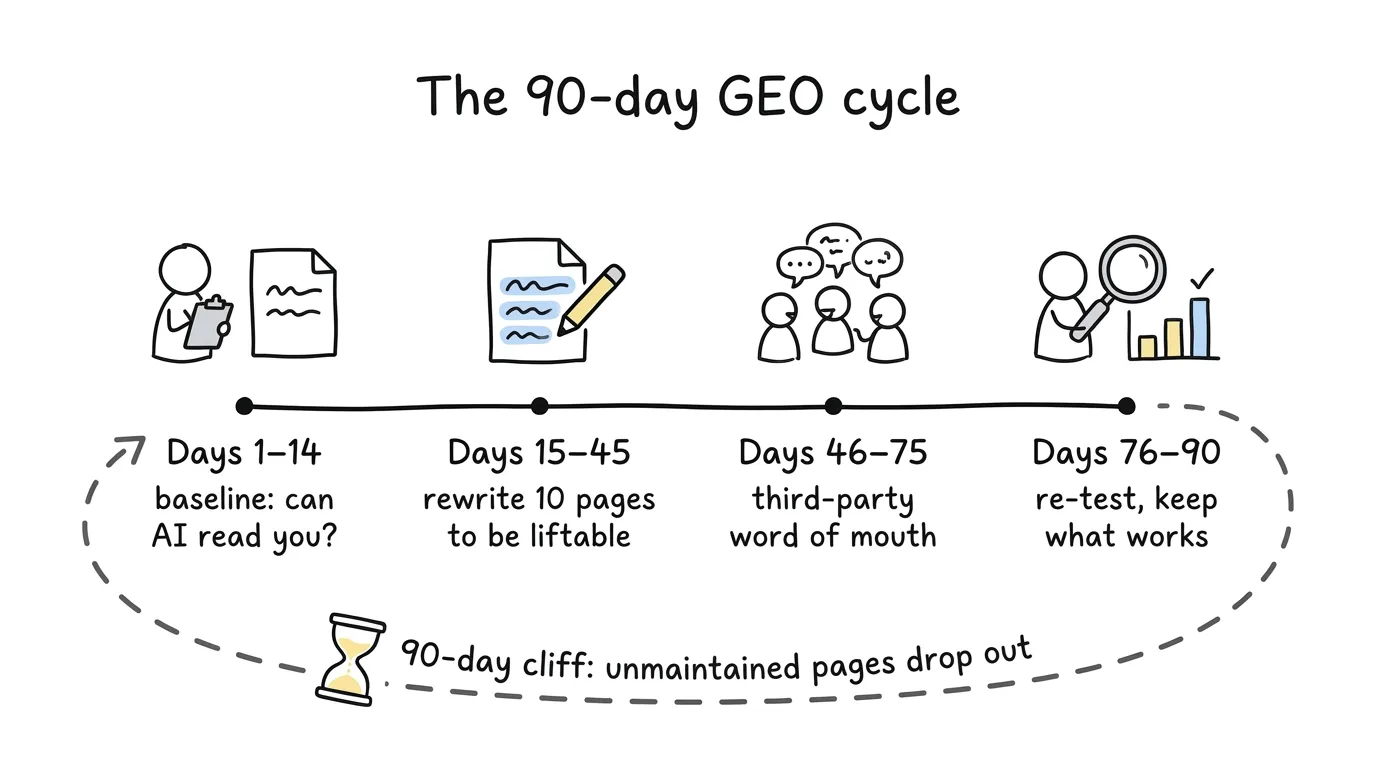
Days 1–14: Confirm the AI can read you. Then write down your starting point.
Check whether your body copy is server-rendered HTML, whether robots.txt lets in the crawlers you actually want, and whether your structured data clearly marks who wrote this page and what each section is about. Then change nothing — just record the baseline: pick 20 to 30 buyer questions, ask all three engines one by one, note whether you were mentioned and who showed up in your place, and log the dates and results in a single spreadsheet.
Without that spreadsheet, none of the progress that follows can be proven.
Days 15–45: Take your ten most important pages and rewrite them so they can be lifted out.
For each page: whatever the subheading asks, the first two sentences beneath it should answer. Add dates, sources, concrete numbers. Change "many users report" into "43% of users report." By the way, those thin pages built around a single keyword? Cut them early. AI favors content that answers one question thoroughly.
Here's an honest self-test: reading only the subheading and the two sentences beneath it, can someone who never scrolls get the answer? If not, the rewrite isn't done.
Days 46–75: Go accumulate "other people saying it for you."
Take your company information and author information, and make the descriptions consistent and current — on your official pages, in industry directories, on review and comparison platforms. Make sure "who you are and what you do" says the same thing everywhere an AI might actually read.
This stretch is the slowest and most tedious part of the entire 90 days, which is why most teams skip it outright.
And that's exactly why whoever does it wins.
Days 76–90: Re-test. Then make your cuts.
Same questions, same day of the week, run it all again, and compare against the Day 1 spreadsheet. Changes that moved the needle, keep. Changes that only added word count without buying citations, roll back. Then put the surviving pages on a refresh schedule — before the next cliff arrives.
Then run the same loop on the next batch of ten pages.
While you're at it, three small anti-self-deception tests. Ask the same question several times in fresh sessions — answers will wobble by nature, so one lucky result proves nothing. Ask "what's the best project management tool," not "how good is your product" — the first is what buyers actually ask. And occasionally check your server logs: did the crawlers come, and how often? You're being read — and that matters as much as being cited.
So What Happened to My Friend?
Back to the friend from dinner.
He did exactly what's described above, in three moves: record the baseline first, then rewrite the core comparison pages, then go build up third-party word of mouth.
Two monitoring cycles later, Perplexity was the first to come around — it started citing his refreshed comparison pages by name. A while after that, his company's name showed up in ChatGPT's recommended lists too.
I asked him what the secret was.
He said, there's no secret. Evidence, structure, corroboration — do all three at once, and keep tending them long after they're done.
He's right. There's no magic in GEO.
What it rewards are things that deserved to be cited in the first place. You just have to put them where the AI can reach them, carry them away, and dare to cite them.
Warren Buffett said time is the friend of the wonderful company and the enemy of the mediocre.
Content is the same. Time is the friend of pages that are continuously maintained, and the enemy of pages you publish and forget.
Toward the end of that dinner, my friend said that nowadays, after every search, he habitually glances at the bottom of the answer to see who got cited.
An occupational hazard. Incurable.
And may you, too, one day soon, look at the bottom of an AI answer and see your own name.
Continue reading
Related articles

It's 2026: Stop "Buying" AI Tools for Your Marketing Team — Start "Hiring" AI Agents
This learn article explains how AI agents differ from standalone AI tools in marketing, outlines three agent categories — build-your-own platforms, CRM-native agents, and vertical tools — and covers use cases across SEO, social media, advertising, and reporting, plus criteria for choosing one.

What Is GEO? How Your Brand Gets "Mentioned" in the Age of AI Search
An explainer on GEO (Generative Engine Optimization) for e-commerce and DTC brands: how it differs from SEO and AEO, why AI answers shape brand visibility, and eight practices covering question-focused content, consistent brand messaging, structured pages, external evidence, comparisons, and AI mention tracking.

AI Is Already Making Decisions for Your Customers. Are You on the List?
A learn article explains GEO (Generative Engine Optimization): why AI-generated answers now shape which brands customers see, and how SEO fundamentals, entity clarity, citable evidence, and monthly measurement affect visibility in AI answers.