
When AI Starts Inspecting the Goods for Customers, Are Marketing's Good Days Numbered?
Explores how agentic buying reshapes marketing: AI assistants evaluate brands using customer experience evidence such as complaints, claims speed, and billing clarity instead of ads, making service quality an acquisition factor and shifting focus from brand promise to brand proof.
A few days ago, an old friend who works in marketing invited me out for tea.
The moment we sat down, he started venting: plenty of ad spend, a brand with real name recognition, a team working overtime every day on campaigns and content — and still, no new customers coming in.
I said, have you considered that maybe you never made it onto your customers' shortlists at all?
He froze.
I asked him: when you buy insurance, when you book flights — do you still do the research yourself these days?
He went quiet. After a long pause, he managed one sentence: "Nowadays I just ask AI."
Exactly. That's what I want to talk about today: agentic buying (customers handing purchase decisions to AI agents) is pulling out one of marketing's old foundation stones.
What Is Agentic Buying?
What is agentic buying?
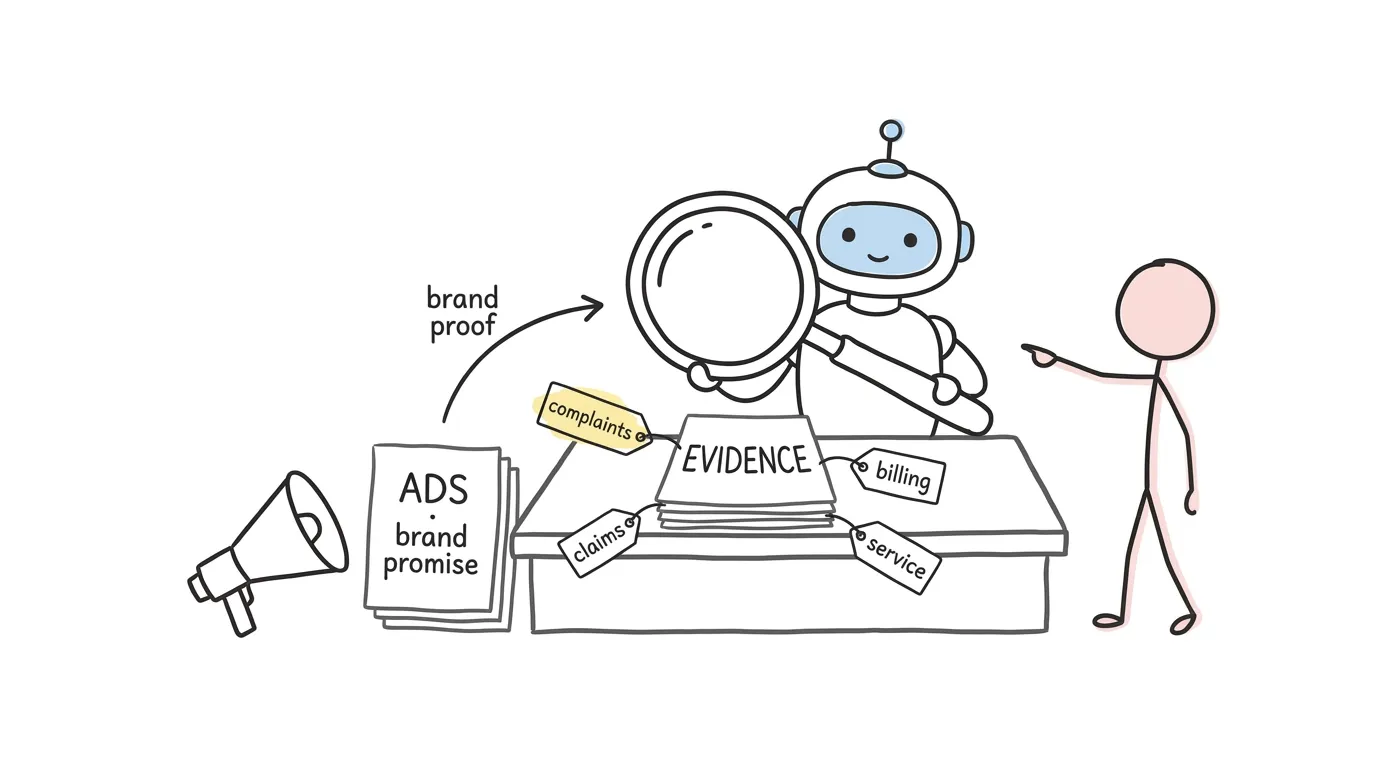
Put simply: instead of comparing options one by one themselves, customers hand the job to an AI assistant. You say one sentence — "help me pick an insurance company" — and it goes off to do exactly one thing: find out whether that company is actually any good.
What does it check?
How many complaints, how fast claims get paid, how clear the bills are, whether deliveries arrive on time, whether service quality holds steady. In a word: it doesn't look at your advertising; it looks at your evidence.
You might say, but AI isn't exactly reliable either, is it?
True — it's no oracle. It depends on the quality of the information it sees, on how it was designed, and on what you happen to care about most. Its recommendations can be polluted, gamed, even fooled.
But the direction has changed: it takes your brand claim and checks it against your actual performance.
The Gap Is Being Filled
There used to be a gap between what brands promised and how they actually operated.
A company with a terrible customer experience could still thrive in the market, as long as its advertising was loud enough, its positioning sharp enough, and its name old enough. Because what customers saw — and how they saw it — was, to a large extent, something the company could control.
Bad experiences did hurt brands, of course. But how deep the damage went and how far it spread — that used to be up to you.
And now?
Picture this: you ask an AI to recommend a bank, an insurance company, an airline. It takes your beautiful ad copy and lays it on the same table as piles of complaints, claims disputes, and billing gripes.
After the comparison, the company with the loudest advertising might rank last on the list.
And a company you've barely heard of — one that quietly does solid work — might rank first.
The AI recognizes only one standard: who is most likely to meet your needs. How familiar the brand is, how much money it poured into ads — it doesn't care.
The gap between brand promise and operational reality is being filled in, one shovelful at a time — by AI.
Customer Experience: From an After-Sales Problem to an Acquisition Problem
The old division of labor was clear.
Marketing pulled customers in. Sales closed the deals. Operations and support handled everything after the signature. Customer experience? That was an after-sales matter, a retention matter.
AI has now scrambled that division of labor.
Because when AI makes decisions for new customers, what it consults is precisely the experiences of existing customers. The old customer dragged through a slow claims process, burned by chaotic billing, ignored after filing three complaints — all of that becomes evidence standing between you and your next customer.
Flip it around, and a company that consistently resolves problems cleanly and delivers on its promises turns its existing customers' reputation into an acquisition asset. That dividend used to belong to the retention team alone; now it belongs to marketing.
It's a flywheel:
Better experience, harder evidence. Harder evidence, the more confidently AI recommends you. The more confident the recommendation, the more willing new customers are to consider you. New customers come in, and the experience climbs another level.
Customer experience is no longer just what happens after marketing succeeds. It decides whether marketing can succeed at all.
Marketing's New Job: Pushing Operations to Fix What's Broken
So what should marketing people do?
Marketing used to be the "Voice of the Customer." Run surveys, run segmentation, run brand tracking — help management understand: what customers want, how customers see us, why customers defect to competitors.
That work still needs doing. But doing only that is no longer enough.
Why?
Here's an example. Suppose a company runs the same survey every year and reaches the same conclusion every year: customer support is the weak link. How did marketing used to respond? Rework the messaging, find a new selling point to lead with, or run a few waves of ads to prop the reputation back up.
And those moves genuinely worked, back then — because there was no evidence out there to undercut you.
Now? The AI is holding a stack of experience evidence. If what your ads say doesn't match the evidence, who's going to believe you?
So marketing has to do something it never quite dared to do before: walk into operations. Claims too slow? Push to speed them up. Billing a mess? Push to make it clear. Tie the experience shortfall directly to the lost acquisitions and put a number on it — the clearer that ledger, the stronger operations' motivation to change.
Note: marketing doesn't need to take over operations. What it needs is a seat with real weight at the operations table — and data that leaves the room no argument.
Measuring Marketing: The Ledger Needs a Few More Pages
Awareness, conversion rate, customer acquisition cost — the old ledger entries still need recording.
But record only those, and the ledger is missing pages.
You also need to record: how does AI describe you to customers? When it recommends you, which experience signals does it draw on? Which of your operational weak spots are pushing AI to rank you further down the list?
And one more skill to pick up: telling the two kinds of problems apart. Some problems can be solved by changing the messaging; others can only be solved by actually fixing the experience, for real.
If you can't tell them apart, the money keeps flowing to messaging while the hole stays in the experience.
From Brand Promise to Brand Proof
Does creativity still matter? Yes.
Does the brand still matter? Yes.
Emotional connection, brand personality — they still shape customer choice. Don't throw those away.
But no advertisement, however brilliant, can suppress a steady stream of evidence of a bad experience.
The winning companies will be a particular kind of company: one whose operational performance actually delivers on its brand promise — and that leaves evidence both customers and AI can see.
That is the move from brand promise to brand proof.
That day, as the tea was running out, I told my friend: don't stop your advertising. But go back and call one meeting — bring the operations people in, and put the weak link that shows up in your surveys year after year right in the middle of the table.
The future of marketing doesn't depend on what you can get customers to believe.
It depends on what you can get your organization to improve.
And may you move that chair to the operations table, sooner rather than later.
Continue reading
Related articles

What Is GEO? How Your Brand Gets "Mentioned" in the Age of AI Search
An explainer on GEO (Generative Engine Optimization) for e-commerce and DTC brands: how it differs from SEO and AEO, why AI answers shape brand visibility, and eight practices covering question-focused content, consistent brand messaging, structured pages, external evidence, comparisons, and AI mention tracking.

AI Is Already Making Decisions for Your Customers. Are You on the List?
A learn article explains GEO (Generative Engine Optimization): why AI-generated answers now shape which brands customers see, and how SEO fundamentals, entity clarity, citable evidence, and monthly measurement affect visibility in AI answers.

Google Is Stuffing Ads Into AI Search: These Recent Stories Are Really One Story
A news roundup linking recent AI marketing stories—Google adding ads to AI Mode, Amazon's Ads Agent, ChatGPT image updates, a UK startup tracking brand mentions in AI answers, and an AI ransomware warning—arguing that control over ad data and visibility is shifting toward platforms.