
In January, 100 Advertising Heavyweights Wrote Down Their Predictions. The Year Is Almost Over — How Many Came True?
A year-end look back at 100 advertising and marketing executives' January predictions about AI, revisiting themes such as AEO/GEO visibility in AI answers, AI becoming a routine utility, pressure on hourly agency billing, creators seeking equity, and attention quality over scale.
A couple of days ago, while tidying up my computer, I dug out a file I'd saved at the start of the year.
Every January, the overseas advertising and marketing industry has a standing ritual: invite a batch of industry executives, and have each of them write a short prediction for the new year. This round, they rounded up 100. Agency chiefs, ad-tech chiefs, brand and marketing leads — all of them wrote one.
I saved it on a whim and never read it closely. A few days ago I opened it up and reread it, and I couldn't quite sit still.
Because more than half a year later, many lines that read like bold speculation back then now read like descriptions of things that have already happened.
Let me walk you through a few. They're all about AI — not because AI is new, but because it replaced the floor the entire industry stands on.
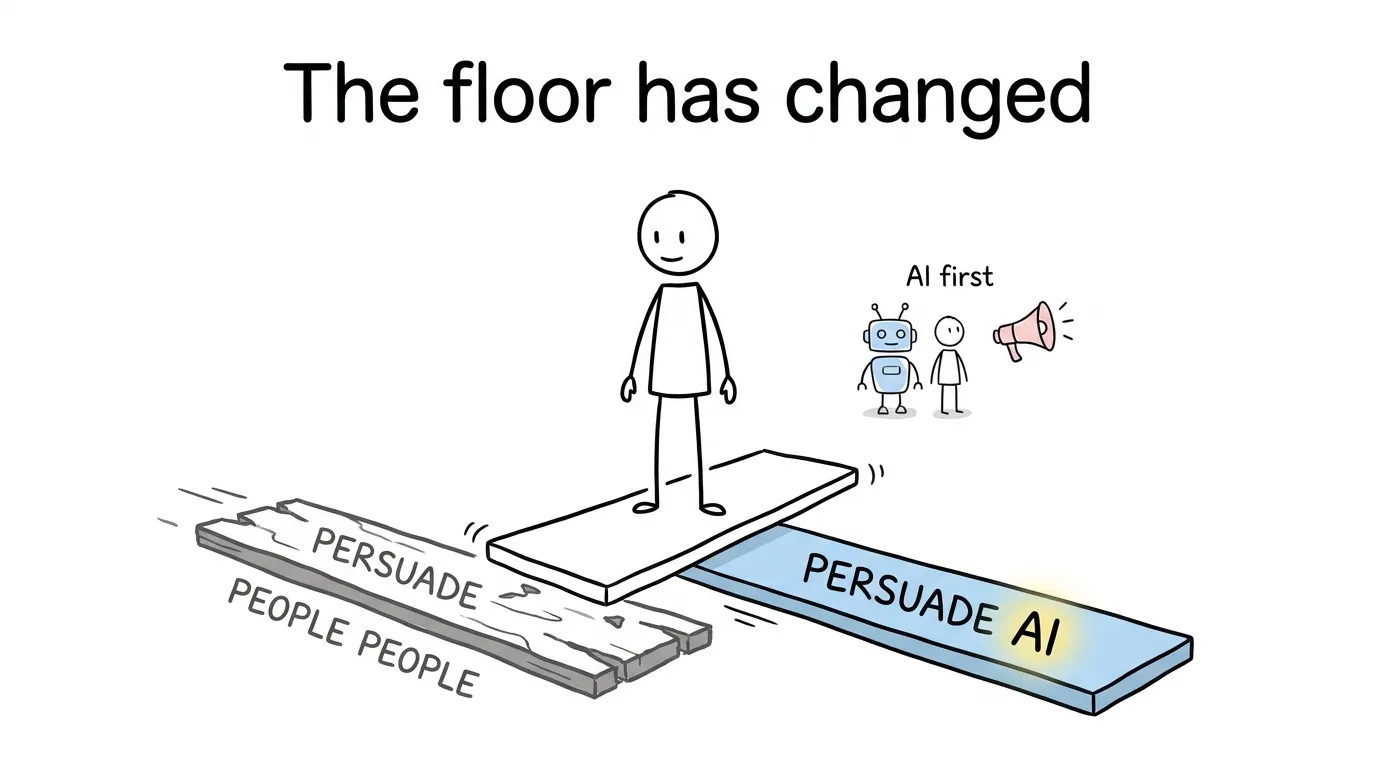
First, the most disruptive one: on the internet, humans are about to become the minority
At the start of the year, David Cohen, CEO of the Interactive Advertising Bureau (IAB), wrote a passage that went roughly like this: the internet is splitting into two worlds — one belonging to humans, one belonging to AI agents. Two-thirds of all global internet traffic is bots. Good bots, bad bots, errand-runners working for people, and the ones that come with bad intentions — they all come knocking.
The first time I saw that number, I stared at it for a long while.
Those of us in marketing have spent the past few decades pondering exactly one thing: how to persuade people. Human nature, emotion, impulse, face — we've studied it all to the bone, and spent untold billions doing it.
But now, more and more purchase decisions aren't getting their first step from a human.
The data shows that nearly two-thirds of consumers now ask an AI before they buy, instead of searching first. Ask them "so why did you end up buying this one?" and they can't really tell you. Because the one who filtered out the other 99 options was their AI assistant.
Hence two new terms that popped up in the industry this year: AEO and GEO.
What is AEO (Answer Engine Optimization — getting AI to mention you)? In the old days you did SEO: charm the search engine, rank high, get traffic. Now more and more people don't search at all — they just ask an AI. Whoever gets mentioned in the AI's answer is the one who exists. Getting large models willing to mention you — that's AEO.
Put bluntly: your first audience has switched from humans to models.
Think about what that means. The copy you write is no longer read by a person first — it's read by a machine that is ruthlessly logical, accepts only structured information, and cares intensely about two words: "trustworthy." Only after it has finished reading does it decide whether to repeat any of it to its owner.
We used to court search engines; now we're submitting résumés to AI assistants. It doesn't care whether your slides are pretty. It checks whether the information is clean, credible, and clearly structured.
Cohen added one more line that stings: brands have spent billions learning to persuade humans. On how to persuade a large language model, this industry knows almost nothing.
Before a human even walks through the door, bots have already decided half the outcome.
AI went from star of the show to a utility
There was another subtle shift this year: the way people talk about AI changed.
Two years ago, when people talked about AI, their eyes lit up — it was like discussing a new toy. This year, it's like discussing tap water and electricity. Nobody thinks it's cool, but nobody can do without it.
Duolingo's head of brand marketing said that this year they crammed AI into everything they do day to day: negotiation prep, pitches, creative proposals, prototyping. AI isn't a project over there — it's a coworker.
Stagwell's chairman made an even bigger call: the mark of a winner is putting AI into every single link of the chain, until it compounds into the brand's own data platform — targeting, buying, generating, automating, all in one unbroken motion.
There are two more down-to-earth changes, and they concern you and me.
One is synthetic data. What is synthetic data? Data produced by algorithms that mimic the patterns of the real world without touching any actual person's privacy. Once it became cheap, and analytics platforms kept getting better, plenty of small teams that used to run on gut feel could suddenly model, test, and predict this year too. The number-crunching that only the giants could once afford became standard equipment.
The other is "creative diagnostics." Advertising used to be measured by impressions and clicks. This year, clients started demanding an answer to a harder question: why did it move people? Spreading far and touching hearts are two different things. Teams that can take those two apart and explain each clearly now quote their prices differently.
Once everyone has the tools, the gap moves to how you use them.
The biggest risk, in one word: sameness
But everything has a flip side.
AI-generated content has a congenital flaw: it learns from the past. So what it serves up is always the same familiar ideas, re-plated.
One creative executive put it even more harshly: AI is, in essence, a conservative force.
Brand leaders were warning about this back in January: if your brand design system can't tell AI what "distinctive" even means, you'll end up with exactly one thing — mediocrity, produced at scale. Before, one ad was mediocre at a time; now it's ten thousand a day, every one of them mediocre in perfect unison.
And on this matter of sameness, consumers really did vote with their feet.
You may remember Coca-Cola's AI remake of its Christmas ad last year — a loud, spectacular crash. The opposite worked too: brands like Polaroid and Aerie, built entirely on being "real," shouted "we don't use AI" and got praised to the skies.
On social media, people even gave machine-flavored content a name: AI slop. This year the word went from meme to common sense. Some people openly boycott AI ads in the comments, and platforms simply built a "turn off AI content" switch, which users have been happily flipping.
The result: "human-made" — those two words — is turning into a medal of honor.
Think about how interesting that is. A decade or more ago, factories stamped "handmade" on their labels to sell a premium; this year, digital content needs the same stamp.
So a saying has taken hold in the industry: marketing will split into two systems. One built for machines to look at — structured, parseable, ready for agents to read at any moment. One built for people to look at — story, worldview, culture, the kind that makes a heart stir. You have to be able to do both. Knowing only one of the two is dangerous.
Machines handle speed. Humans handle truth.
The business that charges by the hour is dying
This prediction was written down at the start of the year. Looking at it now, it has basically come true.
How do traditional agencies make money? Billing by person-day, by the hour. More people, more layers of hierarchy, thicker invoices.
Then AI showed up, and that logic sprang a leak. Writing proposals, generating creative, launching campaigns — AI does it faster and cheaper. If you keep charging by the hour, the client does the math and concludes: I might as well just run the tools myself.
So the ledger in the agency business this year reads like this: either move up — become the client's business partner, answer directly to the client's P&L, and get paid on results — or wait to be replaced by the client's own in-house AI assembly line.
Looking back at year's end, several of these things have actually happened.
The big agency groups are still merging and consolidating, but the talent is heading for the exits. The January call: the best creative people will go to independent boutiques. Not for the money — for the ability to genuinely call their own shots and make things that are "weird and good." A year in, the little shops are indeed having an easier time than the big ships.
Pitches changed too. One agency founder said it straight: "The new pitch is no pitch." Clients got tired long ago of 40-page decks and a pile of fashionable buzzwords — they want to see the real thing: pull the data on the spot, build something on the spot, revise it together. Speed is respect for the client's time.
And there's an even quieter change: the title of CMO is disappearing.
Not because the role matters less — quite the opposite. One CMO wrote in January: in the future nobody will be called a CMO, because the role no longer owns marketing; it owns the business itself. Revenue, operations, strategy — all managed together. The title shrinks; the mandate expands.
Oh, and one true story: this year even AI started picking agencies on behalf of clients. The client asks the AI "who should I hire?" and the AI produces a shortlist. If you're not on the list, you don't exist.
Sell outcomes, or sell craftsmanship. Sell only your time, and the machine is clocking in for you.
Creators are no longer satisfied with just moving product
Of all those January predictions, the group that surprised me most was this one: what creators want isn't money — it's equity.
Brands used to work with creators on the simplest of models: pay them, they post a video, done. This year it's different. Creators have started asking for equity, for a share of revenue, for a long-term strategic seat.
On what grounds?
Because creators are no longer a "channel." They are an entire business: their own media channels, their own product lines, their own content studios. The space that opened up as traditional agencies contracted is space they're filling. One data point shows that independent creators this year have already picked up close to a quarter of the ad budgets that used to flow to traditional publishers.
Livestreaming is this year's biggest trust signal.
What's a trust signal? Ads of the past could be meticulously retouched, staged, and re-recorded a hundred times. Livestreams can't. A livestream is live — a mistake is a mistake. So a brand that dares to keep streaming is inherently more believable than a brand that only ever posts polished content.
Look at Justin Bieber going live on Twitch, or e.l.f. selling up a storm through livestreams. The timestamp has become the new seal of trust.
And ad money follows the people. The January call: money that used to be spent on advertising will increasingly go straight to creators instead. At year's end, the direction holds.
Depth beats scale. Ten thousand followers who genuinely buy in beat a million who merely pass by.
Attention switched ledgers
Finally, two things that concern your wallet.
The first is about "attention."
For the past few years, the industry's favorite phrase was the attention economy: whoever's ad grabbed the eyeballs won. This year, the phrase started to fail. Why? Because attention that has been grabbed isn't necessarily worth anything.
One ad-tech executive offered an analogy: the attention of a house buyer and the attention of a candy buyer are not remotely the same thing. The former needs to research, to compare, to build trust; the latter needs only love at first sight. Measure both kinds with the same ruler, and everything you measure turns out to be inflated.
So this year's keyword in media buying switched from "scale" to "quality." Junk content sites got cleaned out, the path from ad to purchase got sliced shorter and shorter, and publishers went so far as to rebuild themselves as data companies. After all, the traffic may have collapsed, but user behavior data is still there.
The second is about "desire."
This year brought a very quiet but very deep variable: GLP-1 (a class of weight-loss drugs). As more people take them, the underlying physiology of impulse buying changes. Marketing used to study how to ignite impulses; this year it has to think one layer deeper: once the drug presses the impulse down, how does desire grow back?
And while we're here, one argument that comes around every year but got especially lively this time: is the Super Bowl still worth buying into?
In January, one executive came right out and said it: for most brands, the Super Bowl is a waste of money. He laid out a set of numbers: The Game Awards drew 153 million livestream viewers; the Met Gala, 53 million. Much smaller venues, but much denser crowds — and much more precisely spent money.
See, that's how the math works now. The best venue isn't the biggest one — it's the one most crowded with your people.
Everything AI can copy will depreciate. What it can't copy is what goes up in price.
One last thing
When I first read those 100 predictions back in January, I was, honestly, a bit unconvinced. They're predictions — getting three out of ten right would be a good year.
Rereading them at year's end, I put the skepticism away.
Not because the predictions were accurate, but because the people who wrote them shared a single intuition: this year, marketing's foundation was swapped out. From persuading people to persuading the machines that decide on people's behalf; from selling hours to selling outcomes; from mass production to craftsmanship that's worth something again.
When they wrote all this at the start of the year, there was a fair amount of guesswork in it. More than half a year later, the guesses have become what's happening.
We've all heard people shout "the industry is about to change" before — they shouted it for a decade, and the industry barely changed. This year is different. What's changing this year isn't some play within the game. It's the floor beneath the game.
When the floor changes, how you stand on it has to change with it.
Here's wishing you steady footing on the new floor.
Continue reading
Related articles

What Is GEO? How Your Brand Gets "Mentioned" in the Age of AI Search
An explainer on GEO (Generative Engine Optimization) for e-commerce and DTC brands: how it differs from SEO and AEO, why AI answers shape brand visibility, and eight practices covering question-focused content, consistent brand messaging, structured pages, external evidence, comparisons, and AI mention tracking.

AI Is Already Making Decisions for Your Customers. Are You on the List?
A learn article explains GEO (Generative Engine Optimization): why AI-generated answers now shape which brands customers see, and how SEO fundamentals, entity clarity, citable evidence, and monthly measurement affect visibility in AI answers.

Google Is Stuffing Ads Into AI Search: These Recent Stories Are Really One Story
A news roundup linking recent AI marketing stories—Google adding ads to AI Mode, Amazon's Ads Agent, ChatGPT image updates, a UK startup tracking brand mentions in AI answers, and an AI ransomware warning—arguing that control over ad data and visibility is shifting toward platforms.