
AI Is Deployed. So Why Isn't Your Team Using It?
A learn article on why AI tools stall after deployment in marketing teams: it covers psychological safety, beginner ramps, shared learning routines, fixing real bottlenecks before automating, and granting AI autonomy based on track record, with practices shared by industry practitioners.
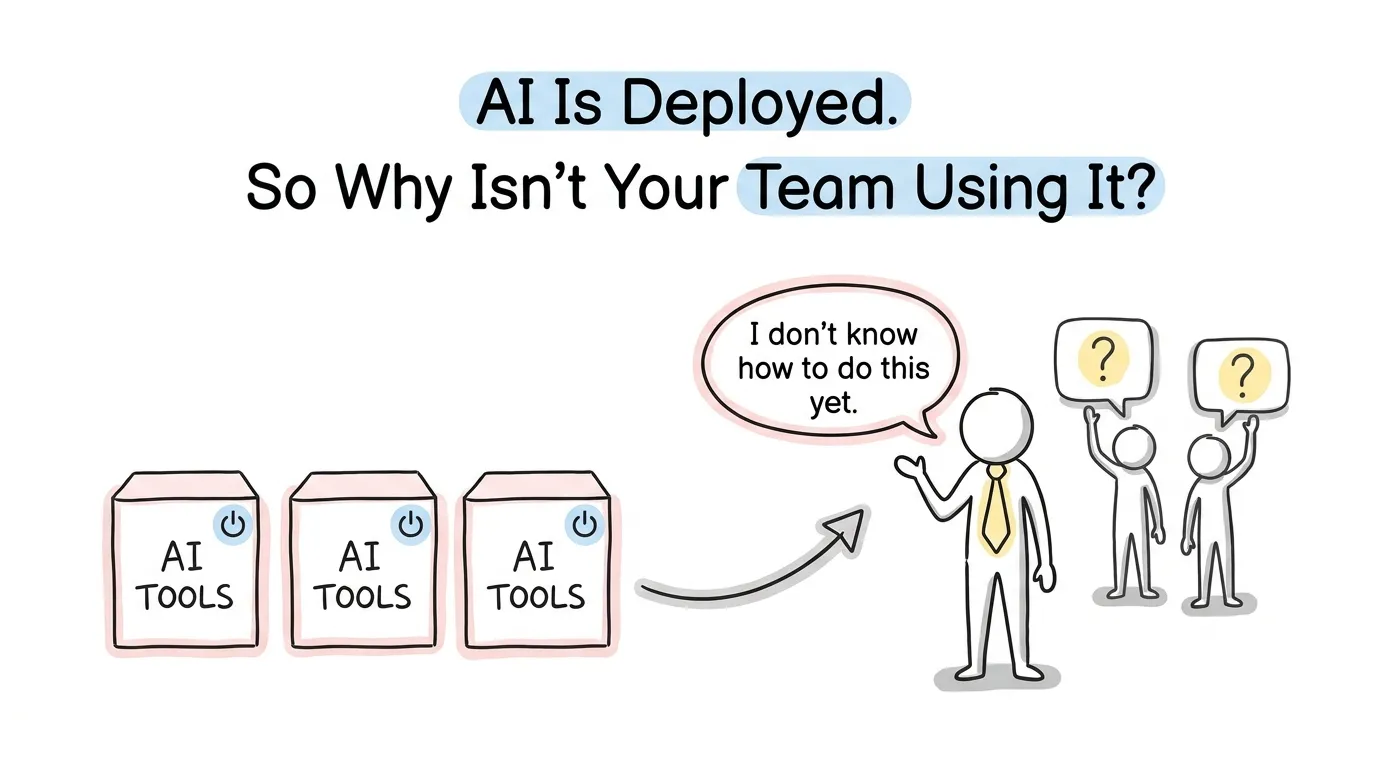
A few days ago, an old friend who has spent more than a decade in marketing invited me out for tea. The conversation turned to AI, and he suddenly lowered his voice:
"Let me tell you something a little embarrassing. Our company has bought all the tools. We've done the training. But to this day I've barely dared to use any of it. And there are so many basic questions I'm too embarrassed to ask anyone."
I told him: what's embarrassing about that?
He gave a bitter smile: "Everyone on the team talks like they're experts. I'm the only one with no clue. The moment I open my mouth, won't I give myself away?"
You see, when it comes to getting AI to actually stick, the blocker has nothing to do with technology.
The tools are deployed. The people are not.
What does that mean? Recently, at a marketing technology industry conference, several practitioners who have actually led AI rollouts talked this through: Kim Brainard, founder of ABG; Harry Browne, Vice President of TV, audio and display advertising innovation at Tinuiti; Melissa Reeve, founder of Hyperadaptive Solutions. The consensus that emerged stayed with me: getting AI to truly take hold in a team doesn't come from forcing everyone to become prompt engineers overnight. It comes from leaving everyone a path to the table, and turning learning into work the whole team shares.
Where do you start? Start from that moment of being "too embarrassed to ask."
1. First, Make It Safe to Be a Beginner
My friend's embarrassment is, in fact, remarkably common.
Brainard shared a story. She taught her mother, a retired teacher, to use AI. Her mother had asked to learn, yet she was uncomfortable the entire time, terrified of exposing what she didn't understand. Someone who spent a lifetime teaching, the moment she became a beginner in a new field, immediately got a taste of that feeling.
And inside companies, the same scene plays out every day.
What to do? Holding ten mobilization meetings on "psychological safety" won't help. If you want your team to stop hiding what they don't know, leaders have to stop hiding first. Brainard put it roughly this way: if we want employees to stop hiding their ignorance, we have to stop first ourselves.
This is a leader's first assignment: in front of everyone, say, "I don't know how to do this yet."
There's also a trap, one many companies plant themselves: celebrating "experts" too early and too loudly. In every team there are a few people with more spare time and a love of tinkering who progress at lightning speed. What about everyone else? The more they watch, the more they feel they're falling behind — and the further behind they feel, the less they dare to speak up.
Reeve offered an analogy I really like: AI is easy to pick up and hard to master. It's like the piano — anyone can press a key and make a sound, but nobody performs without practicing. The tools are accessible to everyone; fluency requires a coach.
So what about teams where the divide has already opened up? Tinuiti described their own approach. After a blanket rollout, a few "natural builders" took off at full speed while everyone else had no idea where to start. They didn't blame the latter. They built ramps for beginners: breaking tasks into smaller pieces, adding step-by-step videos, writing clear instructions. Meanwhile, they ran hackathons for the experts so they could go all out.
Beginners get their own path; experts get their own arena. Run the two tracks in parallel, and the team won't break.
2. Save a Seat for the People Who Use the Tools, Too
But there's a pitfall here.
The best builder in a company isn't necessarily the best teacher. And an AI team built to go the distance needs far more than builders — someone also has to watch the automated pipelines, catch data drift, and guard quality. If incentives go only to the people making the tools, those seats stay empty forever.
Brainard shared a monthly exercise that stopped me short, called Showcase Showdown. Cross-functional teams, three roles:
The Spotter finds which step in everyday work creates the most friction; the Tester takes AI tools and attacks that bottleneck; the Skeptic keeps asking what hasn't been considered, checks for risks, verifies quality.
At the end of the month, each team shows its results: what worked, what flopped, what to change next month. Then they swap roles and run another round.
What's brilliant about this design? It hands the skeptics an official badge. Non-technical marketers and the naturally cautious are, for the first time, invited in as "essential partners" — not wheeled out for show.
Even better, it prevents wasted work. One team, before starting to automate, was asked one question by their own Skeptic: why do these steps exist at all? They found that instead of spending effort making a process that shouldn't exist run faster, they could simply delete it.
Automation is an efficiency tool. But the greatest efficiency is figuring out first which things never needed doing at all.
3. A Faster Step Doesn't Mean a Faster Result
As we kept talking, we arrived at the calculation I most wanted to run.
Why do AI projects stall? In many cases, what the team automated was never the bottleneck in the first place.
Brainard gave an example — feel this one out for yourself: a marketing email takes 20 minutes to draft, and 3 days to get through legal and stakeholder approvals. You use AI to compress drafting from 20 minutes down to 2, saving 18 minutes. How long does the whole pipeline take now? Three days and two minutes.
You saved 18 minutes and let 72 hours slip by.
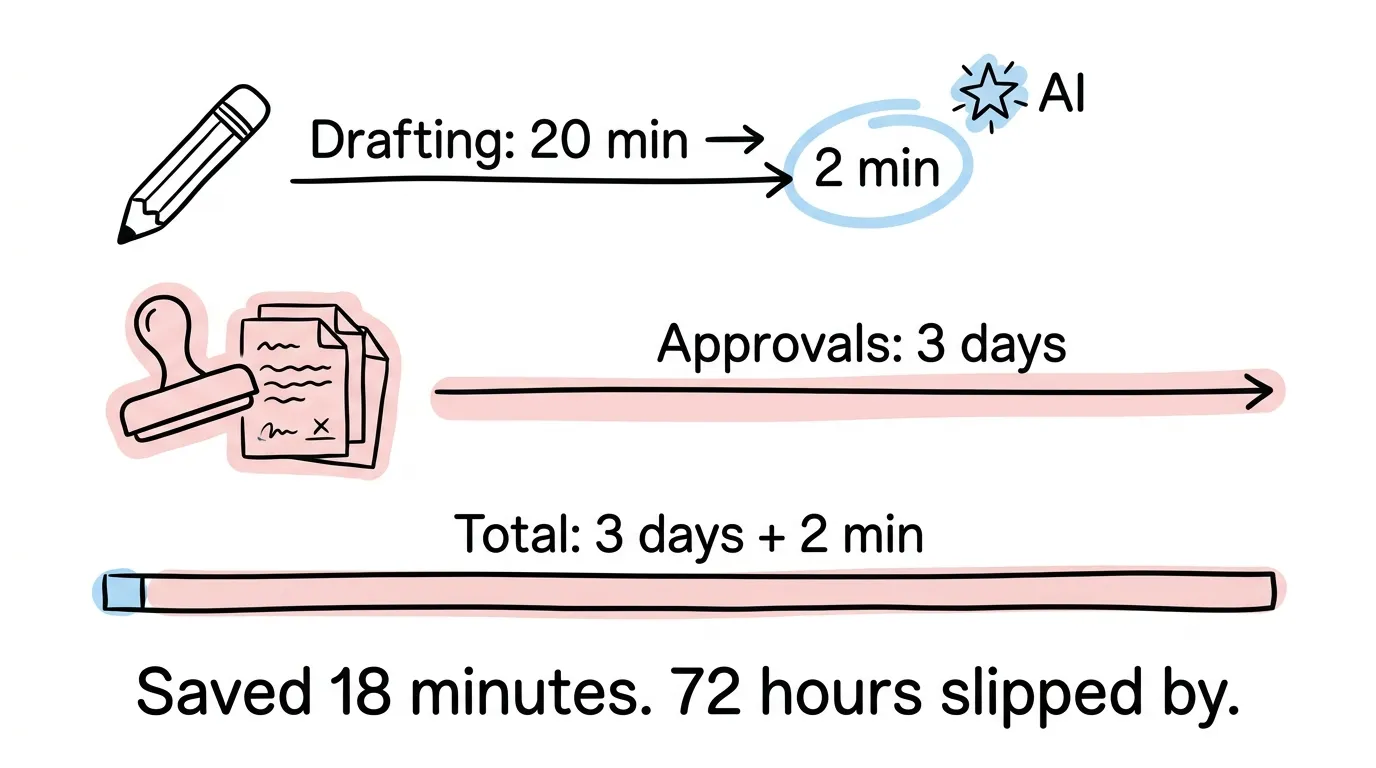
She has another line that I think everyone running an AI project should copy into their notes: one step getting faster doesn't mean the result actually arrives faster.
So her method is plain: before bringing in a tool, walk through the daily workflow shoulder to shoulder with the people who actually do the work, find the real bottleneck, then decide where to push. And look at the whole chain. If you take a shortcut in your own department, don't dump a pile of cleanup work on your partners next door.
Is there a low-risk way to start that pays off fast? There is. Browne shared one of Tinuiti's: pipe advertising data into a language model environment so marketers can ask questions in plain language. That one move produces business value immediately, without handing the budget to an autonomous AI agent to manage.
They call this restrained approach agentic deference. In plain language: strategic decisions stay in human hands, and an AI's autonomy is earned one engagement at a time, on its own track record.
This runs exactly opposite to how many of us imagine AI. Delegation isn't granted up front; it's earned through performance. Think about it — doesn't it resemble a new hire coming off probation? Only after the probation period goes well do you talk about handing over the reins.
4. Learning Needs Someone "On Duty"
The last piece of consensus is, I believe, the easiest to overlook.
In today's marketing technology, the models change, the governance rules change, and the job descriptions change too. Expecting every employee, after finishing their day job, to track AI developments in their spare time? That's pushing people straight into burnout.
Reeve's term for it is "managing the flow of change," and it maps to one very concrete move: designate clear owners. Big companies can set up a dedicated enablement team; small companies can appoint a few team leads. These people act as a filter, translating the changes gushing out of the industry every day into small chunks of learning the team can digest.
As long as the changes keep flowing, the owners have to stay in place.
With someone watching over learning, you also need guardrails that make people bold enough to experiment. Brainard's practice is, before anything goes live, to align on three things with her Ready to Represent framework: brand voice, factual accuracy, approval process. At the base of the framework sits one question:
Would you dare put your own name on it?
Add easy-to-find how-to guides and a clearly named contact for help, and governance turns from a tripwire into a safety net — catching people as they experiment boldly.
Finally, Back to That Friend Over Tea
After all this, I left him one assignment. Today, I leave it with you too.
At next week's meeting, in front of everyone, pick one AI use you genuinely don't know, and say: "I don't know how to do this yet — let's learn it together."
With that one move, you've built your team's first ramp.
Tools will keep updating; what you master today may be outdated tomorrow. But a team that dares to say "I don't know yet" isn't afraid of any new tool that comes along.
And may you never again have to feel ashamed of not knowing.
Continue reading
Related articles

It's 2026: Stop "Buying" AI Tools for Your Marketing Team — Start "Hiring" AI Agents
This learn article explains how AI agents differ from standalone AI tools in marketing, outlines three agent categories — build-your-own platforms, CRM-native agents, and vertical tools — and covers use cases across SEO, social media, advertising, and reporting, plus criteria for choosing one.

Did the Money You Spent on AI Marketing Ever Come Back?
A guide to measuring AI marketing ROI across three layers: ad reports, sales pipeline, and the financial ledger. Covers metrics such as ROAS and CPA, eight dashboard metrics, industry benchmarks, and common measurement mistakes.

How to Pick a Creative Automation Platform: First, Figure Out What These Eleven Actually Do
A learn article sorts eleven creative automation platforms — including Bannerflow, Celtra, Smartly.io, and Storyteq — into four functional groups and proposes five evaluation questions covering publishing reach, automation depth, ease of adoption, team fit, and verifiable evidence.