
2026: Search Has Changed — From Being Found to Being Cited
A learn article on how AI-generated answers are changing search behavior, covering zero-click traffic loss, outdated SEO habits to drop, and practices for being cited in AI answers, such as answer-first writing, credible sourcing, structured markup, and brand mention tracking.
The other night, I set out to pick a blood-pressure monitor for my parents.
A while back, my routine would have been: open a search engine, scroll through ten blue links, click into seven or eight sites, compare prices, study spec sheets — and end up more confused than when I started. This time I skipped all of that. I just asked an AI.
Within seconds, the answer was served up: which brands have a good reputation, which model suits elderly users, what to watch out for. I read it, closed the window, placed the order.
I didn't open a single website the whole time.
It took me a moment of stunned silence before it hit me: I was the "new user." And that offhand habit of mine was quietly rewriting an entire business called SEO.
What Is AI SEO?
So what is AI SEO?
AI SEO means getting your brand and your content to show up inside the answers AI gives.
Note: not ranking first on a results page — appearing inside the answer itself.
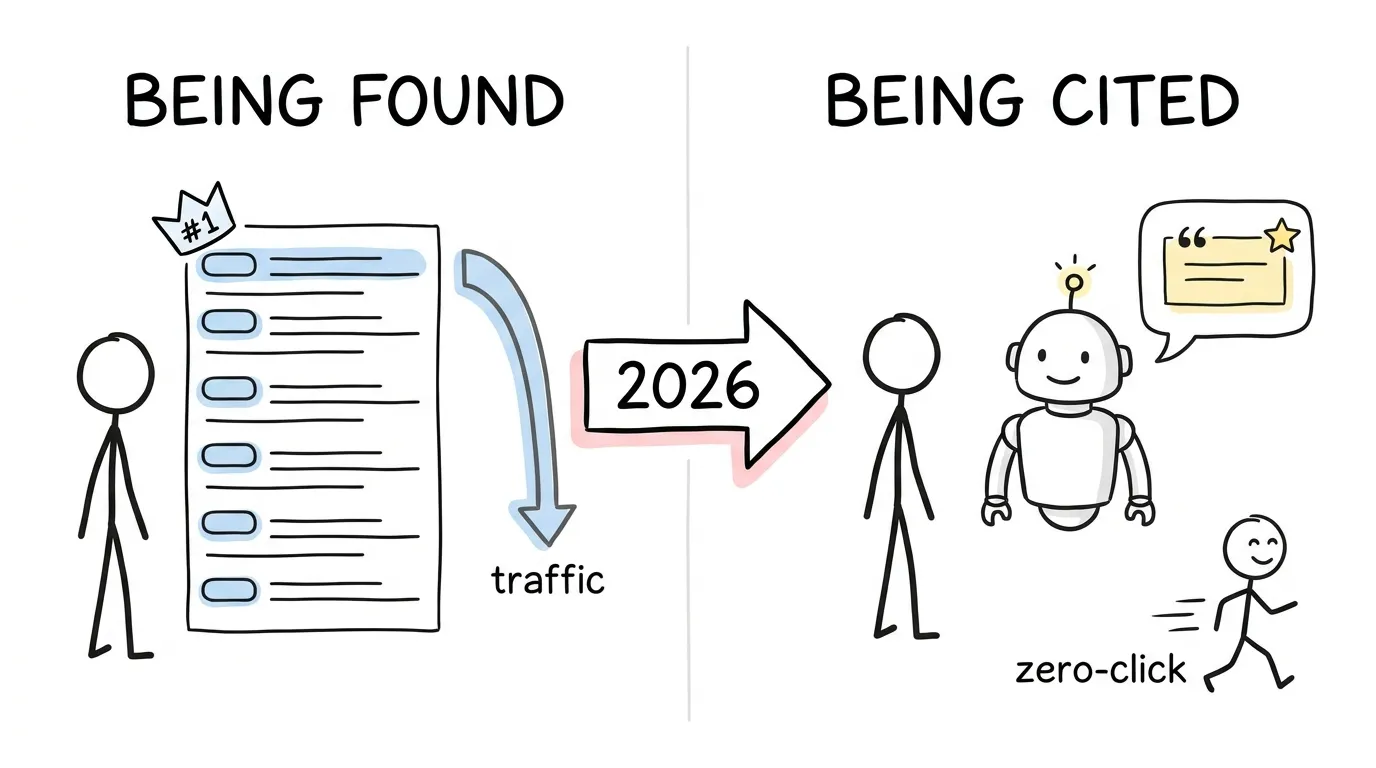
Think about how people look for things now. The front door has changed. Some people search on Google, where the top of the results page is an AI-generated summary (AI Overviews) with the answer sitting right there. Others have Google's AI Mode open, going back and forth with the search engine until the errand is done. And a huge group of people never open a search engine at all — they open ChatGPT or Gemini and type in "recommend me a..."
Search is no longer a list of links. It has become a service counter that answers any question you ask.
That's the heart of this shift — and it's why so many business owners have watched their traffic suddenly dry up.
The Rankings Didn't Drop. The Customers Did.
Let me run the numbers for you.
Suppose your website used to get 1,000 visitors a day from search. You worked hard on content, traded links, fine-tuned headlines, pushed your keyword to the #1 spot — and felt safe.
And now? AI plucks the answer straight out and puts it at the very top of the results page. The user glances at it, is satisfied, and leaves. This is called zero-click.
What's the most painful scenario? Your ranking doesn't move an inch — still #1 — while traffic shrinks by the day. You kept the report card and lost the paycheck.
Three Things You Can Stop Doing
Which three?
First: stop obsessing over a single keyword.
The old play was this: pick a term, write a 500-word page, stuff the keyword in ten times, and hope it ranks. Against AI, that play is dead. AI doesn't count how many times your keyword appears. It asks one question: does this page actually answer, thoroughly, the question behind the search?
If the answer isn't thorough, stuffing it in a hundred times changes nothing. And the more you stuff, the uglier the article gets.
Second: don't bet everything on "rank #1."
We just ran the numbers. The answer is handed over directly — who's still clicking links? If your entire strategy rests on "I'm #1," then all you're defending is a spot fewer and fewer people ever look at.
Third: stop mass-producing AI filler.
This one isn't just useless — it's actively harmful. Think about it: when the whole web is piled high with bland filler stamped from the same mold, what's the scarcest thing of all?
Real experience. Real opinions.
The scarcer something is, the more it's worth. With content, it has always been that way.
So What Actually Works?
Here's the good news: the things that work now are the very things good marketers have always believed in. The difference is that they've moved from bonus points to the questions you can't skip.
First: give the answer in your very first sentence.
What does a page that gets cited in AI answers look like? It gets straight to the point. The first sentence is a direct, confident answer; the examples and details unfold after it, layer by layer. Like a seasoned pro explaining things face-to-face to a client — not a robot circling around to pad the word count.
When you write, imagine the user standing in front of you, asking one question. Write it the way you'd answer out loud — whatever your first spoken sentence would be.
Second: make AI believe you're a source worth citing.
Who does AI cite? Credible people. What counts as credible? Real author bylines, genuine hands-on experience, original data, solid case studies, real user reviews — plus your business information matching up in every corner of the web.
Turn it around: content with no author, no provenance, nobody accountable for it is, in AI's eyes, pretty much invisible.
Third: write pages machines can read.
This one is the most concrete. Clear heading hierarchy, logical content order, short paragraphs, plus proper schema markup (structured tags that describe what your content is). When a page is cleaned up and organized, AI can easily lift a passage from it to answer a user's question.
A wall? A machine can't chew through it. An outline? A machine flips straight to the right spot.
Fourth: make sure both people and machines know you.
Your brand being talked about, continuously, on trusted sites, industry directories, review platforms, social media. This used to be called brand building — a slow, long game. Now it directly shapes how AI understands you.
Why? Because AI assembles its answers from the whole web, not just your own site. If you're not in the room, you won't be remembered.
Fifth: install a dashboard.
The SEO tools everyone used to run watched one thing: where you ranked among ten blue links. The new generation watches something else: in answers from ChatGPT, Gemini, and Google's AI — is your brand mentioned? For which questions?
You can't improve what you can't see. That line holds true in any era.
From Being Found to Being Cited
Set everything above aside, and it comes down to one shift in mindset:
You used to optimize content to be found. Now you optimize it to be chosen — to be cited.
From being found, to being cited — that's the whole hand 2026 holds.
No loophole to exploit, no shortcut to take. This round belongs to businesses that make their content genuinely worth recommending. And that's exactly where small teams have the edge: small, focused businesses tend to know their customers better than big companies do — and can write content with the real stuff in it.
That night, after ordering the blood-pressure monitor, I chatted with my dad. He asked what I'd been working on lately. I said, researching how to get more people to see what we write.
My dad said: then write it well. Don't circle around. Say it clearly.
See? The plainest truths are usually the answer.
Search in 2026 rewards only one kind of person: the kind worth citing.
Here's hoping you're that person.
Continue reading
Related articles

It's 2026: Stop "Buying" AI Tools for Your Marketing Team — Start "Hiring" AI Agents
This learn article explains how AI agents differ from standalone AI tools in marketing, outlines three agent categories — build-your-own platforms, CRM-native agents, and vertical tools — and covers use cases across SEO, social media, advertising, and reporting, plus criteria for choosing one.

What Is GEO? How Your Brand Gets "Mentioned" in the Age of AI Search
An explainer on GEO (Generative Engine Optimization) for e-commerce and DTC brands: how it differs from SEO and AEO, why AI answers shape brand visibility, and eight practices covering question-focused content, consistent brand messaging, structured pages, external evidence, comparisons, and AI mention tracking.

AI Is Already Making Decisions for Your Customers. Are You on the List?
A learn article explains GEO (Generative Engine Optimization): why AI-generated answers now shape which brands customers see, and how SEO fundamentals, entity clarity, citable evidence, and monthly measurement affect visibility in AI answers.