
The Robot Coworker in Advertising Is Here — For Real
A practitioner's overview of how AI agents are shifting from on-demand chat to scheduled, autonomous ad operations, covering an xAI advertising guide, new agent products, Amazon Ads Agent, ads inside ChatGPT and Google AI Mode, and the custom GPTs retirement timeline.
A few days ago, I did something I had never done before.
I put a robot on the schedule.
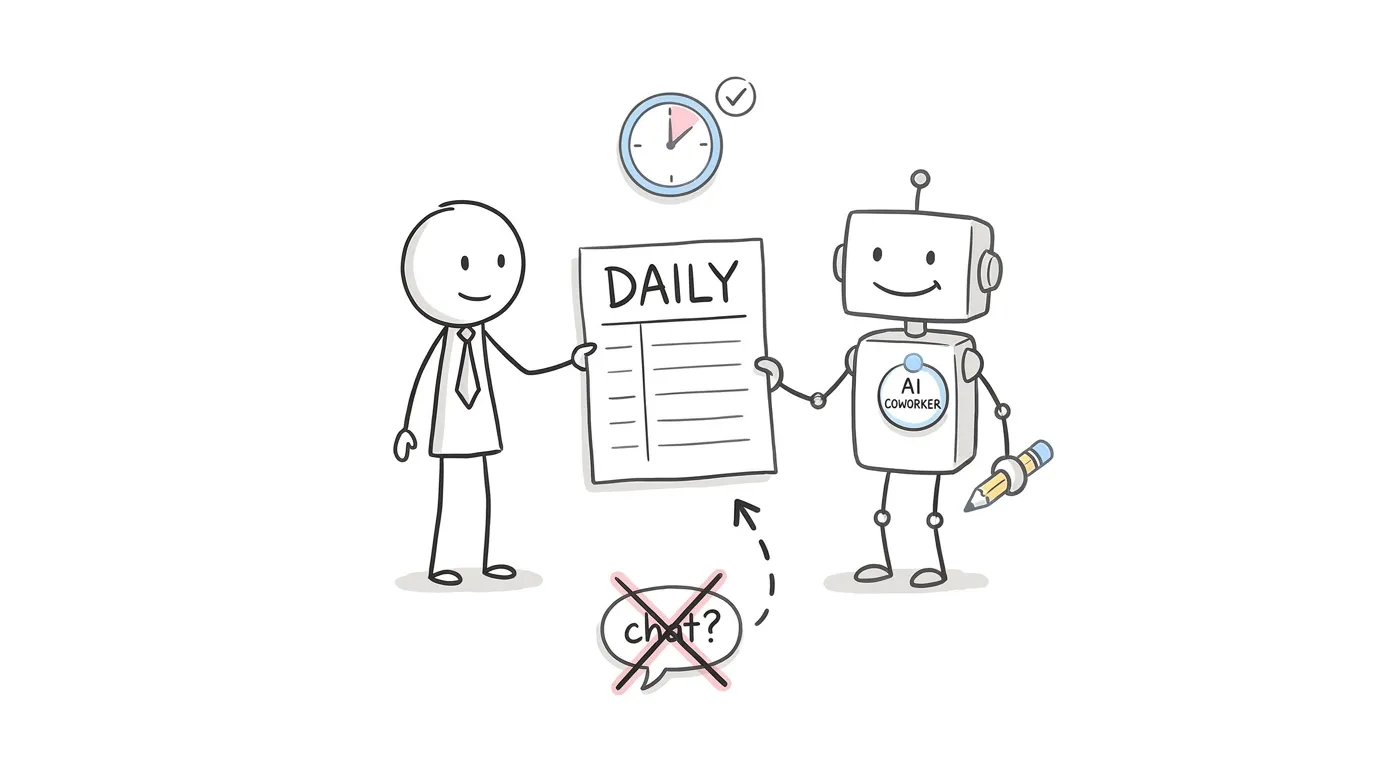
Not to chat with it, not to ask it questions. I told it: every morning, you watch this ad account, and while you're at it, keep an eye on a few competitors. When you're done, don't bother me. If something goes wrong, come find me.
And it really does run the loop every day: searching, taking screenshots, filing everything away. It only knocks on my door when something looks wrong.
That's when it hit me: our relationship with AI has already moved from "chatting" to "scheduling."
What does that mean? Let me walk you through it.
What Does "From Chatting to Scheduling" Mean?
In the past, the way we used AI was "you ask, it answers." I typed a line, it replied with a paragraph, then I went off to do other things. AI was a consultant with a sharp tongue — brilliant on demand, gone the moment you stopped typing.
Now it's different. Now you can tell it: this task is yours, run it on a schedule, report back when it's done, and only call a human when something is abnormal.
The consultant has become an employee.
Last month, this shift was especially visible in the advertising world. Let me tell you what I saw.
First, an "Employee Handbook"
xAI — the company that makes Grok — published a guide last month. The person who wrote it runs paid advertising for Grok itself.
Their setup goes like this: the robot handles audience research, budget drafts, media mix, campaign structure, conversion tracking checks, and reporting. In one sentence: the dirty work, all of it.
The most interesting part is the "reporting rules": every morning, the robot checks spend and conversions across each channel. If everything is normal, it stays silent. If something looks wrong — say a channel burned double its daily budget overnight, or conversions suddenly dropped to zero, and a quick check shows the tracking code had stopped firing — only then does it come call a person.
In other words, what you've configured is not an employee, it's an alarm clock. It doesn't ring when things are fine; when it rings, something is definitely wrong.
The guide also offers two suggestions I find especially practical: start with reporting-type tasks, don't hand over the keys right away; and for the first few weeks, have everything the robot does on the ad platform saved as drafts only, with a human clicking "publish."
Watch first, then trust, then let go. Don't get the order backwards.
AI Agents Are Arriving in Force
At almost the same time, OpenAI launched dots: agents that live permanently inside ChatGPT, each with its own cloud computer, able to connect to more than 4,000 apps through plugins, available first to Pro and Business Premium users. Right after that, Anthropic officially announced its new agent product too — I signed up for the queue immediately and I'm still waiting for my spot.
One after another.
The first place I put a robot to work myself was competitor watching. Every day, a robot searches for competitors' ad copy and promotional messaging, screenshots it for the record, and compares it against my own playbook. I deliberately restricted it to public information only. Real value, low risk — the easiest possible first step with this kind of tool.
But I drew one line for myself: the robot can look for me — for now, it doesn't spend for me.
Letting it move money in the account or change campaigns directly? I'm not ready. It doesn't know my profit margins, doesn't know my inventory, and certainly doesn't know the direction my boss set just last week. These variables, the robot still can't read. At least not yet.
The Platforms Are Moving Even Faster
You might think: the robot is my own tool. But the platforms themselves are turning too.
At the unBoxed conference at the end of September, Amazon merged its DSP (demand-side platform, the system for buying programmatic ads) and its ads console into one thing, called Amazon Ads Agent. What used to be two systems is now a single entry point — sponsored ads, full-funnel campaigns, DVA+ are all inside. Tucked in there is also a conversational AI, in an expanding closed beta, claiming nearly 1,000 metrics you can query with a single sentence of natural language.
Even more aggressive is the full-funnel play: you set just one goal, and the channel mix, creative, audiences, and optimization — video, display, audio — are all handled by AI. Amazon's own test data says long-term ad returns are 67% higher, and the cost of acquiring new customers is 29% lower.
Wow, 67%.
But hold on — these are numbers Amazon measured itself. Amazon wrote its own exam and graded its own paper. Believe it or not, you'll have to verify with your own account.
I once consulted a hands-on operator who has run Amazon ads for years, and I very much agree with his judgment: the direction is right, and the biggest value is turning Amazon's mountain of sleeping data into something truly usable. He worries about only one thing: when AI gives advice, it often skips your numbers — profit margins, inventory, business goals.
So my advice fits in four words: trust, but verify. Before you adopt anything, take your gross margin, your inventory, and your goals, and go through them one by one.
Ads Are Starting to Grow Into AI's Answers
The second thing is that the position of ads has changed.
OpenAI announced last month that it has started testing visual ads inside ChatGPT's image generation. Aimed first at free and lower-tier plan users in the US, the ads are displayed separately from the image the user is generating, and clearly labeled. Along the way, it also added conversion integrations, more attribution partners, and negative keyword controls for qualified advertisers.
What's worth pondering is OpenAI's description of this ad format: the inspiration for a product, its use cases, the experience it creates. It sounds like ads are no longer an interruption, and more like a source of inspiration. What it will concretely look like, nobody has seen. My plan is to test all of them when the time comes — lifestyle images, product images, and plain-text images.
The data side has already offered a small taste of upside: third-party attribution data shows that WeightWatchers' customer acquisition cost on ChatGPT ads was 15.3% lower than its blended paid search baseline.
15.3%, not a lot. But the direction is worth writing down.
Google has moved too. Google confirmed it is testing ads in AI Mode, targeting users who have turned on Personal Intelligence and connected their own apps. The summaries, excerpts, and inferences produced by those apps may be used to decide which ads to show you. Google also drew a few lines: ads will not be based directly on your Gmail inbox or photo library; they only run when the user opts in, and can be switched off at any time; advertisers cannot touch the apps you connect.
I'm a heavy AI Mode user myself. Honestly, I haven't seen an ad in my results yet — or maybe I saw one and didn't recognize it. My attitude is simple: personalized ads beat random ads. After all, these tools are free precisely because of ads. What really needs thinking through is where that line is drawn. Convenience and privacy are forever the two ends of a scale.
A Deadline — Put It on Your Calendar
The last thing is not a trend, it's a deadline.
On September 11, OpenAI announced in its release notes that it will retire custom GPTs (user-built versions of ChatGPT with their own instructions and files). The standard date is December 11, 2026; enterprise workspaces can apply for an extension to February 11, 2027, and the entry point for creating new ones will be shut off first.
The migration itself is not hard — there's an official one-click migration: instructions become skills, knowledge files come along, and connected apps are carried over too. But three things don't come along: custom actions must be rewritten, the selected model must be re-chosen, and new plugins are private by default, so sharing has to be set up again. After migration, the original GPT can only be viewed, not used anymore.
Our team uses GPTs heavily; the simplest one writes ad copy in our own framing. My advice is just three steps: list the GPTs your team depends on; migrate the frequently used ones first; after migrating, test with the same inputs to confirm output quality hasn't dropped, then adjust gradually.
Don't wait until December 11. Platform evolution is not a bad thing — missing the window is.
Final Thoughts
Last month's five events in the ad world are, on the surface, five pieces of product news. Strung together, they're really the same thing: AI is turning from a "you ask, it answers" consultant into a coworker who's clocked in on schedule.
At first you may not be used to it. Just like back in the day, when you weren't used to handing your budget to machines for automated bidding. And then? Then you couldn't live without it.
My robot coworker now quietly does its inspection rounds every morning. When it stays silent, I know everything is fine.
I actually find myself looking forward to the day when some team's onboarding list officially includes a robot. No desk required — it comes with its own cloud computer.
Wishing you and your robot coworker a pleasant collaboration.
Continue reading
Related articles

It's 2026: Stop "Buying" AI Tools for Your Marketing Team — Start "Hiring" AI Agents
This learn article explains how AI agents differ from standalone AI tools in marketing, outlines three agent categories — build-your-own platforms, CRM-native agents, and vertical tools — and covers use cases across SEO, social media, advertising, and reporting, plus criteria for choosing one.

Did the Money You Spent on AI Marketing Ever Come Back?
A guide to measuring AI marketing ROI across three layers: ad reports, sales pipeline, and the financial ledger. Covers metrics such as ROAS and CPA, eight dashboard metrics, industry benchmarks, and common measurement mistakes.

How to Pick a Creative Automation Platform: First, Figure Out What These Eleven Actually Do
A learn article sorts eleven creative automation platforms — including Bannerflow, Celtra, Smartly.io, and Storyteq — into four functional groups and proposes five evaluation questions covering publishing reach, automation depth, ease of adoption, team fit, and verifiable evidence.