
The 12 Manual Jobs of Marketing — AI Has Already Priced Them for You
An article that maps twelve common manual marketing tasks to AI tools, covering a task-first approach to automation, per-task costs and failure points, a phased rollout plan, model pricing trade-offs, and governance safeguards such as approvals and spending caps.
A while back, an old friend who works in marketing asked me out for coffee. The first thing she said when we sat down: her team had a dozen-odd repetitive tasks — writing briefs, tracking competitors, logging CRM entries, producing weekly reports — and even after two rounds of overtime, they were still short-handed. Could these tasks be handed over to AI?
I said yes. But don't rush off to pick tools just yet.
First, let me tell you a story. Six months ago — this past May — over the span of a single week, several vendors played their cards one after another, as if they had coordinated.
On May 13, Microsoft pushed Copilot Studio's computer-use to general availability, opening it up in every commercial region. What is computer-use? It's AI with eyes and hands. It looks at your screen and clicks buttons, fills in forms, and switches pages like a human would. When a website gets redesigned, it adapts on its own. Legacy systems without APIs? It operates them anyway.
My goodness — with this one move, the doors swung open for countless legacy systems that were "impossible to automate because there's no interface."
On May 19, at Google I/O, the company pulled three things out at once: Gemini Spark, Antigravity 2.0, and a Managed Agents API. Spark is a personal assistant that runs around the clock on your own dedicated cloud VM, wired into Gmail, Docs, Sheets, Drive, and Calendar. That same day, Anthropic announced in London a self-hosted sandbox: regulated companies in finance and healthcare can now run Claude inside their own intranet.
Microsoft covers enterprise compliance, Google covers everyday office work, Anthropic covers sensitive data — and in between sits a whole shelf of models to choose from. Seven days, and the full set of building blocks was on the table.
The tools are all in place. What's missing is knowing which task to hand over first.
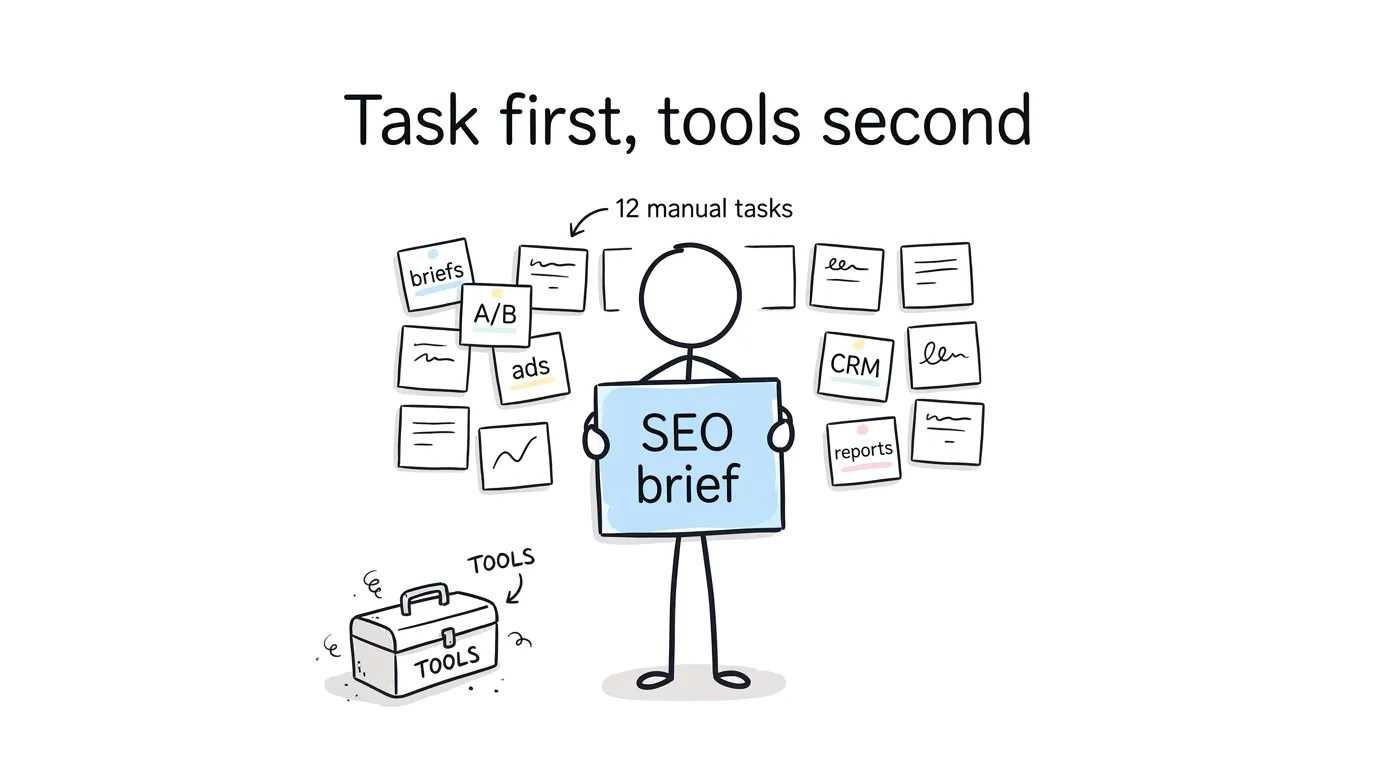
Don't Ask Which AI to Use — Ask Which Task You Want to Kill
When you decide to automate something, what's your first instinct? For most people, it's opening a search box and typing "best AI marketing tools."
Wrong.
When you renovate a house, do you agonize first over which hammer to buy? No. You make a list first: paint the walls, redo the wiring, replace the flooring. Only then do you find the right tool for each job.
Marketing automation works the same way.
What does "task-as-anchor" mean? You write down the manual task that makes your team pull their hair out every week, and only then go find the tool that can kill it. Not the other way around — waving a shiny new tool around the room, hunting for chores it could do.
Following that line of thinking, I've organized the 12 most common manual tasks for marketing teams into a bill of tasks. For each one — which tool to try first, roughly what it costs, where it breaks — all laid out:
| Manual task | Try first | Approx. cost | Where it breaks |
|---|---|---|---|
| SEO content brief | Claude wired to Frase | A few cents to $2 per brief | If the brand voice document isn't uploaded first, the output won't sound like you |
| Email subject A/B | Gemini 3.5 Flash | A batch of 10, about $0.05–0.2 | Without a tone-of-voice doc, subject lines drift further off with every round |
| Multi-platform ad copy | Hyper MCP wired to Claude | $0.1–0.3 per ad | Finance and healthcare need safety guardrails installed first |
| Social media writing and scheduling | Claude + n8n + Notion | See the case below | Platform API rate limits |
| Community reply monitoring | Gumloop | A few cents a day | Each community's bot rules |
| Competitor blog monitoring | Google's Managed Agents API | About $0.1–0.5 per crawl | The preview doesn't support some tool calls |
| Lead enrichment, CRM entry | Claude computer-use or Copilot Studio | $0.5–2 per lead | CAPTCHAs and anti-scraping |
| Weekly KPI reports | Spark, or Claude reading spreadsheets | Under $0.5 per run | If the data isn't in Workspace, it can't see it |
| Images and posters | Gemini generation | $0.04–0.2 per image | The developer API isn't fully open yet |
| Short video generation | Gemini plus Flow | Billed by duration | Requires the AI Ultra plan |
| Influencer outreach DMs | Claude Opus 4.7 | $0.2–0.8 per message | LinkedIn's anti-spam threshold — high volume gets you blocked |
| Marketing reports to executive summaries | Spark, or Opus 4.7 | Under $1 per run | It can't get hold of the report files |
A few numbers worth pausing on.
Take the SEO brief row. By Frase's own account, AI generates a brief in 3 to 5 minutes, while a human doing the same thing needs one to two hours. Note that this is vendor-reported data — take it with a grain of salt. But even if you halve those figures, the efficiency gap is startling.
For the social media row, an independent marketing practitioner shared real-world numbers this past April: a pipeline built with Claude plus n8n plus Notion compressed 3 to 6 hours of weekly social media work down to about an hour and a half. Again, a single sample — not an industry average. But the direction is clear.
BCG research (cited via Frase) says AI workflows can cut low-value work time by 25% to 40%. It's secondhand data, and I'm labeling it as such. But add these rows up one by one and the conclusion hits harder than you'd expect: 12 tasks, each one a few hours of weekly sweat, now down to cents to a few dollars per job.
Figure out which task to hand over before you talk tools. Get the order backwards and it all goes to waste.
First, the Pitfalls
One ugly truth before anything else. The "where it breaks" column above deserves a second, longer look. Nine out of ten articles about AI marketing only talk about how to use it, not where it snaps. But once you actually go to production, the break — not the build — is what decides success or failure.
The failure points boil down to three types.
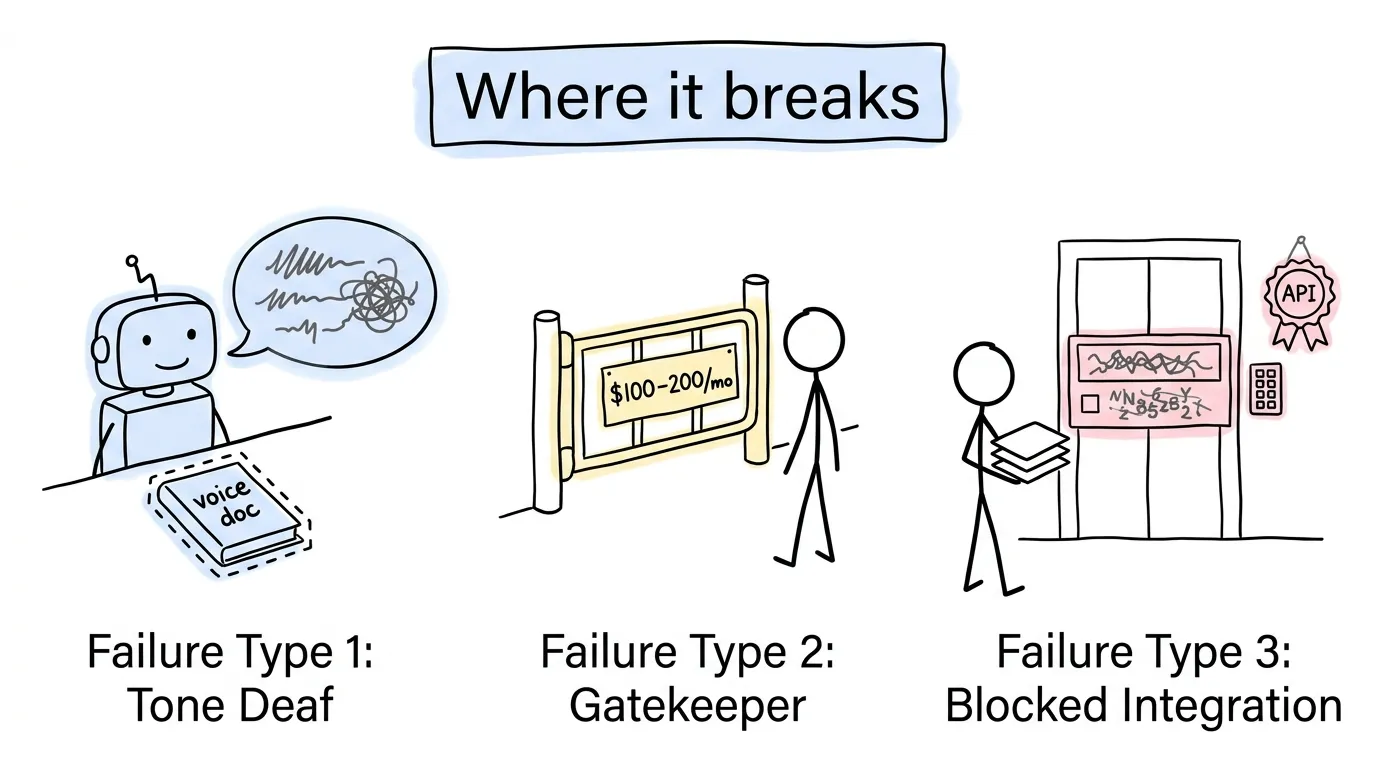
Type one: the brand voice was never fed in. Every agent that speaks publicly needs to first ingest your brand handbook, your tone guidelines, examples of copy that made it past review. In Claude, put it in a Project; in Gemini, write it into the system instructions; in Copilot Studio, write it into the topic prompts. Skip this step, and the output starts drifting by the second round. I've seen too many teams adopt a tool with fanfare in week one and quietly abandon it by week three — and when they trace the root, it comes back to this every time.
Type two: gates. At launch, Spark was open only to U.S. users, and it required the AI Ultra plan at $100 to $200 a month. Google's Managed Agents API is in preview, and the managed path doesn't support advanced calls like computer_use and function_calling. The most powerful play you had in mind may be off the table for now.
Type three: friction from the physical world. Using computer-use to enrich leads and log CRM entries? A single CAPTCHA on the target website leaves your agent standing outside the door. It's like hiring an errand runner to deliver documents to an office tower, only to find the elevator requires a staff badge. However capable the runner is, if he can't get in, he can't get in.
Where it breaks matters more than where it works. Look there first.
Do Two This Week, Schedule the Rest for Next Quarter
Someone will ask: all 12 tasks look great — can't we launch them all at once?
No. This is the most common death I've seen: signing up for ten gym memberships on day one, and by week two not setting foot in a single one.
The right cadence comes in three steps.
Step one: this week. Pick two — SEO briefs, plus email subject lines. Why these two? No new contracts to sign; you probably already have the tools; set up today, output today; if something breaks, debug it today. In one afternoon, the team gets to see with their own eyes that "oh, this actually works." Seeing it work firsthand beats any ROI projection.
Step two: weeks two through four. Roll out three more: ad copy, social media scheduling, competitor monitoring. These take a bit of engineering: wire up a Hyper MCP ($49 a month, integrations with 80-plus marketing platforms), or build an n8n workflow, or make one Managed Agents API call. Once it's built, at team scale you save 8 to 15 hours a week.
Step three: months two to three. Lead enrichment, deployment in regulated environments, cross-channel report consolidation. These three require legal review, engineering sprints, and vendor contract negotiations; for regulated-industry deployments, budget six to eight weeks. But the savings are the largest too — starting at 15 to 30 hours a week. While we're here, a word on the tooling layer: for marketing-platform-specific integrations there's Hyper; for spanning CRM, e-commerce, and cloud services there's Composio — over a thousand tools, far less hassle than hand-writing API connections one by one. And if you're building your own skills, there's an open standard called agentskills.io: write once, and it works across dozens of platforms.
By the way, if lead enrichment needs to go the regulated route, Anthropic's self-hosted sandbox comes into its own: Cloudflare, Daytona, Modal, and Vercel can all serve as hosts, the agent runs inside your own VPC, and the data never leaves home.
Slow is fast. Get the easy things working end to end, bank the trust and governance muscle, then take on the hard stuff.
Now, Another Math Check
There's one more calculation most articles won't do for you. I've done it for you.
For the same job, switching models can swing the price two- to threefold. Gemini 3.5 Flash: $1.50 per million input tokens, $9 output. Claude Sonnet 4.6: $3 in, $15 out. Opus 4.7: $5 in, $25 out.
Do the math. Say you write 100 SEO briefs a month — once you price a single brief out by tokens, Flash runs you maybe a few dozen dollars a month, while Opus could run to several hundred. This is a quantitative decision, not voodoo.
Is cheaper always better? No. For summaries that go to executives, a single off-key phrase can get magnified — the Opus premium is worth paying. For overnight batch jobs, Flash is plenty.
Two more money-saving switches, in passing: Sonnet 4.6's prompt caching saves up to 90% on repeated system prompts; batch processing cuts another half off tasks that aren't in a hurry.
More automation projects die from the bill than from the technology.
Four Safeguards
Finally, governance. Four words: handbook, approval, spending caps, monitoring.
You would never hire an employee without giving them the employee handbook, without approval workflows, without expense limits, without attendance records — and then hand over every company account password.
Same principle for agents.
The handbook is the brand voice document mentioned earlier — not one word can be cut. Approval: any action that writes into production systems — editing the CRM, launching ads, sending mass emails — keeps one human confirmation before execution. Microsoft's computer-use builds this in: low-confidence steps stop and ask a person. That design is worth copying. Spending caps: set a daily spending limit for every agent, or a single runaway crawler task can burn through the budget in 48 hours. Monitoring: in regulated industries, audit logs must be in place before the first production run — not patched in after something goes wrong.
With all four safeguards installed, you can finally let go for real.
Back to That Cup of Coffee
At the end of the coffee, I asked my friend: of these 12 tasks, could you squeeze out two hours next week?
She thought for a moment and picked SEO briefs and email subject lines. I said, good — start with those two. The big ones can wait until next quarter, once your brand docs, approval workflows, and spending caps are all standing.
That week six months ago, the toolset was already complete. In the six months since, the tools have only gotten more mature, cheaper, more open. So the real dividing line was never on the vendors' side.
It's in whether anyone actually rolls up their sleeves and hands over the first task.
Here's to handing over your first one — this very week.
Continue reading
Related articles

It's 2026: Stop "Buying" AI Tools for Your Marketing Team — Start "Hiring" AI Agents
This learn article explains how AI agents differ from standalone AI tools in marketing, outlines three agent categories — build-your-own platforms, CRM-native agents, and vertical tools — and covers use cases across SEO, social media, advertising, and reporting, plus criteria for choosing one.

What Is GEO? How Your Brand Gets "Mentioned" in the Age of AI Search
An explainer on GEO (Generative Engine Optimization) for e-commerce and DTC brands: how it differs from SEO and AEO, why AI answers shape brand visibility, and eight practices covering question-focused content, consistent brand messaging, structured pages, external evidence, comparisons, and AI mention tracking.

AI Is Already Making Decisions for Your Customers. Are You on the List?
A learn article explains GEO (Generative Engine Optimization): why AI-generated answers now shape which brands customers see, and how SEO fundamentals, entity clarity, citable evidence, and monthly measurement affect visibility in AI answers.