
Getting Named by AI Is Worth More Than Ranking First: After This Year's Google I/O, It's Time to Rerun the Search Math
An analysis of how Google's AI Mode, AI overviews, and personalized search reshape organic traffic, arguing that brand citations in AI answers now matter more than top rankings. It covers zero-click data, citation tracking, and practical steps for AI-ready content and structured data.
A few days ago, an old friend who runs a cross-border e-commerce business asked me out for tea.
The moment he opened my laptop bag, he pulled up his dashboard data and said: take a look at this. Something's off.
Impressions climbing steadily, clicks sliding down. The click-through rate had dropped enough to spook him.
He asked me: have I been penalized?
I said, you haven't been penalized. You're just standing at the door of a new era, still clutching an old map.
This past May, at the Google I/O conference, Google rewrote the rules behind the word "search."
Today, let's run the numbers all over again.
What Is AI Mode?
First, a quick explainer: AI Mode.
It's this: when you search on Google, instead of handing you ten blue links to click through one by one, the system sends out an AI that digs through the web, reads articles, makes comparisons, and then simply hands you an answer — "I've already looked this up for you."
You don't have to click anymore. The AI clicked for you.
A year after launch, this feature has passed 1 billion monthly active users. And query volume doubles every quarter.
Think about that: 1 billion people have already formed the habit of not clicking links. The traffic you worked so hard to build rankings for is being intercepted halfway.
What's more brutal: a few sets of numbers announced at this year's I/O essentially confirmed that downward curve my friend saw in his dashboard.
The Four Things That Really Mattered at This Year's I/O
This conference packed in a lot of news. Four items directly affect whether you can be found.
First, the search box — its biggest overhaul in 25 years.
You can now drop in images, files, videos, even an entire Chrome tab. What users type in is no longer a two- or three-word keyword like "email marketing tools," but a full paragraph of complete context.
The signal behind this is clear: the entrance to search has changed from "keywords" to "complete questions."
Second, information agents went live.
What's an information agent?
It's a background program that's online 24 hours a day. You tell it clearly what you're looking for, and it keeps circling the web — scanning blogs, scanning news, scanning prices — and the moment it finds a match, it proactively hands you a summary.
The old logic was: a human opens a search engine, types in a question, clicks a link.
Now the middle step has been taken over by machines.
Think about it: your pages, your prices, your inventory can be read by an AI without a single real human ever searching.
Third, Gemini 3.5 Flash became the global default model for AI Mode.
Faster, stronger at multi-step reasoning. And the bar for content has risen with it: surface-level keyword stuffing, it sees through at a glance; genuine depth and expertise, it actually recognizes more easily.
Fourth, Personal Intelligence rolled out worldwide.
It connects AI Mode with your Gmail, your photo library, your calendar — covering nearly 200 countries and 98 languages, for free.
In the same city, two people searching the same phrase can see completely different answers.
Why?
Because the system knows what emails each of you has read, what photos you've saved, what stores you follow.
Personalized search — a different answer for everyone — is really here.
Run the Numbers Ruthlessly
Working from several sets of public data, I ran the math on my friend's behalf — and you can run it against your own dashboard.
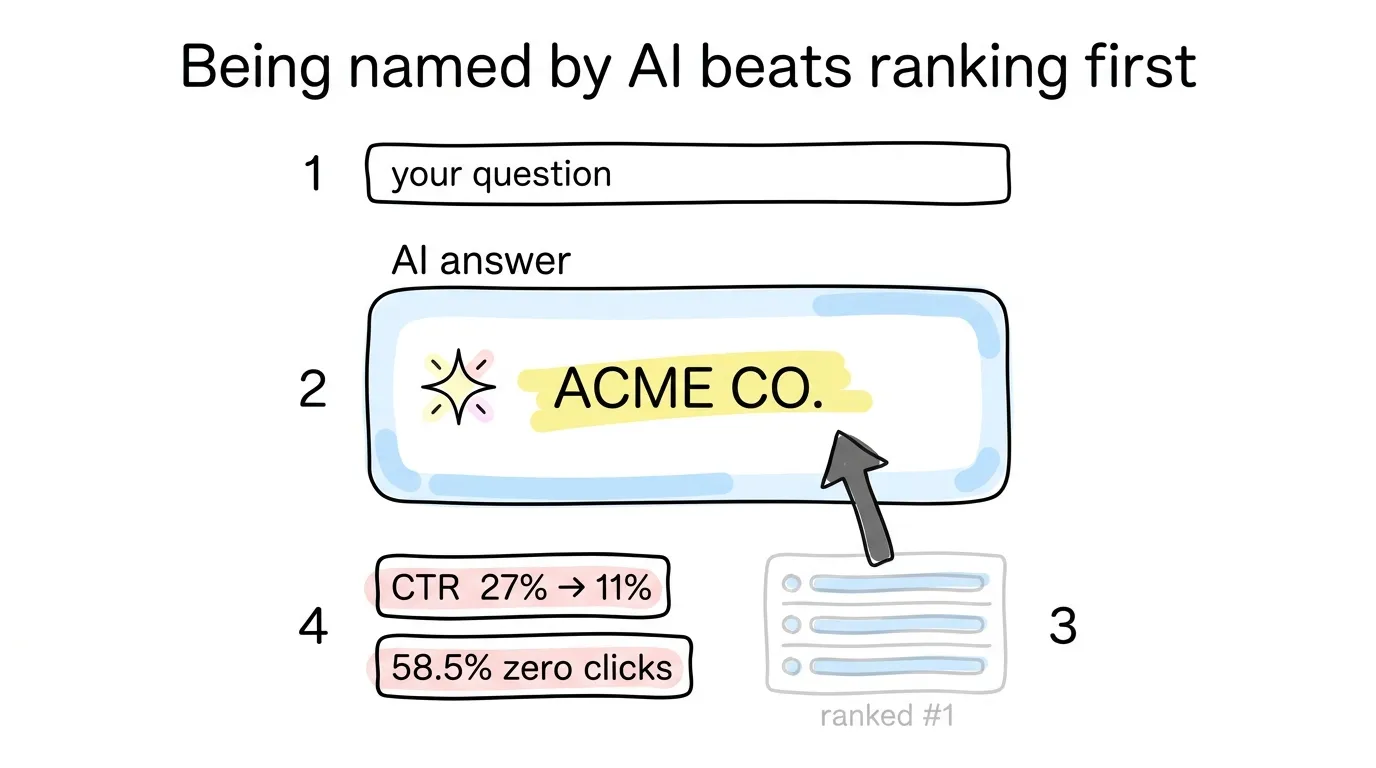
Number one. SISTRIX, a data analytics firm, reported this March: in search results that show AI overviews, the organic click-through rate for the number-one result has fallen from 27% all the way down to 11%.
Number two. Research from SparkToro and Datos: in the US market, 58.5% of Google searches end in zero clicks. More than half of search sessions — not one click outward.
Number three is the scariest. Earlier this year, a randomized controlled experiment split users into two groups — one that could see AI overviews and one that couldn't. The result: the group that could see them made 38% fewer outbound clicks, and the zero-click share jumped from 54% to 72%. Turn the AI overviews off, and outbound clicks nearly double.
This is a causal experiment, not a correlational observation. Causality is what tells the truth.
Gartner also has a prediction: by the end of this year, 25% of organic search traffic will shift to AI chatbots and voice assistants.
See what's happening? Traffic is not coming back to its old levels. This isn't a problem to be solved — it's a reality to be accepted.
Being Named Beats Ranking First
Don't despair yet. One set of data flips the whole picture.
Research published this March by Digital Applied showed: in the very same search results, brands named and cited in AI overviews earned 35% more organic clicks than competitors who weren't named, and 91% more paid clicks.
In search that AI has taken over, being named is the new number one.
Ranking first, right below the AI overview, is worth less than getting one mention inside the AI's answer.
Some will ask: if I build my rankings high enough, won't I naturally get cited?
Not necessarily — and that stopped being guaranteed a while ago.
In mid-2025, roughly 76% of AI overview citations came from pages ranking in the top ten. By the start of this year, research aggregated by several institutions showed that overlap had dropped to somewhere between 17% and 54% — the studies differ widely, but the direction is the same: the pool of sources the AI cites from is far wider than the top ten you can see.
Reddit, niche authority sites, all kinds of structured data sources — they've all made the AI's citation list.
So rank optimization and citation optimization are now two separate disciplines, each tracked on its own, each with its own owner. Rankings are rankings; citations are citations.
That is the biggest change in the search ledger since this year's I/O.
The First Reader of Your Website May Not Be Human
The information-agent story deserves to go one layer deeper.
Google published an official AI search optimization guide this May, and it mentions: browser agents visit websites by taking screenshots, reading the DOM structure (the structural skeleton of a web page), and parsing the accessibility tree (a machine-readable outline of a page built for assistive technology).
Translated into plain language: the thing visiting your site may not even be a browser.
Prices frozen at six months ago, never updated? It reads the old prices.
Core information only rendered by JavaScript? It may never see it at all.
So what do you do? Prepare your website as data, not just as pages. Keep prices and inventory accurate in real time; make sure key information is readable without rendering; write the common pre-purchase questions out in plain language right on the page; feed product data to it in structured formats.
One more detail deserves its own mention. AI Mode has a mechanism called fan-out (when you ask one question, the system quietly breaks it into many): a user asks a single question, and the system fires off up to 16 sub-queries at once, checking price, reputation, after-sales service, and other angles simultaneously.
What does that mean?
It means a narrow page built around a single keyword is getting harder and harder for anyone to find. A content cluster covering many angles of one topic is more likely to surface in questions it never directly answered.
Addy Osmani, an engineering leader at Google Cloud, wrote about this in April: for AI, token efficiency is a real optimization metric. Bury your core answer inside a 3,000-word lyrical essay, and AI systems will skip it — or summarize it wrong.
Getting to the point isn't just good style. It's a technical requirement.
Google's Official Guide: There Is No New Discipline
This, to me, is the point worth banging the table for.
The core message of that May guide is remarkably blunt: there is no such thing as a separate new discipline called "AI search optimization." The AEO and GEO debates that have raged all year are, at their core, old-school SEO with solid fundamentals, applied to AI interfaces.
The guide lists the things that genuinely work: write content AI cannot generate on its own — original research, first-hand experience, named real-world case studies; feed local and product data accurately through Google Business Profile and Merchant Center; keep page structure clear; do the technical SEO you were supposed to do anyway; and if you run a transactional business, start preparing for agent access.
At the same time, the guide calls out two things to stop doing.
One is chopping content into tiny fragments to suit the AI's "digestive habits." Google's search liaison said back in January that engineers explicitly advise against it. Google's systems can read an entire page and extract paragraphs on their own — you'd be fragmenting your content for nothing.
The other is farming fake brand mentions across forums and blogs. Spam filtering systems watch for exactly this, and getting caught costs you trust signals. This road's downside is far bigger than its upside.
Look at that — after one long detour, the answer turns out remarkably plain: master the fundamentals, keep the data accurate, and write the things only you can write.
The newer the era, the more it rewards old-school fundamentals.
After Personalization, What Are You Actually Competing On?
The Personal Intelligence thread deserves a closer look of its own.
Once search results vary from person to person, for local businesses, consistency across every touchpoint becomes more valuable than ever. Your hours, your reviews, your address — they all have to line up across your business profile, review sites, and customers' email exchanges. Only then is AI more likely to hand you over when handling a search with personal context. One mismatch anywhere, a discount everywhere.
For B2B and content brands, first-party relationship assets have appreciated. Subscribers to your emails, registered users, returning readers — their behavioral trails feed back into the results the AI shows them. Cold keyword rankings can never build that kind of relationship.
And for multilingual teams going global: personalized coverage in 98 languages means every market's AI answers are blended with local users' personal context. The weight placed on content quality and factual accuracy has gone up. The keyword-stuffing traffic game is over — time to fold.
Your Three-Step Play
Enough theory. Here's a version you can act on. You don't need to tear everything down — just three steps.
Step one: within 30 days, stop the bleeding.
Open Search Console, pull up the queries with the highest impressions, and find the ones where "impressions rose, clicks fell." That gap is AI overviews drinking your traffic.
Operate on those pages: in every major section, give a clean, direct answer within the first 100 words. No warm-up.
While you're at it, check your Google Business Profile: hours, phone number, categories, recent reviews — all aligned.
One more thing: replace the year-over-year baseline in your internal reports. Using a pre-AI year as your reference systematically understates today's performance and manufactures false urgency.
Step two: over the next 6 months, build citation assets.
Beyond rank tracking, add a separate lane for AI citation tracking. Tools like Semrush, Ahrefs, and BrightEdge already carry AI overview mention data. Whether your brand gets named on high-value queries — treat it as a primary KPI and grow it.
Keep investing in content only your team can produce: original data, cases with real names attached, methodology frameworks nobody else has. The things AI can stitch together from elsewhere will never cite you.
Step three: looking further ahead, stock up for the agentic era.
Check how your pages render — never count on JavaScript for core information. Watch the progress of the Universal Commerce Protocol — an open protocol pushed jointly by Google and Shopify, backed by more than twenty companies, aimed at letting agents complete transactions directly on your website. It's still early, but the direction is worth acting on: get your product data into clean, machine-readable, machine-executable format ahead of time.
Before You Go
What did my friend end up doing?
He pulled a month of impression data, flagged 40-plus queries being intercepted by AI overviews, rewrote the matching pages into answer-first versions, and fed his product data into structured formats.
A month later, his clicks hadn't returned to their old level — but his brand had been named, in the AI answers of several core queries.
That share of clicks is new, and no one can take it away.
This year's I/O did not announce the death of SEO. It announced the death of the version where you could win by ranking alone.
Fundamentals still matter, data has to be alive, content has to be true — and machines have to be able to read you.
Four things. You can't skip a single one.
Here's to your brand — always the one the AI names.
And here's to you — may you never wait until traffic hits zero to recount this ledger.
Continue reading
Related articles

It's 2026: Stop "Buying" AI Tools for Your Marketing Team — Start "Hiring" AI Agents
This learn article explains how AI agents differ from standalone AI tools in marketing, outlines three agent categories — build-your-own platforms, CRM-native agents, and vertical tools — and covers use cases across SEO, social media, advertising, and reporting, plus criteria for choosing one.

What Is GEO? How Your Brand Gets "Mentioned" in the Age of AI Search
An explainer on GEO (Generative Engine Optimization) for e-commerce and DTC brands: how it differs from SEO and AEO, why AI answers shape brand visibility, and eight practices covering question-focused content, consistent brand messaging, structured pages, external evidence, comparisons, and AI mention tracking.

AI Is Already Making Decisions for Your Customers. Are You on the List?
A learn article explains GEO (Generative Engine Optimization): why AI-generated answers now shape which brands customers see, and how SEO fundamentals, entity clarity, citable evidence, and monthly measurement affect visibility in AI answers.