
In the AI Era, 75% of Your Brand Reputation Isn't Yours to Manage
A learn article on brand reputation in the AI era, arguing that most search-result content comes from third-party sources and explaining how to influence what AI answers cite through audits, updated evidence, and ongoing reputation maintenance.
A while back, an old friend texted me in the middle of the night. His company — one he had spent ten grinding years building — was in the middle of a funding round, meeting investors. Instead of asking much about the business, they zeroed in on an AI-generated company profile and asked: that executive change you had back in 2024 — what exactly happened there?
He froze. That matter had been resolved long ago, and it had been publicly clarified online since. But AI didn't know that. AI had taken a single skewed report from two years earlier, treated it as fact, and recounted it to his investors.
He asked me: my official website lays it all out clearly — why did nobody look?
I said: because you occupy just one room out of four.
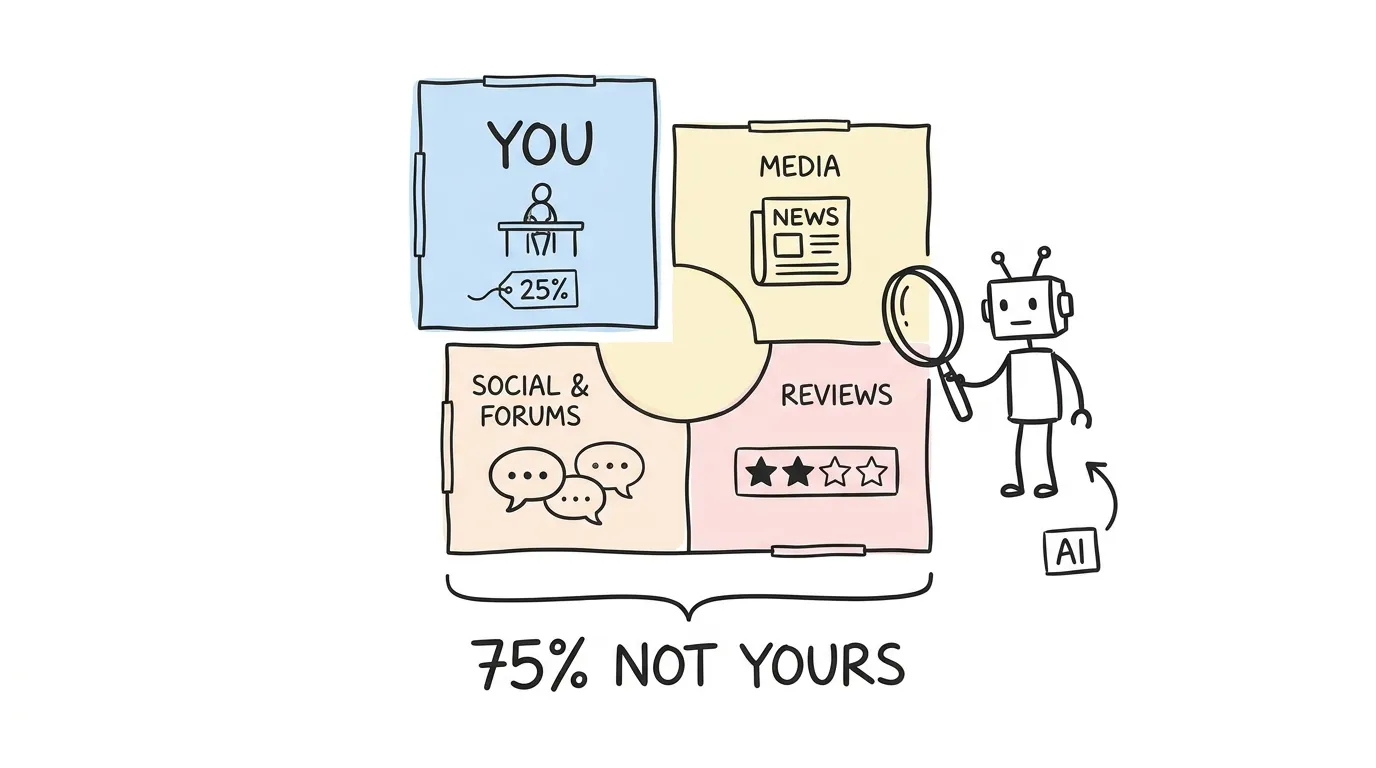
Your Home Base Is Only 25%
What do I mean? First, let me show you a set of numbers.
Terakeet, a reputation management company, ran a study on large Fortune 1000 brands. It found that in Google's search results, content the brand itself can control accounts for just 25%. The remaining 75% sits in the hands of news media, review sites, social platforms, and forum users.
Wow. Three quarters.
What does that mean? Out of every ten times users search for you, seven and a half times what they see is not the message you prepared, but a script someone else wrote for you.
That's right — your official website, your official accounts, your painstakingly polished product pages are all well done. But you are one room out of millions. Whatever is being said in the other rooms, you can't control. And it's precisely those rooms that make up your entire image online.
Why Does This Suddenly Matter So Much?
Because AI showed up.
Think about it: in the past, when users searched for a brand, they saw a list of links — they picked, they judged for themselves. And now? Users simply ask the AI: "Is this company reliable?" "How are their products?" The AI goes off, sweeps the entire web for material, chews up third-party content, and serves up a "standard answer."
Users won't click into your website at all. In the search box, they've already delivered their verdict on you.
In the past, search was the starting point of the journey. Now, search itself is the destination.
This means the ones shaping your image are increasingly not you, but the third-party sources the AI chooses to cite. A single media report, a string of speculation on a forum — either can become "fact" in the AI's telling.
So the playbook of reputation management has changed.
The Goal Isn't Control — It's Influence
Some might say: what if I just delete every negative item out there?
No. And you can't, anyway.
You can't control what people say, but you can influence what people see.
What does "influence" actually involve? Let me walk you through it end to end.
Start from the questions users genuinely ask. If your customer wants to know how the product works, a hundred lines of "leading innovation in the industry" won't help — what he needs is a clear, thorough explanation. If your investor wants to understand that executive change, leaving a set of materials untouched for three years amounts to handing him the wrong answer with your own hands.
Next, put the evidence on display. Pair important conclusions with verifiable materials; keep company information current. Then take one more step outward: supply your professional content to credible media and platforms, so authoritative voices speak for you. And when you find factual errors, request corrections where corrections are warranted.
There's one more situation you shouldn't dodge: legitimate criticism. When the same complaint keeps recurring, there's usually a real business problem behind it. Fixing it is itself part of reputation management.
What Is "Reputation Infrastructure"?
The term sounds grand, but it's remarkably plain.
When you renovate a house, you don't decorate the plumbing and wiring. But the day a pipe bursts, no amount of styling will save you. Reputation infrastructure is exactly that plumbing.
What specifically needs maintaining? Start with a regular full-web audit: search your brand name, your product names, your executives' names, and see what sources surface, whether they're telling the same story, and whether any key information is missing.
When you evaluate, don't just look at good versus bad. Look at three things: relevance, accuracy, freshness. A glowing report that praises a business line you cut three years ago — is that praise or a trap? It looks like praise; in reality, it misleads. And content goes stale. Only continuously updated assets can hold their position in search results long term.
Once you've read the audit report, you know where the money should go. Some problems take nothing more than fixing one page of your website; others call for more substantial content, or building long-term relationships with the relevant platforms.
Finally, keep an eye on how things change. Is accurate information showing up more often? Are the recurring challenges still there? Look back at regular intervals, and problems get solved while there's still time.
Run Your Reputation Like Ops
One layer deeper.
Some companies treat reputation management as "call in the PR firm when something breaks." That won't do. It should be infrastructure for a critical business function — online year-round, like water and power. Terakeet has a name for this approach: the "Reputation Operating System" — use technology to map everything being said about you across the web, prioritize it, measure continuously, iterate continuously, and have contingency plans ready before the crisis ever arrives.
Why prepare in advance? Because when a crisis hits, scrambling for information and cobbling together content on the spot is too late. A company that has its facts in order during normal times has material on hand and stays calm. While others rush to explain, it answers with composure.
Finally, Back to My Friend
He went on to do three things: updated all the outdated executive materials, wrote the full story of that change into a clear article published on his official website, and proactively contributed pieces to two industry media outlets about the pitfalls his company had stumbled through.
Three months later, at the next round of due diligence, the story the AI told looked a whole lot better.
He hadn't managed to delete a single item online. He had simply made sure accurate information showed up where it needed to be.
In the AI era, brand reputation doesn't depend on what you say — it depends on whom the AI cites.
Whoever manages those third-party sources well gets to write the answer before the user ever asks.
May your brand always be the accurate version in the AI's telling.
Continue reading
Related articles

It's 2026: Stop "Buying" AI Tools for Your Marketing Team — Start "Hiring" AI Agents
This learn article explains how AI agents differ from standalone AI tools in marketing, outlines three agent categories — build-your-own platforms, CRM-native agents, and vertical tools — and covers use cases across SEO, social media, advertising, and reporting, plus criteria for choosing one.

What Is GEO? How Your Brand Gets "Mentioned" in the Age of AI Search
An explainer on GEO (Generative Engine Optimization) for e-commerce and DTC brands: how it differs from SEO and AEO, why AI answers shape brand visibility, and eight practices covering question-focused content, consistent brand messaging, structured pages, external evidence, comparisons, and AI mention tracking.

AI Is Already Making Decisions for Your Customers. Are You on the List?
A learn article explains GEO (Generative Engine Optimization): why AI-generated answers now shape which brands customers see, and how SEO fundamentals, entity clarity, citable evidence, and monthly measurement affect visibility in AI answers.