
Last Year, AI Rebuilt the Marketing Industry from the Ground Up
A year-in-review article on how AI reshaped marketing in 2025 across brands, agencies, and media, covering brand adoption of generative production, agency automation and consolidation, and LLM-driven search reducing publisher referral traffic.
A while back, I had dinner with a friend who does creative work at an ad agency. Halfway through the meal, his phone rang — a reminder for his team's weekly meeting. He silenced it and said something to me that I still remember:
"Our team had 10 people the year before last. Last year, 3 were left."
Why?
Because any work that could be templated was taken over by machines.
That one line is practically the footnote for the entire past year. In 2024, AI officially made its debut in the marketing world; by 2025, it started rewiring things: how brands shoot ads, how agencies organize production, how media companies make money — all of it was churned up.
Let me break this year of change into three parts: brands, agencies, and media. By the end, you'll see that AI has become the industry itself.
1. Brands: From Experiment to Requirement
What does "from experiment to requirement" mean?
It means that earlier, a brand using AI was called a "pilot," and what it produced was called "exploration." By 2025, top brands wrote AI directly into their production systems.
An example.
Last December, Disney announced a $1 billion investment in OpenAI. That money bought more than equity — it secured one thing in particular: users can shoot short videos starring Mickey Mouse, Cinderella, and other characters inside Sora and ChatGPT. Good grief — Mickey Mouse is inside generative tools now. Could the signal be any clearer?
Right after that, a batch of brands crowded into OpenAI's chat app: Spotify, Expedia, Zillow, Canva, Adobe. They went there to claim territory.
Coca-Cola moved even earlier. Its first strongly AI-flavored Christmas ad, two years ago, got slammed; in 2025 it kept at it, with generative tools pushed right to the core of production, and it even opened a co-creation platform letting users generate branded assets themselves. The criticism never stopped, and neither did the moves. That attitude is itself a statement: AI is now installed in Coca-Cola's creative operating system — whether you boo or not, it's there. At year's end, WPP Open X and VML rolled out new holiday campaigns on top of it.
The boldest move came from Mondelez, the parent company of Oreo and Cadbury. It spent more than $40 million building its own generative AI production engine — from social assets to broadcast-ready TV commercials, everything handed over to AI. Early estimates put creative production cost reductions at 30% to 50%.
Let's do the math. A global advertiser spends anywhere from hundreds of millions of dollars a year on creative production. Cutting 40% means conjuring an aircraft-carrier-sized budget out of thin air. Even bolder: Mondelez says the system will be used on Super Bowl-level campaigns. A 30-second Super Bowl slot costs several million dollars apiece — that used to be the creative teams' badge-of-honor fight. Now the machines are entering the field.
Of course, there were plenty of crashes too. Google's Gemini Super Bowl ad had errors, Valentino's AI social ad was widely mocked, and Duolingo went all-in on AI too fast and infuriated its users.
But string the year's moves together and the picture is clear: optimism far outweighs fear. Meta and Canva are still hustling to hand marketers tools; even vodka brand Svedka announced it would use AI in its Super Bowl ad.
Brands no longer ask "should we use AI?" They only ask "how fast?"
2. Agencies: The Table Got Flipped; Time to Find a New Seat
Brands run fast; agencies change even faster.
Within a single year, all the big holding groups made their moves: WPP launched Open Pro, Omnicom has Omni Assist, Publicis rolled out CoreAI — each also appointed a dedicated AI lead and re-sorted creative, media, and production teams around automation.
But the real pressure isn't about technology. It's about existence.
Think about it: brands are building their own generative tools and opening their own co-creation platforms. So of the work of "helping brands execute," how much is still uniquely the agency's? Agencies have no choice but to move their value upstream, toward strategy.
At the same time, a batch of AI-native small companies emerged. What they sell is "copilot-style" production: accelerated concept generation, hyper-personalized creative variants, small teams doing big-team work. These small shops are cheap, fast, and don't owe old clients any favors — and they hit traditional agencies right in the chest.
The biggest hammer to fall last year was the Omnicom–IPG merger. It essentially declared a judgment: the agency industry's logic of scale is being swapped for the logic of automation.
Sam Huston, Senior VP at DEPT, described the post-merger company this way: every step that can be templated — optimization, forecasting, reporting, content production, QA, scheduling — is being re-architected through automation. Work that used to need 10 people will need 3 people plus machines. Machines don't drink coffee, and they don't need rest.
My friend at that dinner lives inside that sentence.
3. Media: The Traffic at the Door, Carried Off by AI
The first two parts were about efficiency. This part is about life and death.
In 2025, LLM-driven search and Q&A became the default entry point on the big platforms. Users ask a question, the AI hands over one well-synthesized answer, they finish reading and leave — never clicking the original link. The referral traffic publishers live on is visibly evaporating.
Subtler still: newsrooms themselves are plugging LLMs into their workflows. The boundary between original reporting and AI-assisted production grows blurrier.
So what can publishers do?
Josh Peters, VP of Global Data Partnerships and Strategy at Bombora, wrote a 125-page guide, and one piece of advice in it strikes me as exactly right: don't treat AI as a threat — treat it as a new monetization layer, placed alongside subscriptions, advertising, and content licensing, collecting money layer by layer. Some publishers are already negotiating partnerships with LLM platforms to make this layer of revenue real.
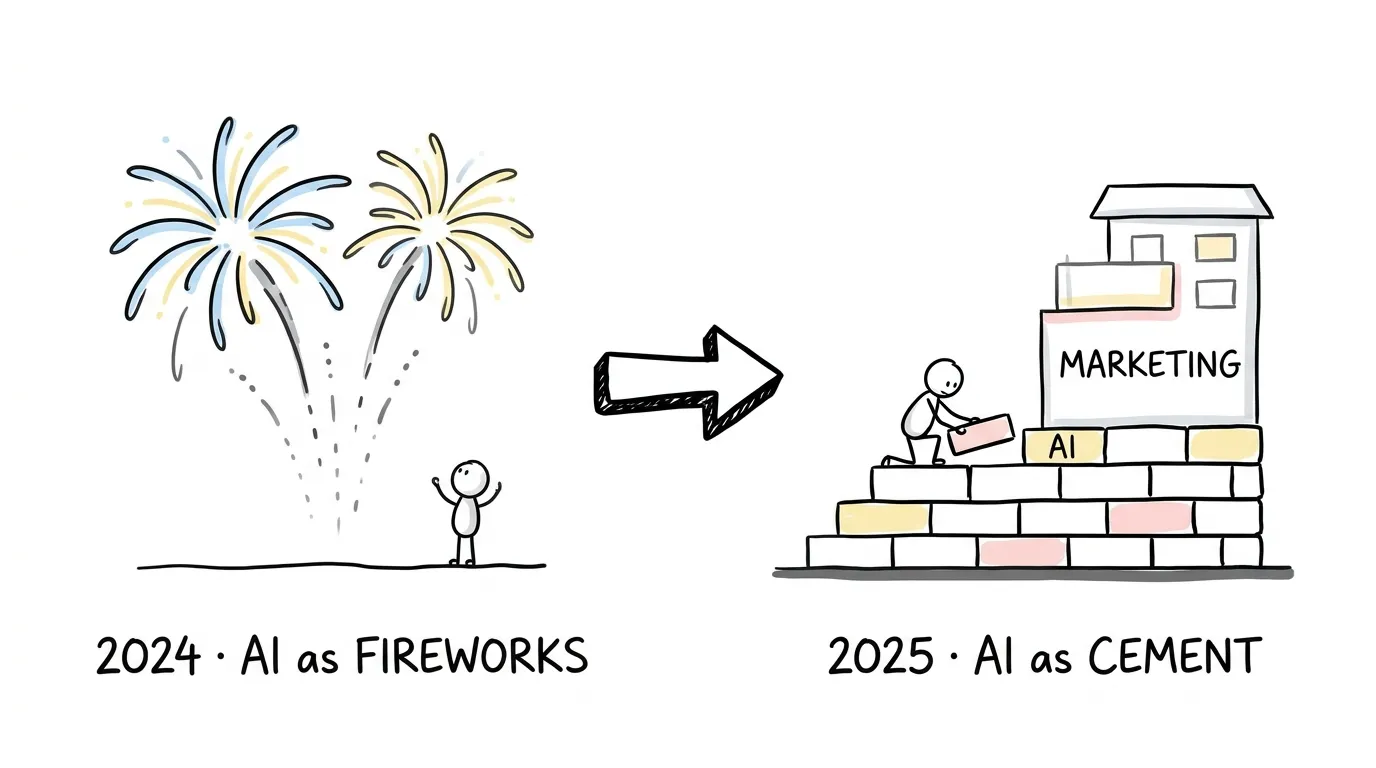
4. Looking Back: AI Went from Fireworks to Cement
After watching this whole year, my biggest takeaway is: AI is no longer fireworks; it's cement. Fireworks are for people to watch. Cement is for building.
The quarrel between the efficiency camp and the soul camp never stopped either. Audiences bash AI ads as "soulless"; brands praise AI as fast and cheap. But notice — the bashing itself proves it's already the lead actor. Nobody goes out of their way to bash a toy.
What's next? Terence Kawaja, founder of LUMA Partners, has a prediction: the mergers will continue. He says AI is accelerating the industry's migration toward "outcomes," and that blade will cut all the way through the entire marketing supply chain.
The blade is already out of the sheath.
At the end of that dinner, I asked my friend what the remaining 3 people were doing. He said: the things they never got a turn to do when there were 10 — thinking strategy.
So there's no need to be too pessimistic. What the machines take is the part that can be templated; what remains in your hands is the part that can't be. Keep thickening the latter, and there will always be a place for you up front.
Here's a wish for you: may the work in your hands never be templateable.
Continue reading
Related articles

What Is GEO? How Your Brand Gets "Mentioned" in the Age of AI Search
An explainer on GEO (Generative Engine Optimization) for e-commerce and DTC brands: how it differs from SEO and AEO, why AI answers shape brand visibility, and eight practices covering question-focused content, consistent brand messaging, structured pages, external evidence, comparisons, and AI mention tracking.

AI Is Already Making Decisions for Your Customers. Are You on the List?
A learn article explains GEO (Generative Engine Optimization): why AI-generated answers now shape which brands customers see, and how SEO fundamentals, entity clarity, citable evidence, and monthly measurement affect visibility in AI answers.

Google Is Stuffing Ads Into AI Search: These Recent Stories Are Really One Story
A news roundup linking recent AI marketing stories—Google adding ads to AI Mode, Amazon's Ads Agent, ChatGPT image updates, a UK startup tracking brand mentions in AI answers, and an AI ransomware warning—arguing that control over ad data and visibility is shifting toward platforms.