
The End of Search Is an Answer: AI Is Rewriting Your Traffic Gateway
A bilingual learning article explaining how AI chatbots and AI-generated search answers are replacing the traditional keyword-and-links search habit. It covers zero-click behavior, the rising value of visitors from AI platforms, and practical steps such as tracking AI visibility and improving conversion.
A few days ago, I casually asked a young colleague in the office: when you look something up now, is your first instinct to open a search box, or to just ask an AI?
He thought about it for a second, and said: ask an AI.
I asked a few more people nearby. Pretty much the same answer. Including me.
In that moment it suddenly hit me: a set of moves we've spent more than twenty years practicing is being quietly replaced. Type in keywords, hit Enter, pick one link out of ten blue ones. We drilled that routine into muscle memory. But today, for many people, the first "search box" they ever touch in their lives is an AI that talks back.
The gateway has changed. And every business behind that door has to change with it.
Let's Run Some Numbers
Data doesn't lie. Let's run a few numbers first.
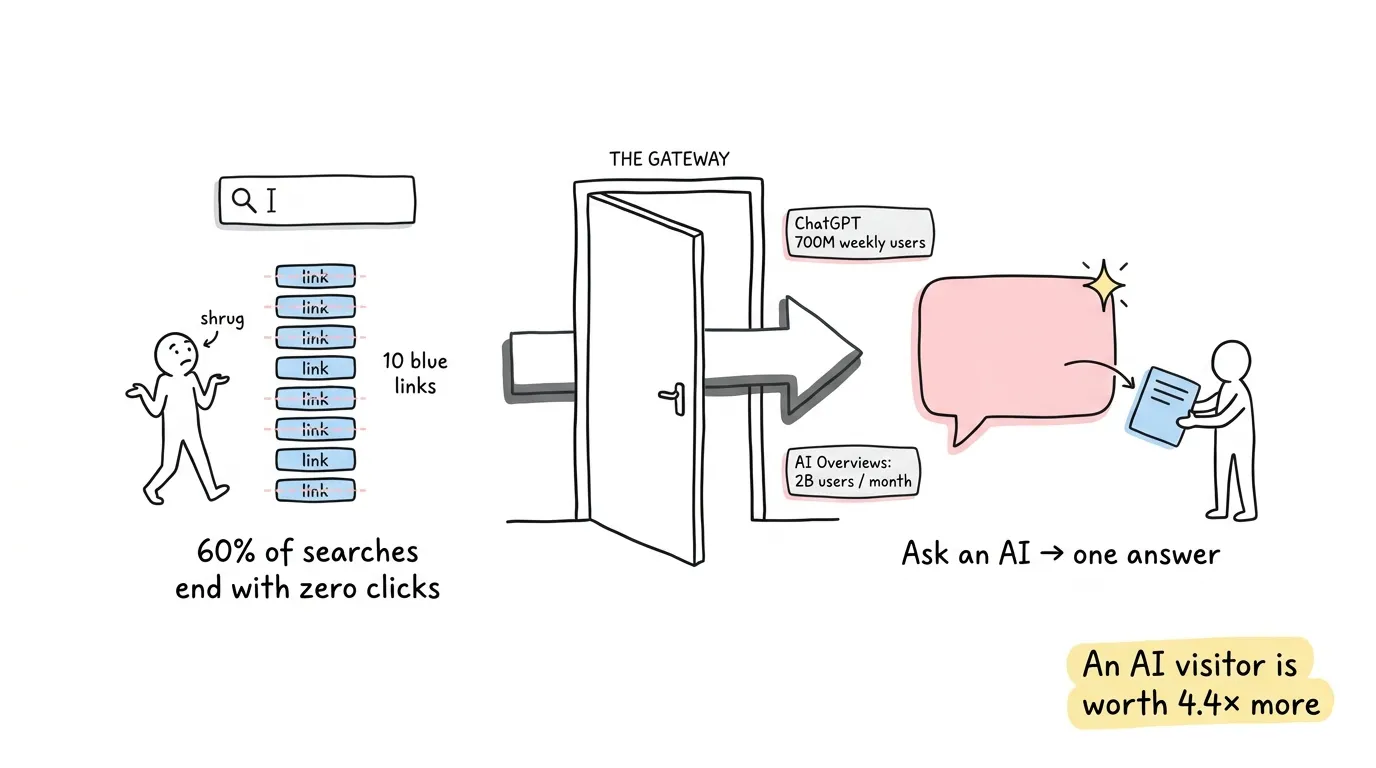
In 2025, OpenAI announced that ChatGPT had reached 700 million weekly active users. It is already the fourth most-visited website in the world, receiving more than 5 billion visits every month.
5 billion. In a single month.
What surprised me even more was this: in low-income countries, ChatGPT's usage rate is more than four times that of high-income countries. Think about it — the more a place lacks experts and access, the more people treat AI as that "consultant who knows everything."
Google hasn't been sitting still, either. Since its AI Mode launched, the two markets it entered first — the United States and India — have together accumulated 100 million users, and it now covers more than 200 countries and regions. As for AI Overviews — the summaries that appear right at the top of search results and wrap the answer up for you — they reach 2 billion users every month.
2 billion. That's like renovating half the storefront of search itself.
Young people are further ahead. A 2025 survey found that among Americans aged 16 to 27, nearly 35% already habitually turn to AI chatbots to look things up — the highest share of any age group. But they haven't thrown out the old tools either: YouTube, Instagram, and TikTok are all still in heavy rotation. AI has just claimed one more slot — one that keeps moving toward the front of the line.
Traffic follows the people. A 2025 AI traffic report tracked the backend analytics of 19 websites: comparing January through May of 2024 with the same period in 2025, visits coming from large language models (large language models, the AI systems behind chatbots like ChatGPT) grew from roughly 17,000 sessions to 107,000.
Up 527%.
The volume is still small. On some websites, traffic from platforms like ChatGPT, Perplexity, and Copilot has only just crossed 1% of the total. But Semrush predicts that by 2028, visits to websites from AI platforms could overtake those from traditional search engines. And if AI Mode becomes Google's default experience, that day will only come sooner.
60% of Searches Now End Without a Single Click
Users are drifting toward AI — and that's still the gentle version of the story. The sting comes later.
In 2025, a survey by Bain & Company found that roughly 60% of searches end in zero clicks.
What does zero-click mean? The user searches, and the answer is laid out right there on the results page. They glance at it, and they leave. Not a single link clicked.
Picture that scene. Search used to be like a store guide: it walked the customer to your door, and whether they stepped inside was up to them. Now AI is the butler. The customer doesn't even go out shopping anymore — they send the butler to browse. And when the butler comes home, it reports only the conclusion.
Pew Research Center ran an even finer comparison in 2025. When the results page carries an AI summary, only 8% of users click the traditional links below it; without an AI summary, that figure is 15% — nearly double. On searches with an AI summary, about 26% of users read the summary and do nothing at all; on traditional results only, it's 16%.
There is also a study covering more than 7,800 queries: if your website is cited as a source in AI Overviews, your click-through rate rises from 0.6% to 1.08%. It did rise — but look at the magnitude. That isn't a traffic gateway. That's a moving shop window.
Harsher still. One study observed how people actually read AI Overviews: about 70% of readers swipe away after the first third. The users who go on to open the sources cited in the summary? Only about 19%.
Being cited gets you a ticket. But once inside, most people just glance at the poster.
By the way, users don't take it all on faith either. One survey found that more than 80% of people are at least somewhat skeptical of AI Overviews, only 9% always trust them, and more than 40% say they've watched one make an error with a perfectly straight face. But doubting while still using — that's the most honest picture of right now. The same Bain survey: 80% of consumers already use AI summaries for at least 40% of their searches.
Skeptical, yet using it anyway — that, in a nutshell, is exactly where we are right now.
Every Coin Has a Flip Side
Reading this far, you might be feeling a little deflated: so why bother making content at all?
But everything has a flip side.
The visitors AI brings are few — but they're valuable.
Semrush's data shows that a visitor arriving from AI search is worth roughly 4.4 times as much as one from traditional search.
Adobe analyzed retail website data in 2025: customers coming in from AI platforms had a bounce rate 27% lower, stayed 38% longer, and viewed more pages.
Here's another telling comparison: ChatGPT users open 1.4 external links per visit on average; Google users open only 0.6. More than twice as many. Why? ChatGPT users arrive carrying a question. They click links to verify whether the AI got it right — or to dig deeper.
Once you understand that, you understand why something else matters so much: half of the links ChatGPT cites point to business and service websites. News media account for 9.5%, blogs 8.3%, e-commerce 7.6%.
For the first time, the quality content on a company's own website has a chance to stand in the same recommendation slot as news sites.
In the past, no matter how good your website content was, it was hard to squeeze onto the first page of search results — that turf belonged to media companies and big platforms. Not anymore. AI needs reliable sources to support its answers, and the content on company websites that earnestly explains products and methods is exactly what it's looking for.
Who's Left Out in the Cold, and Who's Quietly Cashing In
So in this round of change, who gets hit — and who comes out ahead?
Start with those out in the cold. Semrush analyzed the keywords that trigger AI Overviews, and the pattern is strikingly consistent. Nearly ninety percent (above 88%) are informational queries — people trying to understand something, not buy something; commercial queries make up only 8.69%, transactional 1.76%, navigational 1.43%. More than 68% of trigger keywords get fewer than 100 searches a month; nearly 80% sit in the 0-to-40% difficulty range — the long-tail keywords (long-tail keywords: low-volume, niche search phrases that are the easiest to rank for) that were always the best targets for ranking. Follow the money: 95% of trigger keywords either carry no ads at all, or a cost per click so low it barely registers.
Put those together and the conclusion writes itself: AI Overviews essentially leave the valuable keywords alone; what they digest is the long-tail, informational, unprofitable slice of traffic.
Google is clear-eyed about this. Let the informational AI answers run — but the commercial-keyword pot must not be touched, because that's the bedrock of its advertising revenue.
So the content that lives off long-tail informational keywords feels the chill first.
And who is quietly cashing in? The businesses that actually put AI to work. Originality.ai has been tracking the share of AI-generated content in Google's search results: 2.27% in 2019, rising to 17.31% in 2025. The climb was not a straight line — after Google's core algorithm update of March 2024, the share dropped back a notch. Which says: AI content can rank, but it cannot survive an algorithm about-face on its own. Someone has to keep watch.
The speed is real. A 2024 Semrush survey found that roughly two-thirds of AI-generated content made it into search results within two months. A survey of e-commerce sellers the same year: 47% were already using AI to write product descriptions. Nearly 70% of businesses said that after wiring AI into their SEO and content workflows, their returns went up — and the time saved went into strategy and optimization.
In one sentence: what AI takes away is the drive-by traffic; what it leaves behind is the chance at visitors worth having.
What This Means for You: Three Things to Do
That's enough numbers. Let's talk about what to do.
My advice comes down to three things.
First, Learn to Read a New Metric: AI Visibility
What is AI visibility? When users ask an AI a question, does your brand — does your page — show up in the answer?
Traditional rankings still exist, but they're only half the scoreboard. Semrush has an AI Visibility Toolkit, and the logic is simple: enter a domain, and it gives you a visibility score from 0 to 100, telling you whether you show up in large language model answers more or less than your peers. You can drill down further: which of your pages the AI's answers cite, and whether your brand name is mentioned when they do. If a page is cited but the brand never comes up, the tool marks it as Missed. And that's exactly where you can strike: the page was seen, but the name wasn't remembered.
Invisibility is the scariest thing of all. Get seen first; optimize second.
Second, When Traffic Shrinks, Catch Every Visitor Better
Even if AI search cuts total clicks, there's still enormous headroom in the conversion rate of the visitors you already get.
I came across one example. An analysis compared the websites of five B2B sales-lead tools, and Apollo.io had the highest purchase conversion rate. What was its secret?
Four of the five put their free trial in the most prominent spot on the homepage. Apollo.io did too — but it added one more layer: it offered several ways to register. A Google account works, a Microsoft account works, one click and you're in. The less friction, the more people start.
It also makes its social proof unusually concrete. No "trusted by customers everywhere" — straight numbers: how much cost it saved clients, how much it lifted sales, how much it raised efficiency. A visitor can see the benefit that applies to them at a glance.
The homepage also carries an FAQ, answering exactly the questions real buyers actually ask — nipping hesitation in the bud before visitors walk away.
You don't have to copy it, but the logic is worth stealing: lower the registration barrier a notch, make the proof more concrete, and answer the common doubts for your users before they have to ask. Traffic is scarcer now — don't let a single person who walks through your door leave empty-handed.
Third, Swap Out the Scoreboard
This last one is the most fundamental. SEO used to be measured by two things: rankings and traffic. Now the scoreboard needs a few more lines.
Line one: AI visibility. How often you appear on platforms like Google AI Overviews and ChatGPT. The more you appear, the more the AI treats you as a trusted source — and cites you again next time.
Line two: engagement quality. Of the visitors who stay: how long do they linger, and will they come back?
Line three: conversion. Whichever door the visitor came in through — did they become a customer?
Rankings are the process. These lines are the result.
Finally, Back to That Colleague
After asking my colleague that day, one more detail came back to me.
When I asked him my question, he hadn't even opened a single web page. The AI gave him the answer, he read it, said thank you, and the matter was settled. Not a single link the whole way, no sources, no search box.
The end of search is a reliable answer. The link era is bowing out.
So stop asking only "did my ranking drop?" Ask the more valuable question first: when users ask an AI, is your name in the answer?
Here's to being remembered by AI — sooner rather than later.
Continue reading
Related articles

It's 2026: Stop "Buying" AI Tools for Your Marketing Team — Start "Hiring" AI Agents
This learn article explains how AI agents differ from standalone AI tools in marketing, outlines three agent categories — build-your-own platforms, CRM-native agents, and vertical tools — and covers use cases across SEO, social media, advertising, and reporting, plus criteria for choosing one.

What Is GEO? How Your Brand Gets "Mentioned" in the Age of AI Search
An explainer on GEO (Generative Engine Optimization) for e-commerce and DTC brands: how it differs from SEO and AEO, why AI answers shape brand visibility, and eight practices covering question-focused content, consistent brand messaging, structured pages, external evidence, comparisons, and AI mention tracking.

AI Is Already Making Decisions for Your Customers. Are You on the List?
A learn article explains GEO (Generative Engine Optimization): why AI-generated answers now shape which brands customers see, and how SEO fundamentals, entity clarity, citable evidence, and monthly measurement affect visibility in AI answers.