
Google Just Rebuilt Search Ads with Gemini
A learn article explaining Google's announcement that Gemini is being integrated into Search ads, covering new formats such as Conversational Discovery ads, Highlighted Answers, AI shopping ads, Business Agent for Leads, and Direct Offers.
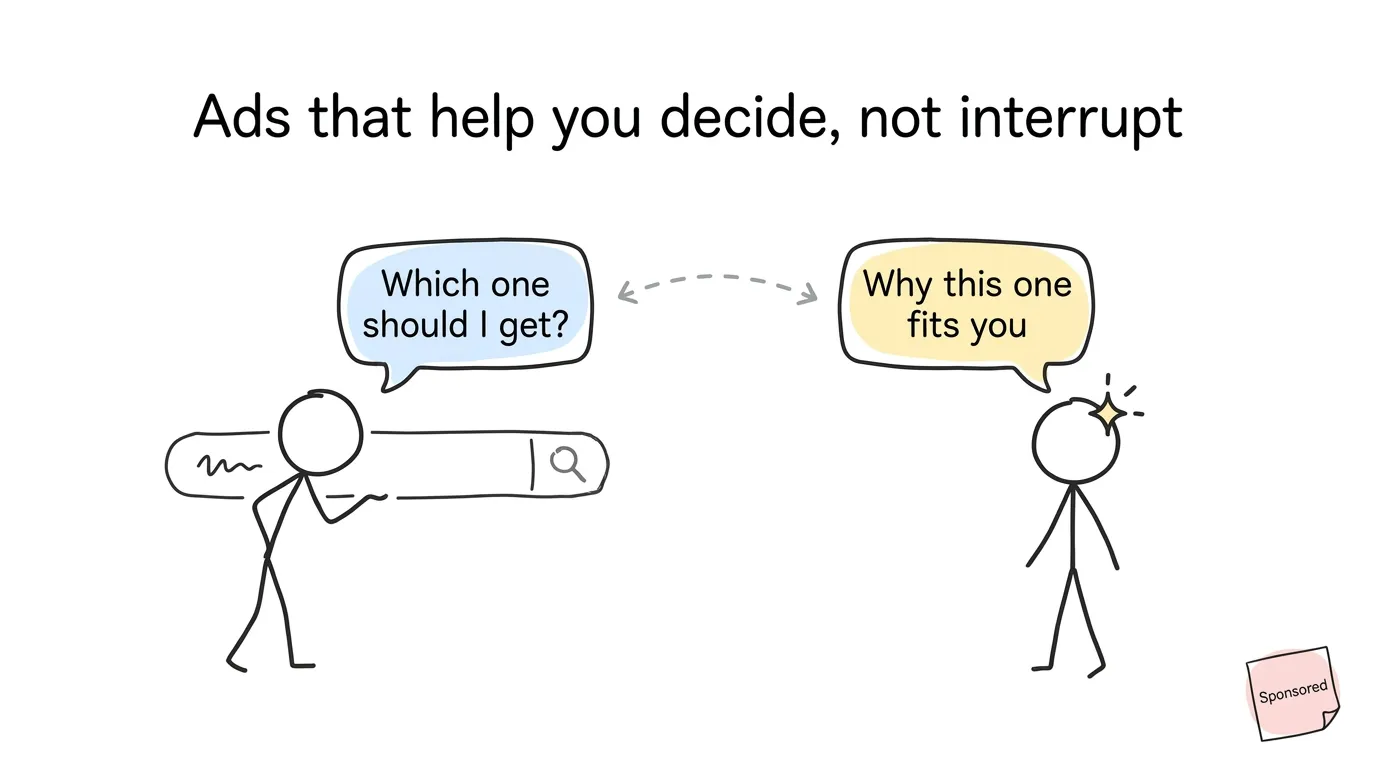
A few days ago, I was at home researching something small: buying an espresso machine.
This stuff isn't cheap — several thousand yuan. Buy the wrong one and it becomes kitchen décor, a very expensive ornament. The old me would have searched for a pile of reviews, opened ten tabs, and ended up more confused than when I started.
But that day, I casually asked: espresso machines under 4,000 yuan, for two people, nothing too bulky — which one should I get?
Right there in the search box, an AI gave me a whole breakdown. Which machine had the most stable boiler, which one ground coarse, why a particular model suited me.
It made a compelling case.
Then, at the bottom of the page, I noticed some small print: Sponsored.
An ad. This was an ad.
Good grief. I had read the whole thing willingly.
That episode stayed on my mind. This past May, Google announced at its marketing conference that it was wedging Gemini into search ads — rebuilding the ad from the ground up. Let me take it apart for you.
What Are "Ads That Can Chat"?
First, a number.
In late 2025, Google commissioned Ipsos to run a survey covering 25 countries and more than 13,000 online shoppers. The result: 75% said that shopping through AI Mode — searching with AI — made their decisions faster and left them more confident.
AI Mode is that assistant inside Search that answers you back and forth, question by question.
Before, you searched "espresso machine" and got ten links. Now you search "espresso machine" and get a knowledgeable friend to talk it over with.
The person changed, so the ad has to change too. Think about it: you're mid-conversation with the AI, and the ad is still standing off to the side, holding up a sign?
What Google figured out has taken shape as two new ad formats now in testing.
The first is called Conversational Discovery ads. In plain language: ads that can chat.
You ask it: "I want my home to smell like a luxury hotel, or a forest after the rain. What's the easy way to do that?"
In the past, the ad didn't care what you asked — it shoved its banner in your face all the same.
Now, Gemini generates an answer on the spot, built around your question, and focuses on why a particular diffuser might be right for you: sandalwood core, three intensity levels, a timer.
Whatever you ask, that's what it answers.
The second is called Highlighted Answers.
You ask in AI Mode: "I'm planning a trip to Tokyo — which app should I use to learn Japanese?" The AI hands you a list of recommendations. At that moment, a highly relevant ad has earned the right to appear inside that list — as a highlighted answer.
A list can also be a shelf.
An "Expert Friend" Standing in the Ad
These two formats share something in common, and to me it's even more worth pondering than the formats themselves.
Both come with an "independent AI explainer."
What does that mean?
Gemini first evaluates and organizes the publicly available information about a product or service, then places that "objective briefing" right alongside the merchant's own creative.
Put simply: it's like standing at a counter listening to a salesperson's pitch, while next to you stands an expert friend who doesn't work for the seller and only tells the truth.
A good ad is confident for one reason: it can stand up to follow-up questions.
Of course, the rules haven't gone anywhere: these ads still carry a clear "Sponsored" label. Transparency is the price of admission to this whole shift.
Big-Ticket Purchases and "Customer Service" Are Changing Too
That May announcement included two more things headed for ordinary Search.
One is AI shopping ads.
When you buy something big — a refrigerator, a TV, an espresso machine — what do you fear most? Choosing wrong. Search for an espresso machine, and Gemini pulls out the most relevant products and writes, on the spot, an explanation of "why this one might be right for you."
And that's exactly how my story from earlier happened.
The other is called Business Agent for Leads — a chat agent for merchants.
In the past, if an ad caught your interest, you filled out a cold, impersonal form. Now the ad has an AI built in that knows the business, answering questions on the spot based on the merchant's own website. A student researching universities clicks "chat" — majors, tuition, housing — ask anything, get an answer.
The form becomes a conversation.
And an undecided visitor becomes a warm lead.
Deals, Delivered Straight — and Shipped Too
There's one more line of work you may have missed: Direct Offers.
This pilot started in January of this year, with brands like Chewy, Gap, and L'Oréal taking part — handing shoppers highly relevant offers as they browse. In May, Google announced an expansion.
The variety of offers grew. Discounts, free gifts, local coupons — all can be uploaded to Google Ads, then aimed at the right audience through AI Brief. Gemini assembles the best-fitting combination on the spot for the search at hand — say, a bundle price on a set of highly relevant products.
Paying got faster, too. Merchants connected to the Universal Commerce Protocol (UCP) can let you check out natively inside Search. See it, buy it — no bouncing between pages.
Travel is coming along as well. Platforms like Booking and Expedia plan to put exclusive offers inside the trips AI helps you plan.
Before long, these offers will grow naturally into AI Mode's answers. You're chatting away about your itinerary — and there the offer sits, waiting for you.
The Advertiser's Homework
So what are advertisers supposed to do?
Google puts it plainly: pour the foundation first. AI Max for Search, AI Max for Shopping, Performance Max — these need to be up and running.
The new formats are the building. If the foundation is shaky, the building has nothing to do with you.
Finally, My Own Take
Coming out of this announcement, my strongest impression is this: the definition of advertising is being rewritten.
The old ad fought for attention. Your eyes were on the content, and it insisted on squeezing itself in.
The new ad races to help you decide. Right when you need an answer, it gives you one — along with an explanation of why.
The endgame of advertising isn't exposure. It's advice.
This isn't a matter of swapping in a few formats. It's marketing logic switching tracks: from interrupting people to helping them.
Back to that espresso machine. That day, an ad won me over — and I didn't resent it, because what it answered happened to be the very question I had.
Of course, the expert friend may be standing there because someone paid. How long an "independent explainer" stays independent, and how honest that "Sponsored" label really is — that remains to be seen.
But the direction is already clear: whoever does the best job of helping people decide wins the next era of search.
Here's my wish for you: the next time an ad moves you, may the line that moved you have truly helped you.
Continue reading
Related articles

What Is GEO? How Your Brand Gets "Mentioned" in the Age of AI Search
An explainer on GEO (Generative Engine Optimization) for e-commerce and DTC brands: how it differs from SEO and AEO, why AI answers shape brand visibility, and eight practices covering question-focused content, consistent brand messaging, structured pages, external evidence, comparisons, and AI mention tracking.

AI Is Already Making Decisions for Your Customers. Are You on the List?
A learn article explains GEO (Generative Engine Optimization): why AI-generated answers now shape which brands customers see, and how SEO fundamentals, entity clarity, citable evidence, and monthly measurement affect visibility in AI answers.

Google Is Stuffing Ads Into AI Search: These Recent Stories Are Really One Story
A news roundup linking recent AI marketing stories—Google adding ads to AI Mode, Amazon's Ads Agent, ChatGPT image updates, a UK startup tracking brand mentions in AI answers, and an AI ransomware warning—arguing that control over ad data and visibility is shifting toward platforms.