
Can AI Write Good Copy? Someone Had 1,000 Consumers Blind-Test 8 Emails
Deloitte Digital had 1,000 US consumers blind-test eight emails written by two copywriters and two AI models for a fictional athletic brand. AI emails rated higher on average, but human copy won among high-intent readers; the article recommends AI as an assist for drafts, insights, and risk control.
A while back, I came across an experiment whose results had me staring at my screen for a long time.
The team behind it was Deloitte Digital, the digital experience arm of Deloitte. They wanted to answer one question: can AI actually write marketing copy?
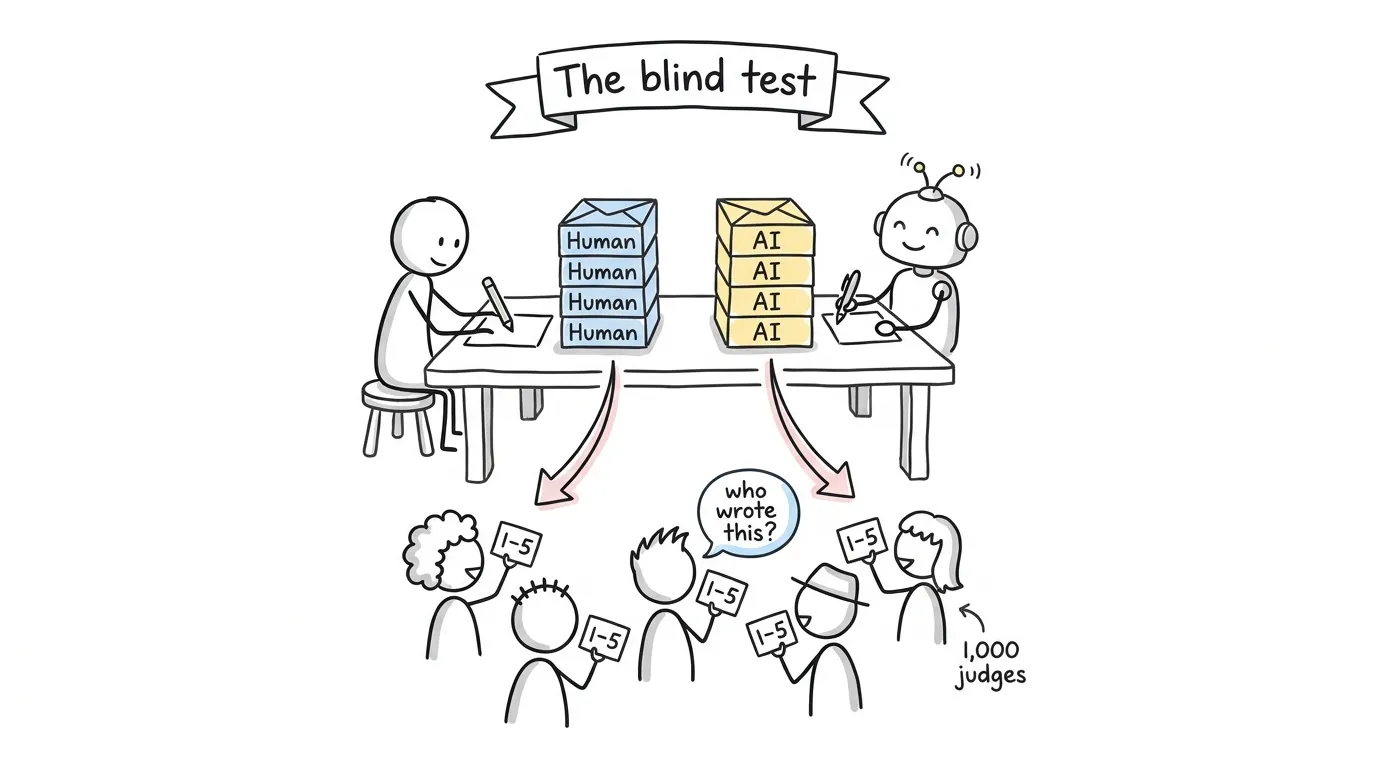
Not the empty kind of debate where one side says "I think it can" and the other says "I think it can't." They staged a real head-to-head contest—and recruited 1,000 ordinary consumers as judges.
The results were fascinating.
First, Why Everyone Is So Torn About This
For marketers, GenAI (generative AI) is a love-it-and-fear-it kind of thing.
What they love is the potential: faster content production, sharper personalization, more output from fewer people.
At the end of 2024, Deloitte Digital ran its own survey of marketing leaders: 29% of brands were already using GenAI in their marketing operations. Of those, 41% said content production costs had come down. And the deep users, on average, beat their revenue targets—by 22%.
Think about that: beating targets by 22%. What a hook.
What they fear is a different set of questions—none of which has an answer yet:
Large language models are trained on the world's corpus—can they really capture your brand's one-of-a-kind voice? Will what AI writes actually land with real customers? And once you plug it into your team and workflows, will it amplify the capabilities you already have—or slowly grind away the hard-won craft you've built up?
Until now, these questions were mostly settled by guesswork. Some said yes, some said no, and nobody could produce evidence.
So Deloitte Digital essentially said: let's just run an experiment.
How the Contest Was Designed
What makes a contest fair? Both sides play with exactly the same cards.
In 2025, they brought in two experienced marketing copywriters and picked two top-tier large language models. Then they handed both sides the exact same brief: a creative brief for a fictional athletic apparel brand, aimed at two audiences—existing customers (baby boomers) and new customers (millennials). The brief also included a few passages on audience psychology, a set of brand-voice keywords, and the action they hoped readers would take afterward.
The assignment: for each audience, write two emails—one promoting the membership program, one promoting a 25%-off sale. Two copywriters, two models, eight emails in total.
Note one detail: that's all the information the copywriters and the models got. No brand history, no product lines, no past campaign classics—nothing. And the two copywriters knew they were part of some evaluation, but not how it would be judged or by whom.
Why design it this way? Because the less information you give, the closer the playing field between humans and AI. The point of the contest was to see what happens on a perfectly level starting line.
Then, the Blind Test
The 8 emails, untouched, went out to 1,000 American consumers, ages 18 to 78—a demographically representative sample, with the survey administered by a third-party firm.
What's a blind test? The consumers had no idea whether the emails were written by humans or AI—they didn't even know a test was happening. They simply received emails and rated them on a scale of 1 to 5.
There were six scoring dimensions: Does this email feel personal and authentic? Is it relevant to my interests? Does it read smoothly? Is its purpose clear? Is the next step obvious? And the most important question of all: after reading, how much do you actually want to buy, or sign up for the membership?
The first five dimensions measure how well it's written. The last one measures whether it works.
Round One: AI Wins
Wow—let's get to the verdict first.
Across the first five dimensions, consumers rated the AI emails 4.5% higher on average than the human-written ones.
The biggest gap was "personalization": AI emails scored nearly 7% higher. Can you believe it? A model that knew nothing about the users produced emails that, in the eyes of real consumers, felt more like "this was written for me" than the work of veteran copywriters who've spent years in the industry. The smallest gap was readability—1.3%, basically a tie.
AI won on intent to act, too: after reading the AI emails, consumers' desire to buy or sign up was 3.1% higher on average. That preference held across both types of promotion and both audiences. Millennials actually preferred the AI-written emails by a clear margin; older consumers stood firmly with the humans on just one dimension—how smoothly it read.
At this point you might be wondering: so can copywriters just clock out?
Not so fast.
But There's Always a Flip Side
The real reversal hides among the "high-intent" respondents.
What does "high intent" mean? People who, after reading, clearly scored 4 or 5—signaling "I'm very likely to buy or sign up."
Among this group, human copywriters won decisively.
Overall, human emails were 6.4% more likely to earn high action-intent scores than AI ones. And in two subsets—"millennials rating signup intent" and "boomers rating purchase intent"—the gap approached 20%. That was the largest gap found in the entire study.
Wait—didn't AI lead on intent by 3.1%? How did it flip for this group?
The reason is fascinating—and deeply human: AI's writing makes people go "it's fine." Human writing makes people react.
After reading an AI email, the reaction is: hmm, pretty good. Pretty good. You don't hate it, but it doesn't move you either.
The human-written emails, meanwhile, provoked two extremes: either genuinely moved, ready to pay on the spot—or so put off they wanted to hit "report spam." The scores polarized. But that top segment of people who "love it enough to order"—AI couldn't reach them.
Think about whether this mirrors life around you. Between the safe, inoffensive person nobody can dislike, and the sharp-edged person some adore and some can't stand—who actually walks away with a band of die-hard fans? Usually the latter.
AI wins on "good enough." Humans win on "nothing else will do."
Now, the Efficiency Ledger
On this ledger, AI wins even more decisively.
A human copywriter spends an average of 4 hours on one email. AI? An engineer types out the prompt (the instruction given to an AI model), and a draft is ready in minutes. All 8 emails written, and the total token cost—the usage unit AI models bill by—came to under 1 US dollar. Per email, that's less than one yuan, roughly 15 US cents.
Four hours, versus a few minutes—and less than a dollar.
The numbers are right there. Nothing to argue about.
But don't rush the coronation just yet. This contest had one crucial limitation—and understanding it is the key to using AI right.
Remember? The brief given to the copywriters and models was painfully thin—it didn't even include the brand's history.
In the real world, even a copywriter hired yesterday knows more about the brand than that. Behind them sits a creative director reviewing drafts, a marketing manager who knows the product, and a collaboration-and-iteration process that's been running for years. Real marketing content grows out of that thick layer of context.
What this experiment tested was the extreme scenario of "writing an email cold, in an information vacuum." AI holding its own—even edging ahead—in an extreme scenario doesn't mean it will conquer everything in your real work.
So How Should AI Actually Be Used?
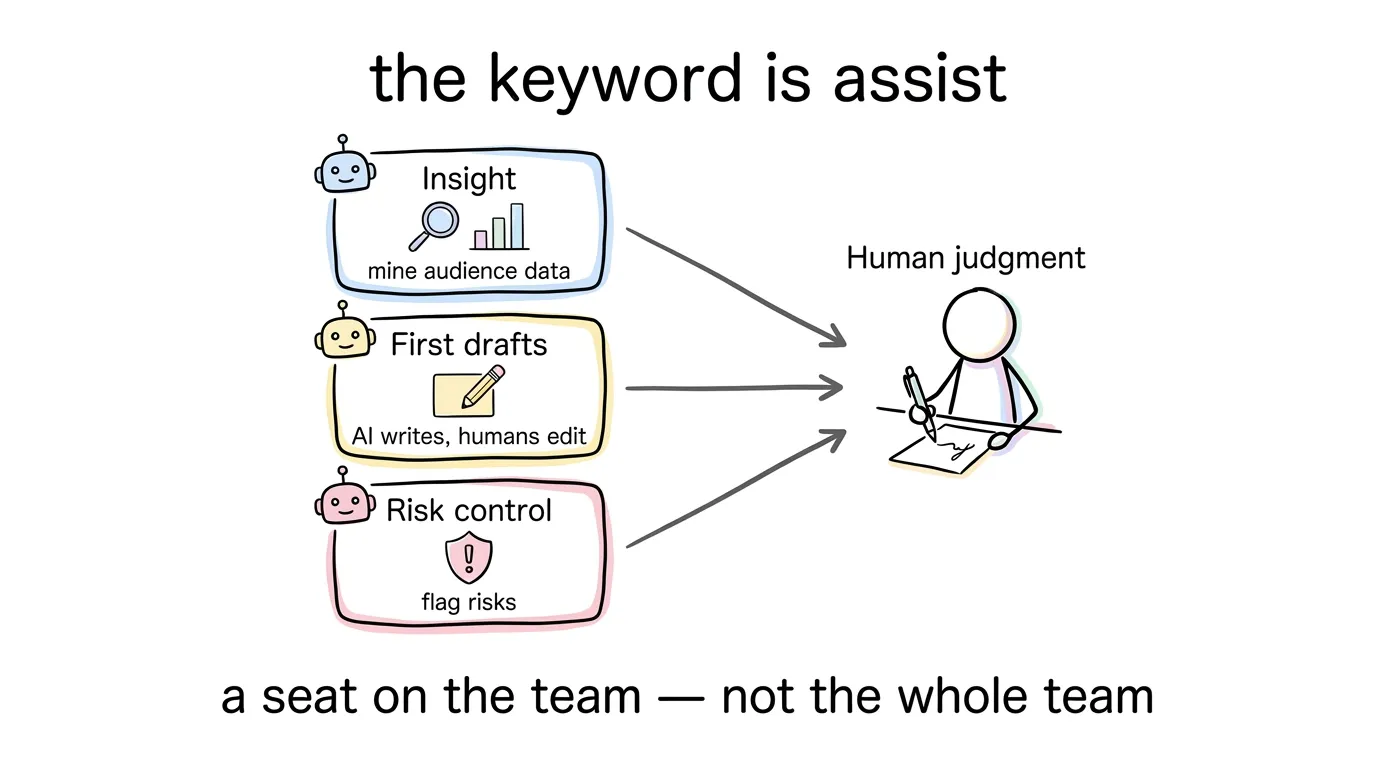
Deloitte Digital's answer, I think, hits it exactly: in every GenAI use case, the keyword is "assist."
Concretely, three places:
First, insight. Let AI mine advertising, media, and customer data for nuanced audience and market insights. The prerequisite: you need a decent data analytics system in place.
Second, first drafts. This experiment proved AI delivers a quality first draft. Let it write the draft, let humans edit, and efficiency takes off immediately.
Third, risk control. Feed your brand guidelines and compliance requirements to AI, and let it watch your marketing activity, flagging risks as they arise.
What do they have in common? None of them lets AI handle the whole job alone.
You wouldn't let a copywriter's draft go out with zero review, right? So why expect AI to single-handedly produce the best insights and content?
AI deserves a seat on the team. But AI is not the whole team.
Because in the end, innovation and growth grow out of "how people use tools." The things that define your brand's differentiation—user trust, contextual understanding, empathy—are still supplied by humans.
If You're Ready to Get Started
Start by asking yourself four questions:
- Which GenAI use cases can genuinely speed up my content production, or improve my marketing's relevance and impact?
- What training and incentives does my team need before they'll actually adopt AI—and use it well?
- How do I train and monitor the models so their output complies with regulations, strategy, and brand voice?
- How do I make sure everyone uses approved tools—rather than someone quietly pasting company-sensitive information into some AI of unknown origin?
That last question is happening right now at plenty of companies. Worth checking at your own.
Finally
Back to the blind test we started with.
1,000 consumers, 8 emails, a dead-even contest. AI proved it has earned a seat at the table, right beside the copywriters.
But that near-20% gap also reminds us: the stroke that truly makes people sit up and pull out their wallets still comes, for now, from a human hand.
AI is ready. Is your marketing organization ready?
May you find your AI partner soon. And may you always be the one who provokes the strongest reaction—no matter who the opponent is.
Continue reading
Related articles

What Is AI Marketing Automation? It Starts With a 40-Point Gap
A learn article explaining what AI marketing automation is: how learning-based systems differ from rule-based automation, how AI decisioning optimizes message, channel, and timing choices, what data it depends on, and where it applies across the customer lifecycle.

Marketing Automation Is Shifting from "You Do It" to "You Say It"
This article explains how marketing automation is shifting from rule-based platforms that merely execute toward AI agents that plan, create, publish, and review campaigns, covering delegable tasks, underlying technologies, tool categories, adoption steps, and risks such as privacy and automating without strategy.

Rankings Are Taking a Dive, Customers Are Sprinting Ahead: This November, I Re-Ran the Numbers on AI Search
A learn article on how AI search reshapes marketing measurement, covering reported mismatches between rank-tracking tools and live Google results, ChatGPT's business profile test, single-page visitors as high-intent leads, and CRO plus GA4 tracking verification practices.