
AI Marketing Daily · 2026-11-14
AI Marketing Daily for 2026-11-14 rounds up 20 items on measurement gaps in AI marketing: agent conversion attribution, Meta's device-side measurement default, Google Ads updates, GEO tactics, and the EU Digital Fairness Act proposal.
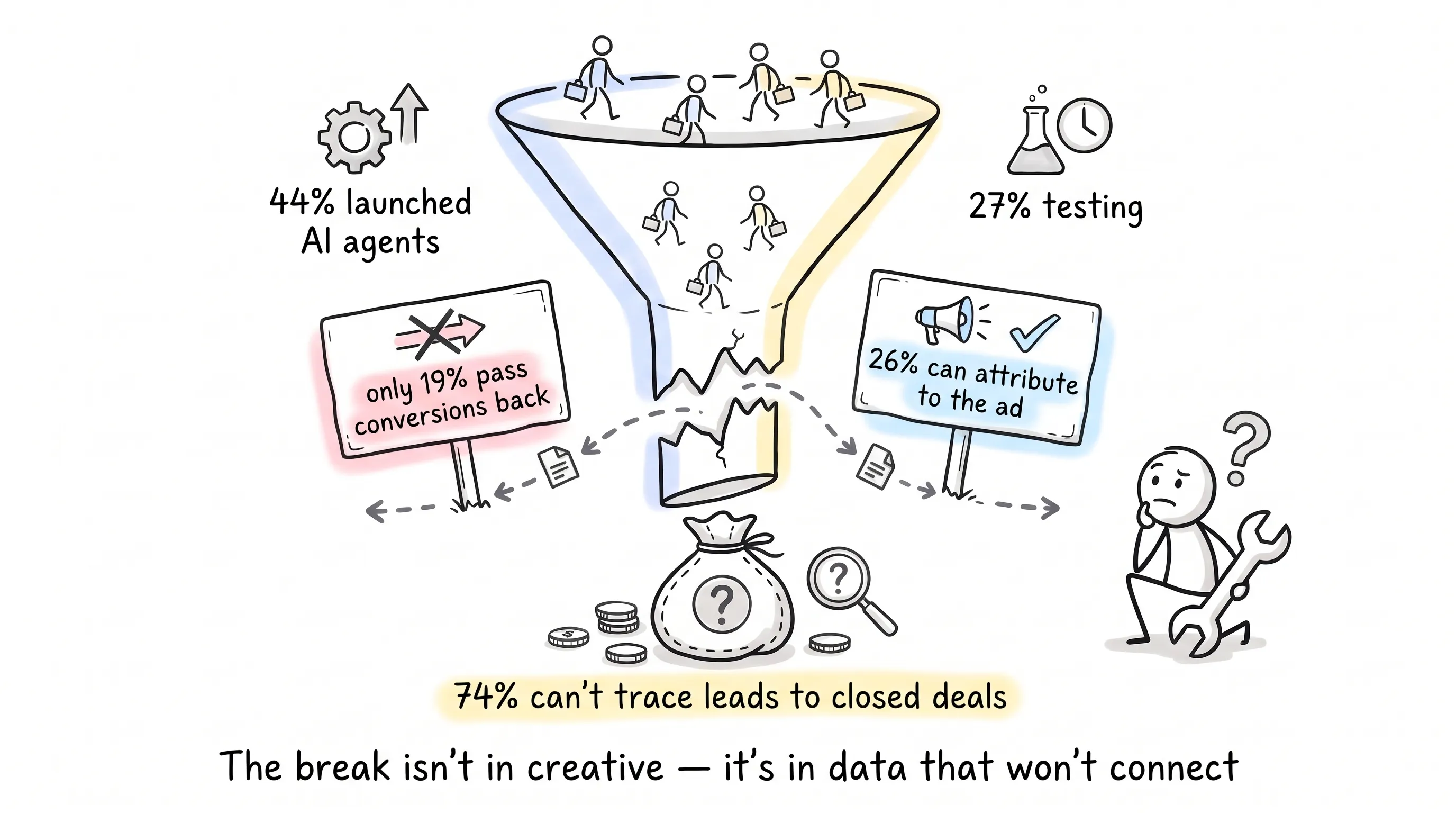
The theme today is measurement. AI agents are being deployed fast and accounted for badly: 44% of B2C marketers have already put one in front of customers, yet fewer than two in ten can pass conversion data back. Meta is changing how conversions are counted, Google is putting video ads' contribution in numbers for the first time, and the EU went straight to writing rules for agent shopping. All three lines point at the same thing: where the money goes and who gets credited for the results — the rules are being rewritten. Twenty items follow, each with an action you can take.
🎯 Today's Top Story
44% of B2C Marketers Have Already Launched AI Agents — Only 19% Can Account for the Conversions They Drive
What happened
Invoca has released its 2026 Broken Funnel Report, based on a September–October survey of 451 US marketers, all from companies of 100+ employees, spanning five industries: home services, healthcare, finance and insurance, automotive, and telecom. The result is a steep drop-off curve: 44% of B2C marketers have already launched a conversational AI agent on at least one channel and 27% are testing, but only 19% can reliably pass agent conversion data back to their ad platforms, and only 26% can attribute an agent conversation to the specific ad or keyword that brought it in. The measurement criteria are a mess too — only 27% use revenue or closed deals as their primary metric, while the rest of the teams look at satisfaction, conversation volume, containment rate (share of conversations resolved without a human handoff), or service cost. Those metrics can tell you whether the agent is busy. They cannot tell you whether it's making money. The timing is worth noting as well: the sample was collected in September and October, right in the middle of the recent wave of agent product launches — meaning the 44% launch rate is only the first half of this surge.
Why it matters
What makes this report solid is that it puts a number on a structural problem. Agents can answer questions, qualify leads, and nudge customers toward a purchase — while the systems that manage media and attribution have no idea any of it happened. 74% of marketers cannot trace a lead from its first digital touchpoint to a closed deal. The funnel was already leaky; now agents have stacked a brand-new break on top of the old ones. In other words, when it comes to 2026's hottest deployment play, most companies can't even say whether they've recouped their costs. The report calls this the broken funnel — the break isn't in creative or bidding, it's in data that won't connect.
What it means for marketers
The breaks follow a clear pattern. When a lead reaches a dealer, franchisee, or local store, 56% of attribution breaks; SMS and chat lose 46%, phone loses 40%. Only 21% of marketers can see and influence the lead's full journey. Customer experience suffers too: only 27% of agents can read a customer's prior digital trail, so someone who has already researched the product — maybe even already spoken to sales — is still a stranger to the agent. Marketers know it themselves: the most-demanded improvement is letting agents tailor conversations to the customer journey, picked by 43% of respondents, and 41% want agents to recognize returning customers and put their history to use.
There's also an easily missed signal on the front end: 44% of respondents say AI answer engines like ChatGPT, Claude, and Gemini deliver their most qualified leads — ranking first, above Google Local Services Ads at 40%, organic search at 39%, and paid social at 37%. That ranking would have been unthinkable two years ago. It means the best-quality lead entry point has moved into AI conversations, and most teams' budget spreadsheets haven't caught up. Meanwhile 86% can at least identify some leads coming from AI answer engines — visibility exists at the entrance, then evaporates bit by bit as the lead moves toward phone calls, stores, and sales conversations.
How to act on this
Three steps, all startable this week. First, wire agent conversations into your CRM and attribution stack as events — at minimum, make conversation IDs linkable to downstream closed deals; that's the direction the report's remediation points to. Second, change the scorecard: swap the agent's primary metric from conversation volume to revenue and closed deals, and demote satisfaction and containment rate to supporting indicators. Third, baseline before you launch any new agent — otherwise, once it's live, you can't tell whether the movement is performance or just a change in how things are counted. Teams in e-commerce and local services should add one more step: pipe closed-deal data back from stores and dealers, because that's exactly where 56% of attribution breaks. The teams that do these three things will walk into their 2027 budget defense carrying attribution evidence nobody else has.
My take
The first half of the deployment race is basically over; the conclusion is that everyone can build agents. The second half is wiring — connecting what the agent knows, what the customer does next, and who finally paid into a single line. Not many teams have that line connected yet, so there's still a window to move. The measurement vacuum carries a hidden cost too: agent purchasing decisions are being built on proxy metrics, and satisfaction won't sustain a renewal case. When Invoca publishes next year's report and 19% becomes 60%, the first-mover advantage is gone.
🔗 Further reading: Read the full article
🏷 Agents & Workflows
MarTech Conference Roundtable: Fix the Workflow First, Then Automate
A November roundtable at MarTech Conference delivered a team-governance checklist for the agent era; live polling showed 51% of organizations piloting AI. Four takeaways worth copying line by line. First, document the reasoning behind decisions — layoffs and team cuts are draining institutional knowledge, and an agent will never know why the brand avoids certain phrasing or what history a long-standing client carries unless the team deliberately captures that context. Second, the order matters: fix the workflow before automating tasks, otherwise you're just using AI to amplify a broken process. Third, keep judgment that happens face to face with customers in human hands — pricing, apologies, and sensitive communication belong to people, while agents handle research, reporting, and first drafts. Fourth, build quality checks and governance into the system itself, not as an after-the-incident patch.
💬 Suggested order of execution: this week, write each of your three most consequential media-buying decisions from the past 90 days as a one-page decision rationale, and feed them to your agent as context. The quality of this step directly determines whether everything you automate afterward is trustworthy.
🔗 Further reading: Read the full article
Supermetrics Field Notes: The Agent Can Start the Job — Just Don't Leave It Unsupervised
Supermetrics has been building agent data access into its own platform since February 2026, and the value of this retrospective is its candor about limits. The numbers are cold: McKinsey counts 62% of organizations experimenting with agents, yet scaling beyond 10% in any single function; Supermetrics' own 2026 State of Marketing Data report shows 80% of marketers feeling adoption pressure, with only 6% having agents fully embedded in their workflows. The line between agents and fixed automation: automation executes decision logic someone else predefined, while an agent decides for itself how to reach the goal — which is exactly why it needs a different kind of delegation. The article lays out a delegation ladder: first have the agent run diagnoses — and specifically diagnoses where you already know the answer — to verify its reasoning quality; then let it build reports and make recommendations; only last, create or stage campaign changes inside a controlled workflow. Any action that touches spend must sit behind permission and approval gates.
💬 Don't let the agent near your budget just yet. Take a performance-decline report where you already know the conclusion, have the agent independently work through the causes, and only discuss further delegation once its answer matches yours. The whole test takes half a day.
🔗 Further reading: Read the full article
MarTech Q4 Roundup: AI Went Into Every App — the Result Is Smarter Silos
MarTech's Mike Pastore published a quarterly roundup in mid-October that distills dozens of reports and practitioner interviews into three throughlines. First: AI is ubiquitous but its value isn't unlocked — consensus clusters around the single use case of content creation, while the disagreement is all about ROI and organizational impact. Second: every app now has AI built in, producing smarter silos — data lives inside each vendor's AI with no coordination, and systematic workflow integration is the precondition for unlocking the value. Third: the time teams spend fixing AI problems has itself become a new hidden cost, and the pace of model iteration is rapidly obsolescing prompt assets and processes, so governance and evaluation must become ongoing practice rather than a one-time project. If the data isn't trusted, the output won't be trusted either — the hardest line in the whole piece.
💬 Advice for leadership: in next year's budget defense, stop reporting how many AI tools you deployed; report how many hours you spent fixing AI output instead. Almost nobody tracks that number today, so the first person to report it wins on the measurement criteria.
🔗 Further reading: Read the full article
MEF Retrospective: The 2023 Predictions — Which Ones Came True?
On November 10, KOMPaaS.tech's Liubov Martynova published a piece at MEF holding 2023's popular predictions up against the reality of 2026. The claims that 80% of marketing content would be AI-written within three years and that copywriting jobs would vanish by 2026 did not pan out as advertised. Her test is worth writing down: AI takes solid root where work can be verified and constrained, and keeps stumbling where the work is expected to run independently. On the landed side: AI first drafts are now the default starting point of production; the editor's role has shifted from writing to reviewing and fact-checking, and revising hasn't saved much time over writing from scratch; the cost of generating creative variants has fallen to nearly zero, so A/B testing's bottleneck has moved from producing versions to insufficient traffic and not enough analyst capacity to interpret results; personalization has shifted from dozens of predefined audience segments to real-time assembly based on what the user is doing right now. On the not-landed side: capabilities expected to run independently — autonomous media buying, fully automated strategy — mostly remain at keynote-demo stage, unable to clear the three gates of budget, legal, and consumer trust.
💬 Use this test to screen any new AI capability before you buy: if the work can be verified and constrained, you can buy it; if it needs to operate independently, treat it as a demo — and don't pay annual-contract money for a demo.
🔗 Further reading: Read the full article
🏷 Platforms & Media Buying
Google Ads 2026 Change Tracker: Two Switches to Flip Before BFCM
Common Thread Collective's weekly tracker is aimed at e-commerce, and two changes from early November land squarely in the action window before BFCM. On November 3, Attributed Branded Searches went live — free and on by default, under Goals → Summary → Consideration — tracking how many users searched your brand after seeing a Demand Gen or YouTube video ad. For the first time, the upper-funnel contribution of video ads has a free, hard number, so budget defenses no longer run on storytelling alone. On November 2, PMax gained campaign-level exclusions by household income via API v26.1 — premium brands can now exclude lower-income tiers, a small step of targeting control handed back to advertisers. Two legacy risks remain on the books: since October 25, PMax's Sourced videos are on by default, automatically pulling up to 10 videos from social media, landing pages, and YouTube — your active campaigns may already be running creatives you never reviewed; and after the October 26 privacy policy update, opt-in Gmail data can influence ad targeting for the first time.
💬 Three things this week, in order: first, turn on Attributed Branded Searches so the data starts accumulating; second, audit Sourced videos on every active PMax campaign one by one; third, premium brands, set up the income exclusions. Every day you delay before BFCM is a day less of baseline.
🔗 Further reading: Read the full article
Meta's October Changes in Full: Half Product Launches, Half a Fight Over Control
Adsuploader's Meta Ads tracker, updated through November 1, is an 81-minute read that splits October into two halves. The first half was launches: on October 6 at Advertising Week, static-to-video became officially available inside Advantage+ creative, and a commerce AI assistant entered testing that can modify campaigns on your behalf. The second half was control and contracts: from October 8, ads from ByteDance are banned across seven countries including the US, along with any third-party ads that funnel to TikTok; on October 28, the product-browsing feature was turned on by default for existing ads — only an opt-out turns it off; age and gender targeting arrived at the single-creative level; and device-side Pixel conversion measurement was set to turn on by default on November 12. That same day, Meta's new advertising terms were forced into suspension after publishers objected to the website-scraping and AI-liability clauses; two days later, the UK competition regulator CMA opened an investigation into Meta's commercial terms.
💬 The seven-country ban hits ad structures that lean on TikTok referral traffic and creator distribution plans hardest — rework them this week, before your account receives a disapproval notice. Product browsing is a default that silently withholds reach: accounts that don't act are being siphoned into Meta's own closed loop right now.
🔗 Further reading: Read the full article
Meta in November: What Changed Is the Measurement Methodology, Not Your Buying Power
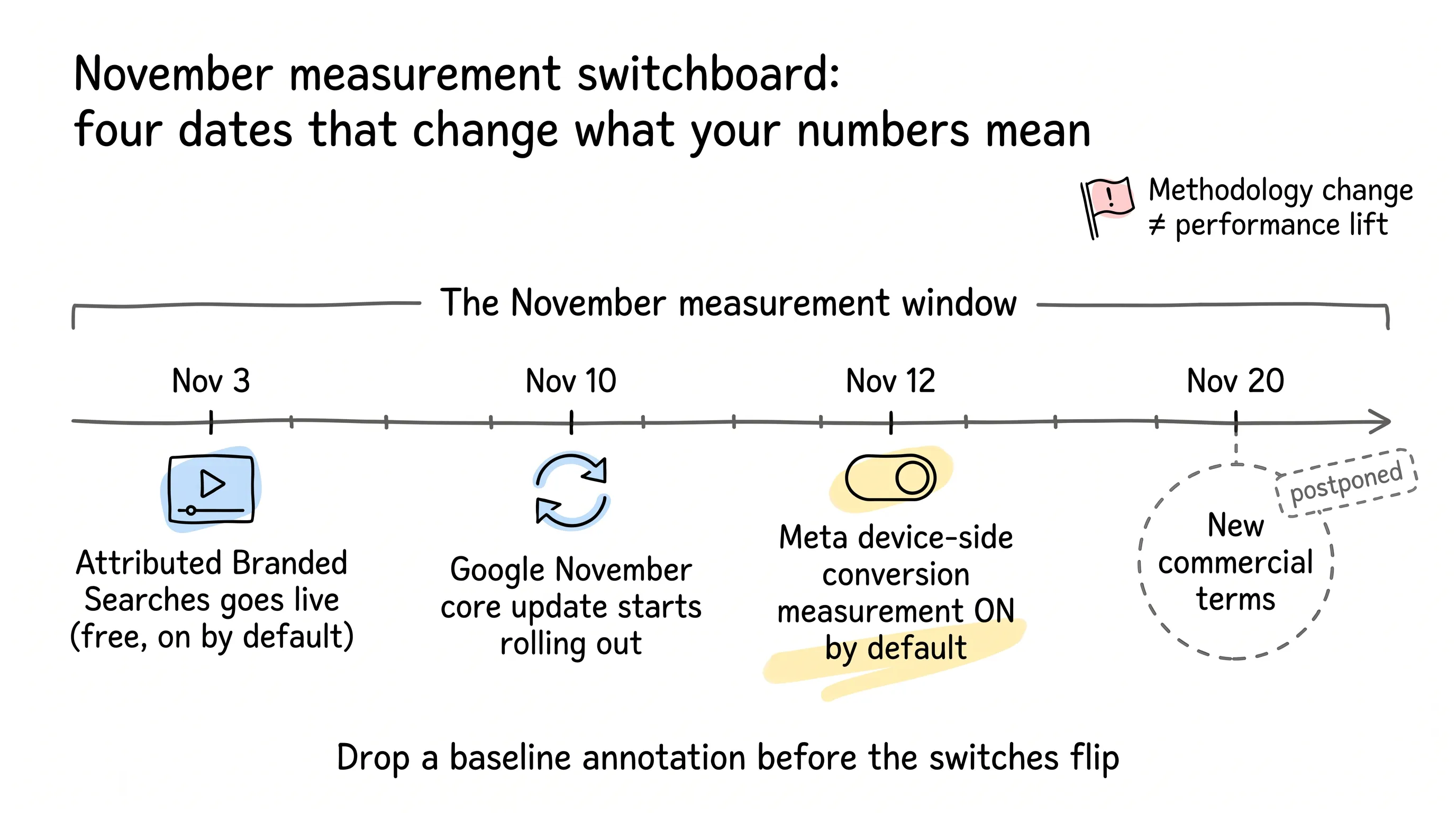
On November 2, admanage.ai's Cedric Yarish re-checked his Meta change log with one point of emphasis: this month's biggest change isn't in how you buy ads, it's in how your results get counted. Starting November 12, the Pixel setting that measures conversions on the consumer's own device is on by default for datasets with already-sent events, and each dataset can opt out individually. The new Commercial Terms, originally set to take effect November 20, were postponed after publishers objected to the website-scraping and AI-liability clauses. Products announced at the October 15 brand-building summit are now labeled across three distinct states: Super Burst has entered phased general availability; First Impression Ads is a US test; Reels Trending Ads is scaling; Aggregated View Time is still in alpha. An announcement, a test, and account-level availability are three different things. The author's biggest warning sits at the interpretation layer: once device-side measurement is on, reported purchases may rise — until verified against backend order data, treat that as a change in measurement, not a lift in performance.
💬 Two steps to prevent misreading: before November 12, drop a baseline annotation on your dashboards; afterward, reconcile every conversion movement against backend order data before it goes into any retrospective. Report a methodology change as a performance change, and Finance will come asking.
🔗 Further reading: Read the full article
SocioSquares Weekly: AI Mode Multi-Turn Ads Arrive, ChatGPT Ads Auto-Edit by Default
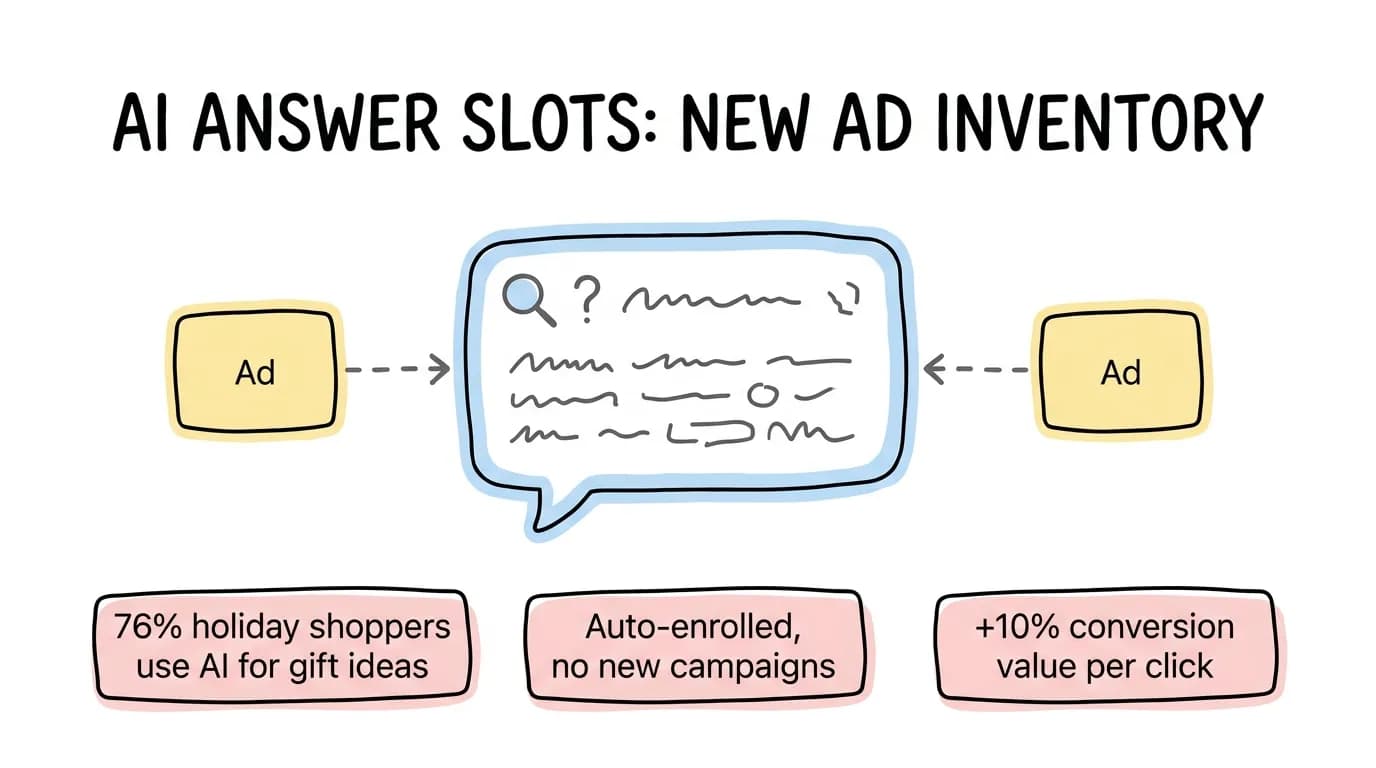
(No full text captured for this item; written up from the summary.) SocioSquares' weekly places three platform-power shifts from October 26 to November 1 on one timeline. On October 28, Google launched ads on AI Mode follow-up questions in the US — the second and third follow-ups within a conversation now carry ads labeled Sponsored, formally opening conversational search as ad inventory; the same day, Google admitted to investors that AI Mode's revenue per ad runs below classic search, and expanded AI Mode to 10 new markets. From October 30, ChatGPT ads have auto-editing on by default — advertisers must actively opt out to keep control of their creative. That same week, Google, Microsoft, and OpenAI jointly announced they would honor robots.txt settings that block site content from being used for AI training.
💬 A platform expanding inventory while admitting its unit price is lower: that's a rare window of negotiating leverage for advertisers — bring it into your renewal talks. And check the auto-editing toggle on your ChatGPT ad account today, because the default no longer sits on your side.
🔗 Further reading: Read the full article
The Meta Playbook 2026: Creative Is the Targeting
Simple Search's 2026 edition of Meta Ads best practices, updated in November, makes a tightly focused argument: now that Meta's AI has taken over targeting, placements, and even part of the creative, the levers left in advertisers' hands are data and creative differentiation. Three moves. First, fix the data: run Pixel and Conversions API in parallel with deduplication, raise your Event Match Quality, and optimize for purchases or qualified leads — not link clicks. Second, open up broad targeting and let genuinely differentiated creative concepts do the audience segmentation: ten near-identical ad variants is not a test; different people-and-product pairings, problem-and-outcome angles, video-versus-static — those count. Third, audit your AI creative guardrails: since July, Advantage+ creative has rewritten on-image text and generated headline variants by default, and without brand guardrails in place you've simply handed over control of your copy. One easily missed line in the change timeline: Threads is now a default placement — if you don't plan for it actively, your ads will run there anyway.
💬 Two defaults to check this week: the brand guardrails in Advantage+, and the share of budget going to the Threads placement. The first is about brand safety; the second is money currently being spent on your behalf, passively.
🔗 Further reading: Read the full article
🏷 AI Search & Content
MarketingProfs Weekly: ChatGPT Search Volume Reaches One-Fifth of Google's
MarketingProfs' weekly AI edition attaches a "what this means for marketers" note to every item — high information density. OpenAI self-reports that ChatGPT's search volume has reached 20% of Google's — the count covers requests that triggered web search, and no comparison method was disclosed, so take the number with a grain of salt; still, the magnitude can no longer be ignored. Digiday interviewed 18 media buyers who broadly question the incremental value of the 10–20% (or more) premium inside Google search budgets; with CPCs rising and attribution shifting, part of the budget is flowing to paid social and YouTube. Reuters reports that AI shopping agents threaten the retail media businesses of Amazon and Walmart, which together hold 88% of the US retail media market — and the two are taking opposite routes: Amazon resists unauthorized agents, while Walmart is building infrastructure to support them. Microsoft Clarity launched Agentic Analytics, which can track which AI agents visited your site and what they accomplished there. The four major model providers jointly endorsed the robots.txt signal for opting content out of AI training — Anthropic is already complying, and OpenAI says it will follow within months. An advocate-general of the EU Court of Justice has issued an opinion that Gemini reproducing protected expression could infringe publishers' rights; the ruling is expected within months.
💬 B2B teams, add one line to your reports this quarter: share of leads sourced from AI channels. However small the number, record the baseline now — when it grows, you'll be holding a trend line while everyone else holds a feeling.
🔗 Further reading: Read the full article
Search Engine Land's Content Strategy Guide: Traffic and Visibility Have Decoupled
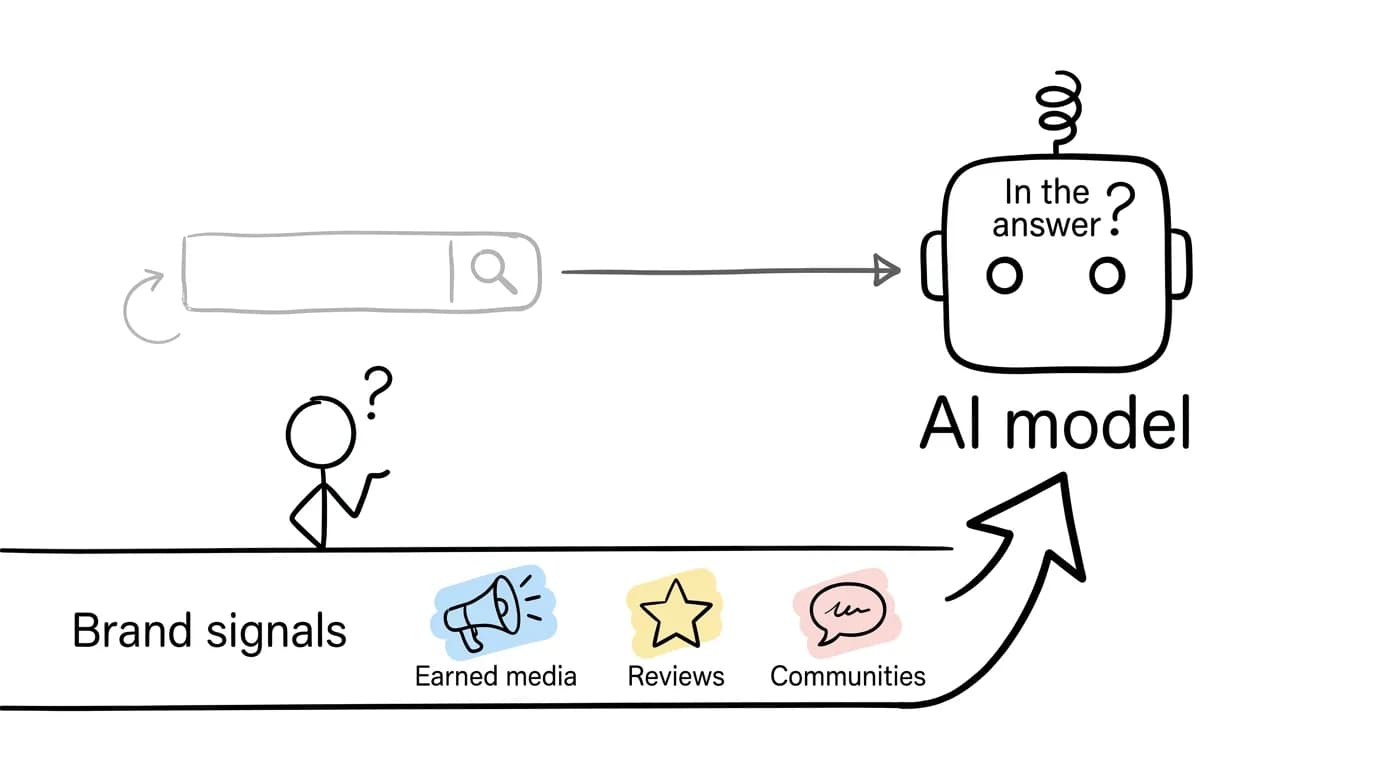
SEL's 2026 content strategy guide opens with a counterintuitive scenario: your organic traffic fell 28% over six months — before you cut the content budget, figure out where the traffic went, because Google Search Console can no longer diagnose this problem. From now on, audits run on two tracks: the same piece of content in the same quarter can absolutely be losing clicks on Google while gaining citations inside LLMs — and the reverse holds too. The traditional track looks at clicks, rankings, and conversions; the LLM track looks at citation frequency, mention consistency, and platform coverage. The two surfaces run on different authority logic underneath: Google reads the link graph and technical signals, while ChatGPT and Perplexity directly evaluate topic depth and trustworthiness — so optimization tactics can't simply be reused across the two. The guide also names a new failure mode, Ghost Rankings: ChatGPT recommends your brand but supplies a broken purchase entry point — or links straight to a competitor. The brand got mentioned; the path to conversion is cut. Entity authority has moved from an advanced topic to the first question you ask before creating anything.
💬 Two things this week: copy the two-track scorecard into your content review checklist, then search your own brand in ChatGPT and check whether the purchase links it gives out are correct. The second takes five minutes and may recover more orders directly than a month of media optimization.
🔗 Further reading: Read the full article
Maintouch GEO Field Guide: Citation Rate Is the New Position One
Maintouch's founder wrote this GEO guide from direct client experience (the author runs a GEO vendor — read the data with that stance in mind), and elevates citation rate to the same tier as ranking number one. The data chain is complete: SparkToro's 2026 analysis shows 68% of Google searches end without a click; Ahrefs measured a 58% drop in click-through rate for top organic results when an AI Overview appears; the number-one ranking gets cited by AI roughly 33% of the time versus 13% for position ten — AI retrieval still draws its candidate pool from traditional authority, so SEO isn't obsolete, it's the foundation; and ChatGPT's weekly active users passed 900 million as of February 2026. Three field tactics worth copying: front-load key data, quotes, and structured answers into the first 200 words; refresh priority content every 90 days or the citation frequency drifts; and stand up citation-frequency monitoring — treat brand appearances in AI answers as a KPI on par with rankings.
💬 The content team's next iteration of its guidelines needs only two changes: data into the first 200 words, and a mandatory 90-day refresh for priority pages. Small edits; the payoff is citation share — a metric nobody has started fighting over yet.
🔗 Further reading: Read the full article
The GEO System Guide: Princeton's Numbers and Share of Model
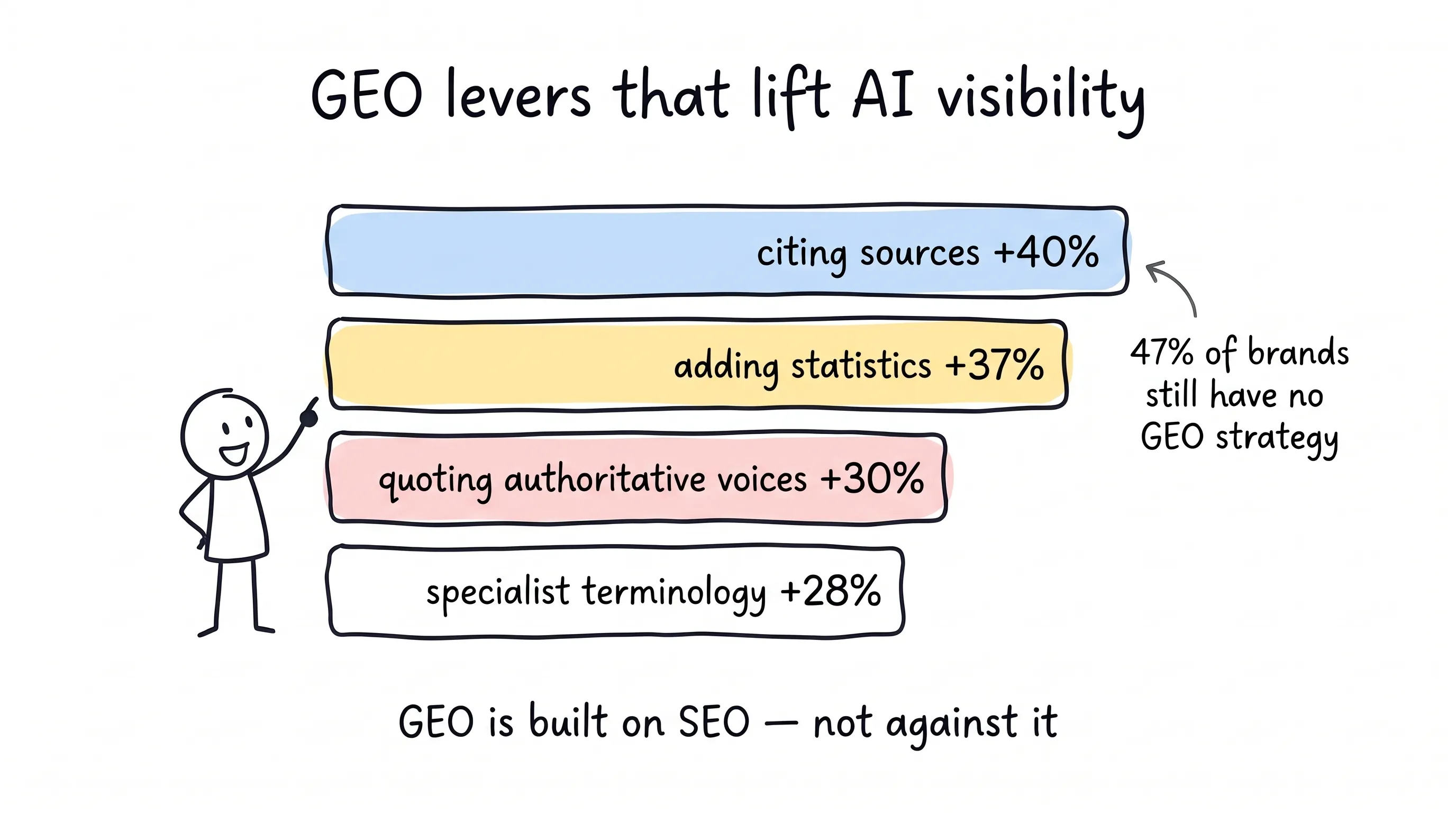
Digital Applied's GEO guide is the most complete in structure, converting Princeton's GEO research into actionable levers: citing sources within content lifts AI visibility by roughly 40%, adding statistics lifts it 37%, quoting authoritative voices 30%, and using specialist terminology 28% — the top methods combined can deliver a 30–40% visibility gain, with an expected ROI horizon of 3 to 6 months. 47% of brands still have no GEO strategy, so the window for early movers is still open. The article stresses that GEO is built on top of SEO: generative engines draw heavily on highly ranked content, and skipping the foundation to do GEO directly is building on sand. For measurement, the recommendation is to switch tracks to Share of Model — your brand's share of appearances inside AI answers — replacing clicks and rankings as the north-star metric.
💬 For teams that already have SEO fundamentals, three additions cost the least: source links, statistics, and expert quotes. No restructuring required — the double-digit visibility gain is hiding in how you write.
🔗 Further reading: Read the full article
The AI SEO Monthly: Don't Touch Anything During the Core Update — Do Grab Business Hub
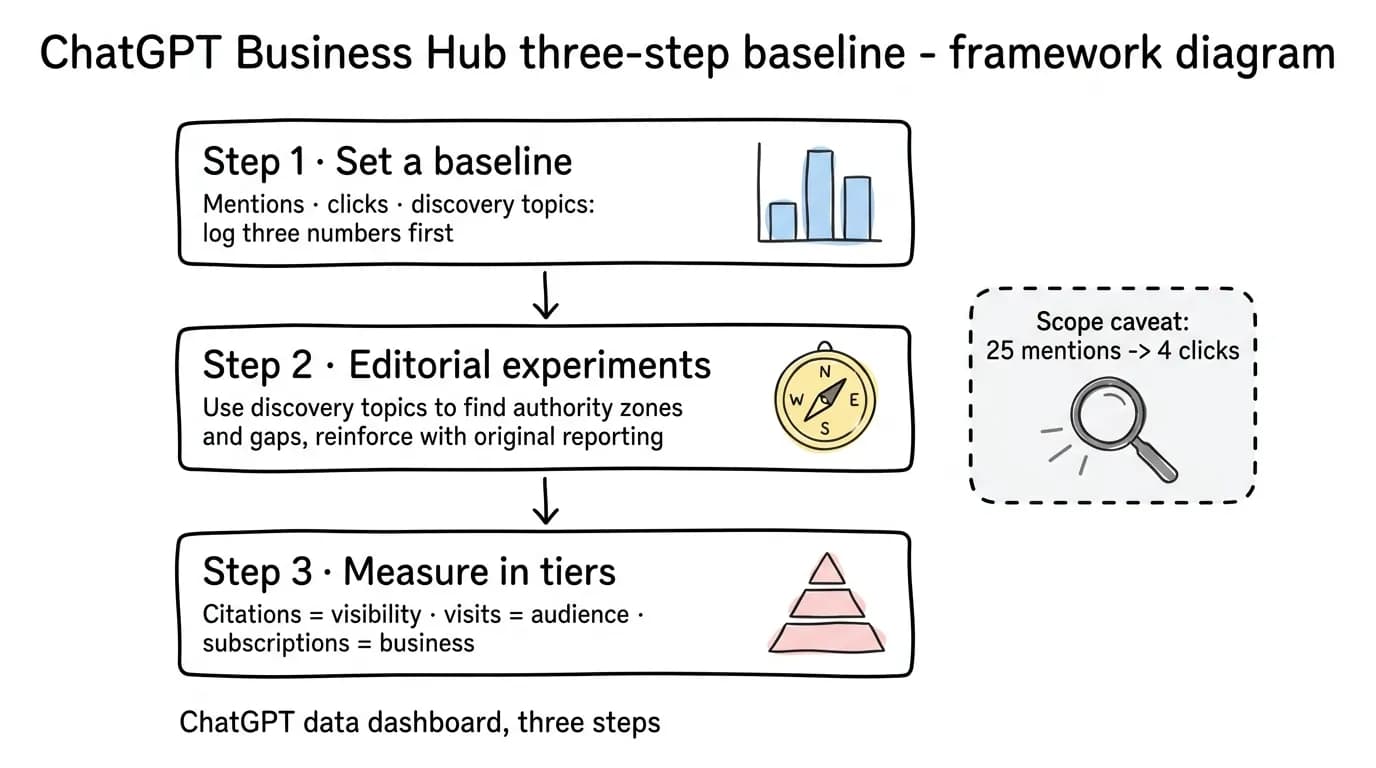
position.digital's AI SEO monthly tracker runs through November 12 and carries one quiet signal and one loud one. On the quiet side, Google began rolling out its November 2026 core update on November 10 — global, all languages, lasting up to two weeks. Ranking volatility during the window is normal, and any attribution drawn during this period is guesswork. On the loud side, OpenAI launched Businesses in ChatGPT and Business Hub: companies can claim their profile, upload a product feed with prices and inventory, and track mention counts, profile visits, website clicks, and the topics they appear in. Prompts and conversation contents stay private, and insights only display once the data volume is sufficient. Brand placement inside ChatGPT can now be claimed and run like any owned channel.
💬 Split the work: freeze every ranking-attribution conclusion for the duration of the core update window, and spend the freed-up energy claiming Business Hub today. First come, first served — those slots won't wait for anyone to finish getting ready.
🔗 Further reading: Read the full article
🏷 Industry Data
The HubSpot Duo on Stage: AI Running on Bad Data, MQLs Down 28%
HubSpot CMO Kipp Bodnar and SVP of Marketing Kieran Flanagan delivered a talk at UNBOUND 2026 (October 16, recorded by Campaign Creators) with a set of numbers worth pinning to the wall. By Pew's methodology, when Google shows an AI Overview, click-through on standard results falls from 15% to 8%. Brand mentions across the web correlate most strongly with getting into AI Overviews — stronger than any single SEO tactic. The most eye-catching figure comes from HubSpot's analysis of 300,000 customers: AI running on low-quality data and context makes output worse — MQLs down 28%, meetings booked down 49%. Turning on AI does not equal a positive return. Two hidden premises of the old playbook just failed at the same time: that buyers would come to your website, and that results could wait until quarter-end to be evaluated. Their proposed replacement is orchestration — wiring data, content, channels, people, and AI into a system where each part calibrates the others. In an era where content production costs nearly nothing, the scarcest skill has become deciding what is worth doing.
💬 Before the next AI budget approval, run a data health check — automation with negative return costs more than no automation. And in hiring and performance criteria, rank the ability to decide what to do above the ability to write prompts.
🔗 Further reading: Read the full article
Blazehive Statistics Roundup: 96% Are Using AI, 76% Are Reworking It
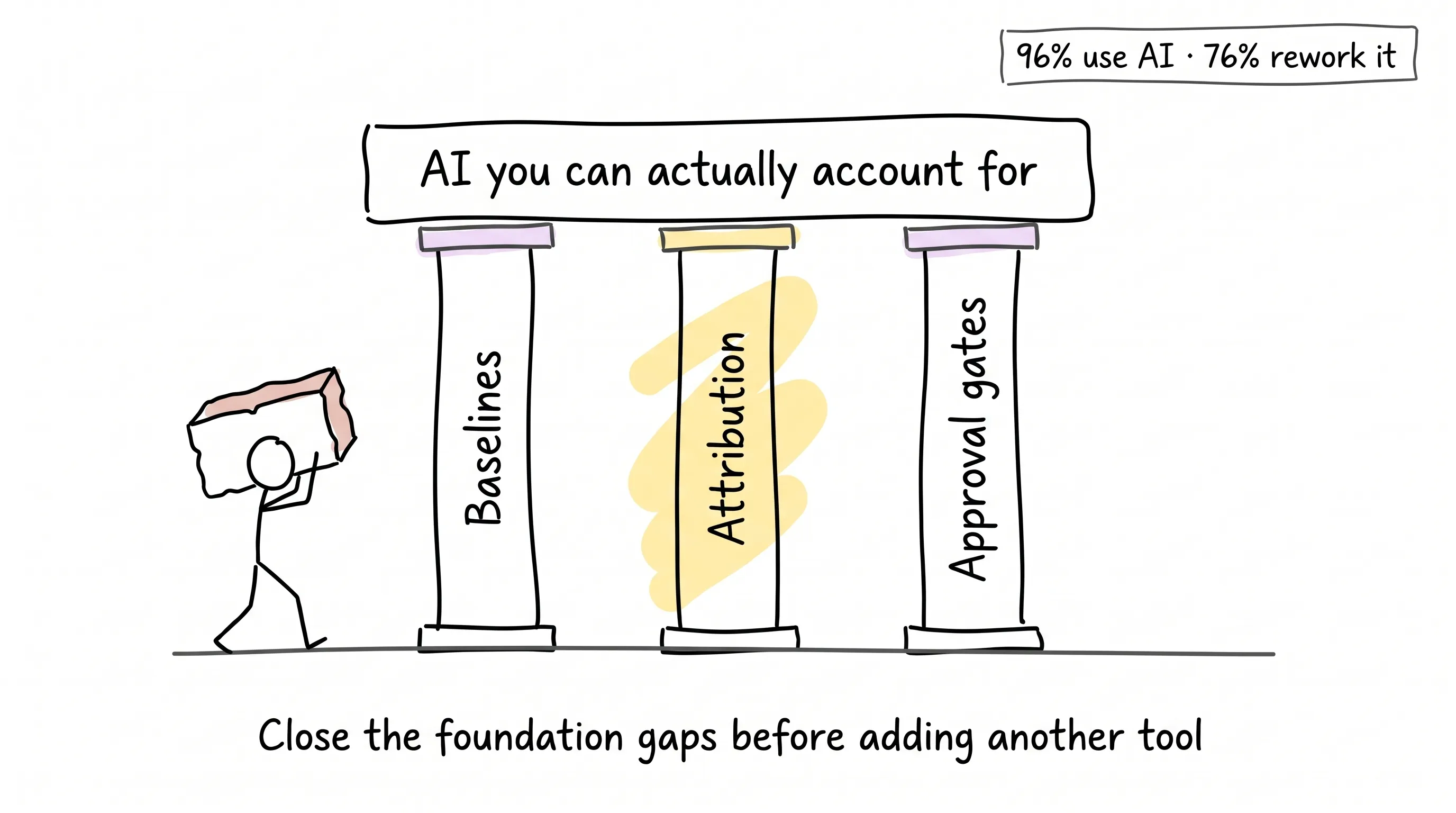
Blazehive's statistics roundup on generative AI in marketing is updated to its November edition: 136 figures, every one linked to a primary source, with vendor-sponsored research separated from independent research — the most citation-worthy data source of this cycle. The sharpest pair of numbers: 96% of leading global brands already use generative or agentic AI in marketing (WFA, September 2026) — up from 45% in 2023, so the "whether to adopt" question is settled; meanwhile, 76% of marketing leaders spend 3+ hours a week fixing AI output (Optimizely, June 2026) — the time saved is being partially clawed back as rework. Other highlights: 85% of AI users say output comes faster and only 2.5% say slower (Ahrefs, September); in a randomized experiment with 2,234 participants, the human-AI team produced 50% more ads per person (arXiv, February 2026); and an experiment by the Marketing Science Institute found display images that don't look AI-generated got a 0.79% click-through rate, versus 0.62% for the obviously-AI ones.
💬 Switch your ROI reporting to a net formula: hours saved, minus weekly rework hours, times labor cost. The 96% versus 76% pair, all by itself, is the best slide material you'll find.
🔗 Further reading: Read the full article
HubSpot Research: How Consumers Feel About AI Influencers
HubSpot draws on its own consumer research to read acceptance of AI virtual influencers. Attitudes are polarized: consumers accept AI influencers for content and entertainment value, but trust drops significantly in scenes of sincere recommendation — whether they buy it depends on the content type. The selling points of AI influencers are cost and control: available around the clock, no scheduling conflicts, no scandal risk. The risk is trust erosion — once the AI is exposed or the audience turns, the damage lands on the brand, not the influencer. The article's boundary advice is explicit: using an AI influencer requires explicit disclosure, and passing one off as human will blow up in your face. When selecting, distinguish three types — traditional CGI characters, VTubers, and influencer personas driven by generative AI — each with different capabilities and risk profiles.
💬 Experimenting is fine. Put disclosure clauses in the contract and on the landing page, use AI influencers for entertainment content, and never for trust-based recommendations. It only takes one blow-up in the latter category for the lesson — and the bill — to land on the brand.
🔗 Further reading: Read the full article
🏷 Policy & Funding
The EU Digital Fairness Act Proposal: Influencer Disclosure, Dark Patterns, and Agent Shopping All in One Bill
On Wednesday, the European Commission tabled its Digital Fairness Act proposal, touching three compliance fronts of AI marketing at once. Influencer marketing content must be clearly labeled as "advertisement," raising compliance costs for brands and MCNs alike; dark patterns are banned, users gain the right to switch off addictive design features — autoplaying video and infinite scroll are both on the list; free trials must come with a reminder before they convert to paid; and pay-to-win mechanics and loot boxes are prohibited for minors. The proposal also confirms that when consumers delegate purchases to an AI agent, they enjoy the same legal rights as when shopping themselves — the European compliance baseline for agentic commerce is starting to take shape. On penalties: major violations can be fined up to 6% of annual turnover, the Commission gains direct investigation and sanction powers, and the proposal is projected to recover up to €13.7 billion a year for EU consumers — about $15.3 billion. In the words of consumer protection chief Michael McGrath, when prices are squeezing households, consumers must be able to trust that the price they see is the price they pay. Added detail: drip pricing — hidden until checkout — is banned; dynamic pricing is not banned, but ticketing transparency requirements are raised. Next come negotiations with member states and the European Parliament; actual effect is still some way off.
💬 Brands selling into Europe should audit themselves along three lines: influencer disclosure workflow, trial-expiry reminders, and the rights-and-liabilities terms for agent shopping. With a 6%-of-turnover fine cap on the table, this is one compliance budget that won't be hard to get approved.
🔗 Further reading: Read the full article
Digiday Summit Coverage: Ad Tech M&A Is a Fight Over the Decision-Making Brain
At LUMA Partners' digital marketing summit this week, CEO Terry Kawaja and partner Conor McKenna offered the same judgment: AI is reshaping ad tech on two fronts — one is the decision automation inside the ad tech stack itself, the other is the AI-ification of how consumers discover and buy. As 2026 winds down, ad tech M&A keeps heating up, with acquisition logic organized around recombining AI capabilities. Once workflow automation has commoditized the execution of media buying, competitive advantage shifts from who runs the process smoothest to who decides best — specifically, the quality of three decisions: which signals to pick, what creative to produce, and where to place. The implication for advertisers is that vendor-selection criteria need to change: when evaluating partners, shift the weight from process capability to decision quality and data assets.
💬 Your RFP scorecard can be updated this week: strike the "process capability" column and add two — decision quality and data assets. A hot M&A market means more sellers, and right now is a buyer's window for negotiating.
🔗 Further reading: Read the full article
💡 The Big Picture
Read today's 20 items in sequence and the same sentence pattern keeps appearing: the action has happened; the accounting hasn't caught up. Agents went live — only 19% can pass conversions back. AI search rewrote how traffic is distributed, and most teams' dashboards still show nothing but a single Google backend. Meta changed its measurement methodology, so no movement should be interpreted until it's verified. Even the way that batch of 2023 predictions played out obeys the rule: the parts that could be verified and constrained landed; the parts expected to operate independently are still floating.
That's why a 96% adoption rate stands right next to the 76% spending hours on rework every week. The industry doesn't lack AI tools; it lacks the foundation that lets tools be accounted for: baselines, attribution, approval gates. HubSpot's 300,000-customer dataset put the price tag on it — AI running on bad data cut MQLs 28%, and AI without a foundation is a net liability. Every dated action item today lands inside the same two-week window: Meta's measurement switch on November 12, Google's core update starting to roll on November 10, and just two Google Ads switches to flip before BFCM. This quarter, rather than adding another new tool, close the gaps in the measurement foundation first — so that every AI you already have running can, for the first time, be accounted for properly. And the EU's 6% fine cap reminds everyone that compliance is part of the foundation too; the European baseline for agent shopping has now been put in writing.
Continue reading
Related articles
AI Marketing Daily · 2026-11-22
AI Marketing Daily for 2026-11-22 rounds up 20 items led by Microsoft opening Bing AI Overviews to ads and Google expanding AI Mode ads to ten countries, plus GEO guides, ad automation delegation guidance, AI Overviews CTR data, and a legal-risk checklist for AI-generated creative.
AI Marketing Daily · 2026-11-21
A November 21, 2026 AI-marketing daily covering AI search visibility, GEO methods, Google AI Mode ads expanding to ten countries, Meta's pre-Black Friday changes, agentic shopping, and industry adoption and ROI data.
AI Marketing Daily · 2026-11-20
AI Marketing Daily for 2026-11-20 rounds up 19 items centered on measurement: OpenAI's ChatGPT Business Hub dashboard, EU rules for agent-mediated purchasing, Meta pausing four AI terms, and B2B data on shortlists and the dark funnel, each with action advice.