
96% of the Biggest Brands Are Using AI for Marketing. Now What?
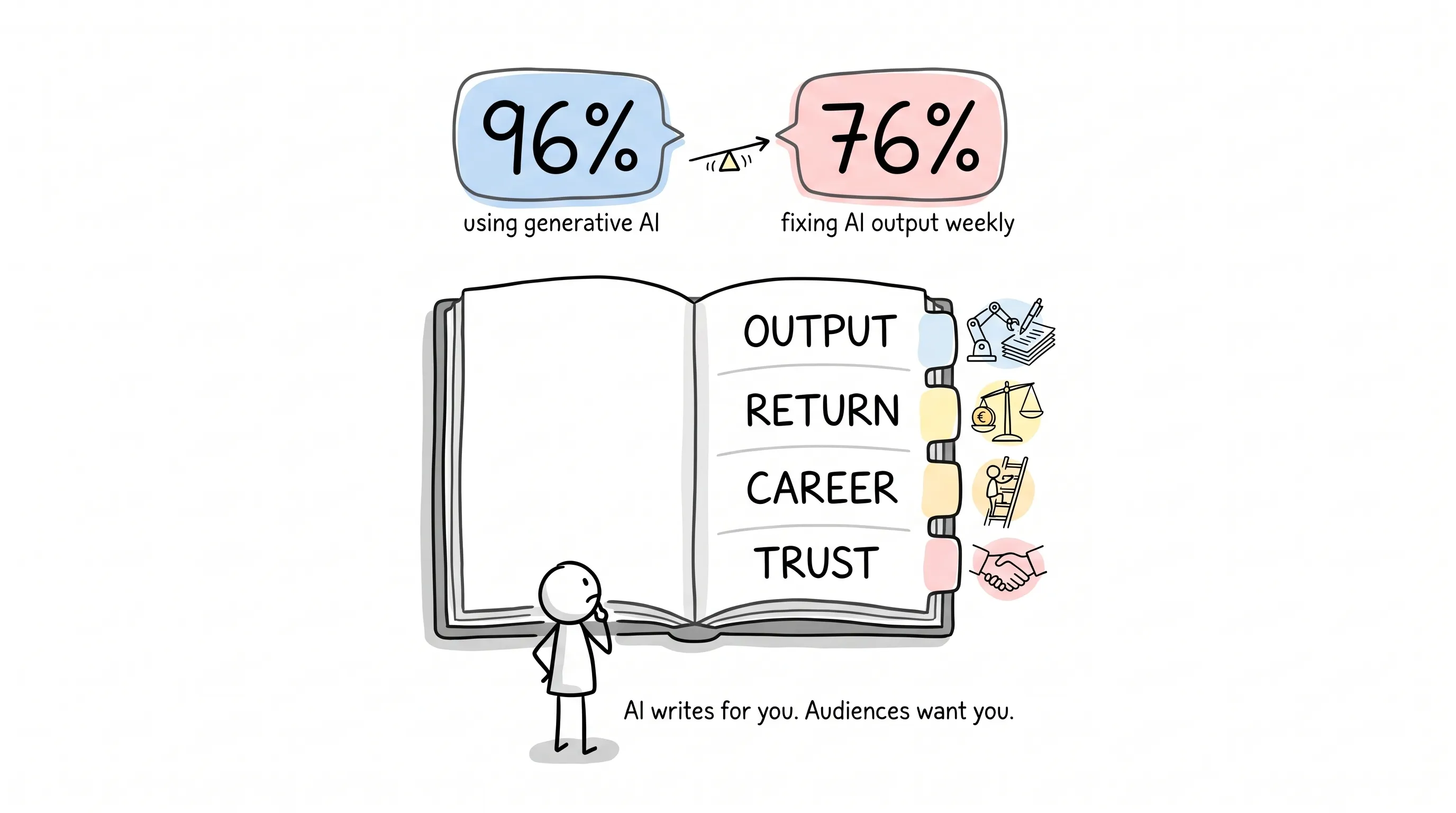
A survey-based analysis of generative AI in marketing, organized around four ledgers: output, return, career, and trust. It cites that 96% of the biggest advertisers use AI, 76% of marketing leaders spend over three hours a week reworking AI output, and 78% of consumers prefer human-made ads.
Lately, I've been turning something over in my head.
In September this year, the World Federation of Advertisers (WFA) released a survey. Among the world's biggest advertisers, 96% are already using generative AI — even agentic AI — in their marketing. What does that mean? In 2023, the number was only 45%.
But another survey, done in June this year by Optimizely, delivers a brutal number: 76% of marketing leaders spend more than three hours a week fixing what AI produces.
On one side, 96% are using it. On the other, 76% are reworking it.
AI has redone the marketing job from top to bottom. But fast doesn't mean valuable. Today, I'm spreading out all the survey data I have on the table and walking you through four ledgers: the output ledger, the return ledger, the career ledger, and the trust ledger.
By the time we're done, you'll see a truth that is genuinely fascinating.
1. The First Ledger: Output
In May this year, Canva and Harris Poll surveyed 1,415 marketing leaders at companies with 500 or more employees. 97% of them use AI in their creative work every single day.
97%. Good grief — almost nobody is left out.
In September this year, Ahrefs surveyed 301 marketers: 93% use AI for content, up 6 points from a year ago. In June this year, Forrester found that nine out of ten American marketing agencies are using generative AI. In January this year, Muck Rack surveyed 564 PR professionals: 76% are using it.
See? Advertisers, agencies, content teams, PR teams — they've all "fallen," basically.
It goes further: 41% of marketing leaders say AI already acts like a "director" on the team. 39% say it's a "collaborator."
See? People have stopped treating AI as a tool. They've started treating it as a "colleague."
Where is it used? It starts with content. 80% of top advertisers use AI for content creation; 74% for creative and production; 72% for research and insights.
But the further down you go, the slower it gets. Using AI for media buying and optimization: 54%. For strategy and planning: only 48%. A survey by BCG in June this year is even more brutal: 42% of CMOs are still using AI as an assistant for single-point tasks; only 8% of CMOs are actually running campaigns where multiple AI agents collaborate autonomously.
What is agentic AI? It's AI that can do the work on its own, without you watching. It breaks down tasks by itself, executes by itself, delivers by itself.
Sounds wonderful, right? But the reality is that most teams are still at the "assistant stage."
Muck Rack's survey in January this year backs this up: 89% of PR professionals require AI agents to get human approval before publishing or sending anything.
The ones actually doing real work, hands on, are still the minority.
In April this year, a HubSpot survey found: 83.5% of marketers have been asked to produce more content because of AI. 35.7% say it's "a lot more."
In February 2025, a team of researchers, Liang et al., published a paper analyzing the text of corporate press releases. They found that by the end of 2024, as much as 24% of the text in corporate press releases had been written with the involvement of large language models.
Before ChatGPT came out, that figure was 2%.
Let me give you an example: Klarna, the Swedish buy now, pay later company. In 2024, it launched its own copywriting assistant, Copy Assistant. The result? 80% of the company's copy was handled by AI. In Q1 2024, it generated more than 1,000 images with AI, compressing the image development cycle from 6 weeks to 7 days.
Six weeks became seven days.
Over a year, AI contributed 37% of Klarna's marketing savings — roughly $10 million.
That's the first ledger of AI: the output is real, and it's massive.
2. The Second Ledger: Return
Output is high — but does it make money? That depends on the spending.
In May this year, a Canva survey: 99% of marketing leaders plan to increase AI investment in 2026. In June this year, a BCG survey: 43% of CMOs say their company's AI marketing investment this year exceeds $15 million. Last year, that number was 28%.
From 28% to 43% — a jump of 15 percentage points in a single year.
In July 2025, MIT NANDA released a report called GenAI Divide. It says that sales and marketing take the lion's share of enterprise generative AI budgets — 50%, even approaching 70%. But the report specifically cautions: marketing leads because it's easy to measure, not because it delivers the highest returns.
Adobe's financials confirm it too. In fiscal Q3 2026, Adobe's "AI-first" annual recurring revenue grew more than 150% year over year. The Creative and Marketing Professionals customer group pulled in $4.65 billion in subscription revenue for a single quarter, up 13%.
The money is genuinely pouring in.
But pouring money in doesn't necessarily equal returns.
In 2023, two researchers, Noy and Zhang, ran an experiment in Science. 453 highly educated people wrote the same tasks. The group using ChatGPT saved 40% of the time and produced 18% higher quality.
40% less time, 18% better quality. Impressive.
And two weeks later, the people who had used AI in the experiment were twice as likely to use AI in their actual work. Once they've tasted the upside, there's no going back.
In 2025, there was an even more brutal experiment. P&G put 776 employees into small teams. The finding: one person who knew how to use AI performed as well as an entire team without AI.
One person, worth a whole team.
In February this year, another team of researchers, Ju and Aral, ran an experiment with 2,234 participants. When humans teamed up with AI, per-person ad output rose 50%. And those 11,024 ads were actually deployed on X with about 5 million impressions, tested in the wild: the better the copy, the higher the click-through rate; the better the images, the lower the cost per click.
But don't jump to conclusions yet. There's a genuinely fascinating finding buried in here.
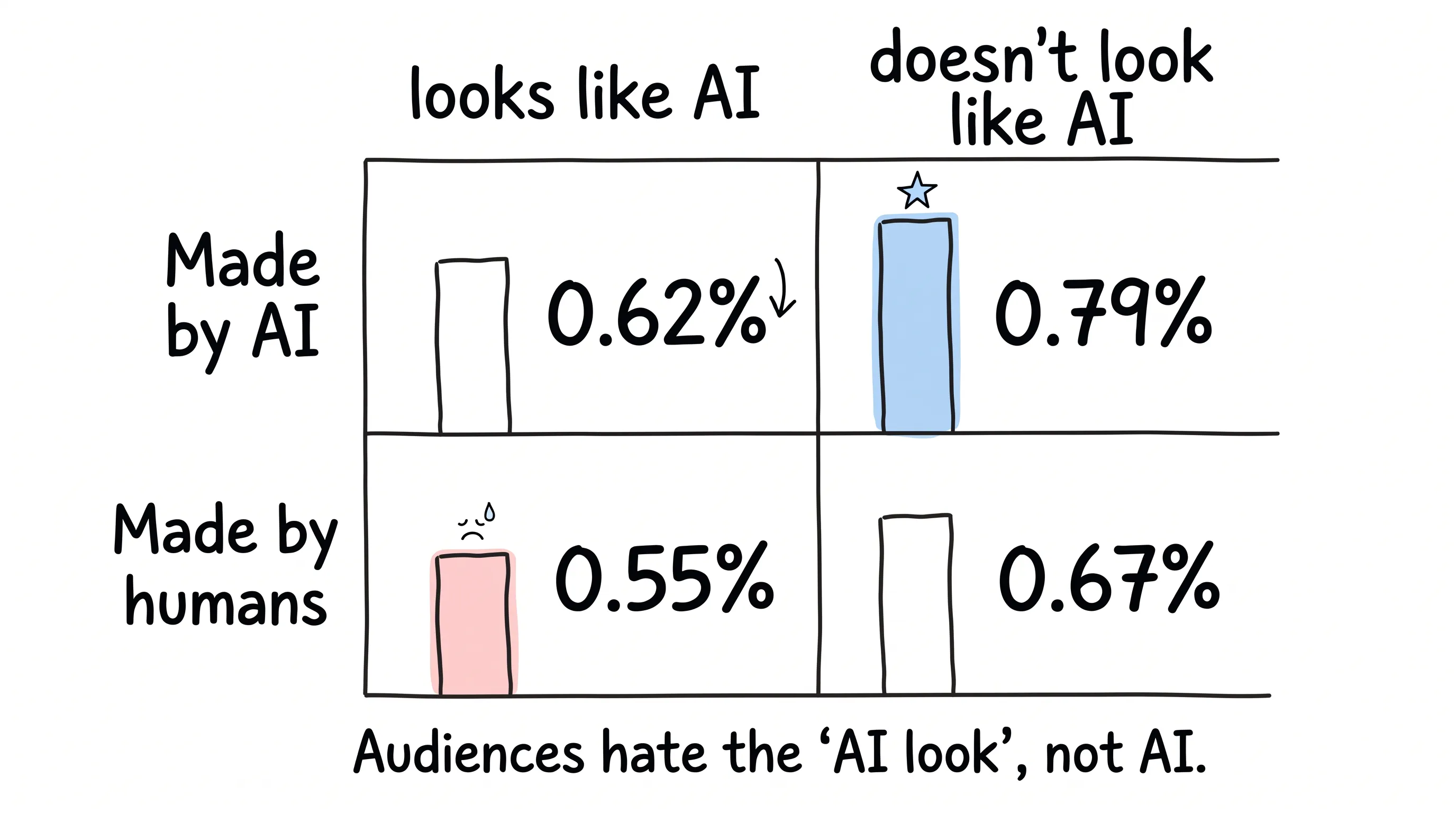
One study, based on real ad data from 1.6 billion impressions and 116 million clicks, compared "images that look like AI" and "images that don't look like AI."
AI-made images that don't look like AI: a 0.79% click-through rate. AI-made images that you can spot as AI at a glance: 0.62%.
And here are two even more delicious ones: human-made images that look like AI: only 0.55%. Human-made images that don't look like AI: 0.67%.
In other words, the worst images aren't the ones made by AI — they're the ones "made by humans, but looking like AI."
What audiences hate has never been AI. It's the "AI look."
Oh, and one more comparison: at the end of 2024, NIQ ran a test with more than 2,000 viewers, about 150 of whom wore EEG devices. The AI-generated ads scored fine on viewers' self-rated quality, but their brainwaves showed memory activation significantly weaker than traditional ads.
The audience's mouth said "good." The brain didn't remember.
And the time saved? It didn't all go into the pocket either.
In June this year, an Optimizely survey: 48% of marketing leaders say fact-checking and hallucination checks are more of a grind than doing other jobs. 40% say moving data between disconnected systems eats the most time. Only 4% say AI saves time end to end; only 19% work on a unified AI platform.
Ahrefs's survey stings too: 41% of AI users say it hasn't saved them the money they'd otherwise spend on writers or freelancers.
Half the time the tools save goes back into fixing the tools.
3. The Third Ledger: Career
Output is high, returns exist — so who wins, and who loses?
Money first.
In June this year, PwC published its Global AI Jobs Barometer. It says that people with AI skills now command an average wage premium of 62%. Last year it was 57%. The highest, in consumer markets, reaches 118%.
118%. What does that mean? For the same job, the person who understands AI can earn more than double the pay.
Now the jobs.
The State of Marketing Careers 2026 report, released by the AMA in July this year: between 2024 and 2025, SEO specialist roles fell 15%; content marketing roles fell 11%. And in 2025, the share of marketing job postings that mention AI doubled. The fastest-growing role is influencer marketing, up 18%.
Indeed Hiring Lab's January data this year is fascinating too: about 15% of marketing job postings mention AI. Data roles? 45%. HR roles? Only 9%.
AI is becoming a filter.
But the ones truly hit are the entry-level.
In February this year, a survey by the Content Marketing Institute (CMI): entry-level marketing hiring, net decline of 19.8 points; senior hiring, net growth of 22.3 points. 75% of working marketers say job hunting is harder than two years ago. For a newcomer, landing a marketing job now takes an average of 5.2 months, versus 3.1 months two years ago.
76% of marketers say they're doing a job and a half.
53% expect AI to augment their role; only 4% fear being fully replaced.
And only 11% of companies have actually replaced people with AI tools.
The freelance market felt it even earlier. Within 8 months of ChatGPT's release, freelance posts in automation-sensitive writing and programming fell 21%. After image generators came out, image-related posts fell 17%. Writing freelancers: monthly gigs down 2%, monthly income down 5.2%.
AI changes the work first, then the headcount.
4. The Fourth Ledger: Trust
Output is high, returns exist, careers are shifting — but the real cost is in trust.
Consumers first.
In August this year, Gallup and Bentley University ran a joint survey: 79% of American adults had seen "looks-like-AI" ads in the past 30 days. 49% hold negative attitudes toward AI ads; only 19% positive.
62% believe that using AI-synthesized "people" or "voices" in ads is unacceptable — even when you're told explicitly it's AI.
But here's the interesting part: 78% of consumers say they'd rather watch ads made by humans, even if AI does it better; 68% say AI is fine as long as the ad is more useful.
See? What audiences push back against isn't AI helping — it's AI replacing humans.
And here's a wonderful contrast: the Canva survey found 70% of consumers claim they can spot AI ads — "it always feels like something's missing." But in April 2024, Bynder ran a blind test with 2,000 British and American readers: only half could actually identify AI-written articles.
They say they can tell. They can't.
And here's the thing — disclosure actually adds points.
In February 2024, research by Yahoo and Publicis Media found: as long as consumers notice the "made with AI" label on an ad, ad favorability rises 47%, ad credibility rises 73%, and trust in the company rises 96%.
+96%.
Yet the Ahrefs survey in September this year: only 22% of marketers actually disclose AI use to visitors. Last year, it was 16%.
Disclosure clearly adds points, yet only 22% do it. This game is getting a little hard to read, isn't it?
Now the marketers' own hearts.
66% of marketers only trust AI content after human review. Only 2.7% dare to use AI-generated content directly, with no human review at all.
25% admit that when racing a deadline, they publish non-compliant content anyway. 30% frequently or always put their own name on AI's output.
The stronger the tools, the more anxious the hearts.
Conclusion
OK, the four ledgers are done.
First, the output ledger: 96% are using it, 85% say it's faster — it really is fast. Second, the return ledger: text tasks save 40% of time and quality rises 18%, experiments are solid; but the "AI look" is a penalty, and audiences vote with their feet. Third, the career ledger: AI-savvy people earn a 62% wage premium, but entry-level is bleeding out. Fourth, the trust ledger: 78% of viewers would rather watch ads made by humans, while only 22% of marketers are willing to disclose AI.
So what is the real moat for marketers in the AI era?
Not tools. Only 1% believe that better tools and platforms are the dividing line between strong and weak marketing talent. 72% of bosses say strategic thinking is the number-one talent gap.
AI writes for you. But what audiences want is you.
Continue reading
Related articles

It's 2026: Stop "Buying" AI Tools for Your Marketing Team — Start "Hiring" AI Agents
This learn article explains how AI agents differ from standalone AI tools in marketing, outlines three agent categories — build-your-own platforms, CRM-native agents, and vertical tools — and covers use cases across SEO, social media, advertising, and reporting, plus criteria for choosing one.

Did the Money You Spent on AI Marketing Ever Come Back?
A guide to measuring AI marketing ROI across three layers: ad reports, sales pipeline, and the financial ledger. Covers metrics such as ROAS and CPA, eight dashboard metrics, industry benchmarks, and common measurement mistakes.

How to Pick a Creative Automation Platform: First, Figure Out What These Eleven Actually Do
A learn article sorts eleven creative automation platforms — including Bannerflow, Celtra, Smartly.io, and Storyteq — into four functional groups and proposes five evaluation questions covering publishing reach, automation depth, ease of adoption, team fit, and verifiable evidence.