
AI Search in 2026: The Traffic Is Still There — Only the Dealer Has Changed
A year-in-review of AI search developments in 2026, covering traffic redistribution, platform monetization, robots.txt rule changes, and new measurement tools for publishers and SEO practitioners.
A few days ago, I went through this year's AI search milestones. From January to November, I read them one by one, and the more I read, the more a chill ran down my spine.
It wasn't that any single piece of news was particularly scary. It was that these scattered pieces, put together, tell the same story:
The card table is still the same card table, but the dealer has changed.
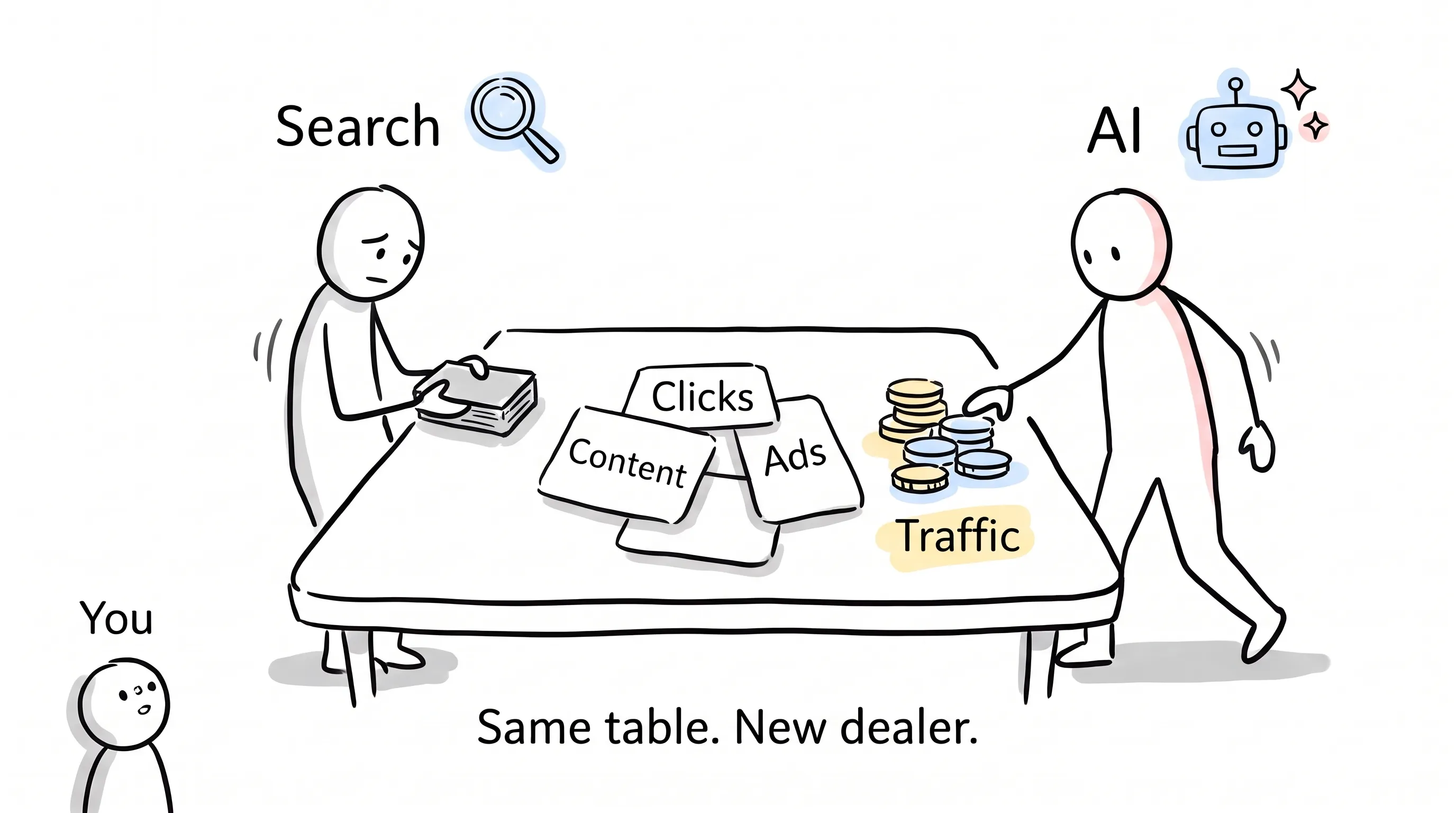
Let me untangle this year's events into a single thread. Once you hear it, you'll understand where people doing search and content in 2026 actually stand.
First, Something That Just Happened
On November 10, Google's core update began rolling out. Global, all languages, and it can take up to two weeks to finish rolling.
What does that mean? Google had been quiet all through the first half of the year — no large-scale core update since May. One practitioner took 25 years of update history plus real-time volatility data and trained a prediction model; in October, its verdict was: the probability of an update within the next 30 days, 96.8%.
And look — the model got it right.
The update is still rolling, and rankings will wobble back and forth, so don't rush to conclusions. But more than the update itself, what I want to talk about is the whole year. Because the changes in AI search in 2026 are bigger than any single algorithm update.
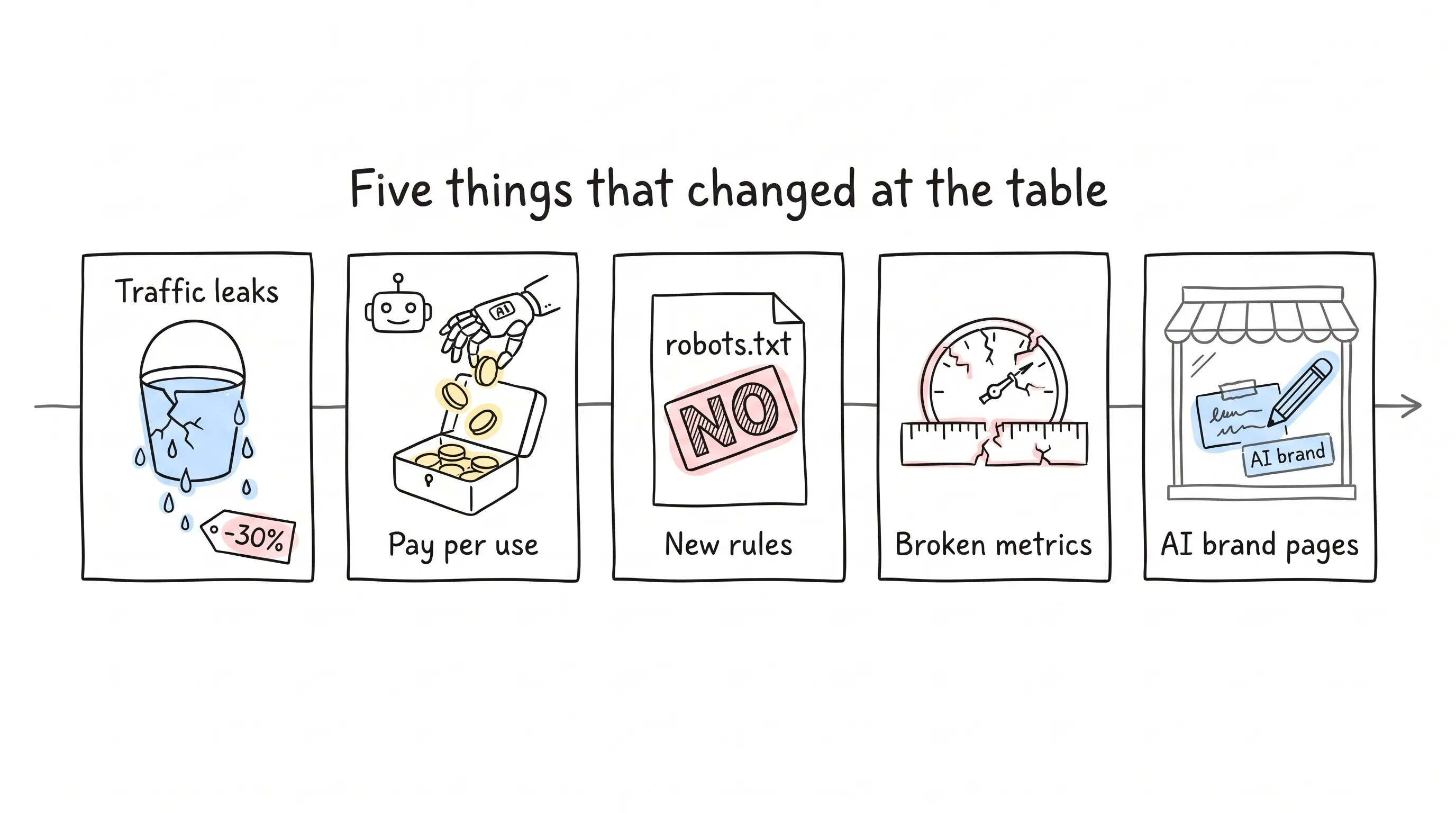
First Thing: Google Itself Admits Traffic Really Is Declining
What counts as the news with the clearest signal? The kind where the party involved says it out loud.
Reddit's CEO, Steve Huffman, recently said publicly that search referral traffic from Google dropped significantly this quarter. Translated, his point is this: Google is turning from a traffic driver into something even he can't quite define.
The moment the news broke, Reddit's stock fell more than 30%.
Good heavens, 30%.
Why couldn't even Reddit hold on? Think about it — Reddit has been the darling of traffic these past few years. After the May 2026 core update, its share of Google's top 3 results rose from 9.19% to 10.24%, and it was being treasured as a citation by every kind of AI summary.
If even the darling is bleeding, what about everyone else?
What about Google? The parent company Alphabet's earnings told the truth: Q3 search revenue grew 12% year over year. Looks decent, right? But Q2 was 17% — two consecutive quarters of slowing. And management itself admitted on the earnings call that AI Mode's ad monetization is weaker than traditional search's.
To put it plainly, AI has punched a hole in the traffic pool of search, and even the one who punched the hole hasn't figured out how to collect money at the hole.
This year also had a particularly interesting detail: Google quietly added UTM tracking parameters to Gemini's outbound links.
Take a closer look at that move. Websites used to beg search engines for a clear source tag; now Google is the one scrambling to prove: I'm still sending you traffic — look, here's the data.
When a platform starts trying to prove its own innocence, you don't need me to spell out what that means.
Second Thing: The Players at the Table Start Collecting Their Own Money
The traffic landscape is shifting, and monetization experiments never stopped. Let me lay out a timeline so you can see the pace:
In February, ChatGPT started testing ads in the US, first open to free and entry-tier users. In March, OpenAI said the ad pilot had generated $100 million in annual recurring revenue and was mulling expansion to Canada, Australia, and New Zealand. By October, ChatGPT Ads had rolled out to 89 countries, ad cards got wider, and multi-image ads opened for testing. Along the way, it pulled in the data company LiveRamp, letting advertisers pipe first-party audiences from their CRM systems and membership programs straight into ChatGPT's ad system.
Google fired on the same front. AI Mode ads expanded to 10 countries, and ads now appear inside follow-up queries. Legacy search, shopping, and Performance Max (PMax) campaigns can join automatically — no setup needed. Canada went a step further: in AI Mode and the Gemini app, you can already check out directly with Google Pay — lululemon, some Shopify merchants, and Shoppers Drug Mart, click and buy.
See it? AI conversations are no longer just a sales guide — they've become the checkout counter.
But the news I find truly worth chewing on this year is a different kind: AI platforms started paying content publishers.
Google set up an AI contribution pilot, with roughly 100 digital publishers getting paid, and Search Console gained an earnings widget where you can see the monthly AI revenue. The spread is absurd: some small sites have earned less than $1,000 combined over several months, while one early participant brings in more than $1 million a year.
Cloudflare went even more aggressive, shipping two products in one go. One is called Monetization Gateway, which lets websites charge AI agents per use — every API call, every dataset, every page of content costs money. The other is called Pay Per Use: if AI uses your content, you get paid.
What does that mean? Here's an analogy.
For the past twenty years, content websites and search engines had a no-strings symbiotic relationship: you scrape my content and send me traffic in return, and we're even. Now AI just takes the answer straight off the table and serves it, the traffic breaks, so content publishers start installing meters.
It used to be trading content for traffic; now it's demanding that AI pay the bill directly. This path has just opened, and pricing is total chaos — $1 million and $1,000 competing in the same arena. But the direction is crystal clear.
Third Thing: The Fight Over the Rules Is Fiercer Than the Fight Over Traffic
The fiercest fight this year wasn't over traffic — it was over rules.
In October, something big happened: Google, Microsoft, OpenAI, and Anthropic — four rivals who had been at each other's throats for years — jointly announced support for a single robots.txt signal, called __usage_ai-training. A site owner writes one line of config and can declare to all participating platforms at once: don't train on my content. Google said it would start supporting it in early 2027, treating it as equivalent to disabling Google-Extended.
Four rivals who'd been fighting each other sat down at the same table over the question of how content owners can say no. Why? Because if every faction sends its own crawler and sets up its own opt-out mechanism, site owners simply can't keep up. Pushed to the limit, the only option was to simplify the rules together.
Microsoft's Bing went finer-grained: it split "training AI on my content" and "having Copilot cite me" into two independent switches. You can refuse training while allowing citation, and neither switch affects normal rankings. A temporary citation control launches on December 15, full enforcement on February 1, 2027, and sites using the old directives must switch over by March 1.
But there's always a flip side.
OpenAI has a safety blacklist mechanism called Aura, which decides whether ChatGPT's real-time search and its agents can open your website. One publisher discovered it had been blocked by ChatGPT since May. The robots.txt gate was wide open, and there was not a single trace of ChatGPT requests in the server logs. Worse, you can't find out why you were blocked, and there's no appeal channel — you can only try your luck with OpenAI's customer support.
This is the most twisted part of the rules: on one side, several companies sit down to unify the opt-out protocol; on the other, a blacklist can override any rule you write.
Google itself wasn't idle, either. Since August, search results have routed through a redirect address called goto, so third-party tools and AI companies can no longer scrape results pages directly. Even more ruthless: Nozzle, a ranking-tools vendor, found that starting in late September, some of the results pages Google returned to automated requests were poisoned — the page structure was complete, but the content was wrong. The ratio once spiked to 25%, and since October it has held steady at 5% to 11% a day. In repeat searches, those fake pages kept only 20.7% of the same sites, versus 88.5% for normal results.
Google didn't respond. But you get the message: want to take my results pages for free? Here, have fakes.
Fourth Thing: Even the Measurement Business Has Started Over
Traffic changed, so the measuring stick for traffic has to be rebuilt from scratch.
In June, Search Console launched its generative AI performance report. Webmasters clicked in full of hope — only impressions, no clicks. In August, the report rolled out to all sites worldwide — still only impressions. When someone pressed on when click data would come, Google's spokesperson Gary Illyes pushed back directly: the team wants to add meaningful data, and for now there's nothing to share.
Bing, ironically, ran faster. Its AI performance report, which at the start of the year could show which pages were cited but not clicks, kept adding up to October's topic-grouped view: it groups the queries citing you by topic, marks the size of each topic, and specifically lists opportunity queries — which topics have competitors cited while you're absent. Isn't that just turning AI-era share analysis straight into a product?
Microsoft's Clarity also entered the field, launching analytics for AI agents: monitoring whether AI agents that support it can complete key tasks on your site, starting with e-commerce and travel. Even Google's own Lighthouse added a new audit in version 13.5, checking whether a site exposes its tools and services according to the new spec so AI agents can find them.
What does it look like when an industry switches tracks? The old set of instruments — rankings, clicks, sessions — fails one by one, while the new set is still being hand-built on site.
How badly has the stick failed? A true story. In early November, many webmasters found that Search Console clicks had surged 2 to 6.5x, and they were overjoyed. The veteran SEO Marie Haynes took one look at the data: impressions and rankings hadn't moved an inch, and the surge was concentrated on desktop pages ranking 11 to 55. Her conclusion: most likely external crawlers, or a glitch in Google's logs — don't change anything.
In other words, even the fact that "I'm growing" may not be real.
Fifth Thing: Your Brand's Introduction Is Now Written by Google's AI
Back to the question people doing brand and content should care about most: in the AI era, how do others see you?
First, two numbers.
One practitioner ran a round of tests: 93% of the tested brands showed AI Overviews when their brand name was searched. Reddit, Salesforce, Amazon, Adobe — not one slipped through.
Since October, AI Overviews for desktop brand searches have moved to the right column, right where the knowledge panel used to sit.
Think about what that means. Before, when a user searched your brand, the right column held an encyclopedia card and info contributed by your official site; now that spot is an AI-generated summary. The first words people read about you are no longer written by your website — they're written by Google's AI.
OpenAI moved even earlier. Since October 2025, ChatGPT has been tagging brands with structured fields in its answers. In November, it launched Businesses in ChatGPT: verified brands can claim their profile, update information, and upload product catalogs with prices and inventory, and the dashboard shows mention counts, profile views, website clicks, and which topics they appear in. It doesn't show you user questions, it doesn't show you competitor data, and when conversation volume is too low, it shows nothing at all.
Set up the shelf first, accumulate the data slowly. Does this playbook look familiar? The social platform pages of yesteryear, then the short-video business accounts — they all started this way. The brand homepage of the AI era opened for business in 2026.
So What Should Content Publishers Do
This year, Google did send some reassuring signals too. In October it announced five adjustments, saying it would make AI Overviews and AI Mode send more traffic to web pages: more inline links placed higher; one or two official pages shown directly at the top of task-based queries; news carousels surfacing the user's own preferred sources; video results with clickable creator profiles. Usage of the preferred sources feature has grown 7x since the start of the year.
Fair enough. But at the same time, the other hand never stopped.
September's spam update rolled for nearly 14 days before wrapping up — slower than the first three this year — and it came with a new detection system dedicated to catching scaled AI abuse. The August update hit hardest at sites mass-producing AI content. Google also updated its helpful content official documentation, adding sections on content effort, originality, accuracy, and how content is produced, and even started testing AI-rewritten news headlines in Discover. Anthropic's Claude added invisible watermarks to its generated content, and the SEO circle's first reaction was: will Google find it easier to detect AI content?
Now think back to that 96.8% prediction in October. That practitioner added one more line: the next update will likely be like the Panda of the old days — targeting low-value AI content produced at scale. And sure enough, on November 10, the core update really started rolling.
Whether the prediction hit, and whether it will hit you — it's too early to say; wait for the roll to finish. But the direction doesn't need guessing.
Three Takeaways from the Table's Edge
Looking back at this year, my biggest takeaways are three lines.
First, traffic hasn't disappeared — it's being redistributed. AI took the entry point, and platforms and publishers are haggling over the new order.
Second, whoever can collect money will collect it first. Brand profiles, per-use billing, contribution payouts — the table is set; there just aren't many chairs yet.
Third, the rebuild period of the measurement system is the opportunity window. While everyone else's reports are still wrong, if you see the real data first, you win a step first.
Yes, this year was truly chaotic. In chaos, the thing to fear most isn't change — it's clinging to an old map.
The November update is still rolling. When it finishes, let's look together at what new rules have appeared at the table.
May you always have a seat at the new table.
Continue reading
Related articles

It's 2026: Stop "Buying" AI Tools for Your Marketing Team — Start "Hiring" AI Agents
This learn article explains how AI agents differ from standalone AI tools in marketing, outlines three agent categories — build-your-own platforms, CRM-native agents, and vertical tools — and covers use cases across SEO, social media, advertising, and reporting, plus criteria for choosing one.

What Is GEO? How Your Brand Gets "Mentioned" in the Age of AI Search
An explainer on GEO (Generative Engine Optimization) for e-commerce and DTC brands: how it differs from SEO and AEO, why AI answers shape brand visibility, and eight practices covering question-focused content, consistent brand messaging, structured pages, external evidence, comparisons, and AI mention tracking.

AI Is Already Making Decisions for Your Customers. Are You on the List?
A learn article explains GEO (Generative Engine Optimization): why AI-generated answers now shape which brands customers see, and how SEO fundamentals, entity clarity, citable evidence, and monthly measurement affect visibility in AI answers.