
Traffic Dropped 28% — Don't Reach for the Knife Yet
This learn article explains why organic traffic drops should be audited across two search surfaces—Google rankings and AI answers from tools like ChatGPT and Perplexity—before cutting content. It covers dual-track measurement, authority mapping, and a decision matrix for expanding, keeping, or pruning pages.
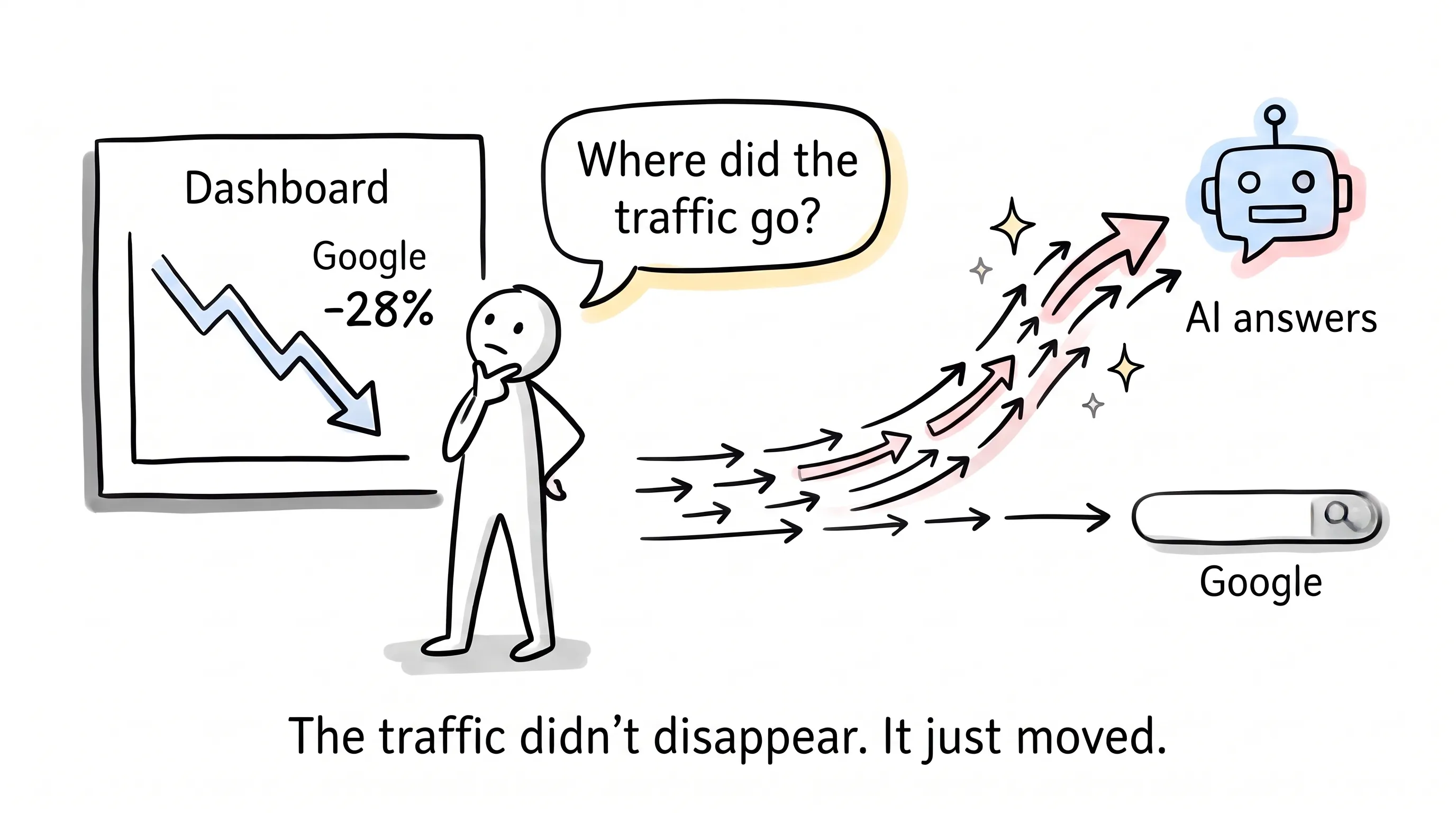
A while back, a friend who has spent eight years in content invited me out for tea. His very first sentence: "Our organic traffic dropped 28% in six months. My boss wants a content slimming plan. Where do you think we should start cutting?"
I told him to put the knife down first.
Before you cut anything, answer me one question: where did the traffic go?
He froze. Traffic dropped, and that's that — the dashboard shows it in plain numbers.
That was exactly the problem. He'd been watching only one dashboard. But today, users look for answers in more places than one.
The traffic didn't disappear. It just moved. If you keep standing at the old address, of course you'll never see the lights on at the new one.
What Are the "Two Search Surfaces"?
What's a search surface? It's wherever users go with a question, looking for an answer.
For years, there was only one: Google. Every move in content strategy — keyword selection, writing, formatting, link building — revolved around it.
Now? Users ask ChatGPT. They ask Perplexity. Even Google's own results page often has AI Overviews at the top, telling users the answer outright — no need to click into any website at all.
That's the second search surface.
The trouble is, the two surfaces score you on completely different systems.
What does Google look at? Backlinks, technical signals, domain authority — a ranking mechanism built up over years. And what do ChatGPT and Perplexity look at? They don't have a link graph at all. They look straight at whether you're deep enough on the topic, and whether your answer actually solves the problem.
Think about what that means.
It means the playbook you used to win with may not work at all on the second surface. The reverse is also true: some content that never ranked on Google at all may be cited by AI every single day.
So the starting point of content strategy has changed. The first question used to be "what words are users searching?" Now it's: on what subjects is this brand genuinely authoritative?
A few years ago, professional teams treated this as an advanced elective in SEO. Today, it's the first exam you have to pass before you write anything.
Three Changes Happening Right Now
I'll break it into three things: measurement has gotten harder, the starting point has moved, and the audit has gone from one target to two.
First, measurement.
Have you ever run into this situation: traffic is falling, impressions are flat, yet your authors keep getting cited by ChatGPT and AI Overviews. So — is that a win, or a loss?
My answer: it depends on what job the content was assigned in the first place.
Content is hard in 2026 because traffic and visibility — two things that used to be tied together — have split up. The same article can lose Google clicks this quarter while gaining AI citations. A page that never once ranked on Google may be getting recommended by ChatGPT over and over.
So your content scoreboard has to run two tracks: one for traditional performance — clicks, rankings, conversions; one for AI visibility — citation frequency, consistency of mentions, and how many platforms you cover. The two tracks don't necessarily move together, but you have to watch both.
There's a particularly sneaky trap here. I call it ghost rankings.
What are ghost rankings? It's when ChatGPT cites your content, even praises your brand — but when the user actually wants to buy or hire a provider, it recommends your competitor instead.
You got seen, you got cited — and the deal went to someone else.
That's not a traffic problem; it's a measurement problem. If the number doesn't exist on your dashboard, how do you fix it?
The teams making wrong calls in 2026 aren't ignoring AI search. Quite the opposite — they take it very seriously. Their mistake is measuring only one surface, then slashing content or adding budget based on half a report card.
Next, the starting point.
Content production used to start with a keyword list. Check search volume, look at competition, assign to pages, schedule production. Keywords were the entry point of the entire assembly line.
Is that process broken? No. But it's no longer the entry point.
The better opening move now is to ask: on what subjects is this brand truly authoritative? Where are the real credentials, real track record, real reputation? The territory that answer draws is your content territory. Keywords? They just map onto that territory — they can't define it.
Why does this matter especially for AI visibility? Because ChatGPT and Perplexity don't run a link graph. They look at topical depth, author credibility, and whether the problem is genuinely solved. Strong backlinks don't guarantee citations; but real expertise plus clear answers can get cited daily even without traditional SEO signals.
Finally, the audit has gone from one target to two.
Let me tell you a true story.
A glossary of 600-plus entries had been essentially dropped from Google's index, with nearly zero organic clicks. A year ago, that would have been an easy call: cut it.
Today? You first have to feed those entries to ChatGPT, Perplexity, and Claude, pull the citation data through their APIs, and see whether they show up in AI answers.
What was the result? Roughly 50 to 80 of those entries were being cited consistently in AI answers.
My goodness — they nearly got wiped out wholesale.
The decision flipped entirely: the cited ones shouldn't just be spared — they should be expanded; the uncited ones get cut or merged.
Don't doubt this: Google organic search is still the main engine of most traffic and revenue today. But ChatGPT, Perplexity, and AI Overviews are already a real second battlefield. Making content decisions while watching only one battlefield is like reading your financials with one eye closed.
One Thing Hasn't Changed
Having covered the changes, I need to pour cold water in the opposite direction.
The fundamentals that grew organic traffic in 2023 still work today. The tectonic plates shifted, but the foundation held.
So the most dangerous mistake isn't failing to keep up with the new — it's throwing out old assets that are still compounding, as if they were old furniture.
Start with keywords.
Keywords aren't dead. They've just moved from the front row of desks to the second row. Content with commercial intent still converts; rankings still bring revenue. In a healthy SEO team, writing briefs, setting strategy, and planning the editorial calendar, keyword research still takes up nearly 20% of the week. Not one of the brands whose traffic is still quietly climbing has stopped doing it.
Keywords are still an input. Just no longer the first one.
Next, content fundamentals.
Clear answers, genuine depth, reliable sources, named authors with real credentials. None of this is some "AI optimization trick" — it's simply what good content has always looked like. You'll notice something: the brands cited consistently in ChatGPT and Perplexity are basically the same ones that hold authority on Google. That's not a coincidence.
But one premise needs to be thought through: not every piece of content has to serve both surfaces at the same time. Force it to do both, and the usual result is mediocre on both.
Some content is born for Google: commercial category pages, high-intent comparison reviews, transactional product detail pages.
Some content is born for AI citations: definitional content, pages that spell out entity relationships, brand authority pages that help ChatGPT recognize "who you are."
For example. When a content marketing agency audited its own site, it found that ChatGPT and Perplexity failed to connect Digital Commerce Partners and Copyblogger. The two have a publicly documented relationship, yet nowhere that AI could read spelled it out.
The fix? Build entity-relationship content on the About page, then create a separate Facts page that lays the relationship out in the open.
A page like that will never bring meaningful Google traffic. It was never born for that.
Before you write a word, be clear about which surface this piece is going to work on.
Some of What Works Is Tactics, Not Strategy
My position: build your content strategy around AI visibility. That's the point this entire article lands on.
But within that strategy, there are indeed some quick-win tactics working right now. While they work, use them.
The most typical: brands writing their own listicles and ranking themselves first. "Best ecommerce SEO agency," "most comfortable yoga pants brand." Self-voting, obvious to anyone paying attention — and it won't rank on Google. But some of these, ChatGPT genuinely cites.
How long will it last? I don't think long. These platforms aren't dumb — the patches will come faster and faster. But if it works today, it works today. Watching your competitors eat the dividends while you sit still isn't prudence; it's falling behind.
So my advice: use it, use it fast, and write down what you used. But don't bet the entire editorial calendar on it. The ground is shaking — a play that buys you citations in Q1 may hurt your credibility by Q4.
What Is a "Surgical" Audit
A strategy that doesn't land is just talk. So how exactly do you wield the knife on the two-surface audit?
Most brands are sitting on 300 or more pages of existing content. Some should be expanded, some cut, some left alone. Run every page through the same decision matrix:
Strong on both surfaces: protect it, don't touch it.
Dropped on Google, rising on AI visibility: expand it.
Failing on both: cut it, or merge it.
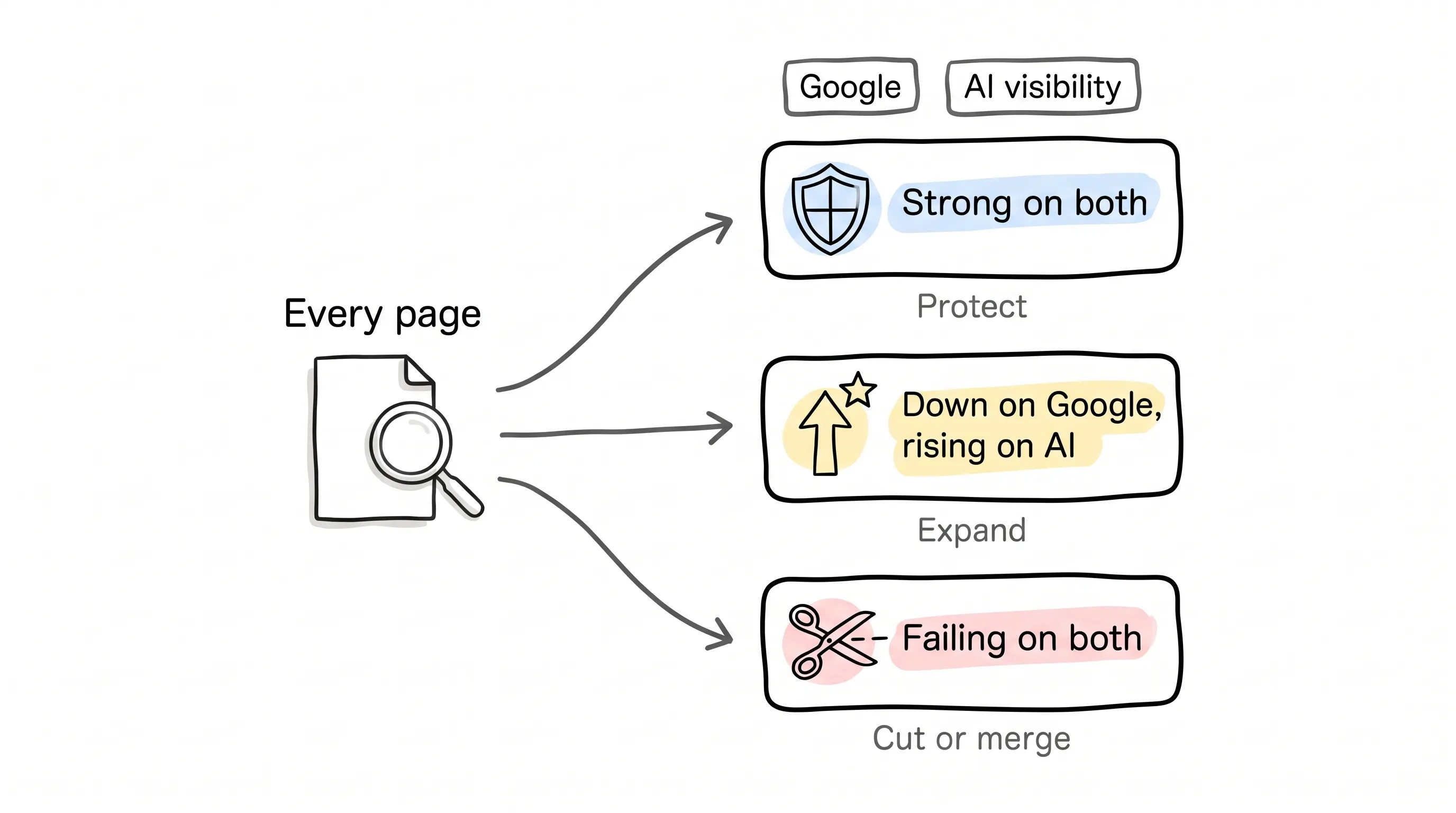
The easiest step to get wrong is "expand or cut." The moment Google traffic dips, your instinct has two moves: rewrite everything, or cut everything. The surgical approach is to first figure out why it stopped working on Google, then check whether it's quietly working on the other surface — and only then make the diagnosis.
So what exactly does "expanding" mean?
Not making the article longer — filling in what the other surface is missing.
For Google: does this page actually solve the problem, or just gesture at it? Is the structure clear, are the internal links enough, can the depth carry a ranking?
For AI citations: the watchword is credibility. Those are the signals ChatGPT and Perplexity look at — the things Google has always rewarded in theory and now demands in practice: authors named with verifiable credentials, not "editorial team"; evidence backed by first-party data and original research, not just rehashing others; content that's fresh — for fast-moving topics, AI roughly favors the last 13 weeks; and depth enough for the page to prove the brand truly knows this industry, rather than stopping at the intro level.
As for when to cut? Cutting is still right — it just can't be the default move. A page that Google doesn't index, where ChatGPT and Perplexity draw a blank, and that has no strategic use: cut it. Even when AI ignores thin content, it still dilutes crawl budget and topical authority on Google's side.
Remember: the two-surface audit can't save bad content. What it saves is the good content that has been quietly working all along while you never measured it.
How Does New Content Grow?
Once the existing content is audited, what about new content?
Start with authority mapping, not with a keyword list.
For the friend who lost 28% at the start, the answer isn't in the keyword list either. It's in a more painful question: on what subjects is this brand truly authoritative? And where's the evidence?
The territory that answer draws is finite. You can't build authority on 40 unrelated topics, but you can absolutely go deep on 8 to 10 topics the brand genuinely understands. Keywords will then map onto that territory naturally, instead of dragging you into producing content the brand has no business writing.
Authority mapping doesn't need new tools. It needs one honest self-question: if you asked ChatGPT right now to describe what this brand is good at, what would it say? Is it right? Is it what you want to hear? If the answer is no — or worse, if it can't say anything coherent at all — congratulations. Your content strategy starts right there.
Then, the editorial calendar gets two entry points:
One is Google opportunity: search volume, competition, commercial intent, category gaps. The source of most revenue, unlikely to change in the short term.
One is AI citation potential: topical depth, credibility, freshness, and fit with the question. It determines whether you show up in ChatGPT, Perplexity, and AI Overviews. It doesn't always align with Google opportunity — and it doesn't need to.
High-intent category pages don't need to please Perplexity. Brand authority pages don't need to rank for any keyword. Before writing a brief, be clear about which entry point this piece is answering.
Finally: two surfaces, two measurement systems, reviewed on the same rhythm.
The traditional track: clicks, conversions, keyword rankings, category page performance. The main revenue signal for most brands — check it monthly, act on 60-to-90-day trends, and don't get dragged around by daily swings.
The AI visibility track: citation frequency in ChatGPT, Perplexity, and AI Overviews; whether brand mentions stay stable when you phrase the questions differently; and whether the AI says good things or bad things about you when it mentions you. Run a fixed question list monthly, log the changes — enough to catch the big shifts.
The goal isn't to make the two curves move in lockstep. The goal is that when you make decisions, the full picture is in front of you — not half of one.
There's Only One Real Mistake
There are two ways to get it wrong.
The first: treating the present as a total restart — throwing out the old strategy, rebuilding everything around AI search, and in chasing citations, abandoning fundamentals that are still compounding.
The second: pretending the second surface doesn't exist — keeping your eyes on Google traffic alone, starting from the keyword list as always, then looking up 18 months later to find your visibility has been worn away in places you never looked.
Both extremes lead nowhere.
The real move is actually quiet: keep the fundamentals, add a layer of AI visibility measurement, and audit the existing content before creating anything new.
At the end of the day, most brands have more content than they need and less authority than they think. The two-surface audit will put both truths on your desk at the same time.
My friend figured it out eventually. He didn't cut the team; he ran a two-surface audit first. He cut far less than planned, and the slice he kept is bringing him new traffic he'd never measured before.
The question at the heart of content has never changed: what does this brand actually know? And how do you make the right people, on the right platforms, truly know it?
What changed is only where you answer that question.
Here's to you: may you always find the new address before the answer moves.
Translator's Notes
- "幽灵排名" is rendered as ghost rankings — a term coined in the source, kept as a coined term in English.
- "地壳动了,地基没塌" is rendered as "The tectonic plates shifted, but the foundation held" — the geological image is preserved in natural English idiom.
- All platform/brand names (Google, ChatGPT, Perplexity, Claude, AI Overviews, Digital Commerce Partners, Copyblogger) are preserved verbatim per the source.
Continue reading
Related articles

It's 2026: Stop "Buying" AI Tools for Your Marketing Team — Start "Hiring" AI Agents
This learn article explains how AI agents differ from standalone AI tools in marketing, outlines three agent categories — build-your-own platforms, CRM-native agents, and vertical tools — and covers use cases across SEO, social media, advertising, and reporting, plus criteria for choosing one.

What Is GEO? How Your Brand Gets "Mentioned" in the Age of AI Search
An explainer on GEO (Generative Engine Optimization) for e-commerce and DTC brands: how it differs from SEO and AEO, why AI answers shape brand visibility, and eight practices covering question-focused content, consistent brand messaging, structured pages, external evidence, comparisons, and AI mention tracking.

AI Is Already Making Decisions for Your Customers. Are You on the List?
A learn article explains GEO (Generative Engine Optimization): why AI-generated answers now shape which brands customers see, and how SEO fundamentals, entity clarity, citable evidence, and monthly measurement affect visibility in AI answers.