
An AI Influencer Makes $10,000 a Month. But You're Probably Not Counting the Full Cost.
An in-depth article on AI influencers: how generative-AI virtual personas differ from CGI avatars, why brands use them, what consumer-trust data shows, and a checklist for total cost, disclosure compliance, and human sign-off, with brand examples.
A few days ago, I was scrolling on my phone and stumbled onto a video.
An influencer was teaching makeup, wearing the latest viral lip gloss. Then the camera cut: she slid into a luxury car, and next she was taste-testing one trendy snack after another. The comments were flying: "So beautiful." "Drop the link."
I thought to myself: this girl really knows how to make money.
Then I looked her up.
Oh my god — she isn't human.
Her name is Aitana Lopez. She has over 400,000 followers on Instagram, billing herself as a "virtual fitness lifestyle influencer." Behind her is a tech company in Barcelona called The Clueless, which built her with AI. Amazon, Victoria's Secret, Olaplex, Razer — they've all partnered with her.
Reportedly, she makes more than $11,000 a month. And all of it goes into her and The Clueless's pockets.
Impressive. Seriously impressive.
Eleven thousand dollars a month — at the exchange rate, that's roughly 80,000 to 90,000 RMB. She doesn't sleep, doesn't eat, doesn't catch flights, doesn't even have to think about what to wear today. Because her "today" was designed too.
Tell me: who wouldn't want this business?
I recently studied this whole thing from start to finish. What I found: AI influencers look beautiful, but hidden inside is a bill that's remarkably easy to overlook.
Today, I'm going to walk you through that bill, line by line.
1. What Is an AI Influencer?
First, let's get the concept straight.
What is an AI influencer?
Simply put: a virtual person whose face, voice, and personality are all generated by generative AI. She posts content online, takes on sponsorships, and does everything a human influencer does.
But here's the thing — not every "virtual influencer" is an AI influencer.
Take the "singer" Miquela Sousa. She was created back in 2016, but with hand-drawn CGI (computer-generated imagery) by artists. Her music is made by real singers, songwriters, and musicians. She's worked with Gucci, Prada, and Calvin Klein, and was the first virtual person to sign with a modeling agency — CAA in 2020, after previously being at WME (both major talent agencies).
So "virtual influencer" is the big umbrella. AI influencers are the small subset of that group made with generative AI.
Does this distinction matter?
It matters. With a CGI virtual human, every frame is drawn by a human. With an AI influencer, the content is generated by machines. The first kind of "fake" is one you know is made; the second kind is one you can't see. And that leads straight into the point of this whole piece: trust.
2. Why Do Brands Love Her?
Let me tell you why one company does this.
Ruben Cruz, founder of The Clueless, put it this way: he built Aitana because he didn't want to be at the mercy of "people with egos who just want to strike a pose and get paid."
What does that mean?
Plainly: human influencers are a nightmare to manage.
Think about it. A human influencer's personality, habits, creative process, and schedule — none of it is up to you. He wants to rewrite the script — do you let him? He's in a bad mood today, your video grinds to a halt. He posts something inappropriate at midnight, and your brand takes the hit.
An AI influencer won't do that.
She reads your script word for word. She produces videos, images, and multilingual versions, all in your brand voice. She's never even late.
Brands love AI influencers for three reasons: controllable output, lower cost, unlimited content.
Human influencers need sleep, food, and school pickups. An AI influencer is always online.
Sounds like a perfect résumé for a "human-shaped employee."
But there's a catch.
3. What Do Consumers Think?
A brand liking it doesn't count. Only consumers liking it counts.
So what do consumers think?
Let me give you three numbers.
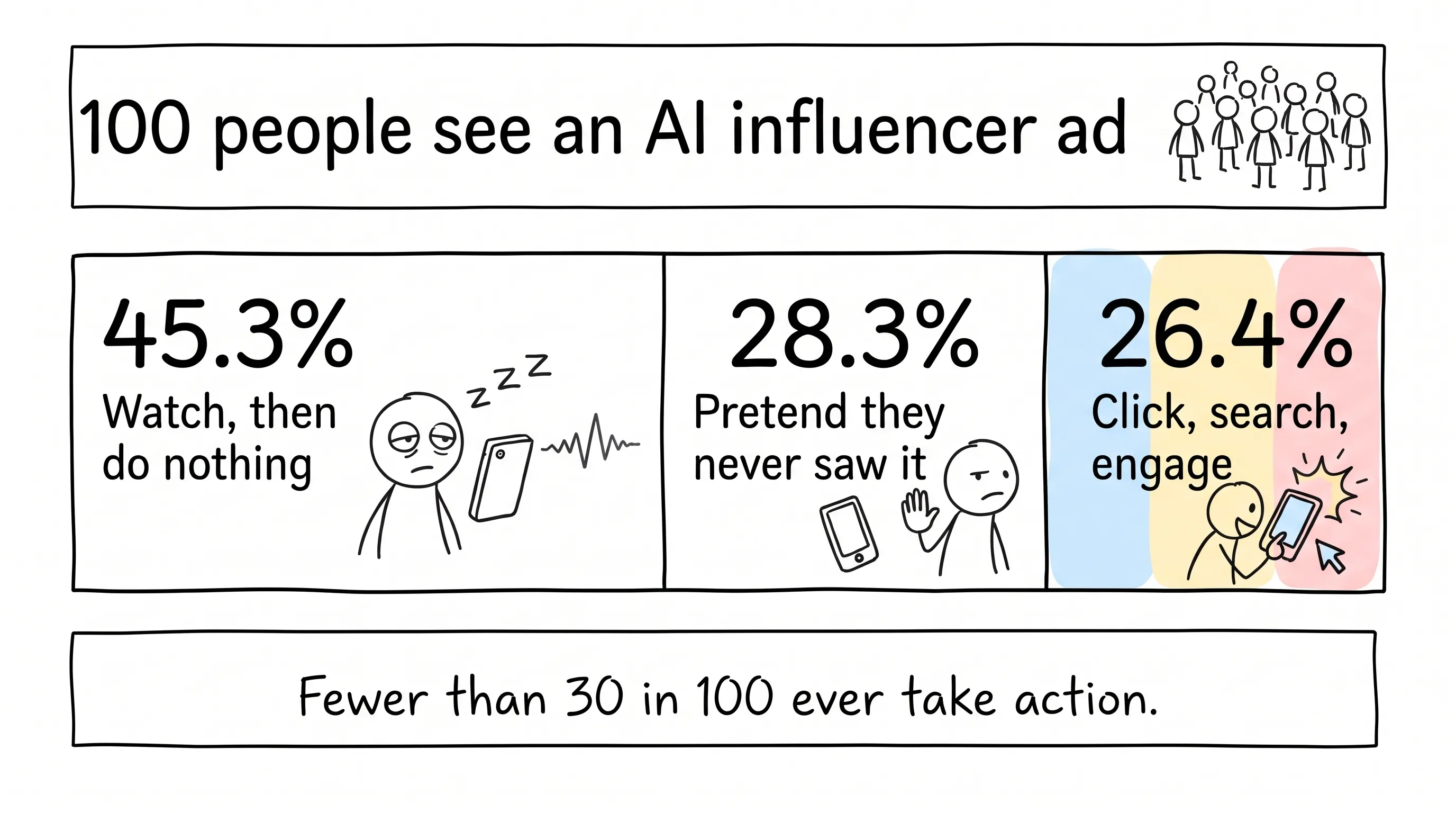
The first number: 45.3%. A study published on ResearchGate found that 45.3% of consumers who see an AI influencer ad watch it all the way through — and then do nothing. Just, watch.
The second number: 28.3%. More than a quarter of people see an AI influencer ad and simply pretend they never saw it.
The third number: 26.4%. Only 26.4% of consumers actively click, search, or engage.
In other words, out of 100 people who see an AI influencer ad, fewer than 30 actually take action.
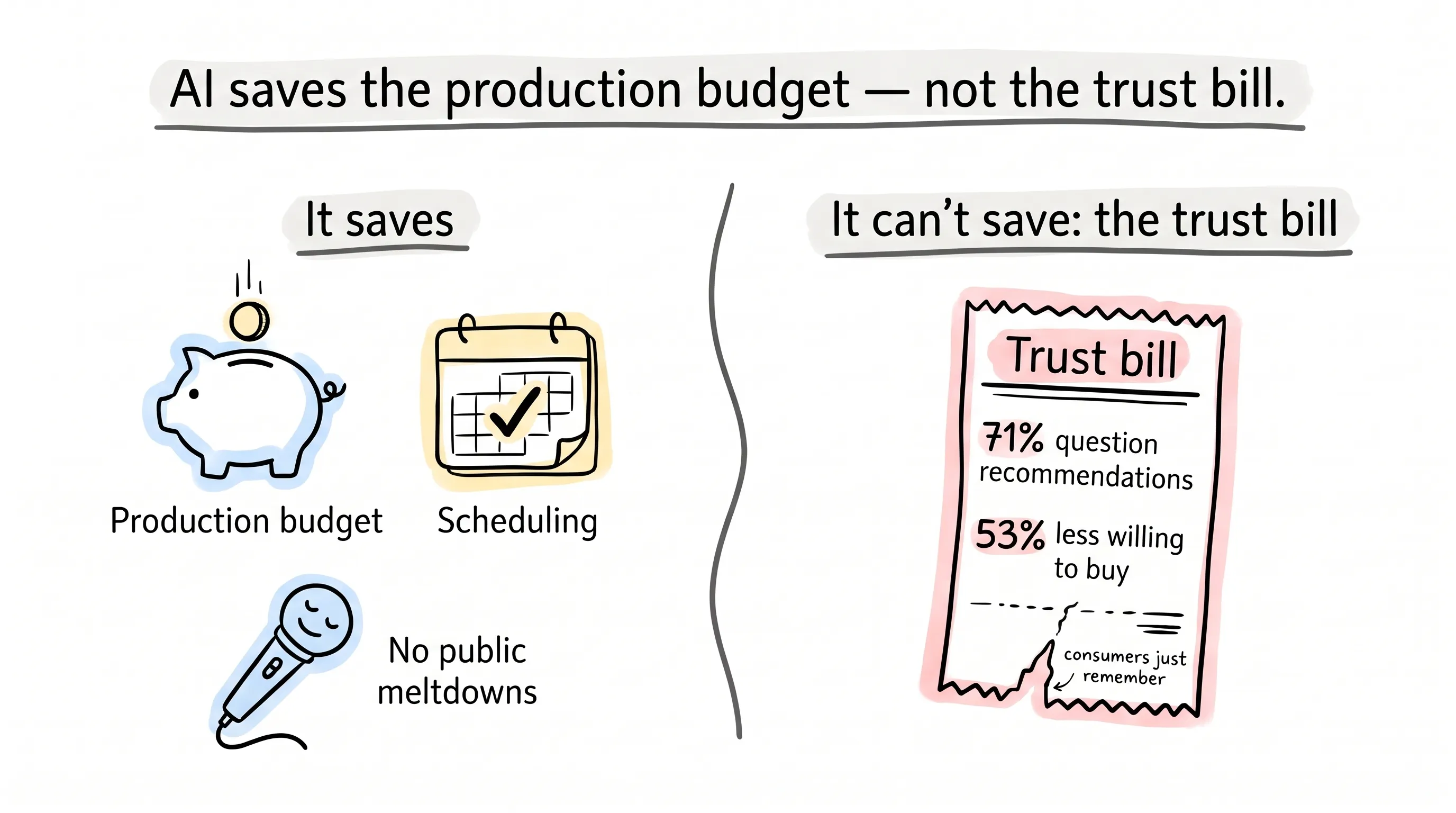
And it gets worse. I dug up an even more painful figure: a Clutch survey found that when consumers discover a human influencer is using AI-generated content, 71% start to question that influencer's recommendations, and 53% become less willing to buy the brand's products.
So even a human influencer loses trust for using AI content. If you build an AI influencer from scratch, how could trust not drop?
There's more: nearly 90% of consumers believe AI-generated content should be disclosed.
The interesting part is that not all AI gets rejected. The same survey found 42% of consumers feel positive about AI used in educational content, but 64% believe AI becomes untrustworthy when it's used to oversell products.
See the difference?
Consumers don't hate AI. They hate AI used to deceive them.
4. So How Do You Actually Do the Math?
OK, now let's talk money.
Do AI influencers actually save money?
One caveat first: most of the AI influencer cost figures you find online come from vendors and agencies themselves, so their value as a reference is limited. Some say building an account costs $15,000 to $100,000, plus $500 to $15,000 a month; others claim you can save 80% to 95%.
So take those numbers as noise, not gospel.
What you really need to calculate is the total cost.
What's total cost?
It's counting every piece of this, from start to finish.
-
Production. This is where you save the most. Once an AI influencer is built, the marginal cost of one more piece of content approaches zero. No appearance fees, no travel, no scheduling conflicts. Publishing one more post costs you almost nothing.
-
Risk management. One survey found 58% of brands like AI influencers because there's "no risk of a public meltdown." If the influencer can't blow up, your brand won't be dragged down with her.
True — but risk doesn't disappear. It just changes shape.
Before, the risk was the influencer drinking, causing scenes, saying the wrong thing. Now, the risk is your own content: AI-generated material may not look human, may say the wrong thing, or may clash with your brand voice. You traded the risk of "someone else's mouth" for the risk of "your own mouth."
- Disclosure compliance. This cost is rising. Instagram and TikTok each have their own AI labeling rules. Article 50 of the EU AI Act has applied since August 2, 2026. New York State, too, has a law effective June 9, 2026, requiring ads featuring AI synthetic performers to be disclosed.
The direct costs here are labels, templates, and legal review. But the hidden cost is trust: consumers don't say anything — they just remember.
-
Rework. AI-generated content is often flawed: an extra finger, expressions that swing wildly, cultural misreads, wrong tone. None of that rework shows up in the vendor's quote.
-
Public relations. If consumers find out you swapped a human for AI and start calling you out for "replacing human creators," who steps up to answer? That playbook needs to be ready in advance.
-
Community. A human influencer comes with a built-in audience and relationships. An AI influencer has nothing and has to build it all from zero. And here's a number that stings: in the first eight months of 2025, brand collaborations with AI social accounts fell 30% compared with the same period in 2024.
-
Measurement. Whether an AI influencer saves you money ultimately has to be proven by data. You need a "human control group" — same content, same budget, side by side. That means analyst hours and tool costs.
Add these seven items up, and you understand one thing:
What an AI influencer saves you is the production budget. What it can't save you is the trust bill.
5. Use It — But Don't Abuse It
So when can you use one?
Here's a test.
When it works: what you're making is "content" — high volume, multiple versions, multiple languages, strong visuals, strong entertainment. Think gaming, fashion campaigns, a virtual host streaming, doing tutorials, serving as a brand ambassador.
Samsung did exactly this. Their virtual human Sam didn't just post content — she even joined the Galaxy Unpacked launch event live from Seoul, and across Latin America she hosted livestreams, ran tutorials, and anchored shows. In January 2024, she was named Samsung's AI ambassador. Samsung said her appearance boosted sales on its Mexican livestream shopping pages by 30%.
This is an example of an AI influencer as a "brand employee." She isn't an "influencer" — she's "a character of the brand."
There's also an example that pairs "fiction" with "fiction." Kyra, a virtual influencer from India, was launched in January 2022 by FUTR Studios. Her first partnership was sci-fi-themed content for the earphone brand boAt. Then Amazon Prime Video planted her into the promotion of its sci-fi series The Peripheral — they even replicated the VR helmet from the show for her.
Why? Because sci-fi is fiction to begin with. A fictional AI influencer inside fictional sci-fi doesn't clash.
Then there's Dior. In 2018, they had the virtual human Noonoouri recreate the Rouge Dior commercial. The original was performed by real-life actress Natalie Portman. Noonoouri's version was nearly a one-to-one remake. Noonoouri is cartoon-styled, obviously "drawn" — nobody gets fooled. But this example also reminds us: when borrowing a real actor's work, likeness rights and licensing must be settled in advance.
And Miquela. In 2022, she partnered with PacSun on back-to-school and holiday campaigns. She openly admits she's "a robot living in Los Angeles," so nobody is misled. But there's a detail here: she has taken part in Black civil rights movements and voter mobilization drives. Who said those words? Her creators. So when a brand pushes a virtual persona onto social issues, it has to be careful — because the "stance" of "it" is written by "someone."
And when can't you use one?
In one sentence: any category that sells through "I've tried it and it really works" is off-limits.
Skincare claims, supplements, health, parenting, personal finance. In these categories, consumers buy a "human's real experience." An AI influencer cannot say "I've used it and it really works" — because she would be lying.
6. Leave the Final Call to Humans
So what if you want to use AI-generated content without throwing away trust?
My advice: let AI draft, let humans decide.
Concretely, here's what you need to do:
-
Write a "voice guide." The brand's tone, what to say, what not to say, which words to use, which to avoid. AI generates its content against it.
-
Tiered approval. Everyday content: the social media lead signs off. Content with product claims: brand and social media sign off together. Anything touching health, finance, or politics, or using a real person's likeness: brand, legal, and social media all sign off.
-
Set a "red line." One named person who can pull any piece of content at any time. Who?
-
Disclosure templates. Three situations — AI influencers, human influencers using AI content, and paid partnerships — pre-write the templates, have legal review them, then reuse.
-
Regular review. Each quarter, compare recent content against the "voice guide" to see if it's drifted.
That's it.
An AI influencer can be a character of your brand. But it can never be your brand's human.
Finally, let's go back to the beginning.
Aitana Lopez: $11,000 a month, 400,000 followers, a luxury car, the viral lip gloss. It's all beautiful.
But you'll notice: her fans will never cry for her, never grow up alongside her, never leave a long, encouraging comment when she's at her lowest.
A human influencer sells trust. An AI influencer sells a persona. Trust is earned. A persona is manufactured.
So before you decide whether to use an AI influencer, get clear on one thing: do you want the content, or the trust?
If you only need content, and your content doesn't depend on "real experience," then an AI influencer might genuinely save you money.
If what you want is that trust, then set the savings aside for now.
May your content always have a pair of real hands behind it.
Continue reading
Related articles

When AI Does the Creative, Mistakes Come in Batches Too
A learn article on the risks of using generative AI for marketing creative across brand, legal, compliance, and operational layers, with case examples and seven practices for review, rights clearance, documentation, and vendor governance.
Which AI Should Your Startup Actually Use for Marketing?
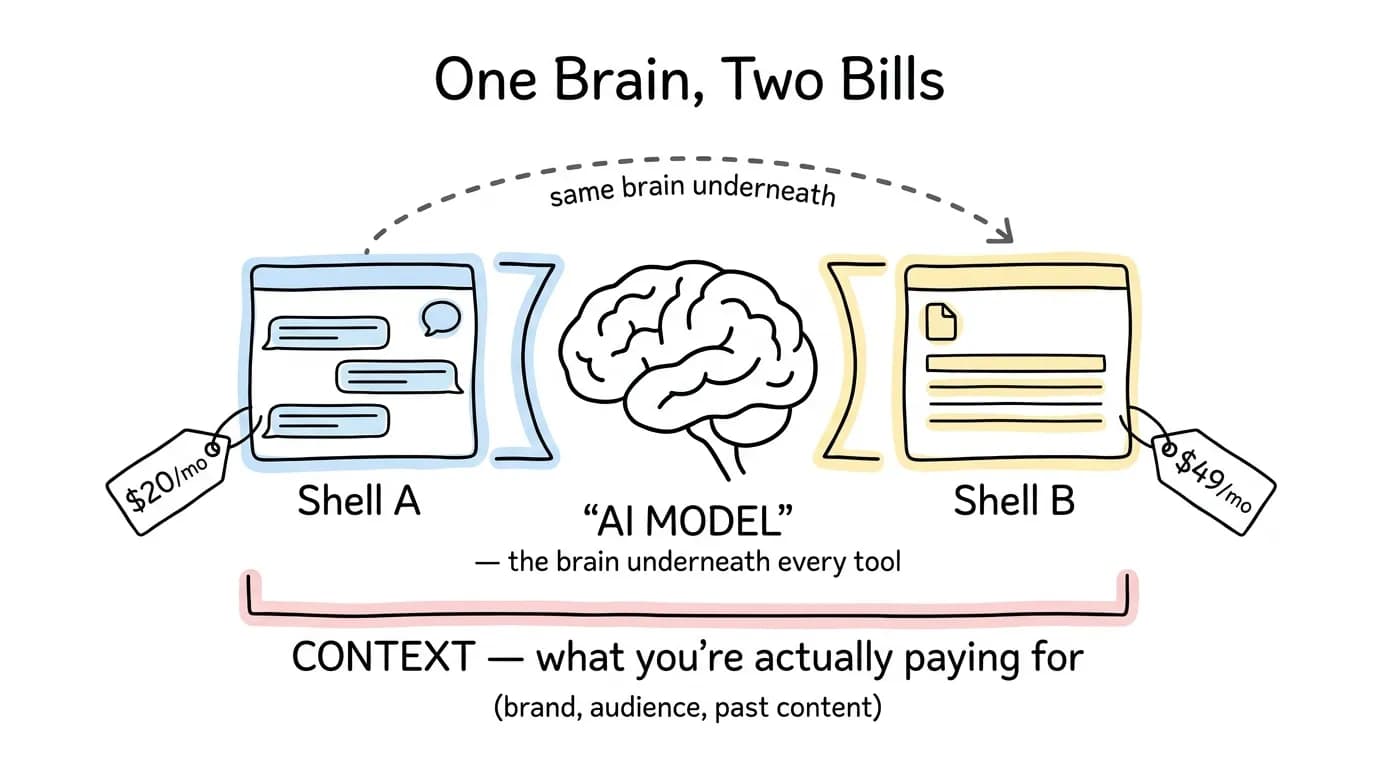
A startup marketing guide explaining the difference between AI models and tools, sorting tools by job (writing, research, design, leads, email, video ads), and outlining a 30-day test plan for choosing them. It also covers generative engine optimization and budget trade-offs.
31 AI Marketing Tools, Reviewed One by One: How Exactly Should You Spend the Money?
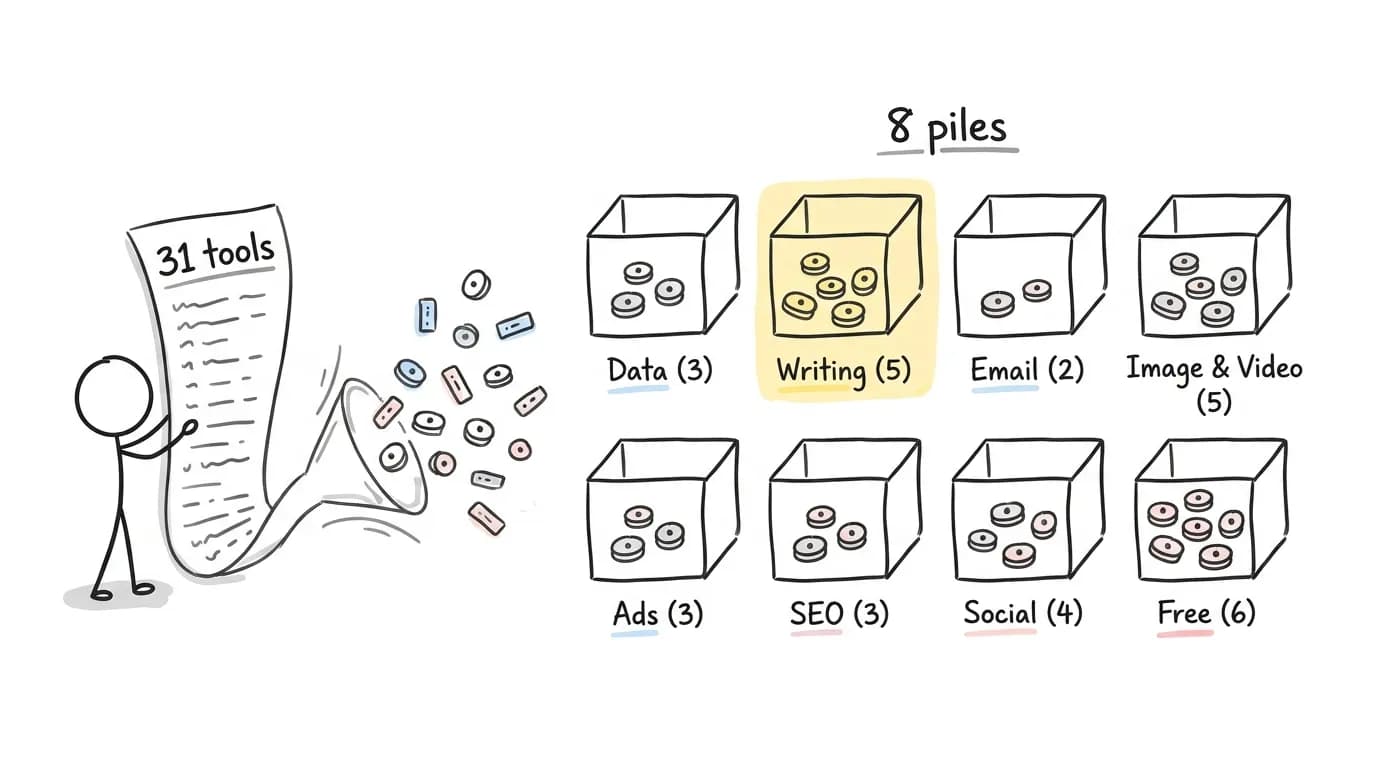
A review of 31 AI marketing tools grouped into eight categories, covering data, content, email, video, ads, SEO, social, and free options, with guidance on choosing one strong tool for your most frequent task and testing free tiers first.