
The EU Is Cracking Down on 'Internet Addiction' and 'Tricks': A New Bill That Touches Both Your Wallet and Your Phone
A plain-language walkthrough of the EU's draft Digital Fairness Act: banning dark patterns, off switches for autoplay and infinite scroll, mandatory 'Ad' labels on influencer posts, free-trial renewal warnings, loot box and pay-to-win restrictions for minors, drip-pricing transparency, and the right to a human customer
Let me start with a question.
Have you ever had this experience: you tap on a video, telling yourself it's just five minutes. Then you snap out of it — and two hours are gone.
Or you signed up for a free trial, forgot to cancel, and quietly got charged for a year.
Or a blogger recommended a product, you fell for it, clicked buy — and only after it arrived did you realize that post was an ad. They never said so. Or the disclosure was so tiny you couldn't even see it.
These three things may seem unrelated.
The EU believes they share the same underlying problem: the money you spend online and the time you spend online may not be decisions you actually made — they may have been engineered for you.
This Wednesday, the European Commission put forward a new bill, the Digital Fairness Act (DFA), aimed squarely at fixing all of this.
The bill hasn't passed yet, but the debate has already started. Let me walk you through the most important parts, one by one.
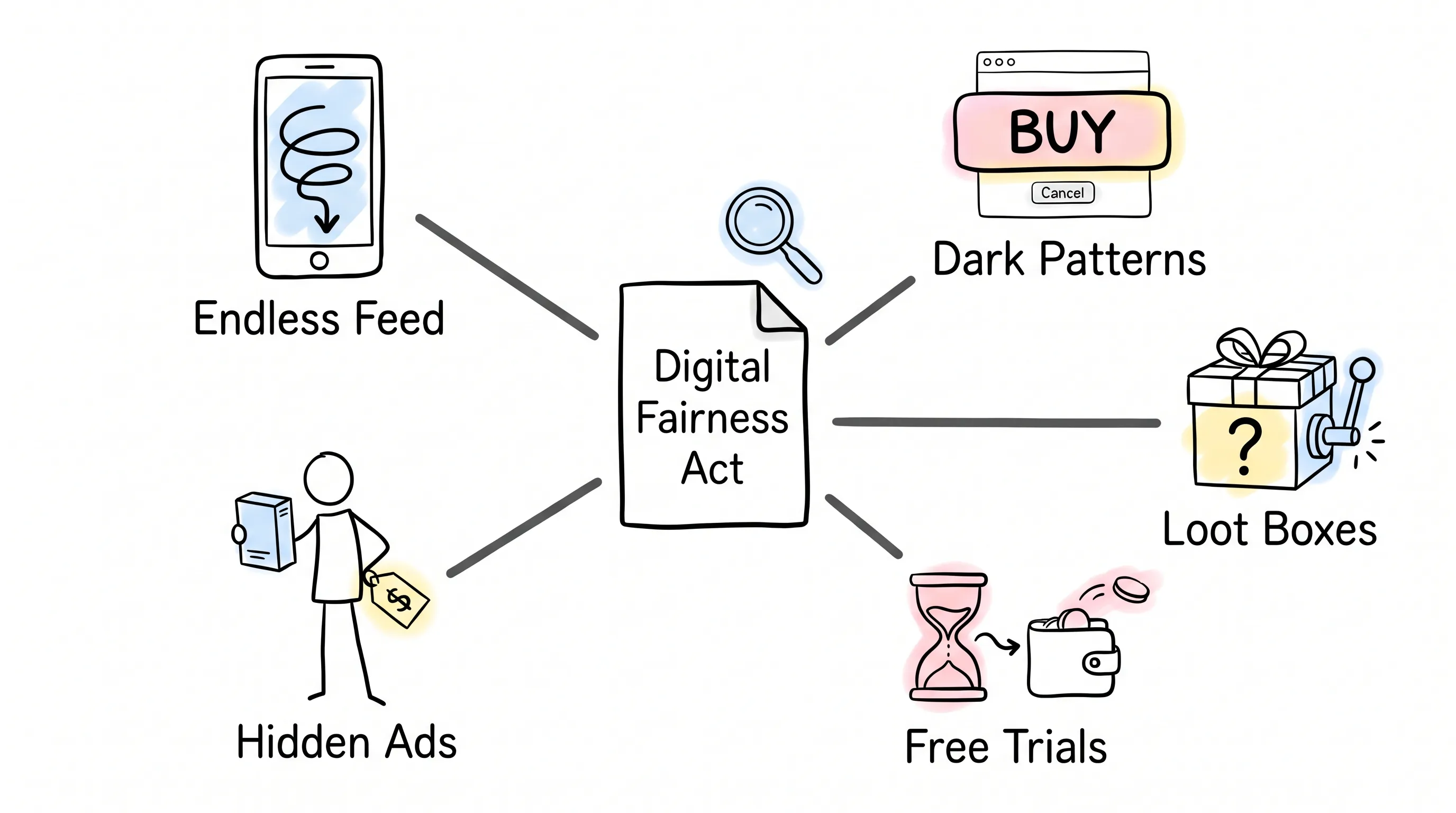
First: What Is a "Dark Pattern"?
Dark patterns — that's what the industry calls them.
What does that mean?
You want to cancel a subscription, and you can't find the cancel button no matter how hard you look. The renew button? Huge and bright, one tap and you've hit it. You think you're clicking "close" — but you're actually agreeing to pay.
That's a dark pattern. Using design to push you into decisions you never wanted to make.
The DFA's answer is blunt: ban them.
Second: The Design That Won't Let You Stop
Why does a video feed swallow two hours at a stretch?
Because for many platforms, the product is designed with one goal: making sure you don't stop. Videos autoplay one after another — you don't have to make any decision, the next one just arrives. The feed scrolls on forever — there's no bottom to reach.
The DFA says: platforms must give users a switch. You have the right to turn off these "addictive features."
Think about how subtle this rule is. Platforms make money on how long you stay; now regulators are demanding that the "brake" be handed back to the user. That amounts to telling everyone who's still scrolling at 2 a.m.: not being able to stop may not be entirely a matter of your self-control.
Third: Influencer Marketing Must Be Clearly Labeled
When a blogger recommends a product, is that an ad?
From now on, it has to be stated plainly. The DFA requires brands that promote products through influencers to attach a clear label — the word "Ad," placed right there in plain sight.
My first reaction when I read this: overdue.
Fourth: Free Trials Must Warn You Before They End
Free trials are great business. How great? So many people forget to cancel and get charged on autopilot.
From now on, platforms must warn you before the trial ends: when it ends, how much the renewal costs — all in one go.
Fifth: It Reaches Into Video Games
This is the most contested item.
The DFA bans pay-to-win features for minors, and bans selling loot boxes.
What's a loot box? You pay to open a mystery box; what you get is pure luck.
Putting a lottery machine into a product built for children isn't payment — it's a gambling table.
There's a companion requirement too: virtual currencies in games must display their real-world value. A child thinks they're spending 100 coins; actually they're spending 100 yuan. The regulator wants the math laid out in plain sight.
Two More, Small but Very Practical
One is "drip pricing." A flight is listed at 500; you click in, and taxes, service fees, and seat-selection charges get added one by one — by checkout, it's 650. Not anymore: you must see the full price before you pay.
The other is more interesting. You can demand a human customer-service agent — no endless bot stalling allowed. And if you authorize an AI agent to place an order on your behalf, you keep exactly the same rights as if you'd bought it yourself.
Yes, the bill has already anticipated the day when "AI shops for you" — and written the rules in advance.
How Much It Can Fine, How Much It Can Save
Two numbers.
Penalties: companies that violate at scale can be fined up to 6% of annual turnover. And if a single problem affects two-thirds of the EU's 450 million people, the European Commission can step in directly — investigate and fine — without waiting for each member state to act.
Savings: the EU has run the numbers itself — these measures could save consumers up to €13.7 billion a year. That's over a hundred billion yuan.
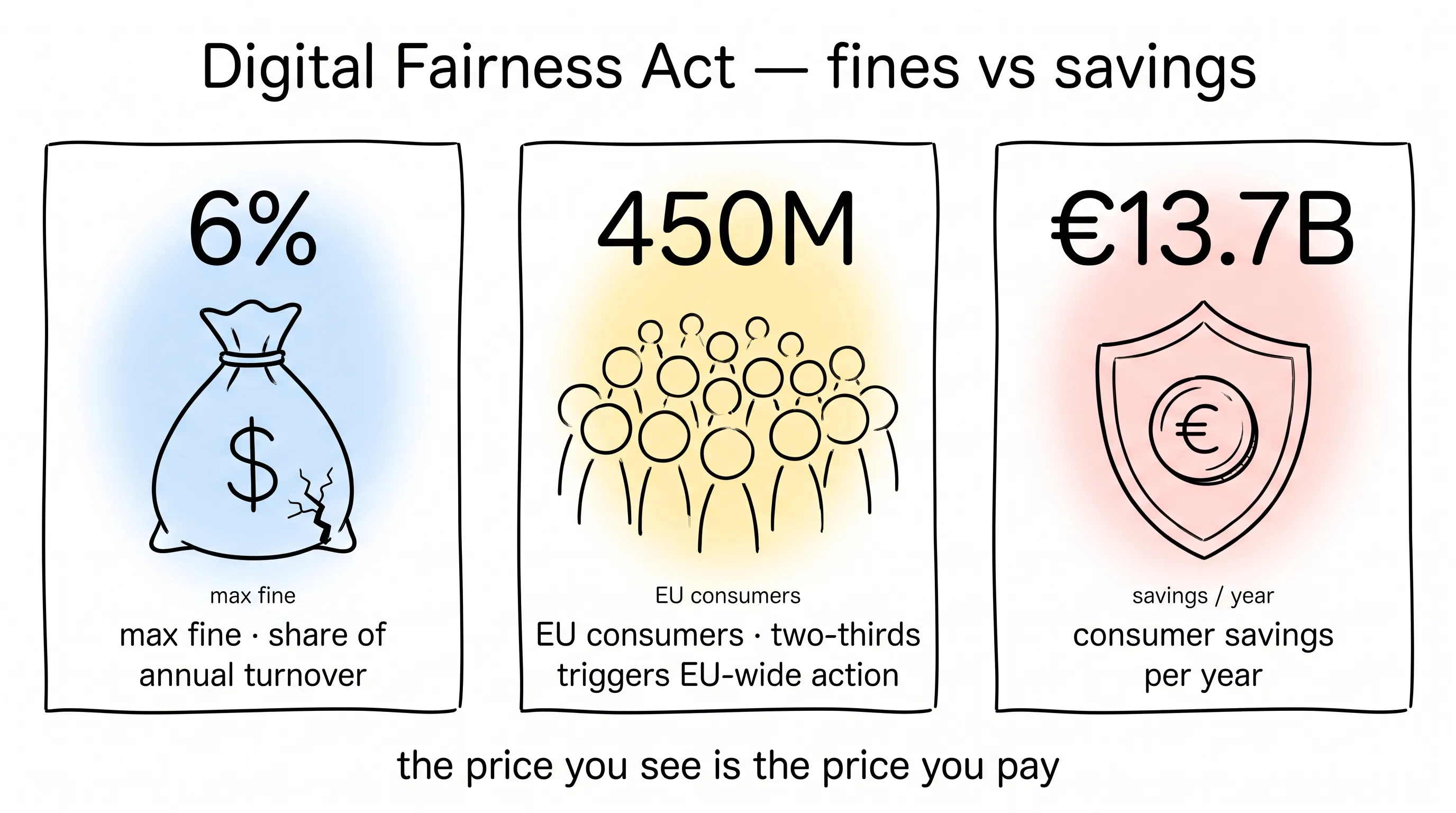
Michael McGrath, the EU Commissioner for consumer protection, put it bluntly: with cost-of-living pressures this heavy, consumers must be able to trust that the price they see is the price they pay — and that they weren't manipulated into spending more.
The Supporters and the Critics Have Both Showed Up
Agustin Reyna of the European Consumer Organisation called it "a much-needed tool to give consumers back control over their time and money." Laura Ballarin Cereza, a Spanish Member of the European Parliament, was more measured: consumer law should be a safety net, and children and adults alike need a safer online space.
The opposition is loud too.
BusinessEurope, which represents companies across Europe, warns that the new rules will bring "unnecessary obligations and overlapping requirements," undermine legal certainty, and clash with the EU's own push for a "simplification agenda."
The two major gaming industry associations are even harsher: the draft "doesn't work, is unnecessary, and is disproportionate," and would "devastate" the competitiveness of the European games industry.
Both sides actually have a point. One says consumers have been gamed by these tricks for too long; the other says rules keep stacking on rules, and companies are running out of breath.
My take: the tricks are designed, and the rules can be designed too. The question is who they're designed for. At least this one bill is plainly designed for consumers.
An Interesting Omission: Dynamic Pricing Isn't Banned
One more thing worth mentioning.
This time the EU banned drip pricing, but not dynamic pricing — the practice of adjusting prices in real time based on demand.
That's not a coincidence. In 2025, when the British band Oasis reunited for a tour, ticket prices surged with demand and the whole thing blew up — dynamic pricing has been under the spotlight ever since.
The EU's choice: don't ban it, but make it transparent. Ticketing platforms must say exactly how many tickets remain at a given price.
Why not ban it? My guess: dynamic pricing is itself a market behavior, and a blanket ban would hurt the wrong people. But laying the cards on the table — letting buyers decide whether to buy — that's something you can regulate.
Regulate the behavior, or regulate the information? This time, the EU chose the latter.
What Happens Next?
This is still just a draft. Next comes the slow negotiation and tug-of-war with the EU member states and the European Parliament. Whether it passes, and what it becomes, is anyone's guess.
But the direction is already on the table: dark patterns, infinite scrolling, hidden ads, silent charges, lottery machines for kids — all of them have been named.
Back to that night from the beginning — the one that was supposed to be five minutes and turned into two hours.
From now on, when you tap "turn off autoplay," that tap will truly be yours.
Here's hoping that from now on, every time you spend money online, it's money you actually meant to spend.
Continue reading
Related articles

It's 2026: Stop "Buying" AI Tools for Your Marketing Team — Start "Hiring" AI Agents
This learn article explains how AI agents differ from standalone AI tools in marketing, outlines three agent categories — build-your-own platforms, CRM-native agents, and vertical tools — and covers use cases across SEO, social media, advertising, and reporting, plus criteria for choosing one.

Did the Money You Spent on AI Marketing Ever Come Back?
A guide to measuring AI marketing ROI across three layers: ad reports, sales pipeline, and the financial ledger. Covers metrics such as ROAS and CPA, eight dashboard metrics, industry benchmarks, and common measurement mistakes.

How to Pick a Creative Automation Platform: First, Figure Out What These Eleven Actually Do
A learn article sorts eleven creative automation platforms — including Bannerflow, Celtra, Smartly.io, and Storyteq — into four functional groups and proposes five evaluation questions covering publishing reach, automation depth, ease of adoption, team fit, and verifiable evidence.