
How Many of AI Marketing's Big Promises Have Actually Delivered by 2026?
A 2026 retrospective on AI marketing: what landed (AI drafting with human review, automated ad bidding, plain-language data queries, tightly scoped service bots), what overpromised (autonomous budget calls, full personalization, cost savings), and how GEO is reshaping search visibility.
A few days ago, I had dinner with an old friend who runs an e-commerce business.
He told me something that stuck with me. In early 2023, at their company's annual meeting, the boss stood up on stage and declared: within three years, 80% of our marketing content will be written by AI, and the copywriting team will be disbanded on the spot.
It's now 2026.
The copywriting team wasn't just left intact — it actually added two new positions, dedicated to fact-checking what the AI writes.
We both laughed when he finished. But after the laughter, I found myself thinking this story deserves a serious accounting.
Over the past three years, what has AI actually delivered in marketing, what has it overpromised and underdelivered on, and what separates the two? Very few people have laid it out clearly. Today, let's settle that account.
The Bottom Line, Up Front
If you only remember one sentence from this piece, make it this one:
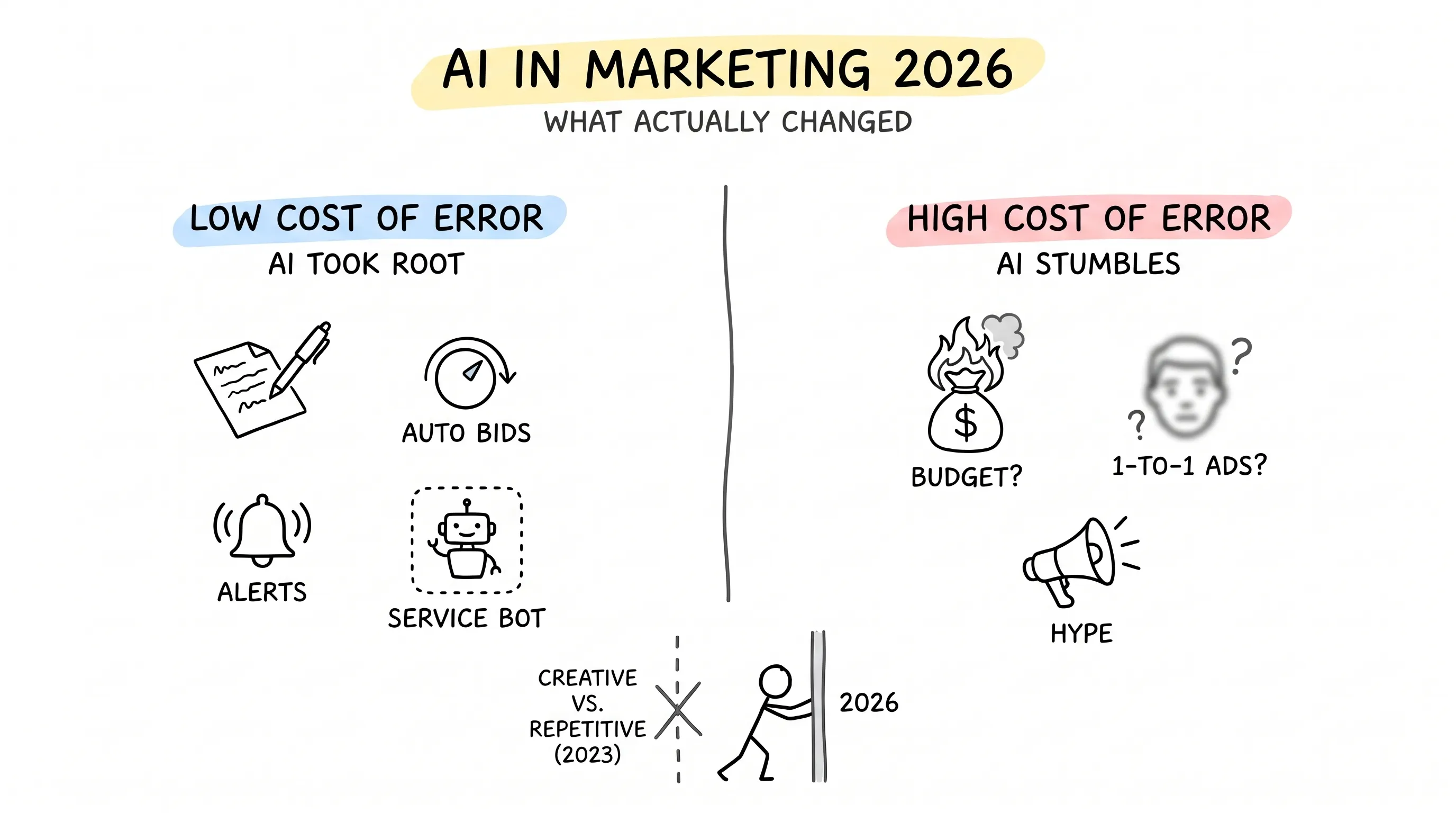
AI has taken root where its work can be verified and constrained; AI struggles where you expect it to make its own calls.
Why do I say that?
Back in 2023, everyone assumed the dividing line ran between "creativity" and "assembly-line work": machines would swallow the repetitive labor, and humans would hold the creative high ground.
Three years on, it turns out the line was drawn in the wrong place. The real line runs between "low cost of error" and "high cost of error."
Put simply: what determines whether AI can actually land is whether you can check its work and catch its mistakes. Whether it's creative has little to do with it.
One more thing to clear up first: there is no single thing called "marketing AI." Tools for writing, for generating images, for producing video, for forecasting sales, for automating ad placement, for chat — these are dozens of distinct technologies, each maturing at its own pace. Treating them as one monolithic thing is the root reason the 2023 wave of predictions all went off the rails together.
Where the technology matured, it became the default setting overnight. Where it didn't, no amount of budget or fanfare could prop it up.
Every account below is settled against that line.
What Actually Landed: Four Things First
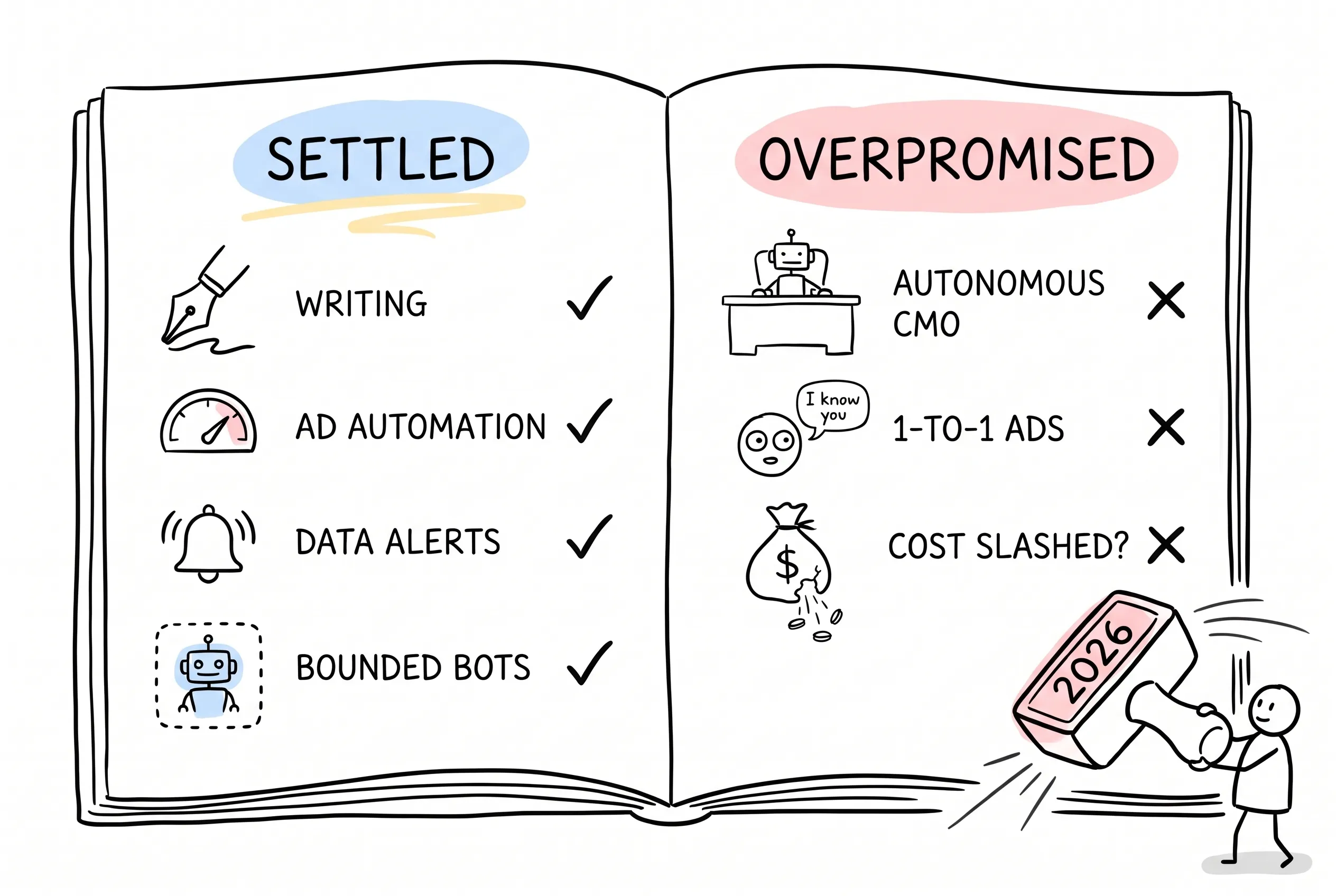
What does "landed" mean? It means that if you're not doing it today, you're the one who looks odd.
The First: Writing
Drafting with AI is no longer a bold experiment — it's the first step of the pipeline.
Marketers used to write an ad headline and test two or three versions; that was about the limit. Now? Generating an extra version costs essentially nothing, and testing dozens of versions at once is routine.
That single change rewired the testing bottleneck. The constraint used to be "can't think of more versions"; now it's two things: not enough traffic to push that many versions to statistical significance, and not enough analysts to keep up.
Production is no longer the bottleneck. Judgment is.
What about the copywriting profession? It hasn't disappeared, but the job has completely changed. It went from "writing from scratch" to "specifying requirements clearly, picking from dozens of drafts, shaping them into the brand's voice, and fact-checking."
Sounds easier?
It isn't. Fact-checking and rewriting take just as much time as writing from scratch. What changed is which skills command a premium; what didn't change is that it's still eight hours a day.
The Second: Running Ads
On platforms like Google and Meta, automated bidding and automated budget allocation have gone from optional "smart features" to the default settings.
A campaign optimizer's core craft used to be manually tuning dozens of campaign parameters. Now the value of that craft has shifted to two places: feeding the algorithm enough high-quality creative assets, and watching the results and adjusting inputs in time.
But a new problem has crept in.
How the budget gets divided is decided inside the platform's black box. When a client asks "why did this campaign underperform?", the optimizer often can only shrug. Efficiency went up; accountability went murky. Many teams still haven't done the math on that trade-off.
The Third: Reading Data
Reading campaign data used to require someone to manually build pivot tables and dashboards. Increasingly, the system watches on its own and raises an alert when something goes wrong.
What does that mean? Say one day you get a notification: mobile ad click-through rate has dropped 18% over three days.
You were notified — you didn't catch it by staring at reports.
Another change: asking questions in plain language has become the mainstream way to query data. "Show me why conversions dropped last week" is a one-sentence question — no more digging through layers of filters in a BI system.
Will dedicated SQL analysts lose their jobs? No. But their work has shifted toward the harder parts: building attribution models and validating the hypotheses that standard reports can't hold.
The barrier to entry dropped, and the ceiling actually rose.
The Fourth: Customer Service Bots
This is the field I think is most widely underestimated.
In 2023, the fantasy was "bots replacing human customer service." That didn't happen. What happened instead was a different version: checking order status, answering common questions, and handling first-line triage. Just those three things.
Watch closely and you'll see a pattern: the successful cases all share one trait — the task boundaries are drawn tightly. The failures share one too: the bot was let loose to "represent the brand" freely, and it started confidently making things up, committing the company to promises it couldn't keep.
The value of conversational AI isn't in how wide it reaches — it's in how tightly it's governed.
One More Thing, Happening Right Now: Search
I have to pull this out on its own, because it strikes at the root.
A substantial share of searches now end with the answer delivered right in the search box — given by AI, with the user never clicking into any website.
Is SEO dead? No. But what SEO means has changed.
A new term has emerged in the industry: GEO (Generative Engine Optimization), also called AEO (Answer Engine Optimization). What is GEO? Simply put: it's the study of how to get AI to cite you when it generates answers.
The content requirements changed along with it: clear structure, direct answers to specific questions, machine readability, trustworthy sources — these are the entry tickets to being cited by AI. The metrics changed too: clicks may be down, but if brand mentions in AI answers are rising, that's not necessarily a bad thing.
The industry hasn't settled on a unified measurement standard yet. But one signal says a lot: this is no longer an SEO specialist's agenda item — it's a serious topic on the CMO's meeting agenda.
Anything that makes it onto the CMO's table doesn't go back.
Now the Other Account: The Overpromises That Failed
Promise No. 1: The Fully Autonomous AI Marketing Officer
This was the loudest promise of the past few years: AI that sets its own goals, allocates its own budget, and runs campaigns end to end.
Technically, such systems do exist, and the demos at conferences look beautiful. But in reality, almost no company actually dares to hand over its budget.
Why? The blocker isn't technical. It's a single question: if the budget gets burned, who's accountable?
If corporate governance can't answer that question, the procurement process goes nowhere. So AI agents' current position is clear: execute subtasks, with humans watching. Proposing plans, running initial screening, doing rough optimization — fine. Making the final call on spending — no.
Promise No. 2: One-to-One Hyper-Personalization
Customizing every single word each user sees, in real time — technically, that's been proven feasible. But at scale, the numbers don't work: data, infrastructure, and compliance costs outweigh the marginal conversion lift.
There's also a more interesting reason.
Personalization has its own uncanny valley. When users sense that a brand "knows too much," the first reaction isn't feeling cared for — it's feeling spooked.
So the personalization that works well today is actually the dumb approach: remind someone who abandoned a cart, and show more of what they've explicitly said they like. Narrow, but accurate.
Promise No. 3: AI Will Slash Marketing Costs
The most popular arithmetic in 2023: content production costs approach zero, and total marketing budgets fall dramatically.
Three years on, the math worked out differently.
Content production did save money. But where did the savings go? More rewriting and fact-checking, subscriptions to various AI tools, and — the most brutal part — bidding: your competitors are optimizing with the same algorithms, and everyone's bids got pushed up together.
As a result, total budgets barely fell — the money just moved from "production" to "verification, tools, and traffic."
This isn't cost reduction. It's cost relocation.
A Few Smaller Promises
Voice marketing. A few years ago, "voice search optimization" was hyped as the next traffic gateway. Instead, smart speakers never became an ad platform, and voice shopping never became a habit. Most of the money invested in those years went down the drain.
Virtual influencers. In categories like beauty and lifestyle that run on authenticity, audiences saw through them instantly and reacted with open disgust. They did carve out a small niche: contexts where emotional authenticity isn't required, like demonstrating how a product works. But replacing real people in long-term fan relationships? Not happening.
Fully automated community management. Having a bot reply to comments in real time is the most crash-prone zone of all. In casual conversation, users spot a bot far faster than in customer-service settings, and they react strongly: "You're talking to me with a machine — that's disrespect."
Predictive models. The models really did get more accurate, but ROI and customer lifetime value never took off the way the hype promised. Two reasons: markets change faster than models update — new channels, seasonal swings, and macro shifts all dilute prediction accuracy; and worse, no matter how accurate the forecast, the person making the call is still bound by process, budget cycles, and response speed. The technology ran ahead of the organization.
Creative teams. Generative models didn't replace creative teams, because they can tell the difference between "producing variants" and "coming up with ideas." Turning one approved creative into dozens of versions — AI is great at that. But the insight that makes an ad memorable is still a human job. The teams didn't disband; the structure changed: fewer people producing variants, more people setting strategy and judging AI output.
What Nobody Warned You About
At least the things above were discussed back in 2023. The real trouble is what nobody discussed then.
First, content noise. Production costs dropped by an order of magnitude, and content flooded by the same order of magnitude. The attention any single piece can earn actually shrank. The easier production gets, the less content is worth.
Second, legal. Regulations requiring AI-generated content to be labeled are rolling out one by one, and the copyright lawsuits over training data aren't finished. Teams running cross-border campaigns now have to write "is this compliant?" into the schedule.
Third, vendor lock-in. A company that binds its core processes deeply to one AI vendor has handed its lifeline to that vendor's price list. The moment they change terms, you're scrambling overnight for a backup.
Fourth, broken measurement. User behavior changed, and the old metrics didn't keep up. A company's traditional search clicks may be falling while brand mentions in AI answers rise, and the old reports can't tell whether that's a win or a loss. The industry is groping toward new metrics: share of brand mentions in AI answers, speed from idea to publication, the share of tasks AI participates in, and lead quality after AI screening. But watch out for another trap: don't mistake "how much content we generated" or "how many AI tools we adopted" for results. Those are vanity metrics — they have nothing to do with making money.
Where Success and Failure Diverge
After looking at so many cases, the pattern is remarkably stable.
The teams that succeeded all took nearly the same path: pick one narrow task, write down the success criteria explicitly, let AI do only that one thing, keep final decision authority in human hands, and expand outward only after validation.
The teams that failed started off wrong: they shouted a grand slogan first — "reinvent marketing with AI" — drew no boundaries, and handed the highest-cost-of-error work to AI, like unsupervised direct customer contact or autonomous spending. And from day one, they never thought through who answers when things go wrong.
Projects like this usually end one of two ways: a public crash, or a quiet shutdown.
What You Can Do Now
If you're making AI investment decisions today, in 2026, my advice is simple.
Get on board with: content drafting with human review, ad automation when you have enough creative assets, plain-language data queries, and customer service with clear boundaries.
Steer clear of for now: fully autonomous strategy and budget decisions, end-to-end personalization without a clear return, and virtual humans in categories that run on authenticity.
Also, before adopting any tool, put four questions on the table:
- If the system makes a mistake, who's accountable?
- Is there still a human in the loop on critical decisions?
- How will you measure real business impact? Note: "how much more money we made," not "we're using it."
- If the vendor changes terms or shuts down, what happens to my workflows?
If you can answer these, you can try. If you can't, hold off — no matter how impressive the demo.
Finally
Back to that dinner at the start.
My friend's company said in 2023 it would disband its copywriting team; in 2026, it added headcount to the fact-checking roles instead.
Does that mean AI failed? I'd say the opposite. It means they figured out where the real dividing line lies.
What machines can never take over isn't creativity — it's accountability.
Over the next year or two, directions like hyper-personalization that are "still being hyped" may finally get their validation — if they can strike the balance between results and privacy. Voice marketing will most likely stay in the experimental zone.
But no matter where the technology goes, the test won't change: whether a new tool is worth using — don't listen to the slogans, just look at two things. Whether its boundaries are drawn clearly. Whether, when something goes wrong, accountability is clear.
The ones that can answer clearly will stay. The ones that can't will hype for a few more cycles, then disappear.
And here's wishing your team is always the kind that thinks it through before acting.
Continue reading
Related articles

What Is GEO? How Your Brand Gets "Mentioned" in the Age of AI Search
An explainer on GEO (Generative Engine Optimization) for e-commerce and DTC brands: how it differs from SEO and AEO, why AI answers shape brand visibility, and eight practices covering question-focused content, consistent brand messaging, structured pages, external evidence, comparisons, and AI mention tracking.

AI Is Already Making Decisions for Your Customers. Are You on the List?
A learn article explains GEO (Generative Engine Optimization): why AI-generated answers now shape which brands customers see, and how SEO fundamentals, entity clarity, citable evidence, and monthly measurement affect visibility in AI answers.

Google Is Stuffing Ads Into AI Search: These Recent Stories Are Really One Story
A news roundup linking recent AI marketing stories—Google adding ads to AI Mode, Amazon's Ads Agent, ChatGPT image updates, a UK startup tracking brand mentions in AI answers, and an AI ransomware warning—arguing that control over ad data and visibility is shifting toward platforms.