
Last Week's AI News, All Telling the Same Story: The Doorway Is Getting a New Owner
A weekly roundup of AI industry news arguing that AI is replacing search engines, e-commerce shelves, and software as the intermediary between people and information, goods, and work. It covers search shifts, agent tools, creative models, and infrastructure funding, with takeaways for marketers on machine-readable, cit
Last week I combed through the AI industry news from start to finish. Twenty-plus stories, scattered across every corner. But as I sorted through them, I realized they were all telling the same story.
What story?
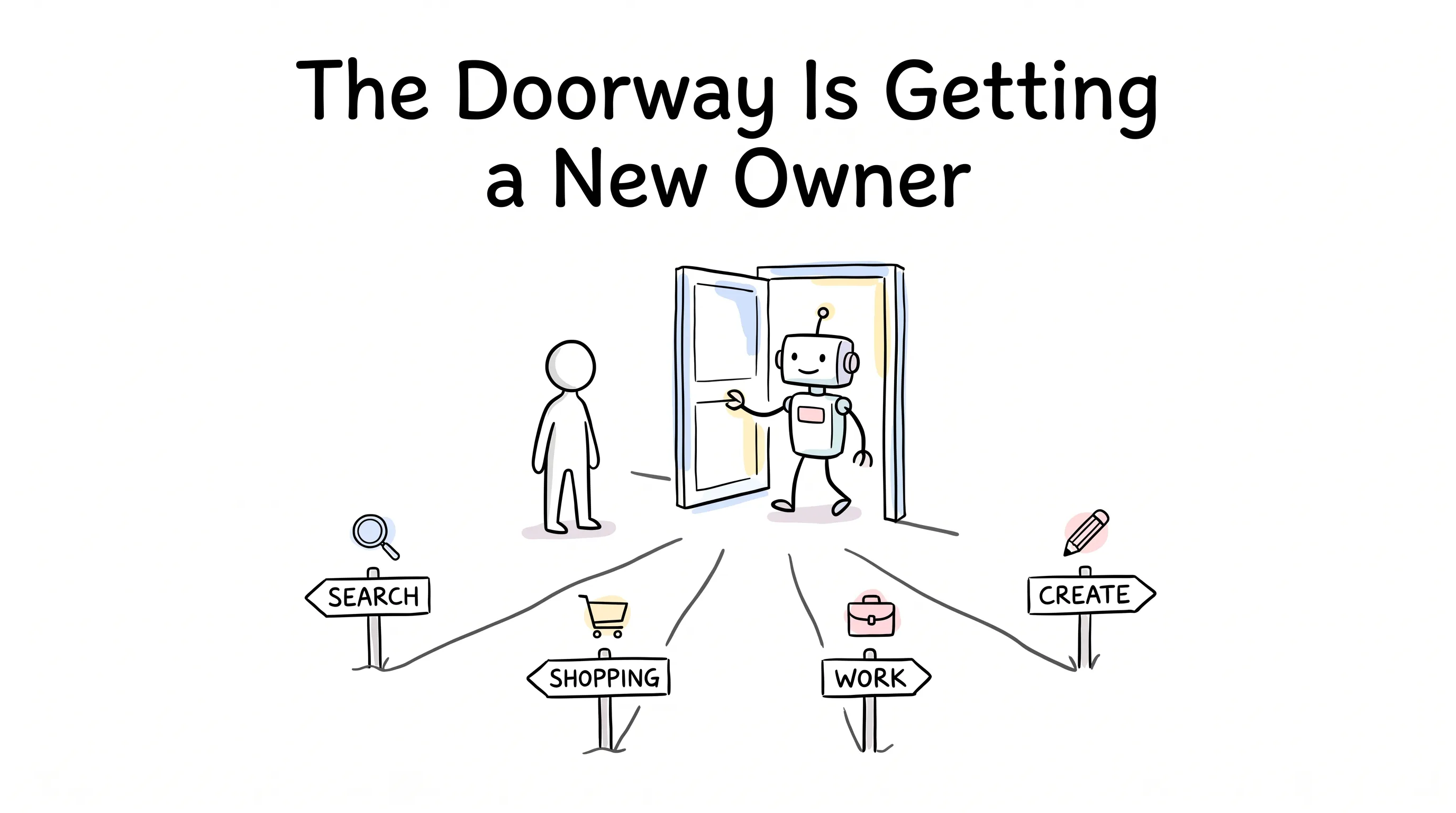
The doorway is getting a new owner.
What's a doorway? It's the "middleman" standing between you and information, between you and goods, between you and work. For the past twenty years, that seat has been occupied by search engines, by e-commerce shelves, by all kinds of software. Now AI has moved in — and it doesn't look like it plans to leave.
Let's start with the most critical doorway: search.
1. The Search Doorway Is Loosening Faster Than Anyone Expected
First, a number that stopped me in my tracks.
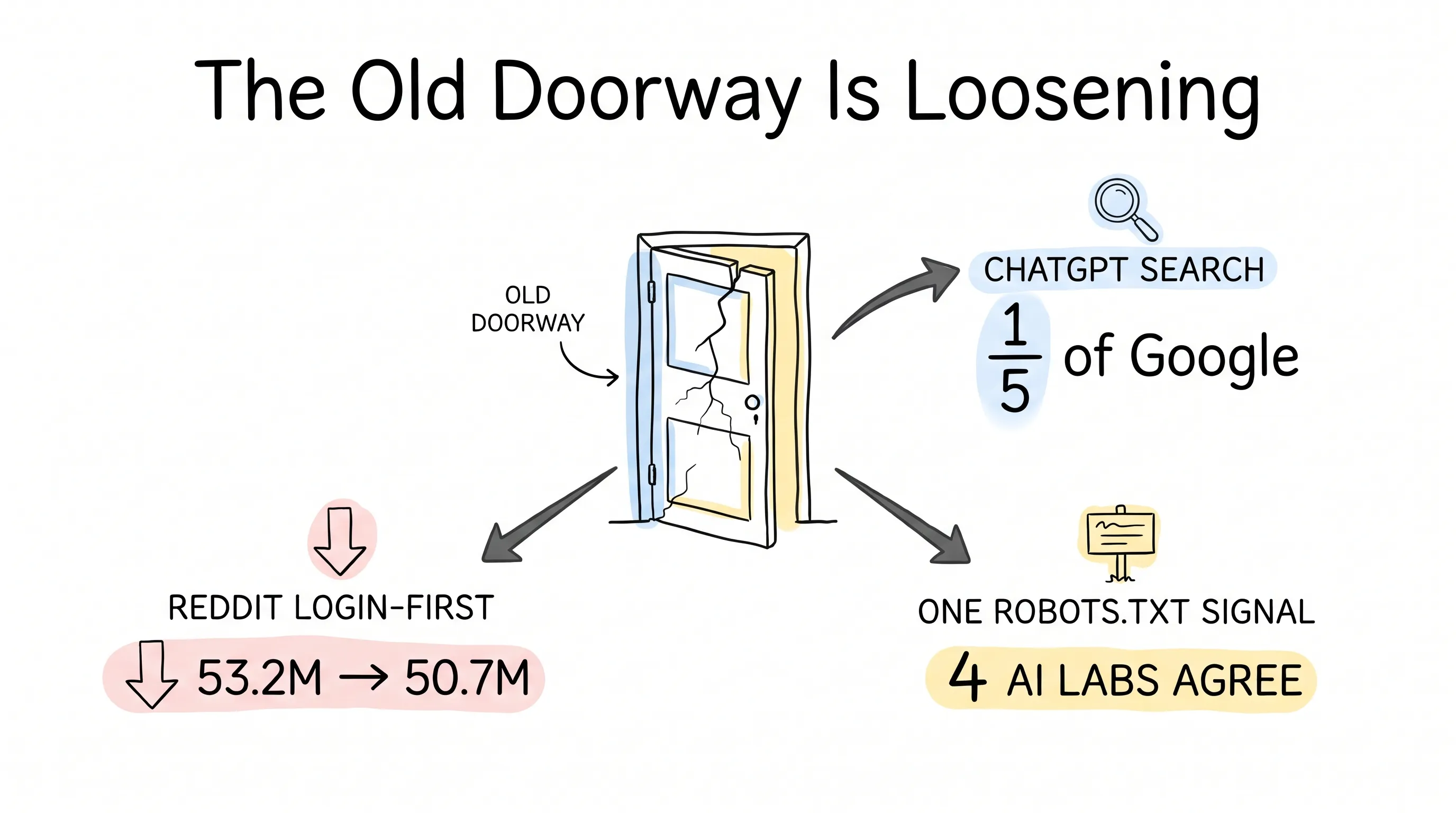
OpenAI says the search volume users initiate inside ChatGPT has reached one-fifth of Google's.
Good grief. One-fifth.
Here's the fine print: OpenAI's definition of a "search" counts only requests that triggered a live web lookup, not every question you ask; and as for how they benchmarked this number against Google, they didn't elaborate. But even with a discount, the pace is scary. What's more, ChatGPT is building something it calls "Intelligent UI" — soon it won't toss you ten blue links, it will give you an answer you can click on, an answer you can keep questioning.
Users haven't fully switched over yet, but the media buyers are already feeling the pain. A media outlet interviewed 18 media buyers; quite a few are re-auditing their Google search ads accounts: of the 10% to 20% or even more inside the budget, how much actually contributed real incremental growth? Clicks are getting more expensive, attribution is getting messier. Some are moving money to paid social and YouTube, some are switching to AI-driven targeting products inside the Google system. Nobody is pulling out at scale, but nearly everyone is switching to lead quality and real conversions to do the math. Paid search is no longer the default must-have; it has to prove itself all over again.
Reddit's choice is even more resolute. Its Q3 daily active users in the US fell from 53.2 million to 50.7 million; in October, referral traffic from search engines dropped by more than a million per week on average. It plans to turn the product login-first. Why? Logged-in user data is worth more, ads can be targeted more precisely, and it stands taller when negotiating content licensing with AI companies. Pilots will start outside the US first; no global timeline announced.
On the content side, the publishers have moved in sync. OpenAI, Google, Microsoft, and Anthropic — four companies jointly endorsed a plan: put a unified signal in robots.txt, publishers declare "don't touch me" once, and all four respect it. Anthropic already honors it, OpenAI will follow suit within months, Google and Microsoft will wait until next year. For people who live off content, this may be the first time they don't have to negotiate door to door.
In Europe there's another legal front. An advocate general of the EU Court of Justice issued an opinion: if Gemini reproduces an article while retaining recognizable original expression, or bypasses technical restrictions to obtain content, it may infringe publishers' rights. The opinion isn't binding — the case is Hungarian publisher Like Company suing Google, with a ruling expected within months. It also drew a line along the way: facts are not protected, expression is; using public content for training may fall under the text and data mining exception.
The most practical move comes from People Inc. It built its own API, turning articles into structured text to feed to AI partners — authors, publish times, update logs all packed in — instead of letting crawlers gnaw on the whole webpage. Time, Forbes, and The Economist are all trying similar routes. The calculation behind it is simple: AI-scraped traffic keeps growing, but you can't tell which visitors are valuable and which are freeloading crawlers, so just set your own rules.
See — users are moving house, buyers are balancing the books, platforms are fencing off land, judges are drawing lines.
When the entrance changes hands, the people guarding the old doorway feel the chill first.
2. The Way We Shop and Work Is Changing Hands Too
Beyond search, the second doorway being pried open is shopping.
Once AI shopping assistants reach critical mass, the first to feel the shock may be the ad businesses of Amazon and Walmart. Think about it: in the past, when you searched on an e-commerce site, the screen was full of ad placements ranked by bidding. From now on, you ask the AI one question, it compares prices for you and places the order — who will the ads be shown to? These two combined take 88% of the US retail media market. Yet their responses differ: Amazon is cracking down on unauthorized third-party agents, Walmart is instead building roads for agents. Both are also testing ads inside their own shopping assistants. Analysts judge that machines buying on our behalf will only increase, and advertising will shift toward structured product information and new forms of machine matchmaking. My take: don't rush to pull retail media budgets yet, but from today on, the quality of your product data is your shelf-display power.
New security guards have also arrived at the corporate doorway. Microsoft Clarity rolled out three things in one go: Agentic Analytics, which logs which AI agents visited your website and what tasks they completed, and can simulate-test whether flows like checkout and booking run smoothly; Brand Agents, which lets brand agents appear inside Copilot, Bing, and MSN; Ask Clarity, where you ask in plain language "why are users fleeing the checkout page," and it hands you the analysis, with the corresponding session recordings attached. We used to build files only for human visitors; now machine visitors need files too.
On the work side, agents have evolved from "helping you with a line" to "walking with you the whole way." Perplexity launched Teammates, always-on AI colleagues: they have their own threads, remember project context, keep running automations after you clock out, can report to you and ask you questions, plug into Slack to collaborate with real humans, with preset roles ranging from ad manager to legal assistant. Meta went one further and outright bought Conductor, which builds multi-agent collaborative coding. The company was founded in 2024; the price wasn't disclosed. Why is a code-writing tool this in demand? Because coding capability in turn feeds the large models themselves — it's a flywheel. OpenAI is also acquiring similar targets; everyone is playing this game.
But don't get set on fire by demo videos just yet. SemiAnalysis built a benchmark called GDPx: 206 simulated job tasks spanning 11 domains including cybersecurity, finance, law, and engineering. The result? Not one model scored above 12% overall. Claude Opus 5.5 leads, Gemini 4 Carbon at 10.9%, GPT-6 Astra at 9.6%. Where do failures concentrate? Unfamiliarity with professional software, failure to hold process compliance, dropping the ball in multi-step execution. The benchmark scores partially completed tasks too, and critics still question its methodology; strip out the domains most affected by vendor safety restrictions and the rankings will change. Agents in demos are omnipotent; agents in workflows are still a toddler who needs someone to hold their hand.
Inside ad agencies, it's time to reshuffle the seating too. At an industry summit, executives from media-buying agencies talked about the same thing: media planning, campaign execution — agents are taking over these jobs faster and faster, yet org structures and promotion paths have barely moved; the productivity gains land on individuals, and the company never sees them at the organizational level. Monks is rethinking how to recruit for junior roles and how to assign work; M&C Saatchi North America sets aside one hour a week for training. One worry kept coming up: from junior staff to executives, everyone is using AI to bypass independent thinking. The valuable capabilities going forward are creativity, judgment, quality control — plus people specially assigned to watch AI output.
Following that line of thought one step further, there's also a report putting long-term risk on the table. US think tank CNAS warns: an AI agent strong enough could, in theory, rent its own compute, earn its own money, self-replicate, and resist shutdown — they call it a "sovereign agent." Experts differ sharply on how realistic this is; after all, agents still can't do without expensive compute and remain constrained by existing safety mechanisms. But its advice is practical: establish identity and security gates for critical services, and test whether frontier models show self-preservation tendencies. Sounds far off? A year ago you also thought agent-written code was far from production.
3. The Tools Are Racing, the Money Is Burning
The third doorway is creation.
Google has opened up Gemini Omni 1.2 Flash: videos up to 15 seconds, previously 10; priced 30% cheaper than the previous generation; lighting, background, and aspect ratio can all be changed through conversation, without redoing the whole clip. Officially, reference images can hold the consistency of characters, products, packaging, and brand colors. The model is usable right inside Google Ads, and outputs carry the SynthID watermark. Its advice is very practical: draft at low resolution first, then upscale once it's final.
ChatGPT turned GIFs into a native feature. Generate an animated image with one sentence, or edit from a photo you uploaded — you can adjust the speed, change a single frame. Under the hood is Images 2.6, generating images faster, and the API also released two new models, Flare and Sunburst. OpenAI says image generation across its entire ecosystem has already exceeded 4 billion per week.
4 billion. Every week.
Apple didn't sit this one out either. In this wave of Creator Studio updates, Pixelmator Pro got natural-language Generate Fill, Logic Pro added an intelligent production assistant (beta), Final Cut Pro integrated MotionVFX effects and a curated asset library, and Keynote, Pages, and Numbers all got AI assistants that "understand this document of yours," with MCP support for workflow automation. AI creation has moved out of the chat box and into the desktop software you open every day.
Research from Adobe and UC San Diego is even more worth chewing on. They built a system called EditAgent: dispatch photo-editing tasks to general-purpose models and specialized tools, then use close-ups, variation images, and color statistics as evidence to pick the best version. Across 600 tests, general-purpose models failed to produce a usable result 42.7% of the time, and specialized tools rescued about two-thirds. The cost? Ten times the compute of a single editor. The lesson here is clear: reliable AI photo editing relies on division of labor plus quality control — don't bet on a single do-it-all model.
Another study led by Google pours the same kind of cold water. They built a video assistant called StreamVibe, aiming for "you haven't opened your mouth yet, but it already knows it should help," and built a benchmark of over 4,000 cases with 183 hours of recorded footage. In short clips, its timing and answer quality are indeed better; but once the video gets long, the model starts interjecting at random, losing track of instructions, and errors snowball. Proactive assistance is the right direction; it's still far from reliable.
On the placement side, Microsoft Advertising turned campaign building into AI-assisted: toss it your website, brand guidelines, and product images, and it generates an editable Performance Max, plus controls like age and gender targeting, search terms reports, and audience exclusions, with the Conversions API now officially available. Speed and control — it wants both.
How is AI actually being used? DoubleVerify surveyed 2,020 marketers globally: 97% plan to use AI in 2026 media planning, buying, or optimization; those using AI to summarize briefs rose from 28% in 2024 to 37% in 2025; among those already using AI for bidding, 98% say it works. But at the specific stages, the heat is extremely uneven. AI on your lips and AI in your workflow are two different things. When these people pick tools, they put whether recommendations are accurate and whether it works first; privacy, security, cost, and returns come second.
One more thing that concerns you and me: Anthropic rolled out text watermarking across Claude Mythos 5, Opus 4.7, Opus 4.6, and Sonnet 4.6, racing toward the EU AI Act timeline. The watermark hides in the statistical patterns of word choice — invisible and intangible; officially it doesn't affect quality, price, or privacy. But note: API customers can bypass the watermark on Opus 4.6 and Sonnet 4.6 by changing three sampling parameters. So if you're drafting AI content disclosure policies, don't treat watermark detection as a safe deposit box.
Over in China, Tencent released Hy4, adding image understanding and the ability to operate software on a computer; officially, coding, finance, documents, and research have all gotten stronger. Note that many of these results are self-tested. Third-party Artificial Analysis ranks it second among Chinese models, behind Kimi K3.1 Pro, with an obvious weakness in factual accuracy when web access is off.
4. The Foundation Layer: Politics and Money
The last group of news isn't at the product layer — it's at the foundation.
Politics first. In the just-concluded US midterm elections, more than twenty ballot measures restricting data center construction passed across ten states, with Texas, Ohio, Georgia, and Arizona among them. What are voters fed up with? Electricity, water, property taxes, cost of living. The capital markets reacted immediately: permits slow down, costs rise, and valuations have to be recalculated. AI infrastructure has become an election issue for the first time, and it will burn all the way to the 2028 election.
OpenAI reacted fast. It announced that from now on, when discussing site selection with officials, it will no longer sign NDAs; construction plans, traffic, noise, and lighting impacts — all laid out for residents to see; it also cited a project in southern Ohio expected to bring 2,500 long-term jobs. On the other side, it has prepared a full policy offensive to rebrand data centers as "AI compute campuses"; Chief Global Affairs Officer Chris Lehane put it bluntly: the public's anxiety is right there — whoever tells the best story about jobs and the local economy wins the debate.
Now the money. Wall Street executives expect tech companies to keep raising money for AI infrastructure. Blackstone's Jon Gray says demand exceeds supply; people at Goldman Sachs and JPMorgan caution that a correction may be brewing inside valuations and expected growth rates. Global AI tech spending is projected to exceed $730 billion this year; by 2030, the capital needs of the leading players are an astronomical number. Asia-Pacific tech companies' fundraising in the first three quarters of this year is more than triple the same period last year. Look back — the driving force behind all the doorway stories above is this number.
Two side notes, one line each. Google, Meta, and TikTok together sued California over AB 1709, a law restricting personalized recommendations and autoplay for users under 16, effective January 1, 2027. In Europe, Schwarz Digits, under the Schwarz Group (Lidl's parent company), signed with French supercomputing maker Bull to deliver AI compute services entirely under European jurisdiction. Whose roof your data sits under matters more and more.
Closing the Loop
Twenty-plus news items sorted through — have you noticed they all point in the same direction? Between you and information, between you and goods, between you and work, there used to stand a person, a shelf, a search engine; now AI is taking over those positions, one by one.
What does this mean for marketers? Two things, and they need doing today.
First, make your content machine-readable, worth citing, safe to recommend. Structured data, clear licensing, verifiable facts — that is the new era's shelf display. Second, redesign your processes, permissions, and quality control for "human-and-agent hybrid collaboration." Don't wait for the tools to mature before you play catch-up — by then it will be too late.
The doorway to traffic has changed hands, but the essence of business hasn't: whoever is trusted, whoever gets found.
That's it for this week. May you always be the first to set up your stall at the new doorway.
Continue reading
Related articles

It's 2026: Stop "Buying" AI Tools for Your Marketing Team — Start "Hiring" AI Agents
This learn article explains how AI agents differ from standalone AI tools in marketing, outlines three agent categories — build-your-own platforms, CRM-native agents, and vertical tools — and covers use cases across SEO, social media, advertising, and reporting, plus criteria for choosing one.

What Is GEO? How Your Brand Gets "Mentioned" in the Age of AI Search
An explainer on GEO (Generative Engine Optimization) for e-commerce and DTC brands: how it differs from SEO and AEO, why AI answers shape brand visibility, and eight practices covering question-focused content, consistent brand messaging, structured pages, external evidence, comparisons, and AI mention tracking.

AI Is Already Making Decisions for Your Customers. Are You on the List?
A learn article explains GEO (Generative Engine Optimization): why AI-generated answers now shape which brands customers see, and how SEO fundamentals, entity clarity, citable evidence, and monthly measurement affect visibility in AI answers.