
Meta Ads November Updates: Two Dated Events, and a Year of Aftershocks
A recap of a year of Meta Ads changes: the Nov 12 default-on Pixel device measurement switch, commercial terms effective Nov 20, March's engage-through attribution shift that split click conversions, Threads ads and reply management, regional fees, and a practical action checklist.
A couple of days ago, a friend who runs e-commerce campaigns was going through half a year of data and noticed that from March onward, Meta's click conversions had dropped noticeably. He audited his account, his creative, his bidding — found nothing — and came to ask me.
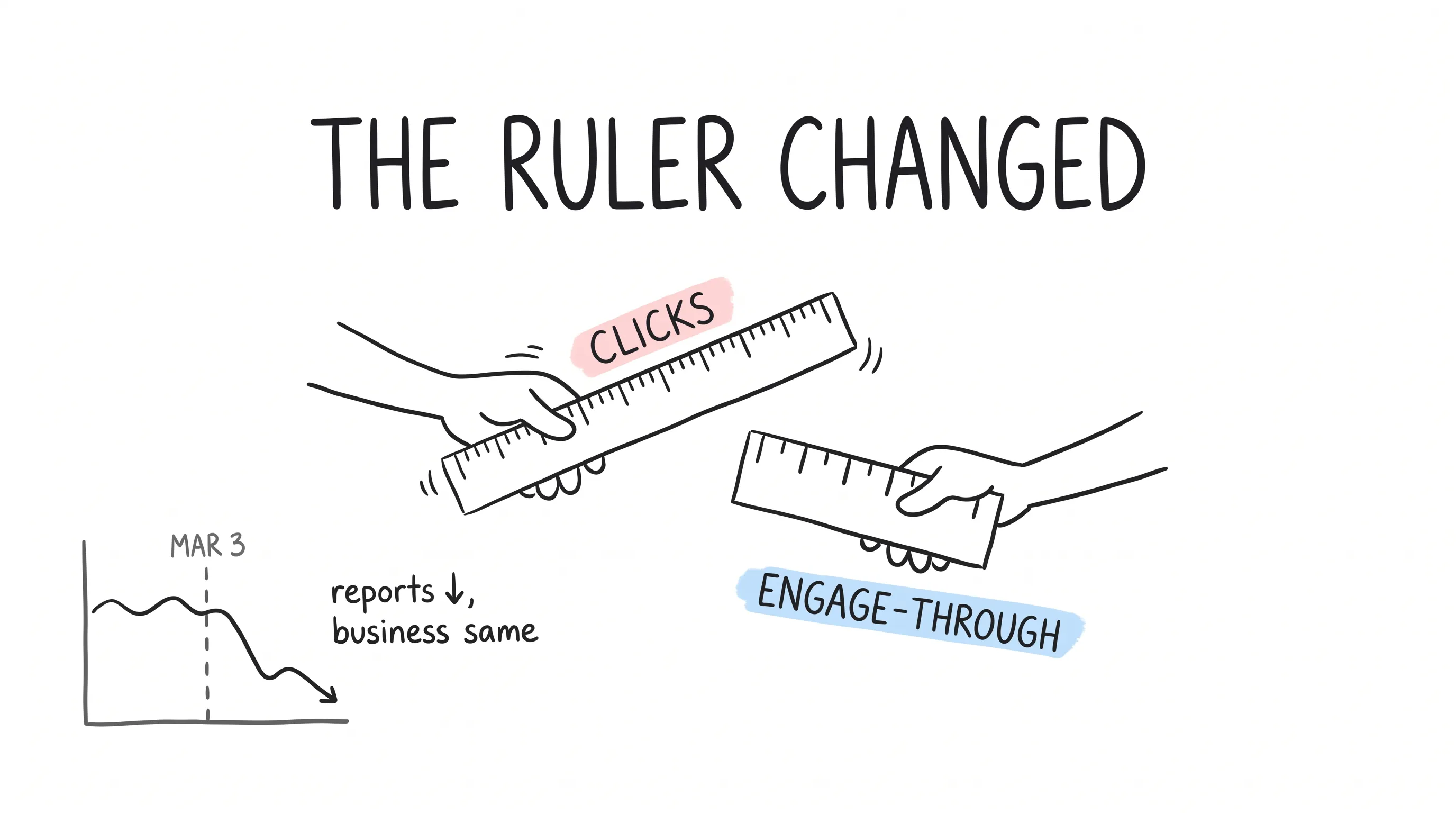
I told him: don't audit the account. Go look at that attribution announcement Meta published on March 3.
He came back and said one sentence: it turns out the account wasn't broken — the ruler changed.
Why am I digging up this old story now? Because November brings two Meta events with hard dates attached. So at this moment, let me walk you through the year's Meta Ads changes from the beginning. The new stuff first; the old stuff becomes a checkup list.
November First: Two Dated Events
The first is a Pixel measurement setting.
What does "measure conversions on the customer's device" mean? It means conversions are reported directly by the Pixel on the user's device. According to industry media reports, starting November 12, this switch will be on by default for datasets that are already sending events. To turn it off, you have to go into each dataset's settings and disable it manually.
By the time this piece is written, it's already mid-November. That date has passed. If you haven't looked at your Events Manager yet, go now.
Why does this deserve serious attention? Because once it changes, the "purchases" in your reports may no longer match what's in your order system. And industry reports have not confirmed whether these recovered conversions will feed into the auction signals. So for now, read any "purchase lift" as a measurement change; let your backend data tell you how the business is actually doing.
The second is the updated commercial terms.
The updated commercial terms and self-serve advertising terms were originally set to take effect on October 30. Because of pushback from publishers, Meta moved the date to November 20. That's one week away. You don't need to memorize the terms now, but whoever signs on your company's behalf must read Meta's final text before the effective date. Nobody can do that for you.
Then October: Four New Things, Four States
On October 15, Meta announced a batch of product updates at Brand Building Summit. Four things, four states — don't mix them up.
Ads Super Burst is now entering phased general availability. You can reserve a burst reach window of 3 to 24 hours — useful for launches and big sales, the moments when "these few hours are all that matter for buzz." Check eligibility and inventory in Reach Planner, and look at the reach and price estimates while you're there.
First Impression Ads, early testing in the US, one brand per day. Remember, this is a test — not a placement everyone can open.
Reels Trending Ads, expanded categories, with custom audience exclusions planned within the year. Watch the wording: "planned," not "already live."
Aggregated View Time, alpha test, measuring attention accumulated over a week. Don't rush to replace your proven old reports with it.
A launch event, a test, and a feature you can actually use in your account are three different states. Moving budgets because of a launch event is the classic money-losing move in this trade.
Then Back to March: The Ruler That Got Swapped
All right, back to my friend's story. What is engage-through attribution? This has to be told from the start.
On March 3, Meta announced: for website conversions and store visit conversions, click attribution would only count link clicks. When a user liked a post, expanded an ad, watched a long stretch of video, and then bought — those conversions no longer count as click attribution; they move into a new bucket called engage-through (renamed and expanded from the former engaged view). At the same time, the video engagement view threshold dropped from 10 seconds to 5 seconds.
Meta said billing stays unchanged. But the reports will change.
This is the classic "ghost drop." You open your reports, see click conversions trending down, and instinct tells you: something's wrong. But nothing is wrong. The same money was recorded from the left pocket to the right.
So the right moves at the time — it's not too late to catch up now:
- In every report that carries website or store visit conversions, add March 3 as an annotation;
- Read the before-change and after-change data separately;
- Teams with custom attribution settings: re-verify your settings — don't assume the old logic still applies;
- When reporting to clients and bosses, explain the changed measurement first, then talk about the ups and downs.
One more thing to do right now: if your reports only have the click attribution and view attribution columns, add engage-through. There may be a sizable chunk of conversions sitting in there. Don't wait for a client to ask "why don't the numbers match" before you remember this column.
March Also Changed the Interface, and Threads
On the interface side, March changed three things: Flexible format was removed from Ad setup; Collection moved to Format display options under Ad creative; and the Facebook Feed placement now includes Friends tab.
None of them looks big on its own. But in many teams' playbooks, the old screenshots are still taped in. Your process documentation may already be wrong even though your strategy is right. Someone asked whether flexible ads were cut? No — they moved house. Collection is the same: it changed location and lives on just fine.
Threads deserves a section of its own. In January, Threads ads opened globally, with monthly active users over 400 million. On March 25, the Threads Marketing API gained two capabilities: global support for app ads, with APP_INSTALLS and app event optimization coming in; and reply management — you can see, hide, and reply to top-level comments under ads, viewing requires ads_read permissions, managing requires ads_management.
The second one is what truly changes the calculus. Advertising in a place where you can't moderate the comments is like running naked in someone else's living room. Now you can manage it. If you're doing app campaigns, move Threads from your "watchlist" to your "test list." Don't just toss 2% of budget at it to check the box — run it like a real test: with creative, a control group, a budget cap, and success criteria agreed in advance.
Three More Technical Chores, and One Bill
For teams that run campaigns through scripts, connectors, and third-party tools, March had three more things to remember.
From March 31, the mTLS certificates for webhooks are signed by Meta's own certificate authority. It sounds like a footnote, but when a trust chain breaks in production and your reporting pipeline silently goes dead, it stops being a footnote. Check your receiver's trust store, keep certificate verification on, and update where needed. Refreshing a token is not a substitute for updating certificates.
On May 19, the old API paths for ASC (Advantage+ Shopping Campaigns) and AAC (Advantage+ App Campaigns) were fully retired, giving way to the new automation-first Advantage+ setup. That deadline has passed. If old paths are still in your code, audit them now and run against the currently supported API versions.
Opportunity Score's 14 recommendation types can now be executed directly through the API. If you're building automation or approval flows, worth a look.
All three point in the same direction: Meta is narrowing the old, manual setup paths and widening the automated, API-first, cross-placement ones. Go with it and you save effort; fight it and you burn energy.
Then, the bill. From July 1, Meta charges regional fees, based on the country where ads are served, regardless of where your company is registered: UK 2%, France, Italy, and Spain 3% each, Austria and Turkey 5%. A US brand targeting French users pays France's 3% all the same.
Do the math: on a £100,000 spend base, 3% is £3,000. Elementary-school arithmetic. But it directly changes your effective CPM, your CPA, and your P&L. If your second-half budget model is still built on the old media costs, it's already wrong. Break this fee out of media costs and model it separately, then reconcile it against your own account's actual billing. A past announcement is no substitute for an invoice.
Automotive advertisers have one more: Nielsen DMA targeting was discontinued on June 22, replaced by Comscore Markets. From March 23 you could update feeds; from April 20, Ads Manager started showing warnings; from June 22, campaigns still carrying dma_codes stop serving outright. Not in automotive? Skip this paragraph. In it? Go check your targeting configuration and delivery status.
Two Small Updates, and One Big Direction
Two small things, worth noting in passing.
Custom audiences gained new filters — you can build audiences by engagement frequency ("at least x times") and time window ("in the past x to x days"). "Recently engaged" and "repeatedly engaged" can now be stacked. Anyone who runs retention campaigns will understand how handy this is. Of course, the precondition is that your Pixel is collecting data properly.
The other is a change observed in the trade: CTA buttons now appear on the ads, and no longer on the original organic posts. This means you can test different CTAs however you like without touching the post that has spent years accumulating likes and comments. Social proof, preserved.
On direction, Meta's signals this year at ShopTalk and IAB NewFronts were plain: Instagram creators can attach up to 30 shoppable products to a single Reel; Facebook's affiliate partnerships start with Amazon in the US and Shopee in selected Asian markets; Reels Trending Ads expanded into film and TV, travel, commerce, and finance categories; and Partnership Ads Hub got a redesign.
Connected, Meta's intent is not hard to guess: bring ad spend closer to creator content, closer to Reels, closer to "scrolling into a purchase." The old recipe of classic feeds plus manual audience building will carry less and less weight.
Finally, Back to That Ruler
This year, Meta changed a lot. Interfaces, terms, certificates, rates, new toys. But if you only remember one thing, I suggest this:
What it changes is often not how ads are run, but how results are counted.
Get the buying wrong, and you can still see it. Get the counting wrong, and you'll be holding a wrong map, earnestly driving the car into the ditch. Misreading the measurement is the fastest route to bad decisions in this trade — no contest.
My friend, since then, has marked March 3 in every report they run. He said the day the numbers "rose" back felt more grounding than any optimization he'd ever done. Even though nothing was optimized — the books were just put back in place.
Before the 20th, have whoever signs on your company's behalf read the terms. Go to Events Manager and check that default-on switch. Add engage-through to your reports.
The rest, leave to time.
May your reports and your business always reconcile.
Continue reading
Related articles

It's 2026: Stop "Buying" AI Tools for Your Marketing Team — Start "Hiring" AI Agents
This learn article explains how AI agents differ from standalone AI tools in marketing, outlines three agent categories — build-your-own platforms, CRM-native agents, and vertical tools — and covers use cases across SEO, social media, advertising, and reporting, plus criteria for choosing one.

Did the Money You Spent on AI Marketing Ever Come Back?
A guide to measuring AI marketing ROI across three layers: ad reports, sales pipeline, and the financial ledger. Covers metrics such as ROAS and CPA, eight dashboard metrics, industry benchmarks, and common measurement mistakes.

How to Pick a Creative Automation Platform: First, Figure Out What These Eleven Actually Do
A learn article sorts eleven creative automation platforms — including Bannerflow, Celtra, Smartly.io, and Storyteq — into four functional groups and proposes five evaluation questions covering publishing reach, automation depth, ease of adoption, team fit, and verifiable evidence.