
In 2026, Google Ads Is Taking the Steering Wheel Out of Your Hands
An analysis of how Google Ads automation in 2026 shifts control away from advertisers through default-on settings, AI Mode shopping placements, and redefined metrics, with guidance on feeds, goals, and first-party data.
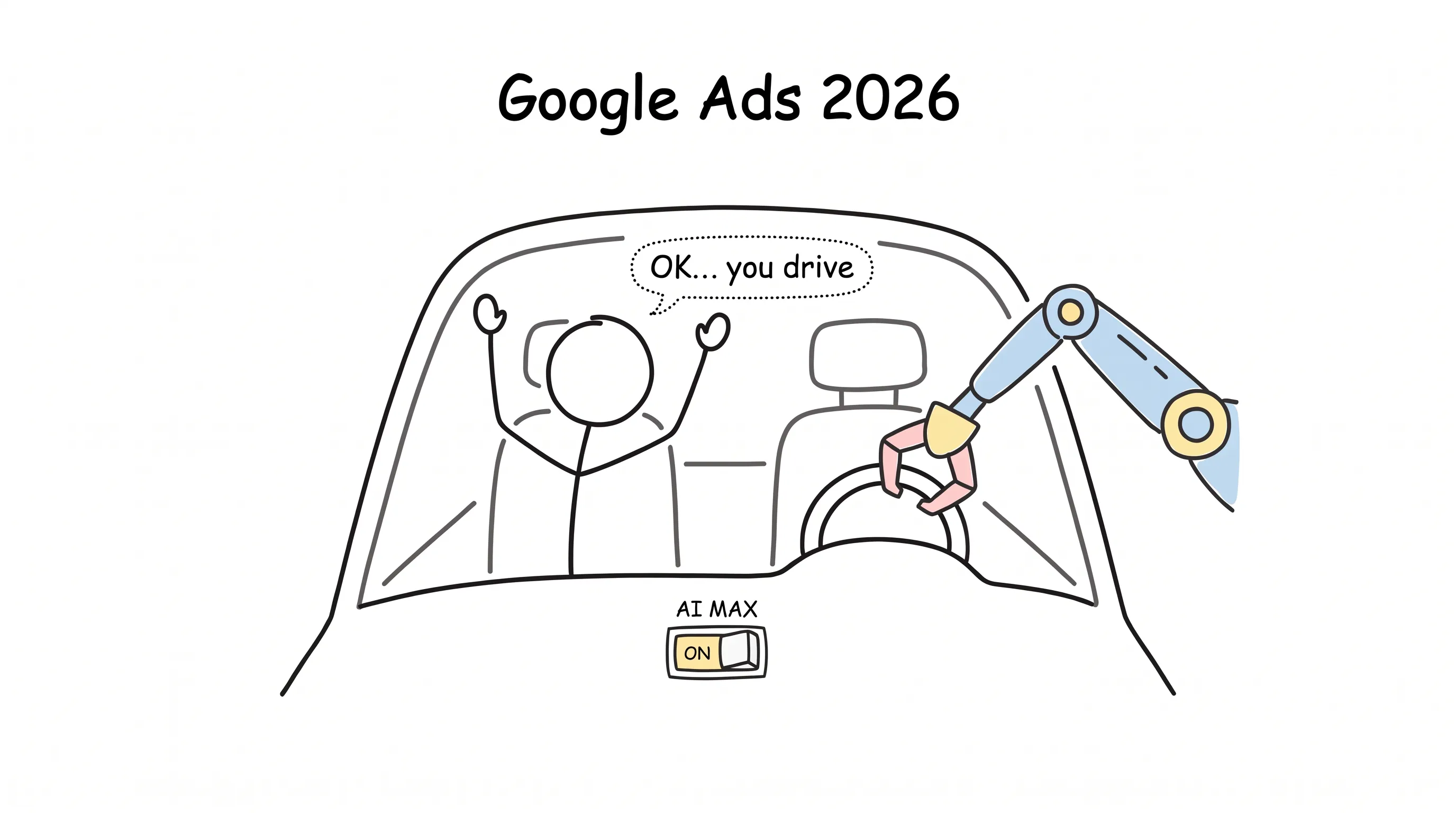
A while back, I came across a quiet little announcement.
On September 1, Google Ads began a round of automatic migration: eligible search campaigns were moved, batch by batch, into something new called AI Max. Nobody asked you, nobody waited for your sign-off — the system just went ahead.
I stared at that announcement for a while, and the longer I looked, the more I felt it mattered far more than it appeared to.
Because behind it is an entire year's trend. All through 2026, Google Ads has been doing exactly one thing: taking the levers out of your hands, one by one.
What do I mean by levers being taken away? Let me walk you through three things.
1. A Lot of Switches Are On by Default
Let me start with the kind of change that sent the biggest chill down my spine.
Around October 21, Performance Max rolled out a switch called Sourced videos. Turn it on, and Google will automatically pull videos from your YouTube channel, your social media, and your landing pages — up to 10 of them — and stuff them into your asset groups. The switch is on by default. Campaigns already running may have been harvested long ago.
Think about what's lying in your asset library. Maybe three review videos from two years ago, a clip an employee shot on the fly, and a product that has since been discontinued. Now every one of them has a chance of being picked by AI and pushed out to the world.
And this kind of thing hasn't happened just once this year.
On October 9, Demand Gen videos got AI-generated text overlays by default. Why? Because 85% of people watch videos with the sound off. Google thought of it for you, slapping your copy straight onto the screen. Want full control back? You'll have to go dig into the settings and turn it off yourself.
On October 12, Google started automatically scanning your website, scraping promo codes and offers off it and pasting them into eligible ads. Expired codes, codes meant only for subscribers — those could get scraped too. Again, on by default; turning it off means digging through the settings yourself.
Now mark December 4 on your calendar. From that day on, every newly created Performance Max campaign will automatically pull high-resolution images from your landing pages and spread them across Search, YouTube, Gmail, and Maps. Don't want in? You have to manually opt out at campaign creation.
And there's something even more thorough. In late July, Google confirmed it was testing AI-written product descriptions for Shopping ads. The AI reads your product feed and landing pages and writes the copy itself. Right now, advertisers can neither turn it off nor edit it.
Good grief. There isn't even a place to turn it off.
What does this mean?
A default is a decision someone else made for you.
We used to talk about running ads like building with blocks: targeting, bidding, copy, creative — you placed each one yourself. Now the blocks are getting fewer, and more of the gears shift themselves. Nobody forbids you from doing anything. You just discover that when you do nothing, the system has already done a lot for you.
2. A New Continent, Not an Extension of the Old One
The second thing is about AI Mode.
What is AI Mode? It's the entrance in Google Search that answers your questions directly with AI. On August 31, Google confirmed that Shopping ads have begun appearing, as carousels, right inside AI Mode's answers. The products are picked by Gemini from your Merchant Center feed — nobody hand-placed them.
How big is this entrance? Google has given two numbers: AI Mode has more than 1 billion monthly active users, and 74% of consumers have already started using AI to find products.
Sounds like a big opportunity — the kind you latch onto quick, right?
Not so fast. A study published on September 24 offered a few numbers, and after reading it, only one phrase came to my mind: a new continent.
For the same query on the same day, only 1.28% of the products that appeared in the traditional shopping carousel also showed up in AI Mode. Traditional search displays 27.8 products at a time; AI Mode displays just 3.9. And the average price of products in AI Mode is 21.6% higher on top of that.
In other words, you can rank #1 on the old continent and not exist at all on the new one. To get in, you have to rework your product feed separately and design your bidding separately. This isn't an extension of the old continent — it's a landmass you have to land on all over again.
And people on this continent speak differently. Google's own data says queries in AI Mode are on average three times the length of traditional searches; one in every six searches now comes with voice or an image. In late October, the US fully rolled out Multiturn ads, where ads follow the user's follow-up questions, shifting with every exchange.
Even more brutal is agentic commerce — shopping done by AI agents on the customer's behalf.
On September 22, Google auto-enrolled all eligible Shopify merchants into native checkout inside AI Mode and Gemini. What does that mean? Customers buy the product right there in Google's interface, with Google Pay, without ever entering your store.
On by default. To opt out, you have to go to a sales channel called Agentic in the Shopify admin and switch it off manually.
On October 15, Universal Cart launched — a cross-merchant shopping cart backed by more than 60 billion product records. Google also connected over 250 million product listings from NielsenIQ, feeding them specifically to the AI agents that shop on users' behalf.
Think about it: as more and more of the buying happens inside Google's interface, how big a role is left for your website and your checkout flow?
The traffic is still there — but the entrance is no longer yours.
3. The Ruler Has Been Swapped Too
The third thing is one most people never noticed at all — and it's the one most worth talking about.
On October 7, Google changed the definition of "view-through conversions" for display ads in Demand Gen. Before, an ad had to be 50% visible on screen and stay there for 1 second to count as a valid view. Now, a sliver of pixels, for however long, counts.
Guess what happens next?
Starting in October, your view-through conversion numbers will rise on their own. By how much? Unknown. But one thing is certain: your business didn't earn a single extra cent.
And it doesn't stop there. On October 10, the threshold for video "engagement" was raised from 5 seconds to 10, covering feed, pre-roll, and Shorts. The result: most accounts will see engagement rates drop by 30% to 50%. Likewise, nobody actually got worse.
Better numbers don't mean a better business. Worse numbers don't mean a worse business either.
Put these two together, and you get the most easily overlooked trap of the second half of 2026: you're making decisions off the dashboard, but someone has quietly redrawn the scale marks on it.
What to do? The answer is almost embarrassingly plain. Export your baseline under the old definitions as soon as you can, annotate exactly which day the definition changed, and never compare new numbers directly against old ones.
Of course, some rulers have been swapped for the better.
On September 10, Google launched a metric called Data Strength Uplift, refreshingly blunt: it tells you how well your first-party data is hooked up and how many extra conversions you can recover. The official math: brands that connect offline and app data into Data Manager see average incremental ROAS up 26%; those with Google tag gateway installed see conversions up 14% on average, and over 20% for Demand Gen.
On October 7, Conversion Lift incremental testing also went self-serve. It used to require scheduling with a Google account manager; now any account with 1,000+ conversions and a $5,000 budget can run it on its own. Run a test before Black Friday spend ramps up, and you'll have real numbers in hand.
What is first-party data? Plainly put, it's the real customers in your CRM: what they bought, how often they come back, how much they spend per order. The more automated the platform gets, the more valuable these things it can't touch become.
4. What's Still in Your Hands: Three Things
By now you might ask: if the levers are all taken away, what can we still do?
The things you can still do lie exactly beyond the levers.
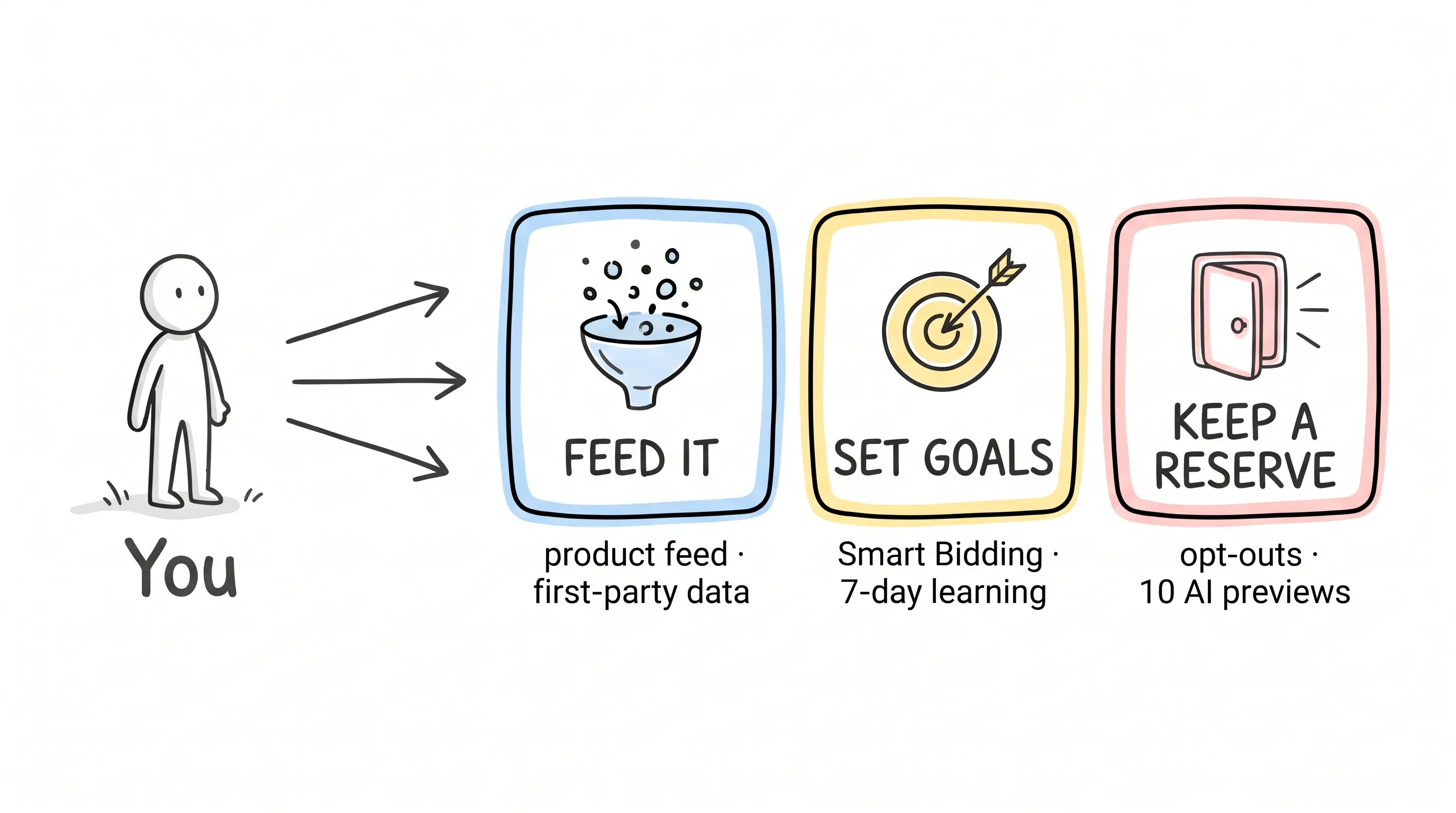
The first: feeding it. The algorithm eats raw materials. The completeness of your product feed, the quality of your creative, the cleanliness of your first-party data — these decide what this machine grows into. In the August 31 announcement about Shopping ads entering AI Mode, Google said so itself: this placement rewards feed completeness, not bidding skill.
The second: setting goals. On October 21, Google capped the Smart Bidding learning period at 7 days, written in black and white in the docs: changing budget, changing goals, or swapping creative does not trigger a reset. People used to be afraid to touch anything, scared that one change would send everything back to square one. Now, with two weeks to go until Black Friday, adjust what needs adjusting. On November 2, PMax also opened up household income exclusion — brands selling premium products can finally walk the users who can't afford them to the exit. The channel priority controls from October 14 are worth using too: keep the high-priority channels fed first, then talk about the low-priority ones.
The third: keeping something in reserve. Nearly everything that got switched on by default this year left an exit hatch. Is there a video in your asset groups that shouldn't be there? Is the AI-written copy off? After October 7, you can preview 10 AI-generated headlines and descriptions before deciding whether to turn on text customization. Thirty seconds, one review, and if it looks wrong — switch it off.
A few dates to jot down, none of which have arrived yet: December 4, new PMax campaigns default to pulling images; November 16, customer data no longer requires pre-hashing, and match rates will rise; January 31, 2027, products with main images under 500 by 500 pixels get delisted outright.
Final Word
Back to the morning of September 1.
What became of those campaigns auto-migrated into AI Max? Google says advertisers who fully adopted AI Max saw conversions improve 7% on average; those who originally relied heavily on exact match and phrase match improved by as much as 27%.
See? Once the system takes over, most people's results aren't bad at all.
This is probably the most subtle thing about 2026: the steering wheel being taken away doesn't necessarily mean someone is out to steal it from you. More likely it's because most people, even with the wheel in hand, can't drive as fast as the algorithm.
But then again, how well a car drives has never depended on the steering wheel alone. Whether the fuel is good, whether you know the roads, where you're going — those are still your business.
What the platform takes away is execution. What it can't take away is the raw material.
Here's to you staying a good driver, even in the age of automatic transmission.
Continue reading
Related articles

What Is GEO? How Your Brand Gets "Mentioned" in the Age of AI Search
An explainer on GEO (Generative Engine Optimization) for e-commerce and DTC brands: how it differs from SEO and AEO, why AI answers shape brand visibility, and eight practices covering question-focused content, consistent brand messaging, structured pages, external evidence, comparisons, and AI mention tracking.

AI Is Already Making Decisions for Your Customers. Are You on the List?
A learn article explains GEO (Generative Engine Optimization): why AI-generated answers now shape which brands customers see, and how SEO fundamentals, entity clarity, citable evidence, and monthly measurement affect visibility in AI answers.

Google Is Stuffing Ads Into AI Search: These Recent Stories Are Really One Story
A news roundup linking recent AI marketing stories—Google adding ads to AI Mode, Amazon's Ads Agent, ChatGPT image updates, a UK startup tracking brand mentions in AI answers, and an AI ransomware warning—arguing that control over ad data and visibility is shifting toward platforms.