
Ad Tech's Next Battle Is Over the Same "Brain"
A recap of the LUMA Partners Digital Marketing Summit in New York, where speakers argued that AI is shifting ad tech advantage from workflow operations toward decisioning, unique signals, and trust, while AI assistants shorten the path to purchase.
A few days ago, I noticed a conference being held in New York on November 9.
The host was an investment bank called LUMA Partners, and the event was the Digital Marketing Summit. The audience was straight off the ad tech street: people who run ad platforms, sell traffic, and operate agencies.
2026 is wrapping up, and M&A in this industry is still heating up — companies changing hands without pause. Normally, when an investment bank hosts a conference, talking about money is the most natural thing.
But what this conference was really arguing about was something else.
Three words: who decides.
The First Front: The Hands That Do the Work
What is a workflow?
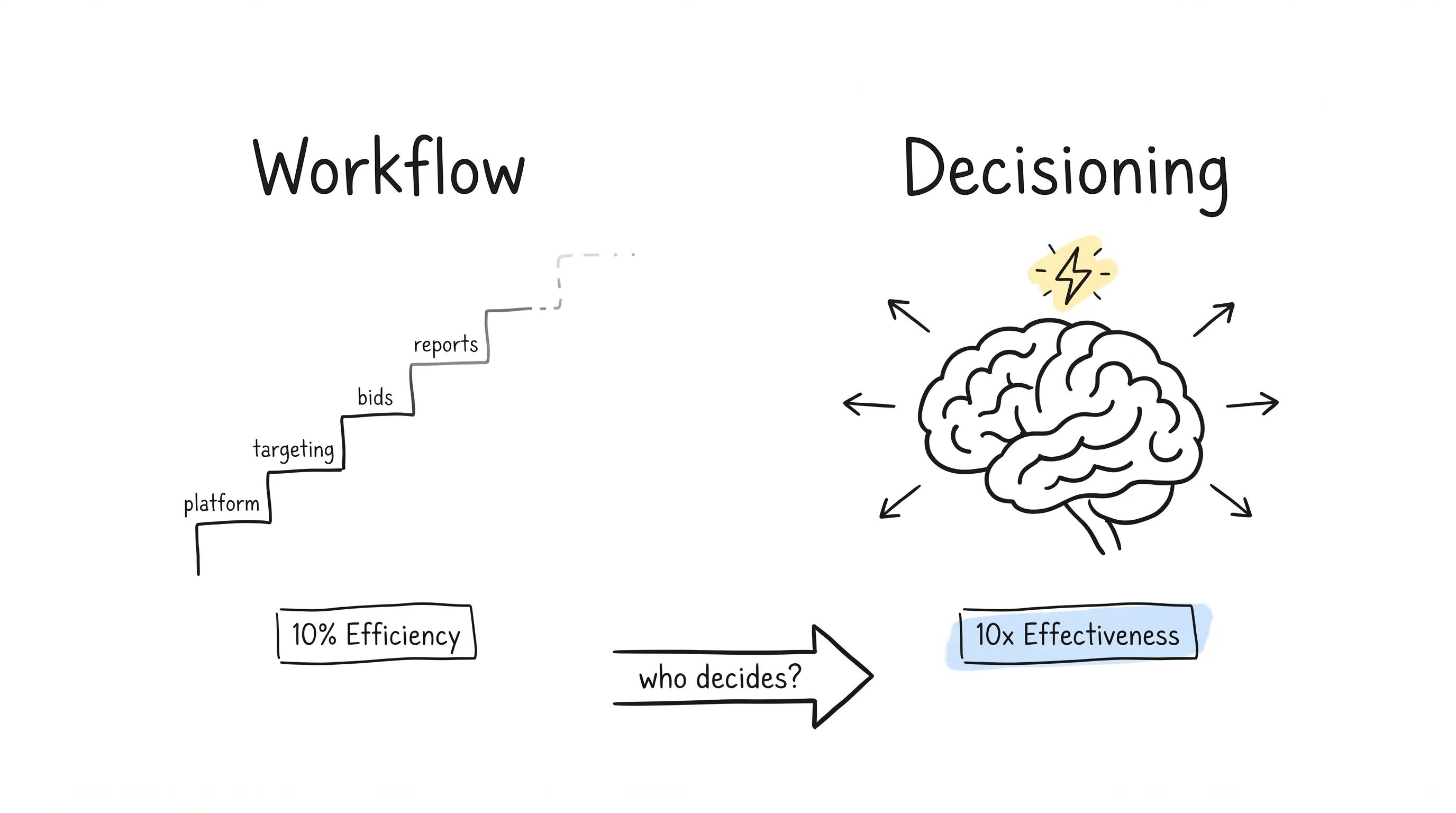
You used to launch an ad by picking a platform, setting targeting, tuning bids, watching schedules, and reading reports. Every step had a learning curve — and whoever mastered the whole routine had a moat.
That wall, in industry jargon, is called the "workflow moat."
LUMA partner Conor McKenna said something on stage that, in essence, went: once AI arrives, the workflow moat starts to evaporate.
The process gets simpler, everyone can do it, and the advantage of making a living off "knowing how to operate" is gone.
So where does the advantage move?
To decision-making.
Which signals to use? Which creative to run? Which placement to buy? If results disappoint, how do you adjust the next second? In the past, a few rounds of decisions a day was a good day. Now, AI lets you re-decide every second.
LUMA's CEO Terry Kawaja ran the numbers:
Efficiency is a 10% incremental improvement. Effectiveness could be a 10x difference.
10% versus 10x.
That is the distance between "running the process well" and "making the decisions right."
For the open web, this stings even more. The LUMA team is blunt: the open web's pie is fragmented — it can't match the big platforms on scale, or on simplicity. To hold onto its already-small share of advertiser budgets, simplifying the workflow alone won't cut it.
It also has to make the results visibly, unmistakably better.
It needs to win on both ends.
The Second Front: The People Buying Things
Done with the sellers; now for the buyers.
AI assistants are doing one thing: stuffing research, discovery, and price comparison into the same chat box.
You used to buy things by searching, reading reviews, and juggling five browser tabs. A long path. Now you ask a question, it answers, the conversation clicks, and the order goes through on the spot.
The path to purchase has been squeezed short.
So where do the ads go?
The speakers at the conference were calm about it: people aren't walking away anytime soon. They'll delegate the legwork to agents, but the key decisions stay theirs.
So for an ad to enter this chat box, it must first pass one gate.
Trust.
Think about it: the one sitting in that chat box is an assistant you trust. If its recommendations carry hidden bias, you turn and walk away. That's why the platforms themselves are more nervous than the advertisers.
Who Takes the Next Ad Dollar?
When these changes finally land on money, what do they look like?
Kawaja had another line that I found especially brutal:
Decisioning, plus unique signals, is what separates companies, separates winners from losers, and ultimately drives consolidation.
To translate: just buying traffic isn't enough. You need signals nobody else has, paired with smart decisioning, to stay at the table.
As for the consolidation part… coming from an investment banker, that carries a bit of professional instinct — you know how it is.
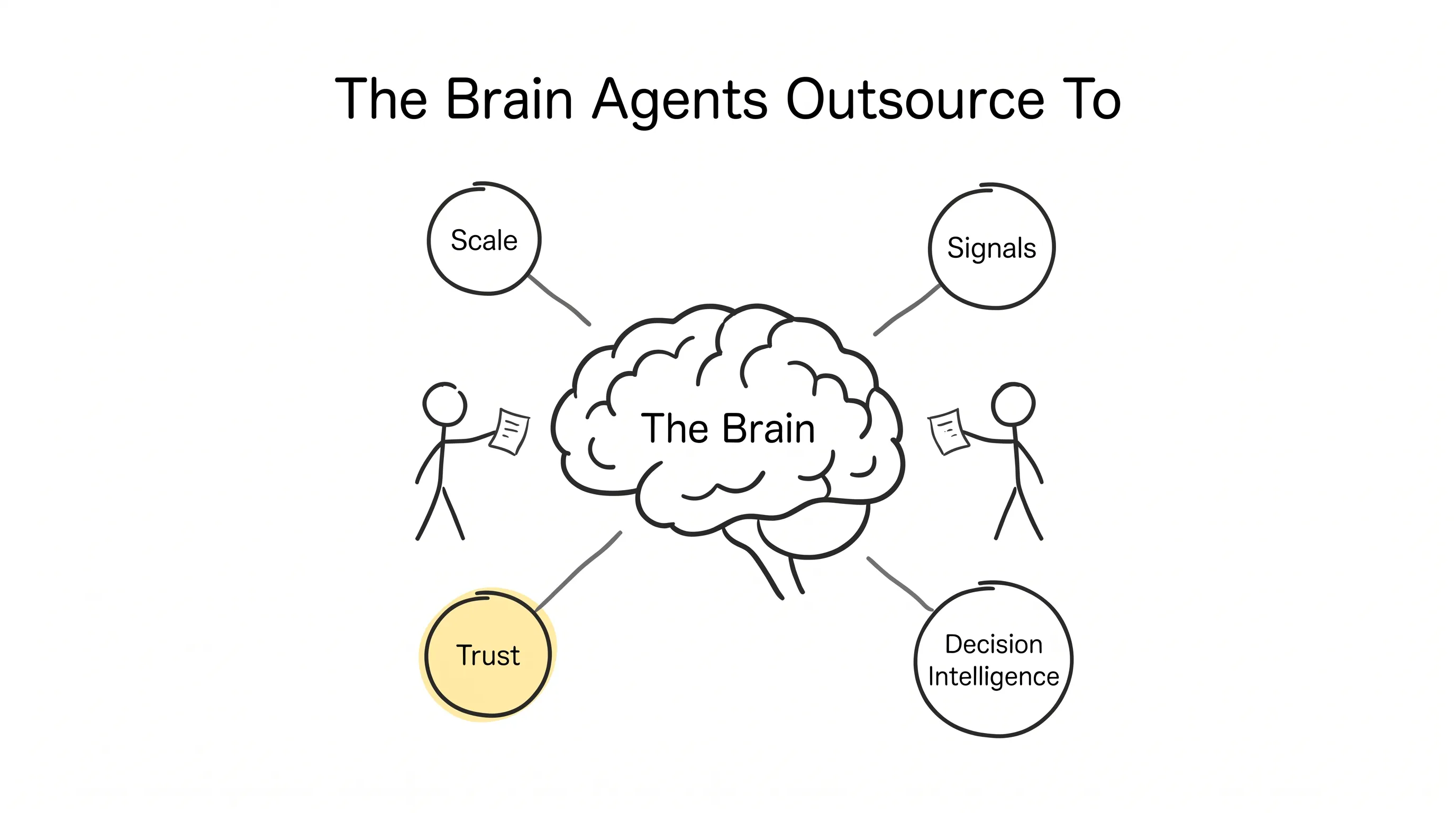
The entry ticket to the next table has four things on it: scale, signals, decision intelligence, and trust.
And the hardest test is still the last one: can a platform prove that every decision it makes on your behalf genuinely improves the results — while never quietly draining your trust in it?
One side demands performance; the other demands people's hearts.
Lose either, and you're out.
Two Quotes Worth Repeating on Their Own
One comes from Sparrow Advisers co-founder Ana Milicevic. Describing the thing everyone is fighting over:
"This is the brain we want to outsource to a bunch of agents."
The brain.
Not a tool. Not a pipeline. A brain.
The other comes from SWYM.ai co-founder and CEO Ravi Patel. He drew a line most people have never thought about.
The industry's new buzzword is the unified media platform, or UMP. What can it do? It can manage "what to run" — and "how much to spend."
But there is one thing it can't manage: who a specific impression gets shown to.
Patel said impression-level decisions still sit inside the systems of Google, Meta, and Amazon themselves. And he said that difference is the whole story.
I stared at that line for a long time.
We used to think the core asset of the ad business was traffic, channels, creative, or craft. Now the answer has gotten simpler: it's the brain that decides for you.
Whoever captures that brain takes the next decade of ad money.
Maybe someday, after your AI assistant finishes comparing prices for you, it will turn around and ask: between these two, which do you trust more?
Whoever you trust — that's whose ads are worth money.
And one more wish for you: in these years where algorithms do the arranging, may you always keep that vote in your hand.
Continue reading
Related articles

What Is GEO? How Your Brand Gets "Mentioned" in the Age of AI Search
An explainer on GEO (Generative Engine Optimization) for e-commerce and DTC brands: how it differs from SEO and AEO, why AI answers shape brand visibility, and eight practices covering question-focused content, consistent brand messaging, structured pages, external evidence, comparisons, and AI mention tracking.

AI Is Already Making Decisions for Your Customers. Are You on the List?
A learn article explains GEO (Generative Engine Optimization): why AI-generated answers now shape which brands customers see, and how SEO fundamentals, entity clarity, citable evidence, and monthly measurement affect visibility in AI answers.

Google Is Stuffing Ads Into AI Search: These Recent Stories Are Really One Story
A news roundup linking recent AI marketing stories—Google adding ads to AI Mode, Amazon's Ads Agent, ChatGPT image updates, a UK startup tracking brand mentions in AI answers, and an AI ransomware warning—arguing that control over ad data and visibility is shifting toward platforms.