
How Much Work Can an AI Agent Actually Do for You?
An explainer on what AI agents can take over in marketing: how they differ from assistants and automation, four levels of delegated trust, common data mistakes, and a read-only path to getting started, with paid-ads examples from Google Ads and Meta.
A few days ago, I had dinner with a friend who runs an e-commerce business. The moment he sat down, he said: "I've been hearing the words 'AI agent' for a full year now. Everyone says it's the future, everyone urges you to jump on it. But let me ask you — what work can I actually hand it?"
I said: that's a good question.
Because asking the right question matters far more than demanding an answer. So today, let me break this whole thing down for you.
What Is an AI Agent?
Let me start with the simplest possible comparison.
You ask an AI assistant: "Compare this week's and last week's CPA on Google Ads and Meta."
It gives you an answer. Great. But notice — you've set the data, the metrics, and the time period — every one of them. It's just a worker. You ask, it answers.
Change the way you ask: "Look into why paid CPA rose last week, then tell me what to do about it."
Now everything changes. What to check first, what to check next, what to check last — it has to decide that itself. It might compare Google Ads and Meta first, notice Meta rose more, then drill into the campaigns, and based on what it finds there, decide whether to look at audience, bids, creative, or the landing page.
You set the destination. It plans the route. That's an agent.
Being Able to Decide Doesn't Mean Being Able to Act on Its Own
A lot of people haven't quite thought this through.
Decision rights and autonomy are two different things. An agent can investigate for you, advise you, even prepare the changes — but every action that costs money should have a gate.
For instance, Supermetrics for Claude: any new campaign is created paused by default, and it doesn't go live until you give the nod.
What Can It Actually Do?
Honestly, quite a lot. Analyzing data, diagnosing problems, writing reports, making recommendations, preparing ad changes for your approval. Look further out, and creative optimization, lifecycle marketing, competitor research, and CRM analysis are all within reach.
They share one thing in common: there's some uncertainty in the work — it has to figure out the path itself.
How Much Power to Give It Is a Skill in Itself
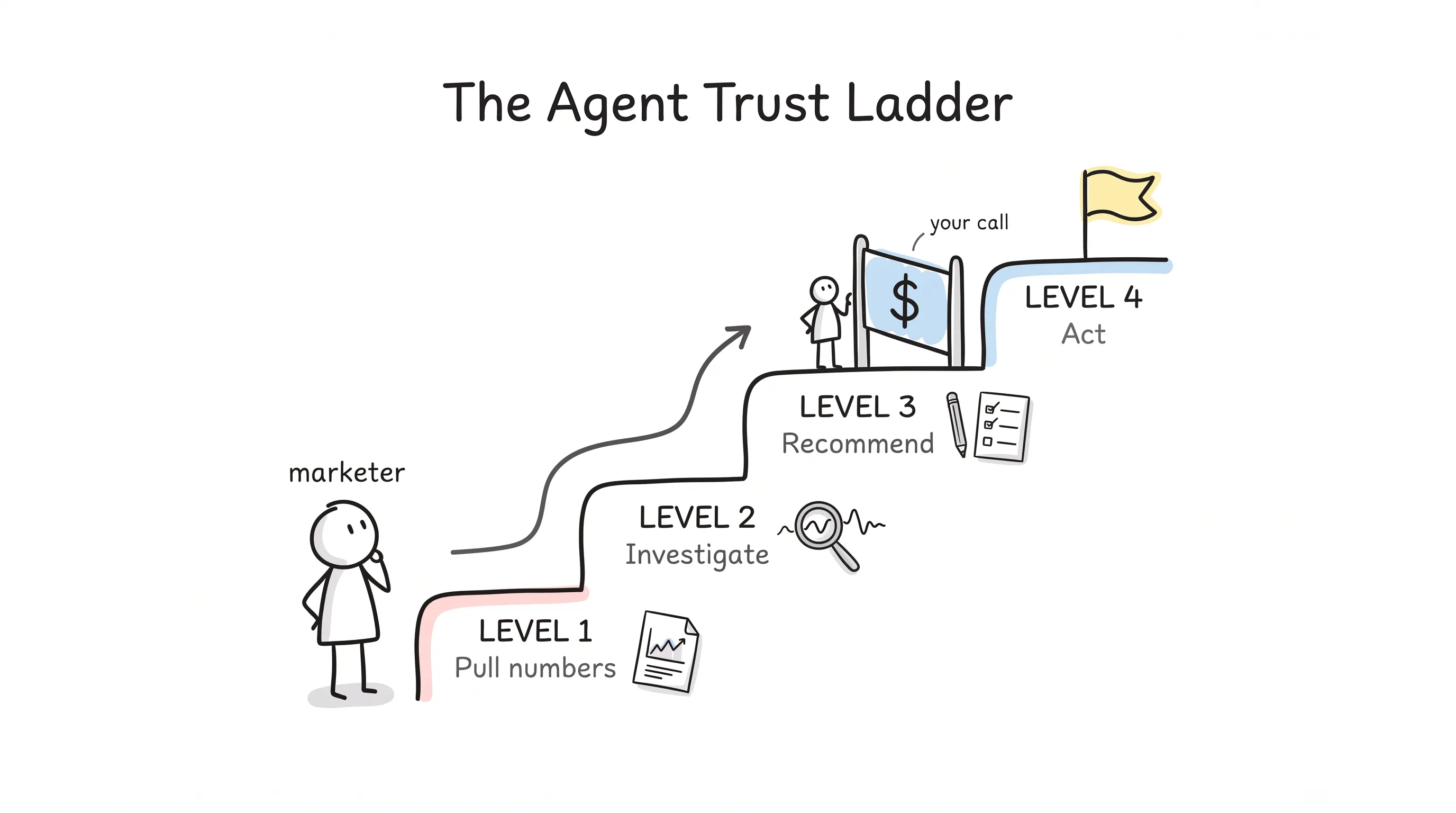
I break this into four levels. Trust has to be earned one level at a time.
Level 1: Pulling Numbers and Answering Questions
You ask: "Which paid campaigns beat their CPA targets last month?" It pulls the data and gives you an answer.
There's not much agency in that, but it saves a lot of manual work. The real difficulty lies elsewhere: is the number underneath the answer the same number you had in mind?
Google Ads and Meta define a "conversion" in fundamentally different ways. Their attribution windows differ too. And CRM has yet another definition. When the numbers aren't aligned, the more precise the answer, the more dangerous it is.
Level 2: Investigating Problems
This is where an agent truly starts to behave like one.
Here's an example. On Thursday, CPA rose 40%. You tell it: "Find out why, show me the evidence, and touch nothing."
It checks spend first. Flat. So the problem is most likely in conversions — and sure enough, they've collapsed. Next it thinks: is the collapse account-wide, or concentrated somewhere? A check: it's concentrated in one Meta campaign. Then: traffic hasn't dropped, so the problem is after the click. A check: the landing page conversion rate has plummeted.
See what's happening — every step of that investigation was decided by what it found in the step before.
An alerting system can only tell you CPA rose 40%. An agent can decide how to find out why it rose.
There's a company called MyoMaster that pipes Meta Ads, Google Ads, and Klaviyo data through Supermetrics into a Claude agent, and feeds it business context too: product margins, target ROAS and CPA, and minimum spend thresholds. Spotting a problem used to take three to four weeks. Now, days. Impressive. When creative fatigue sets in, it flags it; high-intent traffic, it picks out.
Level 3: Recommending and Preparing Changes
At this level, the agent no longer just diagnoses — it starts proposing solutions.
Three campaigns have all blown past their CPA targets. What does a rules-based system do? The blunt one-size-fits-all move: cut every bid. What does an agent do? It investigates them one by one.
The first has heavy audience overlap with another campaign. The second has lost auction share to competitors. The third is healthy in itself — it's the landing page that stopped converting the traffic.
So it prepares an audience adjustment for the first, recommends a bid change for the second, and for the third it recommends you change nothing at all. Because changing the ad settings treats the symptom, not the disease.
That's where an agent is most valuable.
In Supermetrics for Claude, this workflow spans Google Ads, Meta, TikTok, Microsoft Advertising, and LinkedIn — but every change is held pending until you review it.
Level 4: Autonomous Action Within Guardrails
At the final level, you don't give it steps — you give it goals and boundaries.
For example: keep blended CPA below $40 this month; no single-day budget change over 10%; don't touch brand campaigns at all; and if it crosses a line, report back.
Inside the boundaries, it calls its own shots. Outside them, it comes and asks you.
But the risk lives here too. A wrong number, stopped at the "recommendation" stage, you can catch. A wrong number that became "autonomous action" — the money is already spent before you find out.
More initiative shouldn't automatically mean more autonomy.
When to Use Automation, When to Use an Agent?
Here's a simple rule of thumb: when the path is known, use automation; when the path is unknown, use an agent.
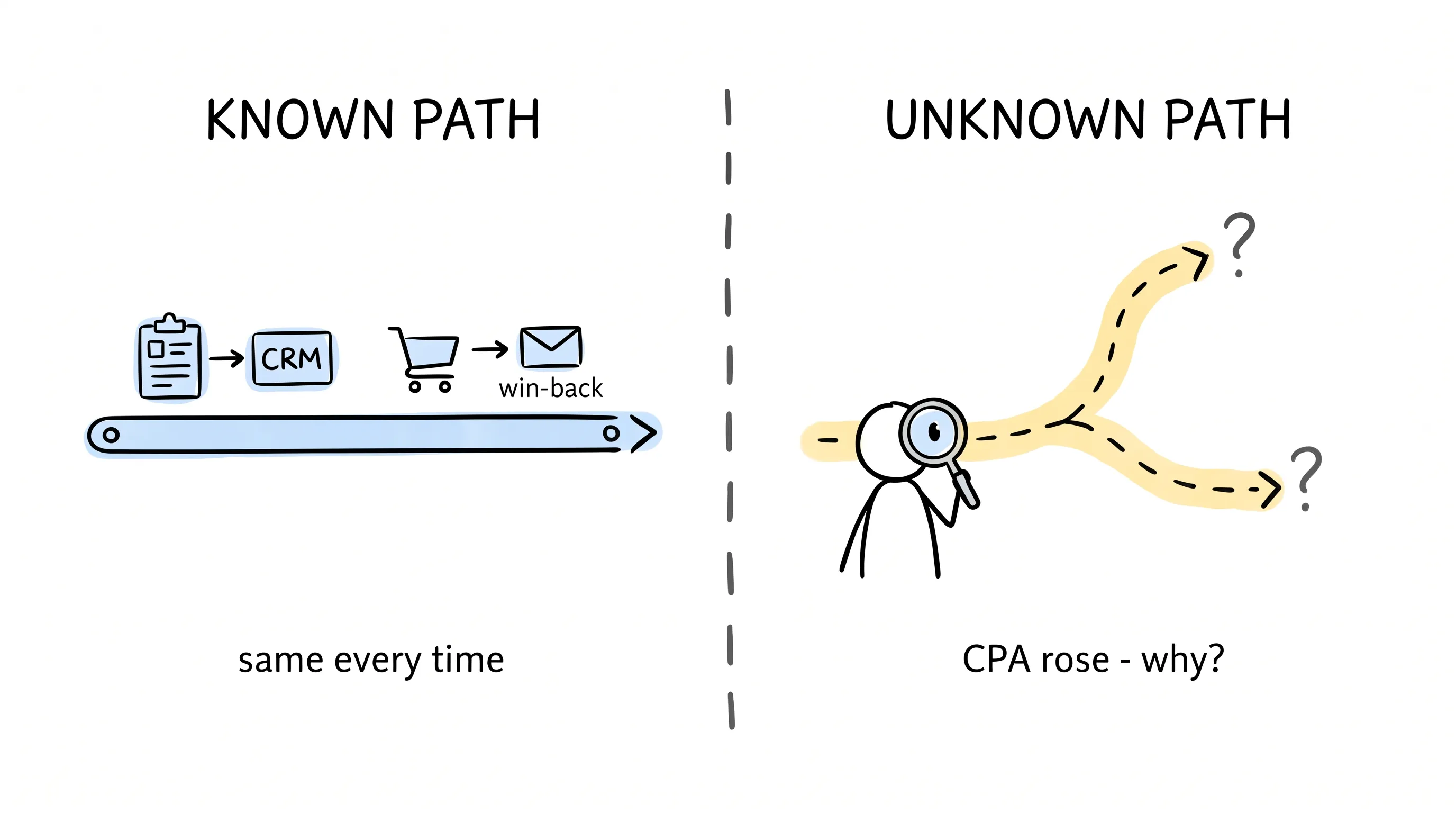
A customer makes a purchase — move them out of your acquisition audience. Same every time: automation. A form gets submitted — update the CRM status. Same every time: automation. A cart gets abandoned — trigger the win-back flow. Same every time: automation.
The other way around: CPA suddenly rises, and you need to find out why. How to investigate depends on what's in the data. Agent. Lead volume is unchanged, but the pipeline is dropping — something broke somewhere, and it needs finding. Agent. Several campaigns missed their targets, each for possibly different reasons. Agent.
Don't swap everything for a large language model. For known paths, automation is faster and steadier. Judgment is what an agent is for.
A Trap That's Easy to Fall Into
Having AI write three Meta ad headlines — that's not an agent, that's generation.
But if you ask: "For the same product, Meta's CPA is 30% higher than Google Ads' — find out why, and recommend what to change." Now it's an agent, because what to check, how to check, and where to drill next are all decided by it as it goes.
And don't judge by the chat box whether something is an agent. Look at its control over the path. A nightly data sync can run completely unattended while making zero decisions. That's automation.
Why Do Agents Get the Numbers Wrong?
Four ways to get it wrong. Take note.
One: pulling the wrong field. The field name sounds right, but the business definition doesn't match. Two: miscalculating. The data is fine, but it got its own math wrong. Three: misreading a real pattern. The data genuinely changed, but it guessed the cause wrong. Four: overstating causality. The evidence points to a possibility, and it reports it as a certainty.
And the further along it goes, the more expensive the mistakes get. At level one, a wrong number is one wrong answer. At level two, one wrong premise and the whole investigation collapses.
So don't just look at whether the data is fully connected. Look at whether metric definitions are aligned and the calculation methods are consistent. That's exactly what Supermetrics does: it puts advertising, analytics, and CRM data into a single governed layer, so the numbers an agent receives are the numbers you've vetted.
But even vetted numbers aren't 100% right. When a conclusion means spending money, touching customers, or changing strategy, you still want to go through it yourself.
Actually, Not That Many People Are Using Them
Now, let's talk about the real picture.
McKinsey's State of AI research: 62% of organizations are experimenting with AI agents, but in any specific business function, no more than 10% have scaled them.
Supermetrics' 2026 Marketing Data Report: 80% of marketers feel pressure to use AI; only 6% have actually embedded AI fully into their workflows.
80% feel the pressure, only 6% have truly embedded it. The 74 points in between — that's the window of opportunity.
For those who move first, this is the opportunity. Start now, and you can still — while everyone else watches — find out exactly how much time agents can save you, build your own trust in them, and get your workflow running smoothly. Wait until it becomes standard equipment to enter, and you're just playing catch-up.
How to Get Started?
Start your first agent with "read-only investigation."
For example: "Paid CPA rose last week. Find out why, show me the evidence, flag anything you can't explain, and don't touch anything."
Then check its work: Did it pull the right data? Is the path reasonable? Which parts does it know, and which parts is it guessing?
Once it's reliable, let it recommend. Once it's reliable again, let it stage changes for approval. Finally — autonomous action.
On the tools side, with Supermetrics for Claude you can pipe ready-made marketing data straight into Claude without building your own data pipeline. And if you want to build your own agents, or embed AI into your own product, Build on Supermetrics provides the API and MCP data layer.
One side note: Supermetrics doesn't train public AI models on customer data. But the third-party AI providers you connect to have their own terms — check sensitive data yourself, one more time.
Will It Replace You?
Not in the short term.
An agent can take over pulling data, organizing, investigating, and repetitive execution. But you set the goals, you weigh the ambiguous evidence, and you make the decisions that affect the business.
The more important the move, the more a human needs to review it.
Back to the Dinner Table
After I finished that day, my friend said: "I get it. Let it audit the books — don't let it spend money."
I said: right.
AI agents are already good enough to be worth using today. But not reliable enough to run without watching.
Start with auditing the books, start with never touching money. Have it investigate something you already know the answer to, and see whether its reasoning follows the same path as yours.
Here's hoping you soon hand over the repetitive work — and keep the judgment in your own hands.
Continue reading
Related articles

It's 2026: Stop "Buying" AI Tools for Your Marketing Team — Start "Hiring" AI Agents
This learn article explains how AI agents differ from standalone AI tools in marketing, outlines three agent categories — build-your-own platforms, CRM-native agents, and vertical tools — and covers use cases across SEO, social media, advertising, and reporting, plus criteria for choosing one.

Did the Money You Spent on AI Marketing Ever Come Back?
A guide to measuring AI marketing ROI across three layers: ad reports, sales pipeline, and the financial ledger. Covers metrics such as ROAS and CPA, eight dashboard metrics, industry benchmarks, and common measurement mistakes.

How to Pick a Creative Automation Platform: First, Figure Out What These Eleven Actually Do
A learn article sorts eleven creative automation platforms — including Bannerflow, Celtra, Smartly.io, and Storyteq — into four functional groups and proposes five evaluation questions covering publishing reach, automation depth, ease of adoption, team fit, and verifiable evidence.