
Is Your Content Getting Cited by AI?
A learn article explaining generative engine optimization (GEO): how AI answers select and cite sources, how GEO relates to SEO and AEO, how visibility can be tracked with Share of Model, and common pitfalls to avoid.
A few days ago, I asked an AI to help me look into a business problem.
A few seconds later, it handed me a perfectly smooth answer. There was a conclusion, there was data, and sources were even listed.
My first reaction was: nice, that's efficient.
My second reaction was: oh no.
Among the sources it cited, we were nowhere to be found.
All those years of grinding away at content, and in the AI's eyes, not a single word of ours got used. Readers never even reach our doorstep.
That's the story I want to get into properly today. Before we get there, remember one sentence:
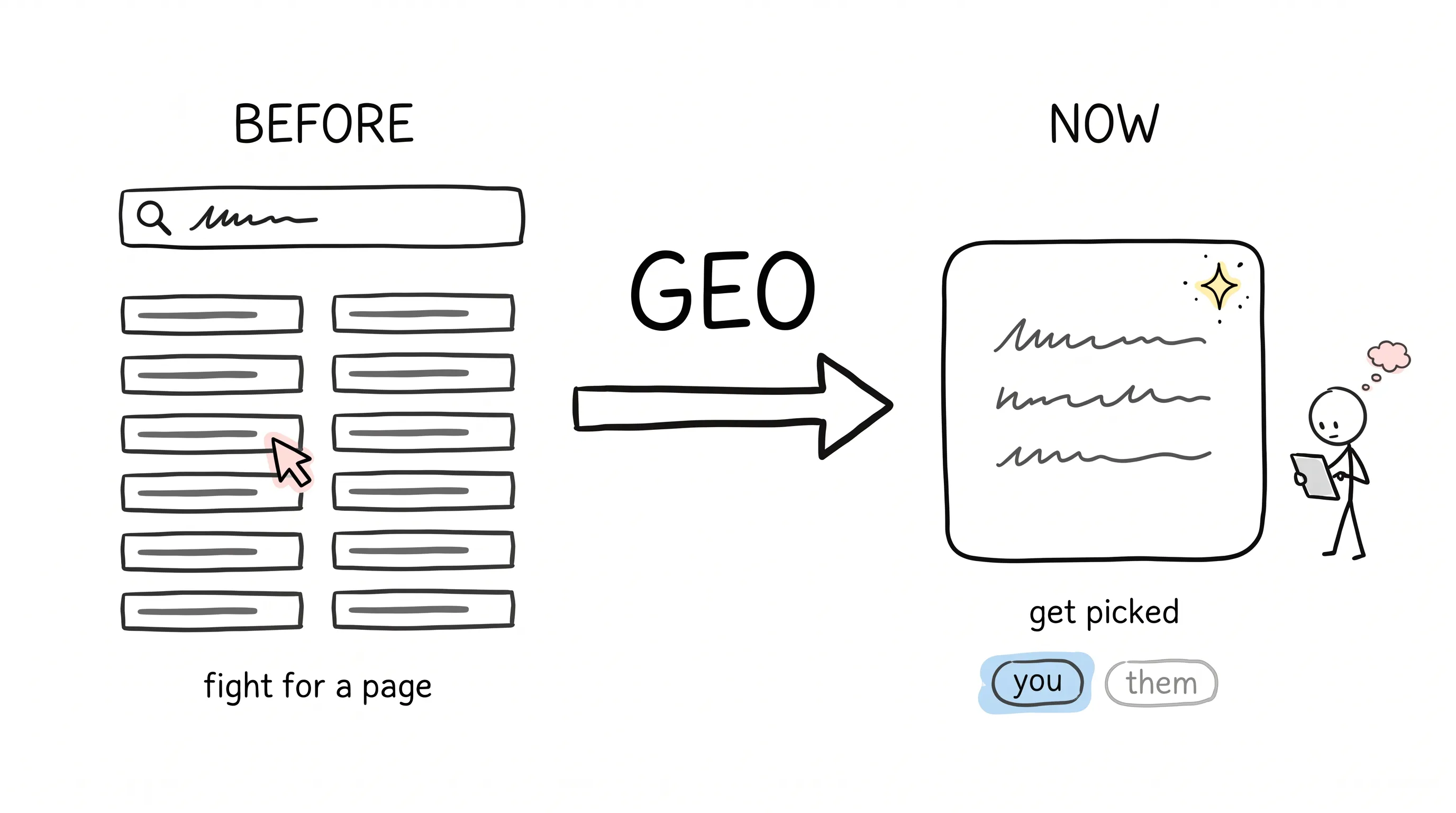
Before, you had to squeeze onto the first page of search results. Now, you have to squeeze into that one paragraph the AI writes.
What Is GEO?
So what is GEO?
The full name is Generative Engine Optimization — optimizing for generative engines.
In plain terms: in the past, you made content for search engines. You researched keywords, traded backlinks, and hoped for a good ranking on Google.
Now? More and more people, when they hit a problem, go straight to ChatGPT, Perplexity, or Gemini. The AI doesn't hand you ten blue links. It writes the answer itself and serves it to you.
Where does that answer come from? The AI sweeps through content across the web, picks a few pieces it trusts, blends them together, and produces one paragraph.
If your content gets picked, you exist. If it doesn't, you might as well have never written it.
Getting picked by AI — that's called GEO.
The term was coined in 2023 by a group of Princeton researchers. Three years later, it has gone from a research paper to a full-blown craft.
So Was All That SEO for Nothing?
Hearing this, many people panic: did all those years of working on SEO go to waste?
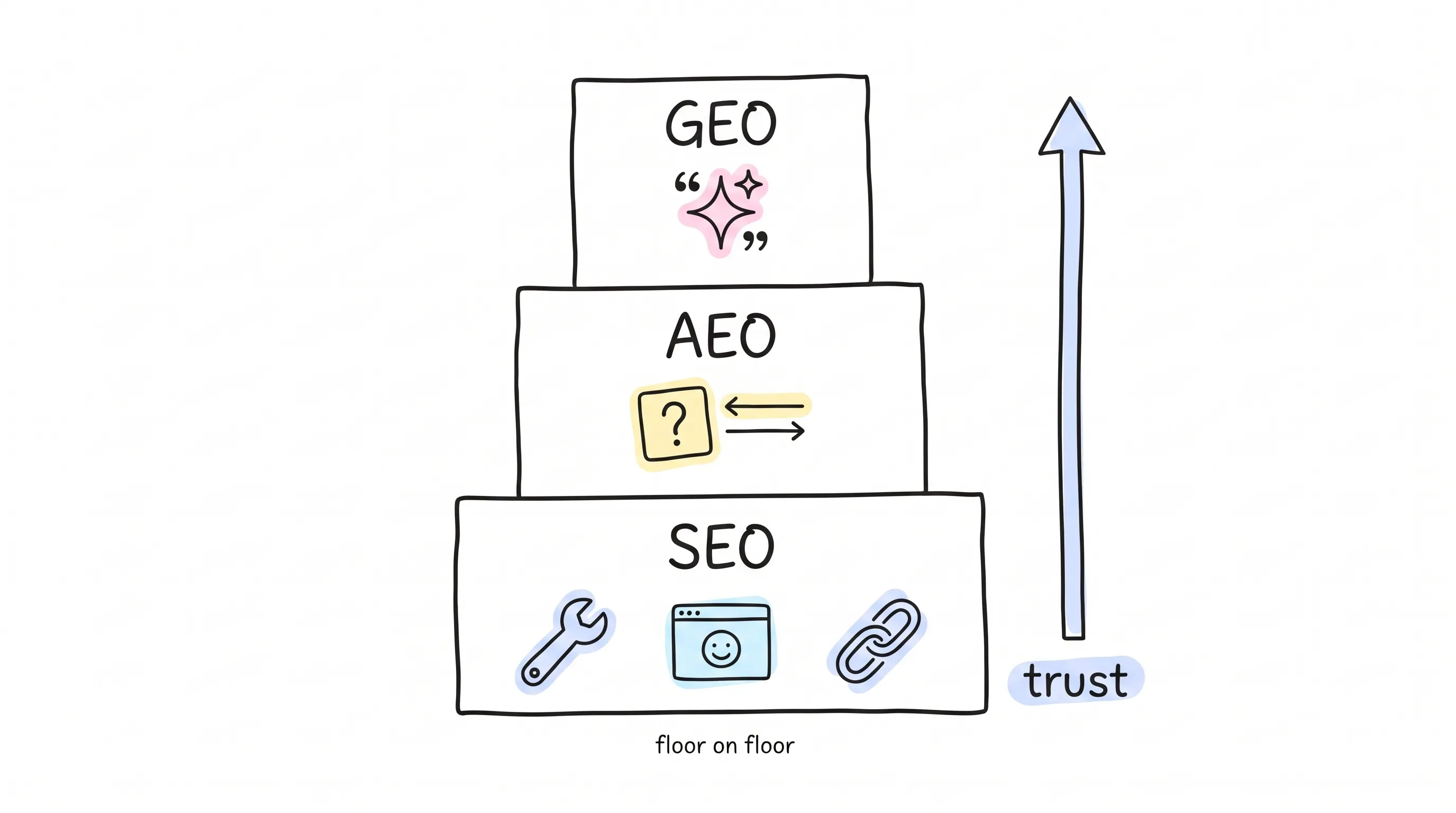
No. Picture these three things as a building.
At the very bottom is SEO. With solid technical foundations, smooth user experience, and strong backlinks, your site earns the right to be treated as a trustworthy source. When AI picks its material, it often references search rankings — the higher-ranked ones get looked at first.
In the middle is AEO — Answer Engine Optimization. You break your content into chunks that can directly answer questions: clear question-and-answer pairs, clear structure. When AI Overview wants to pull out a single sentence, it can pull one, dead-on, every time.
And at the top is GEO. Getting the AI to not just quote your words, but to name you in the answer.
If the foundation is shaky, the two floors above are castles in the air. GEO is not a replacement for SEO. It is the floor above SEO.
How Does AI Pick Content?
If you want to be picked, you first have to know how AI picks.
Broadly, it's four steps.
Step one, understand the question. What are you asking, what do you want? It breaks it down first. Complex questions get split into several smaller ones.
Step two, find the material. It digs through its memory and also through the live web. New, authoritative, and on-topic — those come first.
Step three, inspect the goods. Is this information accurate? Does it have a source? Is the speaker actually qualified?
Step four, synthesize. It stitches the goods from several sources into one paragraph, and conveniently attaches the sources.
Once you understand these four steps, you know where to push. The way AI selects content is a lot like how a procurement manager picks suppliers: the goods must be genuine, the books must be clean, and the supplier must be reliable.
So what kind of content does AI want at first glance?
Content that offers a definition. Content with data, with sources, with dates. Content with real experts going on record. Content with a clear structure, where each paragraph makes one point. Content updated recently.
And the opposite? Opinion everywhere with no facts, data of unknown origin, a wall of text with no breaks, untouched for three years. AI takes one look and walks away.
Someone Has Run the Numbers
At this point, you might think: I get the logic, but does it actually work?
It really works. That same group of Princeton researchers ran experiments, testing optimization methods one by one to see whether AI actually buys them.
Here are the numbers:
Citing authoritative sources in your content boosts visibility by 40%. Adding concrete statistics boosts it by 37%. Getting real experts to speak and leaving quotes boosts it by 30%. Using industry terminology precisely, without vagueness, boosts it by 28%.
Unbelievable. The highest one is forty percent.
And none of these require a big budget. Cite your data with sources, make your claims more precise, open with a definition. These are all things you can do in passing while writing an article.
Here's another number: zero-click searches now account for 65% of all Google queries. In 2022, that number was 50%.
What does that mean? More than half of people search and never click a single link.
The gateway to traffic is moving house — from a page of ten results, into one synthesized paragraph.
How Long Is the Window?
Here's another number.
A survey found that 47% of brands still don't have a GEO strategy at all.
In other words, nearly half of your competitors are still standing in place.
This is like the early days of WeChat official accounts. The first to move got the meat, the next got the soup, and the last ones didn't even get to touch the pot.
The window is real, but it won't stay open forever. By the time GEO becomes a standard practice everyone does, you'll spend several times the effort others did, and get a fraction of their results.
How Do You Know Whether It's Working?
You used to watch rankings. What do you watch now?
A new metric: Share of Model, or SoM for short — your model share.
What is model share? On a given topic, among the brands that get mentioned and cited in AI's answers, how much of that share is yours?
How do you measure it? An example.
Say you pick 50 questions your customers would actually ask, and ask them one by one to ChatGPT and Perplexity, recording every brand mentioned in each answer. Tally it up: you were mentioned 12 times, and your biggest competitor 18 times.
You're at 24%, they're at 36%.
That 24% is your model share on that topic. Record it once a month, and watch whether it rises or falls.
Beyond that number, two things are worth watching: how many visitors AI sends you, and how those visitors convert; and whether AI speaks well or badly of you when it mentions you.
Being cited a hundred times, with every citation saying you're unreliable — that's worse than not being cited at all.
How Long Until You See Results?
My advice: set your expectations right first — 3 to 6 months.
Month one: lay the foundation. Take stock of your existing content, measure today's model share, and rewrite your 10 most important articles first.
Months two to three: accelerate. Extend the optimization to 20 or 30 articles, and write all new content in GEO style from the start. By this point, model share should improve by 10% to 20%.
Months four to six: harvest. The full library is done, and the major AI platforms start mentioning you steadily. Improvement can reach 30% to 40%, and AI-driven visitors become visible in your analytics.
Impressive, right? But there's a trap you need to know about:
When AI models update, who gets cited can reshuffle overnight. The source that ranks first today may be gone in the next version.
So GEO is not a one-time renovation. It is ongoing property management. You have to keep watching, keep adjusting.
The Easiest Pitfalls to Fall Into
First, stating conclusions without sources.
If you don't mark where your data comes from, why should AI trust you? AI favors the verifiable. Every fact gets a source and a date.
Second, burying the good stuff too deep.
The key answer sits behind the fifth screen; AI won't dig through your drawers for you. Lead with the answer.
Third, betting on a single platform.
Some readers might think: isn't doing well on ChatGPT enough? No. In May 2026, ChatGPT's share of AI assistant users fell to 46.4% — the first time it dropped below half. Gemini and Claude are both rising. The answers in this game are spreading across more and more players, so don't bet everything on one of them.
Fourth, not waiting long enough.
You do it for six weeks, see nothing, and quit. Then everything you did before goes to waste. The 3-to-6-month cycle is the normal pace of this craft.
And a few small things you can do along the way: don't title a page "Introduction" — write it as a question your readers would actually ask; organize the questions people ask most often into FAQ pages; use lists and tables instead of a wall of text; and honestly display the last-updated date on your pages. These details are all handles AI can grab.
Final Words
Back to the scene at the beginning.
That day, after finishing my search, the first thing I did was open our most important articles and add sources, data, and expert quotes to each one.
Then I set a rule for myself: after every article, I ask myself one question —
Would AI dare to lift this content straight into its answer?
If yes, it goes out.
Who you write for determines how you write. Ten years ago, we wrote for search engines. Today, we also have to write for that creature that reads the whole web on everyone's behalf.
Next time you ask an AI a question, take an extra look at who it cites.
And here's hoping you get named by it, one day soon.
Continue reading
Related articles

It's 2026: Stop "Buying" AI Tools for Your Marketing Team — Start "Hiring" AI Agents
This learn article explains how AI agents differ from standalone AI tools in marketing, outlines three agent categories — build-your-own platforms, CRM-native agents, and vertical tools — and covers use cases across SEO, social media, advertising, and reporting, plus criteria for choosing one.

What Is GEO? How Your Brand Gets "Mentioned" in the Age of AI Search
An explainer on GEO (Generative Engine Optimization) for e-commerce and DTC brands: how it differs from SEO and AEO, why AI answers shape brand visibility, and eight practices covering question-focused content, consistent brand messaging, structured pages, external evidence, comparisons, and AI mention tracking.

AI Is Already Making Decisions for Your Customers. Are You on the List?
A learn article explains GEO (Generative Engine Optimization): why AI-generated answers now shape which brands customers see, and how SEO fundamentals, entity clarity, citable evidence, and monthly measurement affect visibility in AI answers.