
Ads Are Moving In — Right Into Your Conversations With AI
A weekly industry roundup covering Google's multiturn ads in AI Mode, ChatGPT's automatic creative optimization, traffic shifts from AI search, AI citation volatility, and a new robots.txt directive on AI training, with practical steps for advertisers and small businesses.
A few days ago, a friend of mine who runs a home renovation business asked me: do people still search for "water heater leaking"?
I said: fewer people are searching. But more people are asking.
They open AI and ask: my water heater is leaking from the bottom, should I replace it myself or call a technician? Before they've even finished, they follow up: roughly how much would a replacement cost? And then: which company nearby can come out today?
One question becomes three. That's a "multi-turn conversation."
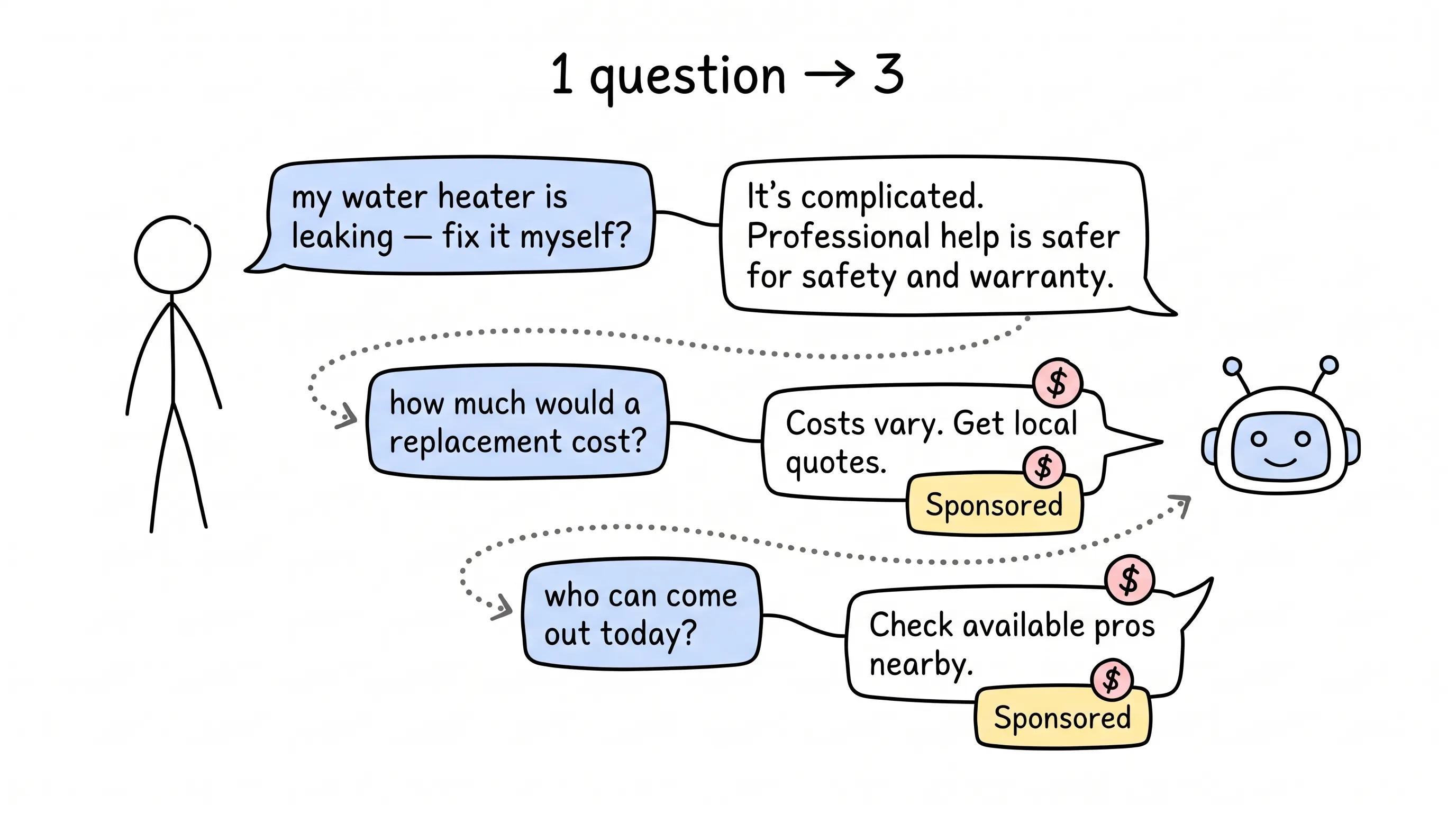
And in the week of October 26 to November 1, the big stories that broke in the industry all revolved around this one behavior. Ads are moving into conversations. Ads are starting to edit themselves. The traffic landscape is quietly shifting routes. Even the question of whether your website should let AI train on its content has gotten a unified answer.
Let me take them one by one.
1. Google Is Stuffing Ads Into Your Follow-Up Questions
On October 28, Google launched "multiturn ads" in the US.
What are multiturn ads?
AI Mode is Google's chat-style search interface: you ask, it answers, you follow up, it answers again. Before, ads only appeared on the first question. Now, on the second question, the third question — every turn can surface an ad labeled "Sponsored."
That friend with the water heater — right when he asked "should I replace it myself or call a technician," there could have been an ad sitting next to the answer.
What justifies putting ads there? Google gave two numbers.
First, questions in AI Mode are on average three times longer than in traditional search. Longer questions mean more specific needs. "What do I do if I got into an accident with my car loan still unpaid?" is worth a lot more than "car accident."
Second, by Google's own US data from August 20 to September 3, the click-through rate on sponsored product listings in AI Mode is already roughly on par with organic results.
Users don't mind, and the questions are worth more. What are you waiting for?
The money. That same day, Alphabet released its Q3 earnings: search and other revenue came in at $63.35 billion, up 12% year over year — a noticeable slowdown from last quarter's 17%, and below the analysts' expectation of $64.85 billion. The stock fell nearly 10% after hours. The Chief Business Officer was blunt on the earnings call: AI Mode query volume is growing fast, but the "monetization rate is relatively low."
Queries are climbing fast; the money isn't keeping up. So what do you do?
Add more ad slots.
Wherever users follow up, the ads will follow.
By the way, this isn't just the US. Australia, Canada, India, Kenya, Malaysia, New Zealand, Nigeria, Pakistan, the Philippines, and Singapore have all already rolled it out; Brazil, Mexico, and the UK will follow within this quarter.
If you're running Google ads, two things you can do right now: ask whoever manages your campaigns which ad groups are eligible for AI Mode and whether those placements show up in the reports; and rework your ad copy from keyword style to question-answering style. "Water heater leaking from the bottom," "Houston accident without insurance" — writing specific scenarios straight into headlines is going to pay off more and more.
2. ChatGPT's Ads Are Now Editing Themselves
Starting October 30, OpenAI turned on a switch by default for all ChatGPT ad accounts: creative enhancements — automatic creative optimization.
Once it's on, the system doesn't ask you. It just does four things:
It rewrites your headlines and descriptions, or starts over from scratch; it translates your ad copy into other languages; it resizes your images into every layout; and it can even send the click to a different landing page it deems "more relevant."
The edited versions go live immediately, and you won't necessarily see previews in Ads Manager. Turning the switch off only blocks future changes. What's already out there — you can't claw it back.
If you're a lawyer, pay extra attention here. Attorney advertising is regulated in every US state, and some states won't even let you use words like "expert" or "specialist" casually. The AI doesn't know your state's rules — it only knows "how to write something that looks more appealing."
Same goes for home renovation: you're advertising heating repair, and it swaps the landing page to AC installation. A pile of leads comes in, and not one of them matches.
So if you're running ChatGPT ads, go into Ads Manager today, open Manage settings, and make a decision on creative enhancements at the account level. Not sure? Leave one test campaign on and turn everything else off. Campaign-level settings can override the account default — that backdoor is worth keeping open.
That same week, OpenAI also fully rolled out multi-image ads to all advertisers: 4 to 6 square images, all pointing to the same page, with a single "Learn more" button. For roofing and yard renovation businesses with plenty of before-and-after shots, this format is a perfect fit.
3. Where Did the Traffic Actually Go?
The most interesting thing this week was two sets of numbers, viewed side by side.
The first set comes from Reddit's Q3 shareholder letter: in October, visits driven by search engines dropped by more than a million per week on average; US daily active users fell from 53.2 million to 50.7 million — the drop was mostly non-logged-in visitors. The CEO was blunt: Google's AI Overviews and AI Mode are the biggest reason, and AI Mode "doesn't send traffic to anyone — at least not to anyone I know of." Reddit also said it will test "login-only access" in markets outside the US this quarter. If it gets to that point, even forum posts could become content search engines can't read. Watch it, but no need to act yet.
Sounds like AI is draining the internet's traffic?
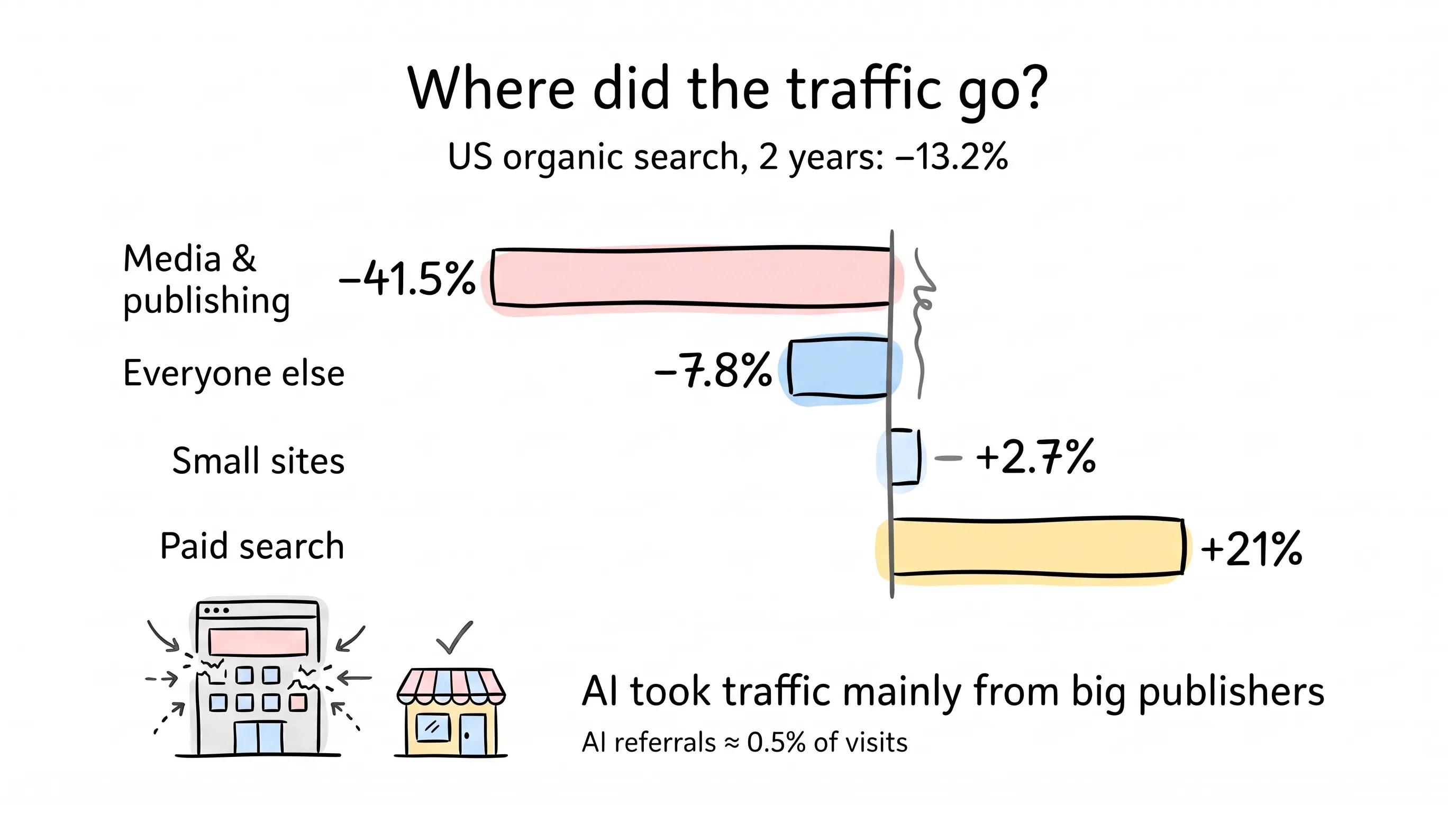
Now look at the second set. Analyst Kevin Indig ran a study on Similarweb data covering 8,658 US websites: from August 2024 to August 2026, organic search traffic fell 13.2% in total.
That's a steep drop. But break it down, and it gets interesting.
Media and publishing sites lost 41.5%. Strip them out, and the overall US decline is only 7.8%. Of the volume lost, about 1% of sites account for 40.2%. And the median for small websites? Basically flat — up 2.7%, in fact. Meanwhile, visits from paid search rose 21%. As for the thing everyone fears most, "AI stealing traffic": AI referrals account for only 2.85% of US search traffic, roughly 0.5% of all visits.
Put plainly: over the past two years, the ones AI has taken traffic from are mainly the big publishers that live off traffic. The clinic on the corner, the renovation crew down the street — they never depended on millions of casual visitors in the first place.
4. AI Citations Are Fickle
So you might ask: should I try to get my content cited by AI?
Yes. But first, know this: AI citation sources — today it's one site, tomorrow it might be a completely different one.
Ahrefs ran a meticulous experiment: for 20 days straight, they asked the same questions to 5 AI tools and tracked about 37,500 cited websites. The result: the share of citations still present the next day was 50% for AI Overviews, 58% for AI Mode, 59% for ChatGPT, 81% for Gemini, and 83% for Copilot. Absurd, right? In Copilot, of every ten cited sites, eight were gone the next day.
The good news: of the citations that dropped out over the 20 days, about 75% came back.
Two details are especially valuable for small businesses.
First, in AI Overviews, pages that rank in Google can be cited for more than 7 consecutive days 29% of the time; pages with no ranking, only 4%. Your old SEO fundamentals are the foundation of AEO (Answer Engine Optimization).
Second, when the question names a brand, the brand's own website has a 28% to 33% chance of being cited every single day for 20 days straight; ordinary sites, only 4% to 7%.
So don't check once today and once tomorrow and draw conclusions. Count how many days you appeared over the past 7 — that's the number that counts.
5. Your Website Needs to Take a Stand on AI
There was also a quiet but important thing this week: Google, Microsoft, and OpenAI have all stated, one after another, that they will respect a new directive in robots.txt. The directive is one sentence: don't take my content and train your models on it.
robots.txt is that small text file in your website's root directory, traditionally used to tell search engines "where you can crawl, where you shouldn't." The new directive adds one more line: crawling, fine; using it for training, no. The format comes from an Internet Engineering Task Force (IETF) draft, drafted by someone from Anthropic — and Anthropic says it's building support too.
Google says it expects to start supporting it in early 2027, and it won't affect your site's performance in search — AI Overviews and AI Mode are controlled separately. Microsoft's Bing went a step further: splitting "can it be trained on" and "can it be cited in answers" into two independent switches. It will recognize the new directive from February 1, 2027, and after March 1, 2027, the old NoArchive and NoCache tags will no longer govern anything AI-related.
How should you take a stand? Look at what your website is for.
For a law firm's practice pages, the whole point of their existence is to be found and cited. Refusing citations is pushing business away. But "do we want to be in training data" is a separate question — some firms want it, some don't; that's their call. Home renovation companies usually have it simpler: their service pages would jump at the chance to have every AI in the world cite them.
There's one thing you should ask your web developer right now: does our robots.txt or page code use NoArchive or NoCache? If yes, after March 1 next year, they'll no longer control AI on Bing's side.
6. Three Quick Things While We're at It
WordPress released 7.1.4 on October 28, patching 22 security vulnerabilities in one go. One of them is in the core update process — in the worst case, an attacker could run their own code on your site. Many hosts auto-update, but not all of them are reliable, and custom-built sites often have that switch turned off. Log into your dashboard and check the version number; if it's below 7.1.4, update it.
A Meta Pixel change took effect on November 12: for eligible advertisers, "measure conversions on customers' devices" is now on by default. In plain terms, Meta uses the email addresses and other information customers have already left with you to run one more match on their own phones and computers, filling in the sales that used to be missed. EU and UK users are not included. Note: once it takes effect, your Meta reports will most likely "look better" — but you haven't spent a dollar more. Reconcile your own lead records and order records first, then decide whether to raise the budget. If you have lead forms, have whoever handles privacy policy take a look at this setting — it can be turned off anytime in Events Manager.
Finally, writing. On October 30, Ahrefs published a guide on the BLUF writing method. BLUF — bottom line up front — is an old rule of US military writing: give the answer in the first sentence, push details back, and put background as far back as it can go. The guide cites an analysis of 1.2 million ChatGPT answers: 44.2% of citations come from the top 30% of a page. It also comes with a free rewriting tool — paste in a paragraph, and it rewrites it in "answer in the first sentence" style.
Does your service page still open with "Founded in 2008, our firm is committed to putting clients first"? What people actually search for is "how long do I have to file a personal injury claim in Texas." When AI reads on the user's behalf, it wants to know the same thing.
Just do one thing this week: take the openings of your three highest-traffic service pages, paste them into that free tool, and see how much the rewrite differs from what you have now.
Finally, a Ready-to-Use Prompt
Fill in the brackets, paste it into whatever AI you use, and it works. Every fact it mentions — verify it against your own records before you publish.
你是 [城市, 州] 一家 [律所 / 暖通公司 / 水暖公司] 的网站内容编辑。我们的 [某项业务] 服务页现在开头 150 字如下:[粘贴]。请给我三样东西:
1. 该城市的潜在 [客户] 可能向 AI 助手问出的 5 个又长又具体的问题,要像真人问的,不要像关键词;
2. 一段不超过 60 字的新开头,第一句就回答其中最常见的问题;
3. 一份待核对清单:页面里哪些事实(价格、周期、服务范围、执照或律师执业资格)需要我本人确认。
不许编造任何关于我们业务的事实。只能由我来填的地方,全部标出来。
Back to the friend with the leaking water heater.
And all of the above, in the end, answers the same question: when your customers start talking to AI, can your business still find them?
Here's to you always being among the ones who get found.
Continue reading
Related articles

It's 2026: Stop "Buying" AI Tools for Your Marketing Team — Start "Hiring" AI Agents
This learn article explains how AI agents differ from standalone AI tools in marketing, outlines three agent categories — build-your-own platforms, CRM-native agents, and vertical tools — and covers use cases across SEO, social media, advertising, and reporting, plus criteria for choosing one.

What Is GEO? How Your Brand Gets "Mentioned" in the Age of AI Search
An explainer on GEO (Generative Engine Optimization) for e-commerce and DTC brands: how it differs from SEO and AEO, why AI answers shape brand visibility, and eight practices covering question-focused content, consistent brand messaging, structured pages, external evidence, comparisons, and AI mention tracking.

AI Is Already Making Decisions for Your Customers. Are You on the List?
A learn article explains GEO (Generative Engine Optimization): why AI-generated answers now shape which brands customers see, and how SEO fundamentals, entity clarity, citable evidence, and monthly measurement affect visibility in AI answers.