
Your Next Customer May Never Open Your Website — Not Even Once
A learn article explaining why strong search rankings no longer guarantee visibility, since AI answers often skip top-ranked sites. It introduces GEO concepts such as query fan-out, citation-friendly content structure, schema markup, entity consistency, and manual tracking of brand mentions in AI answers.
A few days ago, a friend of mine who builds enterprise software asked me out for coffee. The first thing he said when we sat down: "Run, my search rankings are great. So why are my customers drying up?"
Instead of answering, I asked him a question back: have you ever asked ChatGPT about your own category?
He paused, pulled out his phone, and typed in the question his customers always ask: "How do I choose a CRM for a startup?"
The answer came back. The AI recommended three companies. He wasn't one of them.
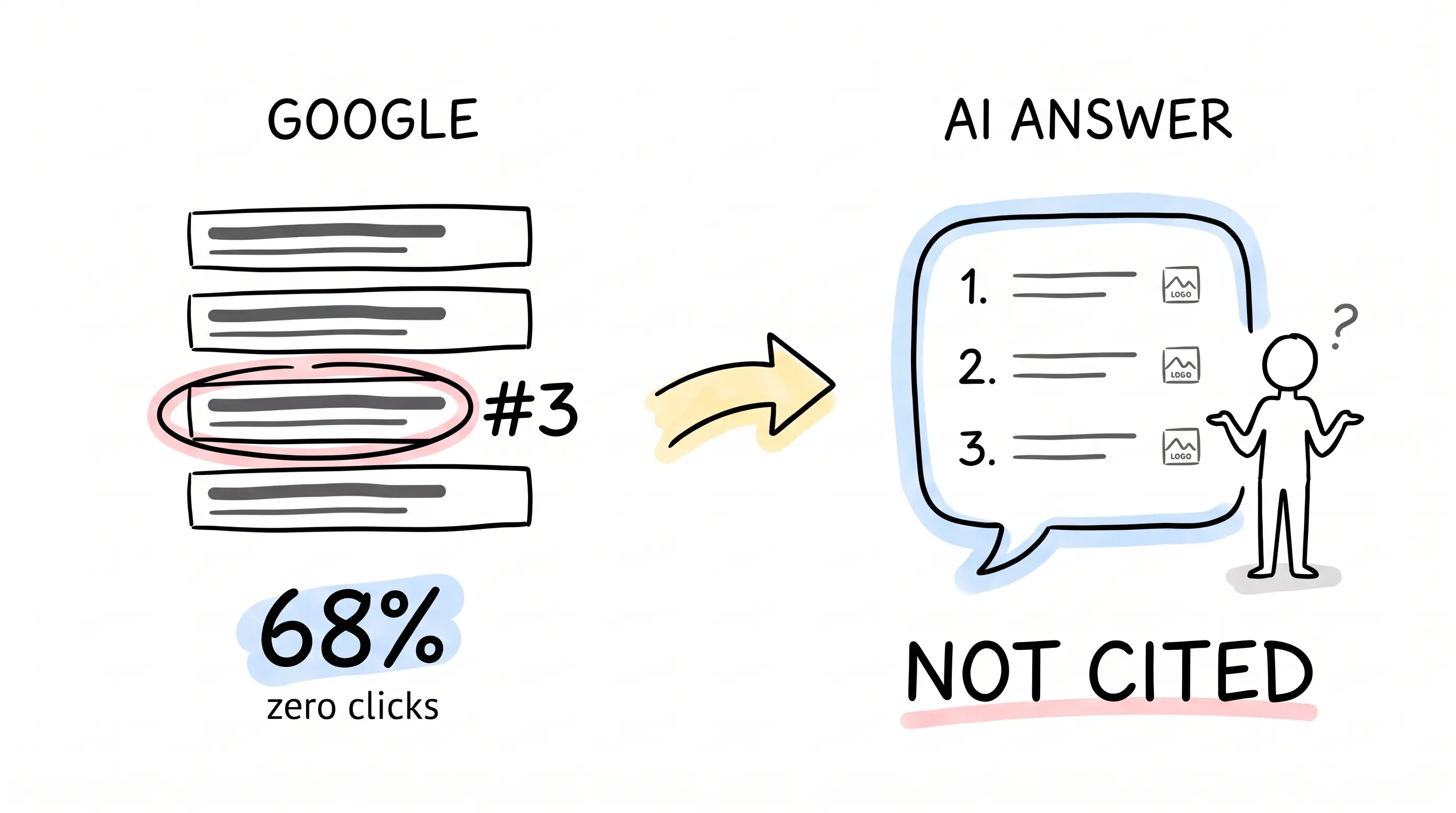
Unbelievable. He ranked third on Google's first page — yet in the AI's answers, he didn't exist.
This is what I want to talk with you about seriously today. Because it isn't just his problem — it's a hurdle every content creator in 2026 has to clear.
Search Is Still Here. The Clicks Are Gone.
Start with a number.
SparkToro's 2026 analysis: 68% of Google searches end with zero clicks. Users search, scan the answers on the page, and leave. No website gets clicked.
Why? Because AI now writes the answer directly into the search results page. Ahrefs ran the numbers too: once an AI Overview appears, the click-through rate for the top organic result drops 58%.
However good your ranking is, you may be exhibiting in a showroom no one walks into.
So what exactly is GEO?
GEO — Generative Engine Optimization. In plain terms: you used to optimize content so Google would rank you near the top. Now you also optimize content so AI systems like ChatGPT, Perplexity, and AI Overviews will name you when they write their answers.
The industry hasn't settled on a name — some call it GEO, some AEO, others AI SEO. Don't get hung up on the label. The playbook is the same.
Ranking and Being Cited Are Two Different Things
Many people assume: once I push my ranking up, the AI will naturally cite me.
The data says: not exactly.
Start with the part that's right. The top-ranked page gets cited by AI 33% of the time. Drop to tenth, and it's only 13%. So traditional SEO is still the foundation. Domain authority, backlinks, keywords — these determine whether AI can even see you when it searches in parallel. If it can't see you, everything else is off the table.
Now the interesting part. Only about 17% of the sources cited in AI Overviews come from the traditional top ten.
In other words, you can rank third and still never make it on screen.
Ranking decides whether AI can see you. Content structure decides whether AI is willing to mention you.
The teams that treat these as one question are the most frustrated teams out there right now.
AI Is an Impatient Copyist
What does AI actually do with your question?
It doesn't search once. It first breaks your question into a pile of sub-questions and searches them in parallel. You ask "How do I choose a CRM for a startup," and it is simultaneously searching "CRM pricing," "CRM features for startups," "CRM user reviews." This step is known in the trade as query fan-out.
Once it's done searching, it pulls material from a filtered pool of sources and writes the answer. This is called retrieval-augmented generation (RAG).
So your content has to pass two gates: first get scooped into the pool, then get picked for citation.
How do you get picked? A 2024 Princeton study found: pages with structured lists, citations, and data get 30–40% more visibility in AI answers.
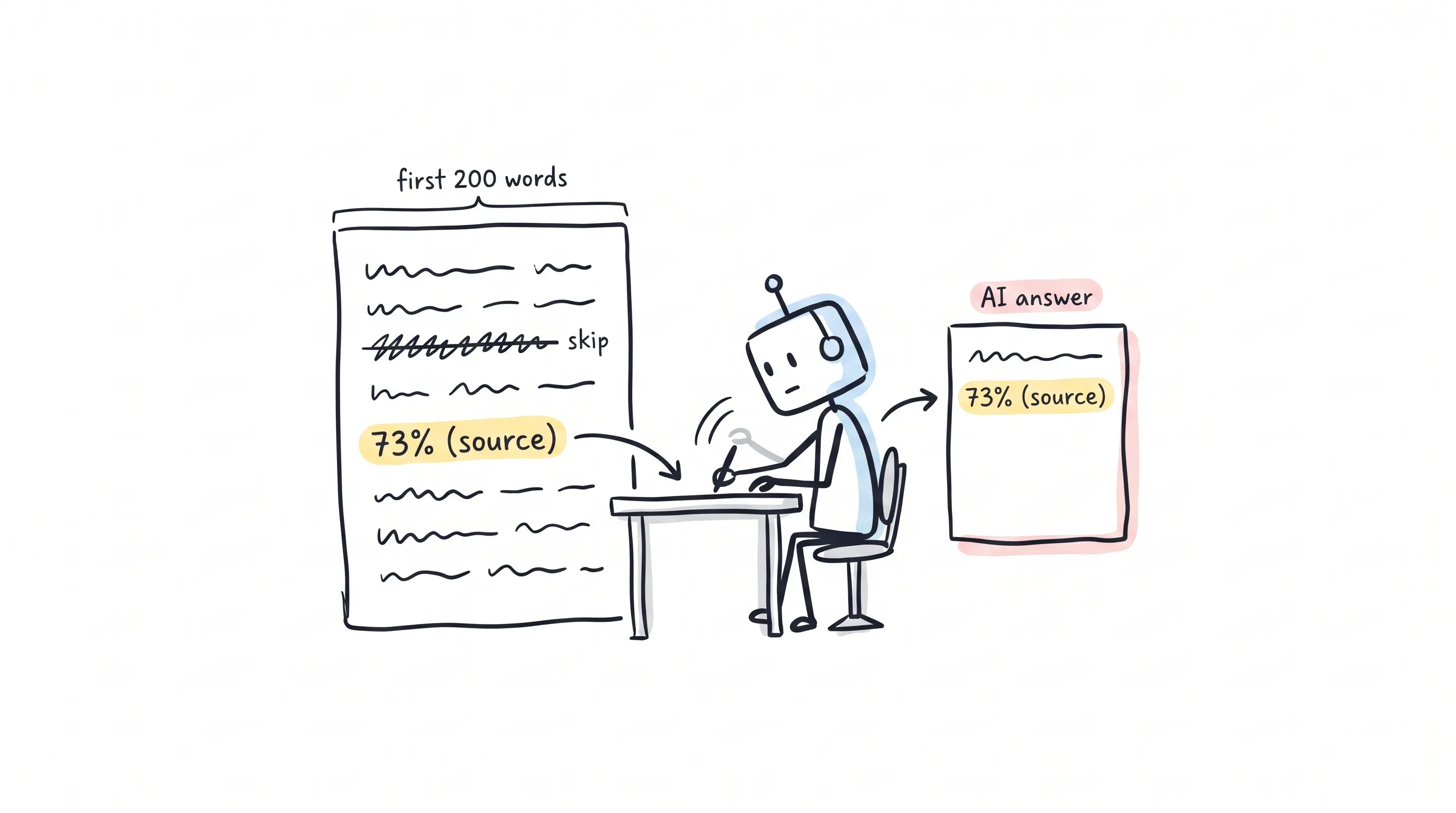
Picture this: when AI writes an answer, it's like a diligent but utterly impatient copyist. It doesn't admire your narrative or savor your prose. It does exactly one thing: find sentences it can lift wholesale, without changing a single word.
So what exactly should you change?
The Fixes Are Just These, and None of Them Are Hard
First, put the answer in the first 200 words.
When AI extracts facts, it mostly takes them from the first 200 words. Spend three paragraphs warming up before you get to the point, and it has already moved on. Get straight to the point — conclusions and data up front.
Second, one idea per paragraph, two or three sentences max.
Every paragraph must stand on its own. When AI plucks a paragraph out of your article, it should work as an answer without reading anything around it. Can't do it? Rewrite that paragraph.
Third, write headings as the questions users actually ask.
"Why does entity authority affect AI citations?" beats "On the Power of Authority" by a mile. Because when AI searches, it matches your headings against its sub-questions. The more a heading sounds like a question, the easier it is to match.
Fourth, pack your content with "quotable assets."
Numbers with sources. Something like "73% of B2B buyers research on their own before contacting sales (Gartner, 2024)" — AI can lift that. Something like "most buyers do their own research" — AI can't attribute it, so it skips it.
Expert quotes with full attribution. Name, title, company — none can be missing. If it's anonymous, AI won't dare cite it.
Definitions placed near the top of the page. For example: "Entity authority is the degree of trust an AI system places in your brand after weighing multiple sources." One complete sentence is a ready-made answer.
And tables. Feature comparisons, price lists — write them in proper table markup. AI loves lifting tables; comparisons buried in prose, not so much.
An Instruction Manual for Machines
One more thing many people overlook: schema.
What is schema? An instruction manual for machines. Your page is built for humans — they can tell at a glance which is the company name, which is the product, which is the Q&A. AI can only guess. One wrong guess, and it may skip you at the retrieval stage.
Four types to start with: Organization, which says clearly which company you are; Person, which proves the author knows the field; Product, which explains your product; and FAQPage, which marks up your Q&A content — this one carries real weight in AI Overviews.
Implement it with JSON-LD — clean and easy to maintain. Then use @id to link the entities together, and sameAs to point to Wikidata and Wikipedia. The purpose is one thing: help AI confirm that you are you, so it doesn't confuse you with someone else.
AI Is Like an HR Doing a Background Check
Everything above is about how to write one article. One level deeper: what kind of entity your brand is in the AI's eyes.
AI verifies your brand as an entity. How does it verify? It asks around.
There are three levers.
Consistent claims across the web. Your website, LinkedIn, Crunchbase, industry directories, review sites — your business description and team info must match word for word. If the accounts contradict each other, the AI doesn't know which one to believe.
Unlinked mentions count too. When industry media, reports, or podcasts mention your brand — even without a link — the AI records it just like a backlink.
The more independent sources, the better. When three sources who don't know each other all state the same fact about you, that fact carries weight.
What does it look like? An HR doing a background check. Three former colleagues all say you can code — he believes it. You writing "I can code" a hundred times in your own resume doesn't count.
90 Days Is a Threshold
There's also a rule on the time dimension: AI favors fresh content.
Pages refreshed within the last 90 days get cited noticeably more often, even if the content itself barely changed. Freshness, by itself, is a signal.
So you can't publish and walk away. Every quarter, pull out your best pieces: swap in new data, add a fresh case, update the date in the metadata, then immediately submit for indexing manually. Don't wait for the crawler to wander over on its own. One day faster, one day sooner to be cited.
And pace yourself — publish steadily, don't hoard your big swing. I've seen too many teams spend three months stockpiling one massive piece, publish it, then vanish. That kind of pulse-style play makes citations spike and collapse, and builds no momentum. Authority compounds month by month.
How Do You Measure This?
Some will ask: where do I see these AI citations in Google Analytics?
You don't. That's exactly the trouble.
When ChatGPT recommends your competitor in an answer and never clicks you, your analytics tool records no trace at all. Zero clicks, zero data.
So you have to test it yourself. The method is crude, but it works.
List 20 questions your customers actually ask. For each one, run it 5 times each in ChatGPT, Perplexity, Gemini, and AI Overviews. Why 5 times? Because AI output is probabilistic — one run doesn't count. Then record: which brands appeared, where in the answer they ranked, and what the surrounding context said.
Then reconcile against your competitors. You appear 6 times out of 10; a competitor appears 8. 60% versus 80% — where the gap is, plain to see. Watch that delta, and track the trend monthly.
Finally, check whether AI has "got you right." It says you're in business A when you're actually in business B; it's still introducing your product from three years ago. That's not a content problem — it's the data-consistency problem we covered earlier. The good news: it's fixable.
What Is This Worth?
Let's do the math.
Data shows that brands cited by AI Overviews get 35% more organic clicks and 91% more paid clicks than brands that aren't. Don't treat citations as a side dish for brand exposure — they feed the entire funnel.
For B2B, this matters even more.
B2B buyers now walk up to AI with long questions like "How do I choose a CRM for a Series A startup?" or "How do I pick an enterprise data warehouse?" These questions return no results in keyword tools — search volume: zero.
But every single one of them is a real buyer.
The customer has already moved the meeting to AI's side. If you don't show up, your name won't be on the table.
Where This Game Stands Now
A few numbers to feel the temperature of the water.
BrightEdge's data: by mid-2026, AI Overviews appeared in 48% of tracked queries, up 58% in a year. Google's AI Mode has 75 million daily active users and processes more than 1 billion queries a month. ChatGPT: about 5.35 billion monthly visits, 2.5 billion questions a day. This February, its weekly active users passed 900 million.
The money is following too. Conductor's early-2026 survey: 32% of digital marketing leaders rank GEO as their top priority. McKinsey's data: 44% of AI search users treat AI as their first source of information; only 31% still treat traditional search that way.
The direction of the wind is now clear.
If You Started From Scratch Today
Back to the friend from the beginning.
What he did afterward was really just these steps. First, audit how often his brand currently appears in AI answers and how it gets described. Then look at the competitors who keep getting cited — what does their content look like? Then go back and fix his own pages: move the data into the first 200 words, cut paragraphs shorter, turn headings into questions, add Organization and FAQPage schema. And set a 90-day alarm on his best pieces.
Not hard. But it has to be done — and kept on being done. Citations drift, competitors keep updating, and AI's taste keeps changing. Treat it as an ongoing operation, not a project that closes the day it ships.
Ranking is the ticket; the citation is the game. You still have to buy the ticket — but stop thinking that buying it means you've won.
Here's wishing your brand always gets called on in the AI's answers.
Continue reading
Related articles

It's 2026: Stop "Buying" AI Tools for Your Marketing Team — Start "Hiring" AI Agents
This learn article explains how AI agents differ from standalone AI tools in marketing, outlines three agent categories — build-your-own platforms, CRM-native agents, and vertical tools — and covers use cases across SEO, social media, advertising, and reporting, plus criteria for choosing one.

What Is GEO? How Your Brand Gets "Mentioned" in the Age of AI Search
An explainer on GEO (Generative Engine Optimization) for e-commerce and DTC brands: how it differs from SEO and AEO, why AI answers shape brand visibility, and eight practices covering question-focused content, consistent brand messaging, structured pages, external evidence, comparisons, and AI mention tracking.

AI Is Already Making Decisions for Your Customers. Are You on the List?
A learn article explains GEO (Generative Engine Optimization): why AI-generated answers now shape which brands customers see, and how SEO fundamentals, entity clarity, citable evidence, and monthly measurement affect visibility in AI answers.